Powering the Modern World
Electrical engineer interview questions generally fall into two distinct categories depending on the industry: electronics/firmware or power systems/construction. This guide focuses on the latter – the Power Systems and MEP (Mechanical, Electrical, and Plumbing) sector. Hiring managers in this field are looking for engineers who can design safe, efficient, and reliable power distribution systems, not just someone who can solder a resistor.
It is crucial to distinguish the role of an Electrical Engineer from that of an Electrician. While an electrician focuses on the physical installation and immediate troubleshooting of wiring, an engineer focuses on the theoretical calculation, code compliance, and system architecture. You will be tested on your ability to size transformers, calculate fault currents, coordinate protection devices, and design control logic that prevents catastrophic failures.
In this guide, we dive deep into the technical realities of electrical design. From analyzing harmonics caused by VFDs to interpreting NEC (National Electrical Code) requirements for healthcare facilities, these questions are designed to prove you possess the engineering judgment required to sign and seal a set of electrical plans.
Power Theory & Circuit Fundamentals
Q: Explain Power Factor and why we correct it in industrial systems.
Power Factor (PF) is the ratio of Real Power (kW) to Apparent Power (kVA). It measures how effectively electrical power is being converted into useful work output. In systems with inductive loads like motors and transformers, the current lags the voltage, creating Reactive Power (kVAR) which sustains the magnetic field but performs no work. A low PF (e.g., 0.7) means the utility must supply more total current to deliver the same amount of real power.
We correct PF (typically aiming for >0.95) for three main reasons. First, Utility Penalties: power companies charge extra for low PF because it strains their transmission lines. Second, Capacity Release: high reactive current uses up the thermal capacity of transformers and cables; correcting it frees up system capacity for more loads. Third, Voltage Drop: reducing total current reduces the $$I \cdot Z$$ voltage drop across the network. Correction is usually achieved by installing capacitor banks parallel to the load to source the reactive power locally.
Q: Compare a VFD (Variable Frequency Drive) with a Soft Starter.
Both devices control the starting of AC induction motors, but they serve different purposes. A Soft Starter uses thyristors to gradually ramp up the voltage supplied to the motor during startup. This limits the massive inrush current (which can be 6-7 times full load current) and reduces mechanical stress (torque shock) on the load. Once the motor is up to speed, a bypass contactor engages, and the motor runs at full line frequency.
A VFD rectifies AC to DC and then inverts it back to AC using Pulse Width Modulation (PWM) to control both voltage and frequency. This allows for continuous speed control, not just starting. VFDs offer massive energy savings for fan and pump applications (following affinity laws) and precise process control. However, VFDs are more expensive, physically larger, and generate harmonics that soft starters do not. I select a Soft Starter if I only need to limit inrush current, and a VFD if I need process speed control.
Q: How do you size a circuit breaker for a motor branch circuit?
Sizing a breaker for a motor is counter-intuitive because of inrush current. If I size it exactly at the Full Load Amps (FLA), it will nuisance trip immediately upon startup. According to NEC Article 430, we separate Short Circuit/Ground Fault protection from Overload protection.
The Circuit Breaker (short circuit protection) is typically sized up to 250% of the motor’s FLA (for an inverse time breaker) to allow the motor to start without tripping. The Overload Relay (thermal protection) is sized much closer, typically at 115-125% of the nameplate rating, to protect the windings from burning out during operation. This “split protection” scheme ensures we can handle the high starting surge while still protecting the equipment from long-term overheating.
Q: What is the significance of the “X/R Ratio” in short circuit calculations?
The X/R ratio compares the system’s Reactance (X) to its Resistance (R). It determines the magnitude of the DC offset during a short circuit fault. When a fault occurs, the current doesn’t just instantly become a symmetrical sine wave; it has a transient DC component that decays exponentially.
A high X/R ratio (common near generators and large transformers) means the DC component decays slowly. This results in a higher “asymmetrical” peak fault current that the breaker must latch and interrupt. If I ignore X/R and only look at the symmetrical RMS fault current, I might specify a breaker that will mechanically fail (blow apart) under the intense magnetic forces of the initial asymmetrical peak. I use software like ETAP or SKM to calculate this precisely.
System Design & Protection
Q: Protection Relay Codes (50/51/87)
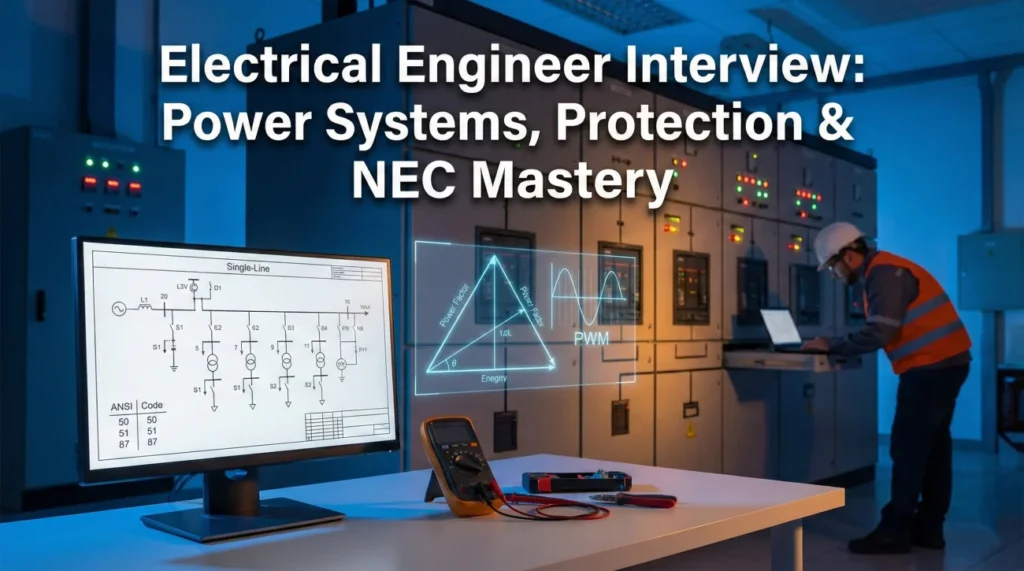
I rely on ANSI device numbers for single-line diagrams. 50 is Instantaneous Overcurrent (Short Circuit protection). 51 is Time-Overcurrent (Overload protection with an inverse curve). 87 is Differential Protection, which compares current entering and leaving a zone (like a transformer); if they don’t match, there is an internal fault, and it trips instantly. 27 and 59 are Undervoltage and Overvoltage, respectively. Knowing these codes is the language of protection engineering.
Q: Transformer Vector Groups (e.g., Dyn11)
The vector group describes the winding configuration and phase shift. Dyn11 is the most common distribution transformer: High voltage is Delta (D), Low voltage is Star (y) with a neutral, and the low voltage lags high voltage by 30 degrees (11 o’clock). The Delta primary traps third harmonic currents, preventing them from entering the supply grid. The Star secondary provides a stable neutral point for single-phase loads. You cannot parallel transformers with different vector groups (e.g., Dyn11 and Dyn1) without catastrophic circulating currents.
Q: Harmonics & THD
Harmonics are currents or voltages at multiples of the fundamental frequency (e.g., 180Hz is the 3rd harmonic of 60Hz), caused by non-linear loads like VFDs, LED drivers, and computers. High Total Harmonic Distortion (THD) causes overheating in neutrals and transformers. I mitigate this by specifying K-rated transformers (designed to handle harmonic heat), upsizing the neutral conductor (often 200%), or installing active/passive harmonic filters at the source.
Q: Arc Flash Analysis
Arc Flash is the sudden release of energy due to an electrical arc. The analysis calculates the Incident Energy (cal/cm²) at a specific working distance to determine the required PPE Category for workers. Energy is a function of fault current magnitude and duration. Paradoxically, a lower fault current can sometimes be more dangerous if it takes the breaker longer to trip. I often use “maintenance mode” switches on breakers to instantaneously lower the trip threshold, protecting personnel during work.
Q: Grounding Systems (TN-S vs. TT)
TN-S (Terra-Neutral-Separate) connects the neutral and protective earth at the source, but keeps them separate throughout the system. This is standard in the US (NEC) and ensures a low-impedance path for fault current, guaranteeing breakers trip quickly. TT uses a local earth electrode at the consumer side independent of the source earth. It relies on RCDs (Residual Current Devices) for fault protection because the earth loop impedance is too high to trip a standard breaker. I select based on local codes and safety requirements.
Q: Voltage Drop Calculation
NEC recommends a max voltage drop of 3% for branch circuits and 5% total (feeder + branch). I use the formula $$VD = \frac{2 \cdot K \cdot L \cdot I}{CM}$$ (for single phase) where K is conductor resistivity, L is length, I is current, and CM is circular mils area. For long runs (e.g., site lighting), voltage drop often dictates wire size rather than ampacity. Upsizing wire reduces resistive losses and ensures equipment receives its rated voltage for proper operation.
Engineering Judgment & Troubleshooting
A client complains that their main breaker trips before the branch breaker during a fault. What is happening?
This is a classic Coordination Study failure (Lack of Selectivity). The upstream breaker’s trip curve overlaps with the downstream breaker. It likely means the instantaneous setting on the main breaker is too low, or the downstream breaker is too slow. I would plot the Time-Current Curves (TCC) in software like SKM. I would adjust the “short-time delay” (LSI or LSIG settings) on the main breaker to give the branch breaker time to clear the fault first, ensuring only the affected circuit goes dark, not the whole building.
You are designing a data center. The client wants to save money by removing the redundant UPS.
I would explain the concept of Reliability Tiers. A single UPS (N design) has multiple single points of failure. If the UPS needs maintenance or fails, the load goes to raw utility power or drops completely. For a mission-critical data center, the cost of downtime usually far exceeds the cost of a redundant UPS (N+1 or 2N). I would present the risk in financial terms: “A 2N system costs $200k more but prevents a potential $1M/hour outage.” I advocate for at least an external maintenance bypass so the UPS can be serviced without killing the load.
A 100HP motor keeps burning out its windings every 6 months. The overload relay never trips.
If the overload doesn’t trip, it’s not a simple over-current issue. My primary suspect would be Voltage Imbalance. Even a small 2-3% voltage imbalance between phases can cause a 15-20% current imbalance and massive localized heating in the stator windings. I would check the phase voltages at the motor terminals. Other causes could be poor power quality (harmonics), blocked cooling vents, or insulation failure due to VFD voltage spikes (dv/dt) if line reactors aren’t installed. I’d recommend a vibration analysis and a Megger test.
Regulatory Codes & Advanced Analysis
Q: How do you navigate the NEC (NFPA 70) for hazardous locations?
Designing for hazardous locations (Class I, Div 1/2) requires strict adherence to NEC Articles 500-516. The first step is Area Classification – defining the boundary where explosive gases or dusts exist. Once classified, I specify equipment methods. For Division 1 (hazard normally present), I use Explosion-Proof enclosures (NEMA 7) which can contain an internal explosion, or Intrinsically Safe circuits which limit energy below the ignition threshold. For Division 2 (hazard present only during failure), simpler Non-Incendive equipment or purged/pressurized enclosures might suffice. Sealing fittings (EYS) are critical to prevent gas migration through conduit systems.
Q: Describe the process of performing a Load Flow Analysis.
Load Flow Analysis is the steady-state simulation of the power system. I model the sources (Grid/Generators), the impedances (Cables/Transformers), and the loads. The goal is to determine the voltage magnitude and phase angle at every bus, and the real/reactive power flow through every branch. I use this to identify under-voltage conditions (buses dropping below 95% nominal), overloaded transformers (running >100% kVA rating), and system losses. It is an iterative process; if I find a voltage issue, I might tap-change a transformer or add capacitor banks, then re-run the simulation.
Q: What is SCADA and how does it interface with your electrical design?
SCADA (Supervisory Control and Data Acquisition) is the brain of the power system. It collects data from field devices (RTUs, PLCs, Protection Relays) and presents it to operators. As a design engineer, I must ensure my equipment is “smart.” I specify circuit breakers with communication modules (Modbus/IEC 61850) and power meters at key distribution points. I create the I/O list that tells the SCADA integrator what data points (Breaker Status, kW, Voltage, Alarms) need to be mapped. This allows for remote monitoring, automated load shedding, and historical trending of energy usage.
Q: How do you calculate Short Circuit Current Rating (SCCR) for an industrial control panel?
Per UL 508A, the panel’s SCCR is limited by the “weakest link” component inside it. I review the withstand rating of every power component: fuses, breakers, contactors, and terminal blocks. If a contactor is rated for 5kA but the available fault current at the panel is 25kA, the panel is unsafe. To raise the SCCR, I can use Current Limiting Fuses or breakers in the feeder circuit that chop the fault current peak, protecting the downstream components. Simply putting a “65kA” sticker on the door without verifying the components inside is a code violation and a major safety liability.
Electrical Engineering Knowledge Check
Test Your Power Systems Knowledge
1. What is the primary function of a CT (Current Transformer)?
- To step up voltage for transmission
- To step down high current to a measurable level for meters/relays
- To provide isolation for sensitive electronics
- To correct power factor
2. In a 3-phase Delta system, line voltage is equal to:
- Phase Voltage multiplied by square root of 3
- Phase Voltage (V_line = V_phase)
- Phase Voltage divided by 2
- Zero
3. Which ANSI device code represents a Differential Relay?
- 50
- 51
- 87
- 27
4. A VFD controls motor speed primarily by varying:
- Voltage only
- Both Frequency and Voltage
- Current only
- Resistance
5. What does “GFCI” stand for?
- General Fuse Control Interface
- Ground Fault Circuit Interrupter
- Grid Frequency Control Instrument
- Ground Frequency Current Indicator
6. In NEC wire sizing, “AWG” stands for:
- Aluminum Wire Gauge
- American Wire Gauge
- Average Wire Geometry
- Ampere Wire Guide
7. The “skin effect” in AC conductors causes current to flow:
- Uniformly through the cross-section
- Primarily near the outer surface of the conductor
- Only in the center core
- In the insulation
8. Which transformer connection blocks 3rd harmonic currents?
- Wye-Wye (Star-Star)
- Delta-Wye (Delta-Star)
- Zig-Zag
- Open Delta
9. What is the unit of Reactive Power?
- Kilowatts (kW)
- Kilovolt-Amperes Reactive (kVAR)
- Kilovolt-Amperes (kVA)
- Joules (J)
10. Arc flash incident energy is typically measured in:
- Volts
- Calories per square centimeter (cal/cm²)
- Amperes
- Watts
11. A “megger” test is used to measure:
- Conductor resistance
- Insulation resistance
- Earth ground resistance
- Contact resistance
12. The maximum number of 90-degree bends allowed in a conduit run between pull points is:
- 2 (180 degrees)
- 4 (360 degrees)
- 6 (540 degrees)
- Unlimited
13. In a 3-phase system, calculating power ($$P$$) involves multiplying $$V \times I \times PF$$ by:
- 2
- Square root of 3 (1.732)
- 3
- Square root of 2 (1.414)
14. Which software is standard for Arc Flash and Coordination studies?
- AutoCAD
- SKM PowerTools or ETAP
- MATLAB
- Revit
15. A UPS “bypass” switch is used to:
- Turn off the load
- Isolate the UPS for maintenance while powering the load from utility
- Discharge the batteries
- Connect the generator
16. What color is the standard wire for Neutral in a 120/208V system (US)?
- Green
- White
- Black
- Gray (typically for 277/480V)
17. “LOTO” stands for:
- Lights On Two Off
- Lock Out / Tag Out
- Low Output Transformer Only
- Line Over Time Overload
18. The “knee” of a saturation curve is critical for selecting:
- Power Transformers
- Current Transformers (CTs) for protection
- Fuses
- Light bulbs
19. Which motor starter provides the highest starting torque?
- Star-Delta
- Direct On Line (DOL)
- Soft Starter
- VFD (ramped)
20. Busway (Bus Duct) is preferred over conduit/wire when:
- Currents are very low
- Currents are high (>1000A) and flexibility for taps is needed
- Waterproofing is the primary concern
- Cost is the only factor (it’s cheaper)
❓ FAQ
📜 Is the FE/PE exam required?
In the MEP and Power industry, Yes. You can work as a designer without it, but you cannot seal drawings. Passing the FE (Fundamentals of Engineering) exam is the first expectation for entry-level hires. Obtaining the PE (Professional Engineer) license is typically required for promotion to Senior Engineer or Project Manager.
💻 What software skills are most marketable?
Revit MEP is the standard for building information modeling (BIM). For analysis, SKM PowerTools and ETAP are industry standards for fault/arc flash studies. AutoCAD remains essential for 2D schematics. Proficiency in lighting software like AGi32 is also valuable.
🚧 Site vs. Office: What’s the balance?
Most design engineers are office-based (80-90%), focusing on calculations and modeling. However, site visits are critical for “punch walks” (inspecting installation quality), verifying existing conditions for renovations, and troubleshooting startup issues. Expect to wear a hard hat occasionally.
⚡ Can I transition from electronics to power?
Yes, but the learning curve is steep regarding codes (NEC) and scale. Electronics deals with 5VDC and milliamps; power deals with 13.8kV and kiloamps. The physics (Ohm’s law) are the same, but the safety stakes and protection methodologies are vastly different.
📚 How do I stay updated with codes?
The NEC is updated every 3 years (2020, 2023, etc.). I attend webinars from manufacturers (like Eaton, Schneider), read IEEE journals, and participate in local engineering society meetings. Continuous education is often a requirement to maintain a PE license.
Connecting the Circuit
To succeed with electrical engineer interview questions, you must demonstrate competence that goes beyond theory. Employers need engineers who can calculate a fault current, select the right breaker to interrupt it, and design the coordination scheme that keeps the rest of the facility running.
Focus on your familiarity with industry codes (NEC/IEC), your proficiency with design software (Revit/SKM), and your safety-first mindset. Show them that you understand the immense responsibility of designing systems that handle lethal energy levels, and you will be well-positioned to land the job.
⚠️ Disclaimer: The interview strategies, sample answers, and negotiation tips provided in this guide are for educational purposes only. Hiring decisions are subjective and vary by company and industry. While these strategies are based on professional HR standards, they do not guarantee a specific job offer or result.