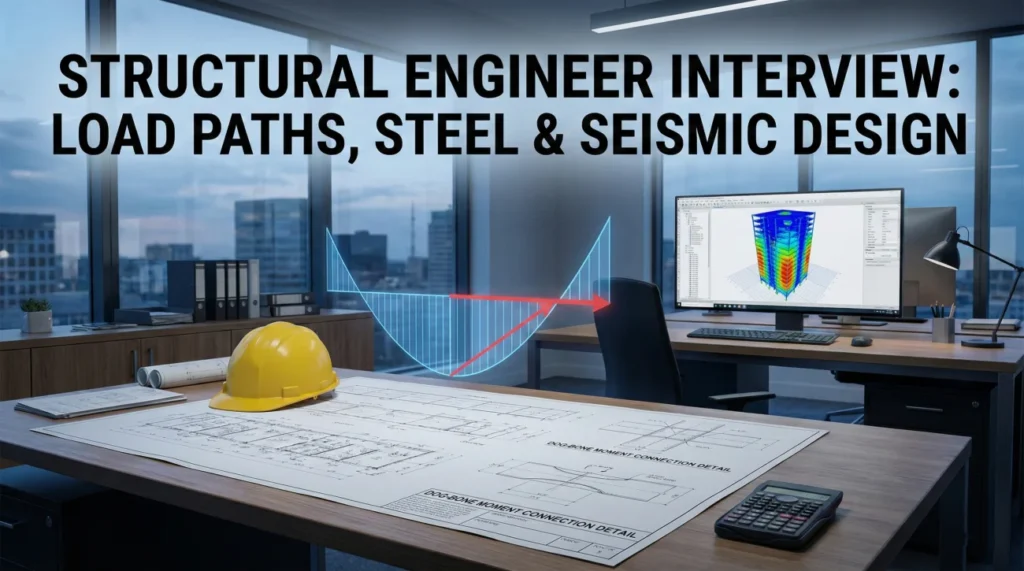
The Backbone of the Built Environment
Structural engineer interview questions are designed to probe the depth of your technical understanding regarding how buildings and bridges stand up. Unlike architects who focus on aesthetics and function, structural engineers act as the guardians of safety, ensuring that gravity, wind, and seismic forces are safely transmitted from the roof down to the foundation soil.
Interviews in this field are notoriously technical. You will not just be asked about your software skills; you will be handed a marker and asked to draw the shear and moment diagrams for a continuous beam or to sketch the detailing of a moment connection. Hiring managers are looking for “engineering intuition” – the ability to look at a structure and instinctively visualize the load path without needing a computer model.
This comprehensive guide covers the spectrum of structural engineering, from the first principles of mechanics to advanced seismic detailing per ASCE 7. Whether you specialize in high-rise steel structures or post-tensioned concrete podiums, mastering these concepts is essential to demonstrate that you can design structures that are both efficient and safe.
First Principles & Mechanics
Q: Explain the concept of “Load Path” and why it is critical.
The load path is the continuous sequence of structural elements that transfer loads from their point of origin to the foundation. For gravity loads, this typically flows from the deck to the beams, beams to girders, girders to columns, and columns to the footings. For lateral loads (wind/seismic), it involves the diaphragm transferring shear to the lateral force-resisting system (frames or shear walls), which then transfers it to the foundation.
Identifying a complete load path is the single most important task in design. If there is a gap in this path – for example, a drag strut missing between a diaphragm and a shear wall – the structure cannot resolve the forces, leading to local or global failure. During a design review, I always trace the load path manually to ensure continuity before running any software analysis.
Q: How do you distinguish between a “One-way” and “Two-way” slab system?
The distinction fundamentally lies in the aspect ratio of the slab panel and the support conditions. A One-way slab bends primarily in one direction and transfers loads to the beams supporting the longer edges. This typically occurs when the ratio of the longer span ($$L$$) to the shorter span ($$S$$) is greater than 2 ($$L/S > 2$$). The reinforcement is designed for bending in the short direction, with only shrinkage steel in the long direction.
A Two-way slab bends in both directions, forming a dish shape, and transfers loads to supports on all four sides. This occurs when the aspect ratio is less than 2 ($$L/S < 2$$). Design is more complex, involving column strips and middle strips to distribute the moments. Flat plates and waffle slabs are common examples of two-way systems. Recognizing this dictates the tributary area calculation: one-way slabs use rectangular areas, while two-way slabs use 45-degree trapezoidal/triangular areas.
Q: What is the difference between Strength Design (LRFD) and Allowable Stress Design (ASD)?
These are the two primary philosophies for sizing members. ASD (Allowable Stress Design) compares actual working loads (unfactored) against an allowable stress, which is the material’s yield stress divided by a safety factor (e.g., $$\Omega = 1.67$$). It keeps the material in the elastic range.
LRFD (Load and Resistance Factor Design) is a probabilistic approach. We factor up the loads to account for uncertainty (e.g., $$1.2D + 1.6L$$) and factor down the material resistance (e.g., $$\phi = 0.9$$ for steel bending). LRFD is generally preferred in modern codes (AISC, ACI) because it provides a more consistent reliability index across different load types. For example, we know dead load with higher certainty than wind load, so LRFD applies different safety margins to each, whereas ASD treats them similarly.
Q: Draw the Shear and Moment diagram for a fixed-fixed beam with a uniform distributed load.
(Note: In an interview, you would draw this. Here is the verbal description.)
For a fixed-fixed beam of length $$L$$ with load $$w$$:
The Shear Diagram is linear, starting positive ($$+wL/2$$) at the left support, crossing zero at the mid-span, and ending negative ($$-wL/2$$) at the right support.
The Moment Diagram is parabolic. Crucially, there are negative moments at the supports ($$M = -wL^2/12$$) due to the fixed connection restraint. The moment curve sags to a positive maximum at the mid-span ($$M = +wL^2/24$$). Recognizing that the support moment is twice the magnitude of the mid-span moment is key for reinforcement detailing, as it dictates where the tension steel needs to be (top bars at supports, bottom bars at mid-span).
Material Design & Systems
Q: Moment Frames vs. Braced Frames
Braced Frames rely on diagonal members (braces) to resist lateral loads through axial tension and compression. They are very stiff and efficient but can obstruct architectural openings. Moment Frames rely on the rigidity of beam-column connections to resist rotation. They allow for open floor plans and flexible architecture but are much more flexible (higher drift) and require heavier steel sections to control deflection. In seismic design, Special Moment Frames (SMF) require expensive detailing (RBS “dog bone” cuts) to ensure plastic hinging occurs in the beam, not the column.
Q: Pre-tensioned vs. Post-tensioned Concrete
Both compress concrete to counteract tensile forces. Pre-tensioning is done in a factory: tendons are pulled tight before concrete is poured. Once cured, cables are cut, transferring force. It’s used for precast elements like double-tees. Post-tensioning (PT) is done on-site: ducts are cast into the concrete. After the concrete cures, cables are threaded and jacked to tension. PT is standard for thin high-rise slabs to reduce deflections and span longer distances.
Q: Connection Design: Shear vs. Moment
A Shear Connection (Simple, Pinned) transfers only vertical gravity loads and allows the beam end to rotate. Examples include single-plate tabs or clip angles on the web. A Moment Connection (Rigid, Fixed) transfers bending moments, preventing rotation. This requires connecting the beam flanges to the column, usually via Full Penetration (CJP) welds or heavy bolted flange plates. Designing a moment connection as a shear connection by mistake is catastrophic, as the beam will lack the expected support rigidity.
Q: Seismic “R” Value
The Response Modification Coefficient ($$R$$) represents the ductility of a structural system – its ability to absorb energy through plastic deformation without collapsing. A high R-value (e.g., $$R=8$$ for Special Moment Frames) means we can design for lower elastic base shear forces because the system will yield and dissipate energy. A low R-value (e.g., $$R=3$$ for Ordinary systems) requires designing for higher forces because the system is brittle and must remain elastic to survive.
Engineering Judgment & Field Scenarios
The architect wants to remove a column to create a larger lobby. How do you assess this?
I start by identifying what that column supports. Is it carrying just the floor above, or is it part of a 30-story gravity stack? Removing a gravity column requires a “transfer girder” – a massive beam that bridges the gap and picks up the load of the removed column. This transfer girder will be very deep, significantly reducing ceiling height. I would calculate the required depth (rule of thumb: span/10 to span/12) and check if it fits the plenum.
If the column is part of the Lateral Force Resisting System (LFRS), the problem is harder. Removing it creates a stiffness irregularity (Soft Story) that might require redesigning the entire building’s seismic strategy. I would communicate these impacts (cost, head height, lateral redesign) to the architect immediately.
A contractor calls from the site: they missed placing top bars in a continuous beam over a support. The concrete is already poured.
This is a critical error because the top of a continuous beam at the support is in tension (negative moment). Without rebar, the concrete will crack and potentially fail. My first step is to check if the beam can work as “simply supported” (pinned). If we assume the connection is pinned, the negative moment disappears, but the positive moment at mid-span increases significantly (from $$wL^2/24$$ to $$wL^2/8$$).
I would check if the existing bottom reinforcement at mid-span has enough capacity to handle this increased positive moment. If yes, we might accept the cracking at the support (checking shear/development). If not, we need a retrofit: typically installing Carbon Fiber Reinforced Polymer (CFRP) strips on the top surface or drilling and epoxying new rebar, though these are expensive and difficult fixes.
Your ETABS model shows a period of vibration that is much longer than expected. What do you check?
A disproportionately long period usually means the model is too flexible or mass is missing. First, I check the Mass Source definition: did I include the correct percentage of Dead Load and Live Load? Second, I check the modifiers on section properties. Are cracked section modifiers (0.35Ig for beams, 0.70Ig for columns) applied correctly, or are they effectively zero?
Third, I check connectivity. Are the nodes actually connected? A common error is a beam falling slightly short of a column node, meaning they aren’t transferring load, leaving parts of the building “floating.” I would view the deformed shape animation; if I see a single beam flying off into space while the building stays still, I’ve found a disconnected node.
Advanced Analysis & Code Compliance
Q: How do you design for Torsion in concrete beams?
Torsion (twisting) is tricky. We distinguish between Equilibrium Torsion and Compatibility Torsion. Equilibrium torsion is required for stability (e.g., a canopy cantilevered off a beam); the beam must resist it. Compatibility torsion arises from the stiffness of connected members (e.g., a slab framing into a spandrel beam). In compatibility cases, ACI 318 allows us to reduce the torsional stiffness to zero, assuming the concrete cracks and redistributes the moment to the slab.
If torsion design is required, I check the interaction equation. Torsion adds shear stress to the beam. We must provide closed stirrups (hoops) to resist the circulating shear flow and longitudinal bars in the corners to resist the warping tension. Open stirrups (U-bars) are useless for torsion.
Q: Describe the “Base Shear” calculation procedure per ASCE 7.
The Equivalent Lateral Force (ELF) procedure calculates the total seismic design force ($$V$$) at the base. The formula is $$V = C_s W$$, where $$W$$ is the effective seismic weight and $$C_s$$ is the seismic response coefficient. $$C_s$$ depends on the mapped spectral acceleration ($$S_{DS}$$, $$S_{D1}$$), the Importance Factor ($$I_e$$), and the Response Modification Factor ($$R$$).
Crucially, $$C_s$$ is inversely proportional to the building period ($$T$$). A flexible (long period) building attracts less acceleration than a stiff (short period) building. However, codes enforce a minimum base shear to ensure stability. Once calculated, this total shear is distributed vertically to each floor based on the floor’s mass and height ($$F_x = C_{vx} V$$), resulting in an inverted triangular load distribution (whipping effect) for regular structures.
Q: What is a P-Delta analysis and when is it required?
P-Delta ($$P-\Delta$$) effects refer to the secondary moments generated when vertical gravity loads ($$P$$) act on the lateral displaced shape ($$\Delta$$) of a structure. In a swaying building, the gravity columns are no longer vertical; the offset creates an overturning moment that destabilizes the structure further.
It is required when the stability coefficient ($$\theta$$) exceeds 0.10. In practice, I include P-Delta in almost all computer analyses for mid-to-high-rise buildings because it reduces the effective lateral stiffness and increases drift. Neglecting P-Delta can lead to a sudden buckling collapse in flexible moment frames under heavy gravity loads.
Q: Explain “Development Length” in reinforced concrete.
Concrete takes time to grip rebar. Development length ($$l_d$$) is the minimum length of embedment required to transfer the yield strength of the bar into the concrete without the concrete splitting or the bar pulling out. It depends on concrete strength ($$f’_c$$), bar size, spacing, and coating (epoxy).
If we don’t have enough room for a straight development length (like at a column face), we use a Standard Hook (90 or 180 degrees), which mechanically anchors the bar in a shorter distance. In congested joints, we might use headed reinforcement (T-heads) to reduce congestion and ensure bond transfer.
Structural Engineering Knowledge Check
Test Your Structural IQ
1. In a simply supported beam under uniform load, where is the maximum shear?
- At the mid-span where moment is max
- At the supports (Reaction points)
- At the quarter points of the span
- Shear is constant throughout
2. The “Tributary Area” method assumes:
- The floor slab acts as a rigid diaphragm
- Floors behave as simply supported spans between beams (half-way logic)
- Loads are distributed based on member stiffness
- All connections are fully fixed moment connections
3. Which steel section is most efficient for a column?
- Wide Flange (W-shape) with deep web
- Wide Flange (W14 series) with square aspect ratio or HSS Tube
- Channel (C-shape)
- Angle (L-shape)
4. What is the primary purpose of stirrups in a concrete beam?
- To help hold the top bars in place
- To resist diagonal tension cracks caused by shear forces
- To increase the bending moment capacity
- To prevent the concrete from shrinking
5. The “Redundancy Factor” ($\rho$) in seismic design penalizes:
- Buildings that are too heavy
- Lateral systems where removing one element significantly reduces strength
- Buildings located in low seismic zones
- Steel structures with too many bolts
6. A “slender column” is susceptible to:
- Crushing failure only
- Buckling instability before reaching material yield strength
- Shear failure at the mid-height
- Excessive tensile forces
7. What is “curing” in concrete construction?
- Adding chemicals to make it dry faster
- Maintaining moisture and temperature to ensure proper hydration
- Mixing the concrete in the truck
- Polishing the surface for aesthetics
8. In a steel W-shape beam, what resists most of the shear?
- The flanges
- The web
- The fillets
- The bolts
9. What is “liquefaction”?
- Melting steel at high temperatures
- Saturated soil losing stiffness and behaving like a liquid during an earthquake
- Water turning into ice in concrete pores
- The process of mixing cement paste
10. The “modulus of elasticity” ($E$) of steel is approximately:
- 3,000 ksi
- 29,000 ksi (200 GPa)
- 50 ksi
- 10,000 ksi
11. A “drag strut” (collector) is used to:
- Support vertical loads from heavy equipment
- Collect diaphragm shear and transfer it to the lateral resisting element
- Brace the bottom flange of a beam
- Prevent uplift in foundations
12. Which load combination typically governs roof design?
- Dead Load + Live Load
- Dead Load + Roof Live Load (or Snow/Wind/Rain)
- Seismic Load + Live Load
- Dead Load only
13. What is the main advantage of a “staggered truss” system?
- It looks architecturally unique
- It allows for large column-free spaces on alternating floors
- It uses no columns at all
- It is the cheapest way to build a shed
14. “Camber” is applied to beams to:
- Increase their ultimate strength
- Counteract dead load deflection so the beam is flat in service
- Make them easier to transport
- Help drain water off the roof
15. The “effective length factor” ($K$) for a column fixed at both ends is:
- 1.0
- 2.0
- 0.65 (Theoretical 0.5)
- 0.85
16. Why do we put temperature and shrinkage steel in slabs?
- To increase the load bearing capacity
- To control crack widths caused by concrete curing shrinkage
- To prevent the slab from freezing
- To act as the primary reinforcement
17. An “expansion anchor” works by:
- Chemical bonding with the concrete
- Wedging against the sides of the drilled hole via friction
- Hooking around the rebar
- Melting into the base material
18. “Punched” windows in a shear wall:
- Increase the wall’s stiffness
- Reduce stiffness and require coupling beams design
- Have no effect on structural performance
- Are not allowed by code
19. A “blind bolt” is used when:
- The bolt is invisible
- Access is available from only one side (e.g., HSS tube connection)
- The bolt has no threads
- The worker cannot see the hole
20. Which ASCE 7 chapter covers wind loads?
- Chapter 7 (Snow)
- Chapter 11 (Seismic)
- Chapter 26-31
- Chapter 1 (General)
❓ FAQ
📜 Is the SE (Structural Engineer) license required?
It depends on the state. In seismic states like California, Illinois, or Washington, an SE license is mandatory to design schools, hospitals, or high-rise buildings. In other states, a standard PE license is sufficient for most structures. However, having the SE is the “gold standard” credential.
💻 What is the industry standard software?
For building analysis: ETABS (High-rise/Concrete) and RAM Structural System (Steel gravity). For general FEA: SAP2000. For connection design: RISA or IDEA StatiCa. For drafting/BIM: Revit Structure is essential.
📐 Should I bring a portfolio to the interview?
Absolutely. Bring photos of site visits, 3D renderings of complex models you built, and examples of clear hand calculations. Being able to point to a detail and explain, “I designed this connection to resolve this conflict,” is very powerful.
🏗️ How much time is spent on site?
Typically 10-20% for design engineers. Site visits occur for observation (making sure the rebar matches the drawings) or troubleshooting field errors. It provides crucial feedback; you learn more from one mistake on site than a month in the office.
🌍 Do structural engineers work on sustainable design?
Yes. We focus on reducing “embodied carbon.” This involves optimizing member sizes to use less material, specifying concrete mixes with high fly ash/slag content (reducing cement), or using mass timber as a renewable alternative to steel/concrete.
Designing for Safety
To succeed with structural engineer interview questions, focus on the “why” behind the math. Software can calculate the numbers, but only an engineer can interpret if those numbers make sense.
Demonstrate your grasp of load paths, your respect for code requirements, and your practical understanding of how things are built. Show the interviewer that you are not just a modeler, but a designer who takes ownership of the safety and stability of the built environment.
⚠️ Disclaimer: The interview strategies, sample answers, and negotiation tips provided in this guide are for educational purposes only. Hiring decisions are subjective and vary by company and industry. While these strategies are based on professional HR standards, they do not guarantee a specific job offer or result.