Designing the Future of Mobility
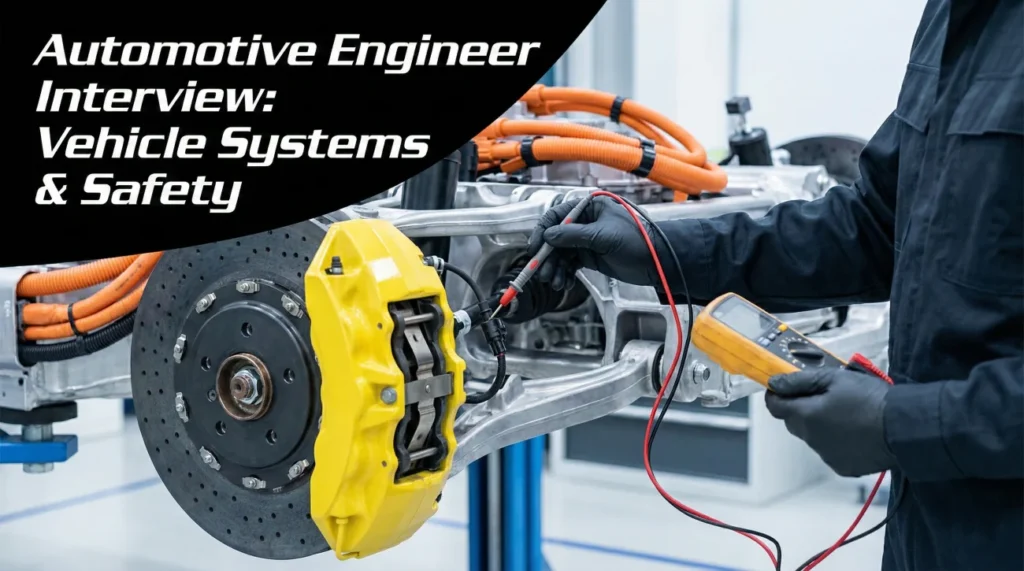
Automotive engineer interview questions evaluate your ability to integrate complex mechanical, electrical, and software systems into a safe, reliable, and efficient vehicle. The industry is currently undergoing its biggest transformation in a century – shifting from Internal Combustion Engines (ICE) to Electric Vehicles (EVs) and Autonomous Driving. Hiring managers are looking for engineers who are not only grounded in the fundamentals of vehicle dynamics but are also fluent in battery chemistry, sensor fusion, and embedded software.
Whether you are designing a suspension knuckle, calibrating an engine ECU, or simulating a crash test, you must demonstrate a holistic understanding of how one component affects the whole car. You will be tested on your ability to balance conflicting constraints: performance vs. fuel economy, weight vs. safety cost vs. durability.
This guide covers the technical breadth of the modern automotive landscape. We explore the physics of Ackermann steering, the thermodynamics of battery cooling, the logic of the CAN bus network, and the rigorous standards of ISO 26262 functional safety. These answers will help you prove that you have the engineering rigor to drive innovation in a rapidly evolving field.
Vehicle Dynamics & Powertrain
Q: Explain “Ackermann Steering Geometry” and why it is important.
Ackermann steering is a geometric arrangement of linkages in the steering of a car designed to solve the problem of wheels on the inside and outside of a turn needing to trace circles of different radii. In a turn, the inner wheel travels a smaller circle than the outer wheel. Therefore, the inner wheel must turn at a steeper angle.
If the wheels turned parallel to each other, the inner wheel would scrub sideways, causing excessive tire wear and loss of traction (understeer). Perfect Ackermann geometry intersects the steering arm axes at the center of the rear axle. In modern high-speed cars, we often use “Anti-Ackermann” or parallel geometry to utilize the slip angle of the tires for better cornering force at high loads, but for low-speed maneuvering (parking), Ackermann is essential to prevent tire scrubbing.
Q: Describe the difference between Torque and Horsepower in the context of vehicle performance.
Torque is the rotational force applied to the crankshaft; it represents the engine’s ability to do work instantaneously. It determines acceleration (“get up and go”), especially at low speeds or when towing. Horsepower is the rate at which that work is done over time ($$HP = Torque \times RPM / 5252$$). It determines the vehicle’s top speed and sustained performance.
An electric motor produces peak torque instantly at zero RPM, providing massive acceleration off the line. An internal combustion engine (ICE) needs to build RPM to reach its torque peak. In transmission design, we gear the vehicle to keep the engine in its “Power Band” – the RPM range between peak torque and peak horsepower – to maximize performance.
Q: What is NVH and how do you mitigate it?
NVH stands for Noise, Vibration, and Harshness. It is a critical quality metric for passenger comfort. Noise is what you hear (wind, road, engine). Vibration is what you feel (steering wheel shake). Harshness is the transient physical shock from bumps.
Mitigation involves three strategies: 1) Source: Improving the balance of the engine, optimizing tire tread patterns, or stiffening the chassis to push resonant frequencies above operating range. 2) Path: Using engine mounts (hydraulic or rubber) to isolate the powertrain from the frame, or adding mastic patches to body panels to damp vibration. 3) Receiver: Adding sound insulation (acoustic glass, carpet backing) to block noise from reaching the occupants.
Q: Explain the function of a Limited Slip Differential (LSD).
An open differential allows wheels to spin at different speeds (good for turning) but sends equal torque to both wheels. If one wheel loses traction (ice/mud), it spins freely, and the wheel with grip gets zero torque, stranding the car. A Limited Slip Differential detects this speed difference and mechanically “locks” or transfers torque to the wheel with grip.
This is achieved via clutch packs (friction), gears (Torsen), or viscous fluids. In modern EVs or performance cars, we use Torque Vectoring (electronic LSD), where the brake is applied to the spinning wheel, forcing torque through the open diff to the gripping wheel, or using dual motors to drive wheels independently for precise handling.
Systems & Safety Engineering
Q: CAN Bus Protocol
The Controller Area Network (CAN) is the nervous system of the car. It is a robust, two-wire (CAN High/CAN Low) serial bus that allows ECUs (Engine, Transmission, ABS, Body Control) to communicate without a central host computer. It relies on differential signaling to resist electromagnetic interference (EMI). Messages are prioritized by ID; critical messages (like “Airbag Deploy” or “Brake Pedal Pressed”) override less critical ones (like “Radio Volume”).
Q: Regenerative Braking (EVs)
In hybrids and EVs, the electric motor acts as a generator during deceleration. It converts the vehicle’s kinetic energy back into electrical energy to charge the battery, creating a braking torque. The challenge is “Brake Blending.” The system must seamlessly transition from regenerative braking (at high speeds) to friction braking (hydraulic pads/rotors) as the car comes to a stop or during panic stops, without the driver feeling a jerk or loss of deceleration.
Q: Active vs. Passive Safety
Passive Safety protects occupants during a crash (Crumple Zones, Airbags, Seatbelts, Safety Cage). It is purely reactive. Active Safety prevents the crash from happening (ABS, Electronic Stability Control – ESC, Lane Keep Assist, Automatic Emergency Braking). Modern engineering focuses heavily on Active Safety (ADAS) to reduce the likelihood of impact, while still optimizing Passive Safety structures for the worst-case scenario.
Q: Thermal Management (ICE vs. EV)
In ICE, the goal is to reject waste heat (radiator) to keep the engine from melting and provide cabin heat. Optimum temp is ~90-100°C. In EVs, thermal management is far more complex. We must cool the battery (keep it below 35-40°C to prevent degradation), cool the power electronics/motor, and heat the cabin (using a heat pump or PTC heater) since there is no waste engine heat. Battery temp uniformity is critical for pack life.
Q: Suspension Geometry: Camber/Caster/Toe
Camber: The vertical tilt of the wheel. Negative camber improves cornering grip by counteracting tire roll. Toe: The direction the tires point relative to centerline. Toe-in improves straight-line stability; Toe-out improves turn-in response. Caster: The angle of the steering axis. Positive caster (top tilted back) creates a self-centering torque that helps the steering wheel return to center and improves high-speed stability.
Q: Functional Safety (ISO 26262)
ISO 26262 is the safety standard for automotive electronics. It classifies risk using ASIL (Automotive Safety Integrity Level) from A (Low) to D (High). An ASIL D system (like Electric Steering or Airbags) requires the highest level of redundancy and rigorous testing because failure could be fatal. I use FMEA (Failure Mode and Effects Analysis) to analyze every possible failure and design safety mechanisms (e.g., redundant sensors) to handle them.
Design Trade-offs & Problem Solving
A prototype vehicle fails the “Moose Test” (severe lane change maneuver) due to rollover risk. How do you fix it?
Rollover happens when the lateral force moment exceeds the restoring gravity moment. I need to lower the Center of Gravity (CG) or widen the Track Width, but these are major architectural changes.
The immediate engineering fix is to tune the suspension and Electronic Stability Control (ESC). I would stiffen the anti-roll bars to reduce body roll. I would recalibrate the ESC to intervene earlier – applying the brake to the outer front wheel to induce understeer and scrub speed, preventing the vehicle from gripping and flipping. I might also look at tire selection (grip characteristics) or damper settings to control the weight transfer rate.
You need to reduce the weight of a chassis component by 10% to meet fuel economy targets, but it’s a safety-critical part.
I cannot simply remove material if it compromises structural integrity. I would use Topology Optimization (generative design) in FEA software to identify where material is not carrying load and remove it.
I would consider Material Substitution. Could we switch from mild steel to High-Strength Low-Alloy (HSLA) steel or Boron steel? This allows for thinner gauges with the same strength. Could we switch to Aluminum or Magnesium casting? I would perform fatigue analysis and crash simulation on the new design to validate that the safety factor remains compliant with internal standards before prototyping.
The global chip shortage prevents you from using the specified microcontroller for the ECU. What is your strategy?
This is a common supply chain crisis. I would first check if there is a “pin-compatible” alternative from the same family. If not, I have to redesign the PCB (Printed Circuit Board) for a different available chip.
The biggest risk is software portability. I would work with the software team to rewrite the drivers (HAL – Hardware Abstraction Layer) for the new chip. We would then have to re-validate the entire ECU (environmental testing, EMC, functional testing). I would prioritize chips with a long-term roadmap to avoid obsolescence in 2 years. It’s a costly pivot, but better than stopping the production line.
Advanced Technologies & Trends
Q: How does a Battery Management System (BMS) estimate State of Charge (SoC)?
SoC is the fuel gauge of an EV, but you can’t measure it directly. We use two methods. Voltage Translation: Using the open-circuit voltage (OCV) curve. This works when the battery is resting but is inaccurate under load due to voltage sag. Coulomb Counting: Integrating the current flowing in and out over time. This is accurate short-term but drifts due to sensor error.
A robust BMS uses a Kalman Filter (sensor fusion) to combine both methods, constantly correcting the Coulomb Count with Voltage data. It must also account for State of Health (SoH) (capacity fade) and Temperature, as a cold battery holds less usable energy.
Q: What is the difference between Radar, LiDAR, and Camera sensors for ADAS?
Cameras are best for object classification (reading signs, seeing brake lights, lane lines) but struggle in bad weather or low light. Radar (Radio waves) is excellent for detecting distance and relative velocity (Doppler effect) and works in all weather (fog/rain), but has low resolution. LiDAR (Laser) creates a precise 3D point cloud of the environment but is expensive and can be affected by heavy rain/snow. Level 4/5 autonomy typically requires “Sensor Fusion” of all three to create a redundant map of the world.
Q: Describe the challenges of welding Aluminum vs. Steel in body construction.
Aluminum is used for lightweighting (e.g., Ford F-150 body). However, you cannot spot weld aluminum to steel easily due to galvanic corrosion and different melting points. Aluminum also requires much higher current to weld due to high thermal conductivity and has an oxide layer that must be cleaned.
In mixed-material bodies, we use Self-Piercing Rivets (SPR) and Structural Adhesives instead of welding. This bonds the aluminum to steel without heat distortion and provides a barrier against galvanic corrosion. It also increases body stiffness significantly compared to spot welds alone.
Q: What is a “Drive Cycle” and how is it used in emissions testing?
A drive cycle is a standardized speed-vs-time profile used to simulate real-world driving for fuel economy and emissions certification (EPA FTP-75, WLTP). It includes idle, acceleration, cruise, and deceleration phases. As an engineer, I calibrate the engine and transmission maps to optimize efficiency specifically within the load points of these cycles. However, we must also ensure “Real Driving Emissions” (RDE) compliance to avoid “cycle beating” (dieselgate) by verifying performance on the road, not just the dyno.
Automotive Engineering Knowledge Check
Test Your Auto IQ
1. “Unsprung Weight” refers to:
- The weight of the chassis
- Components not supported by the suspension springs (Wheels, Tires, Brakes, Control Arms)
- The payload capacity
- The weight of the passengers
2. Which sensor measures the mass of air entering the engine?
- MAP (Manifold Absolute Pressure)
- MAF (Mass Air Flow)
- TPS (Throttle Position Sensor)
- O2 Sensor
3. In an EV, the “Inverter” converts:
- AC from the grid to DC for the battery
- DC from the battery to AC for the motor
- High voltage to Low voltage (12V)
- Torque to Horsepower
4. “Stoichiometric Ratio” for gasoline combustion is approximately:
- 12.5:1
- 14.7:1 (Air:Fuel by mass)
- 10:1
- 20:1
5. What does the “C-Rate” of a battery indicate?
- The cost of the battery
- The rate of charge/discharge relative to its capacity (1C = full charge in 1 hour)
- The carbon content
- The cooling capacity
6. A “Turbocharger” is driven by:
- A belt from the crankshaft (Supercharger)
- Exhaust gas energy driving a turbine
- An electric motor
- Gear reduction
7. “Understeer” occurs when:
- The rear tires lose grip and the car spins
- The front tires lose grip and the car pushes wide in a turn (plows)
- The steering wheel is loose
- The car stops turning
8. The “Drag Coefficient” ($$C_d$$) measures:
- Rolling resistance of tires
- Aerodynamic efficiency (shape) independent of frontal area
- Total drag force
- Downforce
9. Which steel phase is hardest and most brittle, often formed during welding or heat treating?
- Austenite
- Martensite
- Ferrite
- Pearlite
10. “OBD-II” is:
- A robot from Star Wars
- On-Board Diagnostics (Standardized port for vehicle diagnostics)
- Over Board Design
- Oil Bearing Device
11. A “Continuously Variable Transmission” (CVT) uses:
- Fixed gears and a clutch
- Pulleys and a belt/chain to provide infinite gear ratios
- Torque converter and planetary gears
- Electric magnets
12. Which SAE level of autonomy represents “Full Self-Driving” (no steering wheel needed)?
- Level 2
- Level 3
- Level 4
- Level 5
13. The “Otto Cycle” describes:
- Diesel engines
- Spark-ignition (Gasoline) engines
- Jet engines
- Steam engines
14. “Hydroplaning” is caused by:
- Going too slow
- A layer of water building up under the tire, separating it from the road surface
- Low tire pressure only
- Bad alignment
15. What is the main advantage of a “Dual Clutch Transmission” (DCT)?
- It is cheaper
- Lightning-fast shifts because the next gear is pre-selected on the second clutch shaft
- It has a torque converter
- It never wears out
16. “Yaw Rate” measures:
- Suspension travel
- Rotation around the vertical axis (spinning/turning rate)
- Forward acceleration
- Body roll angle
17. Which material is used in catalytic converters to reduce emissions?
- Iron
- Platinum, Palladium, Rhodium
- Aluminum
- Copper
18. A “Wishbone” suspension is also known as:
- MacPherson Strut
- Double A-Arm
- Solid Axle
- Torsion Beam
19. In FEA, “Fatigue Analysis” predicts:
- Maximum load before breaking
- Life expectancy under cyclic loading (vibration/bumps)
- Crash performance
- Corrosion rate
20. The “Firewall” (Bulkhead) separates:
- The trunk from the cabin
- The engine compartment from the passenger cabin
- The driver from the passenger
- The roof from the floor
❓ FAQ
📜 Do I need a Master’s degree?
A Bachelor’s (BSME/BSEE) is sufficient for most Design, Manufacturing, or Quality roles. A Master’s is highly valued for specialized R&D roles like Aerodynamics, Battery Chemistry, or Autonomous Algorithms. Formula SAE experience is often more valuable than a Master’s for entry-level vehicle dynamics roles.
💻 What software is industry standard?
CATIA and Siemens NX are the dominant CAD tools for OEMs. MATLAB/Simulink is standard for controls and system modeling. ANSYS/HyperMesh for FEA. Vector CANoe for network analysis.
⚡ Should I focus on ICE or EV?
The industry is aggressively pivoting to EV. While ICE knowledge is still needed for hybrids and legacy fleets, specializing in High Voltage Systems, Battery Thermal Management, and Power Electronics ensures better long-term career security.
🔧 Is hands-on mechanic experience useful?
Extremely. Engineers who have “turned wrenches” design parts that can actually be assembled and serviced. It builds immense credibility with technicians and prevents “unbuildable” designs.
🏭 OEM vs. Tier 1 Supplier?
OEM (Toyota, Ford, Tesla): Focus on system integration, vehicle level attributes, and branding. Tier 1 (Bosch, Continental, Magna): Focus on deep component design (the actual brake caliper or radar sensor). Tier 1 offers deep technical specialization; OEM offers broad vehicle overview.
Driving Innovation
To succeed with automotive engineering interview questions, you must prove you are a system integrator. The car is no longer just a mechanical machine; it is a computer on wheels.
Focus on your ability to work cross-functionally. Explain how you balanced the thermal needs of the battery with the aerodynamic drag of the cooling ducts. Show them you understand the “V-Model” of development – from requirements to validation – and that you are passionate about building the next generation of mobility.
⚠️ Disclaimer: The interview strategies, sample answers, and negotiation tips provided in this guide are for educational purposes only. Hiring decisions are subjective and vary by company and industry. While these strategies are based on professional HR standards, they do not guarantee a specific job offer or result.