Plumbing Is Gravity Plus Air
Plumber interview questions usually start with parts and code, but the deeper goal is simple: can you make water behave inside real buildings. That means thinking in 3D, protecting trap seals, and planning routes that work today and still work after years of use.
Hiring managers want someone who can troubleshoot without guesswork, install cleanly, and communicate with owners and other trades. A good plumber understands why vents matter, why slope matters, and why a “quick fix” can become a callback.
This guide covers materials, layout logic, and field scenarios that reveal real competence. Use it to show you are not just connecting pipe, you are building a system that stays sanitary, safe, and serviceable.
Plumbing Theory & Materials
Q: Explain the function of a P-Trap and why “Venting” is required.
The P-Trap is the most important sanitary device in plumbing. It holds a “trap seal” of water (usually 2 to 4 inches deep) that prevents sewer gases (methane, hydrogen sulfide) from entering the building. Without a trap, the building would smell and be dangerous. However, water flowing down a drain creates positive pressure ahead of it and negative pressure (suction) behind it.
Venting introduces air into the drain system to equalize this pressure. Without a vent, the negative pressure (siphonage) would suck the water out of the P-Trap (“trap siphonage”), breaking the seal. Conversely, positive pressure could blow the water back up (“back pressure”). A properly vented system protects the trap seal, ensuring only water goes down and no gas comes up.
Q: Compare PEX (Cross-linked Polyethylene) vs. Copper piping.
Copper is the traditional standard. It is rigid, heat resistant, bacteriostatic, and looks professional when exposed. We join it by soldering (sweating) or using press fittings (ProPress). It is expensive and susceptible to pinhole leaks in acidic water or if flux is not cleaned off.
PEX is flexible plastic. It is cheaper, faster to install (fewer fittings due to flexibility), and resists freezing better because it can expand. PEX-A uses expansion fittings (flow is not restricted), while PEX-B uses crimp fittings (slightly restricts flow). PEX cannot be used outdoors (UV damage) or directly connected to a water heater (requires an 18-inch metallic offset in some codes). I choose Copper for mechanical rooms/exposed work and PEX for in-wall distribution.
Q: What is the standard slope for drainage pipes (DWV)?
For pipes 3 inches in diameter or smaller, the standard slope is 1/4 inch per foot. This creates a scouring velocity (approx 2 feet per second) that carries solids along with the water. If the pipe is too flat, water moves too slow and solids settle, causing clogs.
Paradoxically, if the pipe is too steep (e.g., vertical drop to horizontal turn without proper sweep), the water can run away from the solids, leaving them behind to dry and clog (“liquids outrun solids”). For pipes 4 inches or larger, codes often allow 1/8 inch per foot because the larger volume of water maintains scouring velocity better. I always use a torpedo level to verify slope, never just “eyeballing” it.
Q: Describe the difference between “Sanitary Tee” and “Wye” fittings.
A Sanitary Tee (San Tee) has a sharp turn. It is designed for use in the vertical to horizontal transition (e.g., a sink drain arm entering a stack) or for venting. It should never be used to change direction from vertical to horizontal (laying on its back) or horizontal to horizontal, because the sharp turn obstructs flow and causes clogs.
A Wye (often combined with a 45-degree elbow to make a “Combo”) has a sweeping curve. It is used for horizontal-to-horizontal turns or vertical-to-horizontal transitions to smooth the flow. Using a San Tee on its back is one of the most common code violations I see in amateur work.
Installation & Troubleshooting
Q: Joining Methods: Solder vs. ProPress
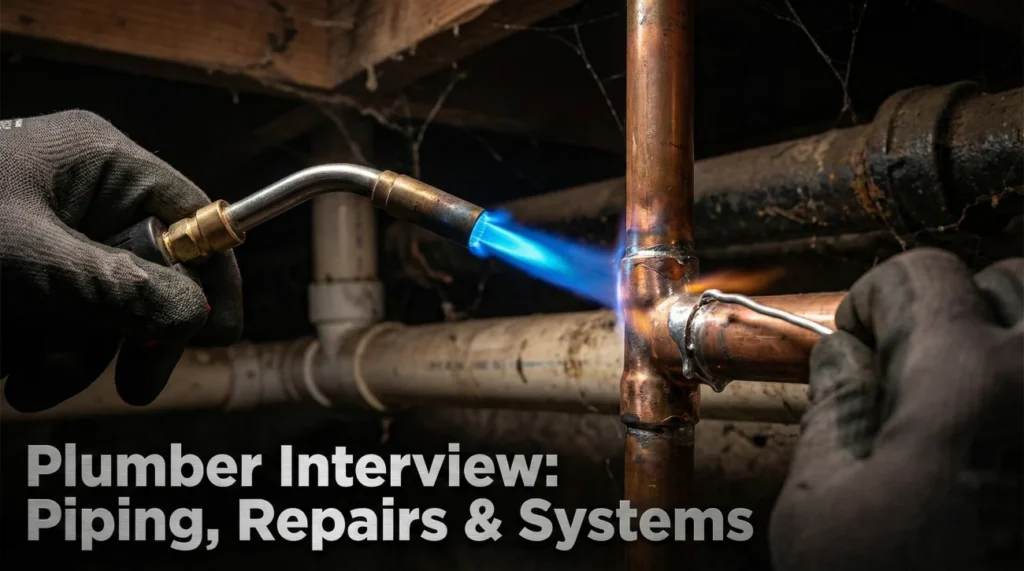
Soldering relies on capillary action to draw molten solder into the joint. It requires a dry pipe, cleaning (flux/sandcloth), and heat (torch). It’s a fire hazard (“Hot Work”) but cheap on materials. ProPress uses a hydraulic tool to crimp an O-ring fitting onto the pipe. It is incredibly fast, can be done on a wet system (great for repairs), and has no fire risk. However, the fittings are expensive. I use ProPress for shutdowns/repairs and Solder for new construction bulk work.
Q: Water Heater Troubleshooting
If an electric heater has no hot water, I check the breaker first, then the reset button on the upper thermostat. If it trips repeatedly, it’s usually a shorted heating element (check resistance) or a bad thermostat. If a gas heater won’t light, I check the gas supply, the thermocouple (millivolts), and the pilot orifice. If the water is lukewarm, it might be a broken dip tube (cold water mixing at the top) or a lower element failure.
Q: Backflow Prevention
Backflow prevents contaminated water (from irrigation or boilers) from reversing into the potable water supply. An Air Gap is the best protection (physical separation). An RPZ (Reduced Pressure Zone) assembly is used for high-hazard connections; it dumps water if it fails. A Vacuum Breaker is used on hose bibs. I must install these in the correct orientation and ensure they are tested annually by a certified tester.
Q: Gas Piping Sizing
Sizing gas pipe (Black Iron or CSST) depends on the Total BTU load, the length of the run (Longest Length Method), and the specific gravity of the gas (Natural Gas vs. Propane). If I undersize the pipe, appliances will starve for fuel, causing incomplete combustion (Carbon Monoxide risk) or pilot outages. I sum up the BTUs of all appliances (Furnace + Water Heater + Stove) and consult the code tables (IFGC) for the required diameter.
Q: Cast Iron: No-Hub vs. Bell & Spigot
No-Hub uses a neoprene gasket and a stainless steel shield clamp. It is fast and compact, standard for commercial above-ground work. I must use a torque wrench (usually 60-80 in-lbs) to ensure a proper seal without crushing the pipe. Bell & Spigot (Hub & Spigot) uses a compression gasket (donut) pushed into the bell. It is extremely durable and typically used for underground work because the joint is more rigid against earth movement.
Q: Pressure Reducing Valve (PRV)
High municipal water pressure (>80 PSI) damages fixtures, causes toilet fill valves to hiss, and risks pipe bursts. A PRV reduces the incoming pressure to a safe level (typically 50-60 PSI). However, installing a PRV creates a “Closed System,” meaning thermal expansion from the water heater has nowhere to go. Therefore, I must also install a thermal expansion tank on the water heater whenever I install a PRV.
Field Scenarios & Safety
A homeowner is furious because a leak you fixed a week ago is dripping again. How do you handle it?
I own the problem immediately. I don’t make excuses over the phone. I say, “I am sorry that happened, I will be there today to make it right.” When I arrive, I investigate. Is it the exact same joint, or a new leak nearby caused by the pressure change or vibration?
If it was my workmanship (e.g., a cold solder joint), I fix it for free and offer a discount on future service to rebuild trust. If it is a new issue (e.g., old pipe cracked next to the repair), I explain the difference clearly using photos, but I might offer a reduced labor rate for the second repair. The goal is to save the relationship.
You are running a drain line and the HVAC duct is exactly where your pipe needs to go to maintain slope.
Gravity always wins. Drain lines must have slope; ducts can move around obstacles. I would stop and talk to the HVAC foreman immediately. I show him my constraint: “I need 1/4 inch per foot to hit the invert at the main stack. I can’t go lower or I’ll miss the connection.”
Usually, the HVAC crew can flatten their duct or offset it. If they refuse, I escalate to the Site Superintendent. I do not just cut through their duct or install my pipe flat (which would fail inspection). Coordination is key, and plumbing drainage typically has the “Right of Way” in the ceiling plenum due to slope requirements.
You need to enter a trench that is 6 feet deep to connect a sewer lateral. There is no shoring box.
I do not enter. OSHA requires protection (Shoring, Sloping, or Shielding) for any trench 5 feet or deeper (or less if soil is unstable). A cubic yard of dirt weighs nearly 3,000 lbs; a collapse will crush and kill me instantly.
I would tell the operator or foreman, “I can’t go in there until we have a trench box or you slope the sides back (bench it).” I would wait until it is safe. I also ensure there is a ladder within 25 feet of me for egress and that the “spoils pile” is at least 2 feet back from the edge.
Advanced Plumbing Systems
Q: How do you size a Grease Interceptor for a commercial kitchen?
Grease Interceptors (Grease Traps) prevent FOG (Fats, Oils, Grease) from clogging the city sewer. Sizing is based on the volume of the fixtures draining into it. I calculate the total volume of all sinks (Length x Width x Depth) in cubic inches, convert to gallons, and apply a fill factor (usually 75%).
Alternatively, some codes base it on Flow Rate (GPM) and retention time. An undersized trap allows hot grease to pass through before cooling/separating. An oversized trap can become septic and generate hydrogen sulfide (rotten egg smell). I also ensure it is vented correctly to prevent siphonage of the accumulated grease mat.
Q: Explain a Hot Water Recirculation System.
In a large building, waiting for hot water at a distant faucet wastes gallons of water. A recirculation loop keeps hot water moving near the fixtures. It involves a dedicated return line from the furthest fixture back to the water heater and a small pump.
The system needs a Check Valve to prevent cold water from backfeeding into the hot line. It also needs a method of control (timer or aquastat) so the pump doesn’t run 24/7, which would erode the copper pipes (velocity erosion) and waste energy. I verify that the pump is sized to overcome the friction loss of the piping loop, not the lift.
Q: What is a “Rolling Offset” and how do you calculate the travel piece?
A rolling offset changes elevation and direction simultaneously (e.g., moving a pipe up and to the right to miss a beam). It forms a right triangle in space. I need the “True Offset” which is the hypotenuse of the horizontal offset (“Roll”) and vertical offset (“Rise”). $$True Offset = \sqrt{Roll^2 + Rise^2}$$.
Once I have the True Offset, I use the standard 45-degree constant (1.414) to find the Travel Piece length: $$Travel = True Offset \times 1.414$$. Then I deduct the “takeoff” for the fittings. Getting this math right on the ground prevents wasting expensive large-diameter pipe in the air.
Q: Describe the “Water Hammer” phenomenon and how to fix it.
Water hammer is a shock wave generated when water flowing at high velocity is stopped suddenly (e.g., a solenoid valve closing on a washing machine). The kinetic energy turns into pressure, banging the pipes. This can rupture fittings. I fix it by installing Water Hammer Arrestors (mechanical chambers with a piston and air cushion) as close to the quick-closing valve as possible. The old-school “air chambers” (capped vertical pipes) eventually fill with water and stop working, so mechanical arrestors are the code-compliant solution.
Plumbing Trade Knowledge Check
Test Your Code Knowledge
1. What is the minimum trap seal depth required by most codes?
- 1 inch
- 2 inches (and max 4 inches)
- 6 inches
- It doesn’t matter
2. “DFU” stands for:
- Drain Flow Unit
- Drainage Fixture Unit (a load value assigned to fixtures)
- Direct Flow Usage
- Diameter For Underground
3. Which gas is produced by sewer decomposition and is heavier than air?
- Helium
- Hydrogen Sulfide (H2S)
- Oxygen
- Carbon Monoxide
4. A “Closet Flange” is used for installing:
- A shower valve
- A toilet (Water Closet)
- A closet rod
- A cleanout
5. Purple primer is required for:
- Soldering copper
- Solvent welding PVC and CPVC (to prove primer was applied)
- Threading iron pipe
- Connecting PEX
6. What is the primary purpose of a “Cleanout”?
- To vent the system
- To provide access for a snake or camera to clear blockages
- To drain the water heater
- To test water pressure
7. The “Hot” water line should typically be on which side of the fixture?
- Right
- Left
- Top
- Bottom
8. A “Dielectric Union” is used to:
- Connect two pieces of copper
- Join dissimilar metals (e.g., Copper to Galvanized) to prevent galvanic corrosion
- Measure electricity
- Increase water pressure
9. “Rough-in” refers to:
- Installing the sink faucet
- Installing the piping inside the walls/floor before they are closed up
- Digging the trench poorly
- The final inspection
10. What is the maximum distance a 1.5″ trap can be from its vent (IPC)?
- 2 feet
- 6 feet (Note: varies by code year/jurisdiction, but 6′ is standard IPC)
- 10 feet
- Unlimited
11. A “T&P Valve” on a water heater releases water if:
- The gas runs out
- Temperature exceeds 210°F or Pressure exceeds 150 PSI
- The water is too cold
- The pilot light goes out
12. “Potable Water” means:
- Water for plants
- Water safe for drinking and cooking
- Water in the toilet bowl
- Sewage water
13. Which pipe material is typically black?
- Copper
- ABS (Drainage) or Black Iron (Gas)
- PVC
- CPVC
14. A “Studor Vent” is also known as:
- Roof Vent
- Air Admittance Valve (AAV)
- Check Valve
- Isolation Valve
15. The “Invert Elevation” of a pipe is:
- The top of the pipe
- The bottom inside surface of the pipe (where water flows)
- The center of the pipe
- The ground above the pipe
16. What is the purpose of “Flux” in soldering?
- To fill the gap
- To clean the metal and prevent oxidation, allowing solder to flow
- To cool the joint
- To glue the pipe
17. A “Ball Valve” is fully open when the handle is:
- Perpendicular to the pipe
- Parallel to the pipe
- Removed
- Rotated 45 degrees
18. “Graywater” includes waste from:
- Toilets and Urinals
- Sinks, showers, and laundry (but NOT toilets/kitchen sinks with food waste)
- Rainwater only
- Industrial chemicals
19. A “Test Plug” is used to:
- Stop the flow permanently
- Seal the pipe temporarily to perform a pressure test (water or air)
- Filter the water
- Measure temperature
20. The vertical pipe carrying waste from upper floors is called a:
- Branch
- Stack (Soil Stack or Waste Stack)
- Vent
- Lateral
❓ FAQ
📜 Do I need a license to be a plumber?
Many roles are tied to apprenticeship levels and local licensing rules, especially for work that must pass inspection.
If you are early in your path, explain your training, your logged hours, and how you follow code under supervision.
🧰 Service plumbing vs new construction: which is better for beginners?
Service teaches troubleshooting, customer communication, and working in tight, imperfect conditions. New construction builds speed and system understanding from plans.
Neither is better universally. Choose based on what you want to learn first, then be open to crossing over later.
⏰ Does plumbing require on-call or weekend work?
Service teams often rotate emergency calls. Construction teams usually follow site schedules, but deadlines can add overtime.
In interviews, be honest about availability, then emphasize reliability and how you communicate if conflicts come up.
🤝 Union vs non-union: what should I consider?
Both paths can lead to strong careers. The difference is usually training structure, job pipelines, benefits, and how work is dispatched.
A smart answer focuses on learning, safety, and steady growth rather than treating it as a status argument.
🚽 Is the job always unpleasant?
Sometimes it is, especially in service work, but professionalism is part of the trade.
Employers want to hear that you can handle tough jobs calmly, follow hygiene and safety practices, and still treat clients with respect.
Be the Person Who Prevents Callbacks
Use the interview questions collection to practice explaining why you do things, not just what you do. The best answers sound like a system builder, not a patch worker.
Talk about slope, venting logic, material choices, and how you troubleshoot step-by-step. When you can describe clean installation plus clear communication, you look like the plumber crews want to keep.
⚠️ Disclaimer: The interview strategies, sample answers, and negotiation tips provided in this guide are for educational purposes only. Hiring decisions are subjective and vary by company and industry. While these strategies are based on professional HR standards, they do not guarantee a specific job offer or result.