Engineering at the Edge of Possibility
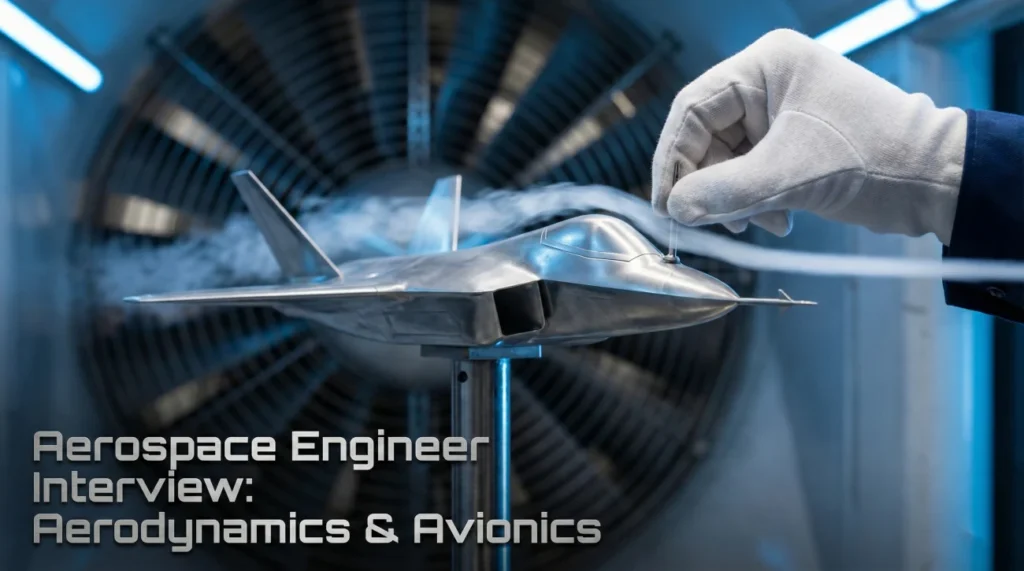
Aerospace engineer interview questions test your ability to design systems that operate in the most hostile environments known to physics. Unlike civil engineering where structures stand still, or automotive engineering where you can pull over if an engine fails, aerospace engineering demands perfection. Gravity and drag are relentless adversaries, and a single calculation error can result in mission failure or loss of life.
Hiring managers at major aerospace firms and space agencies are looking for a mastery of “First Principles.” They want to know if you intuitively understand how a shock wave forms at Mach 1, why a rocket nozzle must expand in a vacuum, and how to stabilize an inherently unstable airframe using control loops. Whether you are designing the wing of a commercial airliner, the turbopump of a liquid rocket engine, or the guidance system of a drone, you must demonstrate deep technical competency.
This guide covers the distinct disciplines within the field: Aerodynamics, Propulsion, Structures, and Avionics. We explore the critical regulations like DO-178C for software safety, the physics of orbital mechanics, and the material science behind carbon fiber composites. These answers will help you prove that you have the right stuff to push the boundaries of flight.
Aerodynamics & Flight Mechanics
Q: Explain the relationship between the Center of Gravity (CG) and the Center of Pressure (CP) for static stability.
Static stability determines if an aircraft returns to its original attitude after a disturbance. For a standard aircraft to be longitudinally stable, the Center of Gravity (CG) must be located forward of the Center of Pressure (CP) (also known as the Neutral Point). This creates a nose-down pitching moment.
To counteract this nose-down tendency and fly level, the horizontal stabilizer (tail) produces a downward force (negative lift). If a gust pitches the nose up, the wing’s lift increases, but the moment arm to the tail ensures a restoring force pushes the nose back down. If the CG moves behind the CP, the aircraft becomes statically unstable and will diverge (flip) without active computer control. In rockets, we say “Center of Pressure must be behind Center of Gravity” for the same reason – like an arrow feather.
Q: Describe the “Boundary Layer” and its significance in drag reduction.
The Boundary Layer is the thin layer of fluid adjacent to the surface where the flow velocity increases from zero (at the surface, due to non-slip condition) to the free stream velocity. It exists in two states: Laminar (smooth, layered flow) and Turbulent (chaotic, mixed flow).
Laminar flow produces much less skin friction drag but is fragile and easily separates. Turbulent flow has higher skin friction but is more energetic and resistant to flow separation (stall). In design, we try to maintain laminar flow as long as possible on the wing leading edge to reduce drag (Laminar Flow Control), but we might intentionally trip the flow to turbulent (using vortex generators) further back to prevent pressure drag caused by flow separation at high angles of attack.
Q: What happens to the aerodynamic center of a wing as it accelerates from Subsonic to Supersonic?
In Subsonic flight (Mach < 0.8), the aerodynamic center (AC) – the point where the pitching moment is constant regardless of Angle of Attack – is located roughly at the 25% chord (quarter-chord). As the aircraft accelerates through the Transonic regime and goes Supersonic (Mach > 1.2), shock waves form and the pressure distribution shifts rearward.
The AC moves aft to approximately the 50% chord (mid-chord). This “Mac Tuck” creates a significant nose-down pitching moment that the trim system must compensate for. Designing for this shift requires variable geometry (like Concorde’s fuel transfer system to move CG) or powerful control surfaces (stabilators) to maintain trim without excessive drag.
Q: How does the “Coanda Effect” apply to lift generation?
While Bernoulli’s principle (pressure differential) is the standard explanation for lift, the Coanda Effect describes the tendency of a fluid jet to stay attached to a convex surface. Air flowing over the curved upper surface of a wing “sticks” to the curve and is deflected downward.
According to Newton’s Third Law, if the wing pushes the air mass down (downwash), the air must push the wing up (Lift). This explains why lift is generated even by thin, flat plates if angled correctly, and why high-lift devices like blown flaps work by energizing the boundary layer to stay attached to steep curves.
Propulsion & Systems
Q: Turbojet vs. Turbofan Engines
A Turbojet passes all air through the core (Compressor, Combustor, Turbine). It creates thrust via high-velocity exhaust. It is efficient at supersonic speeds but loud and fuel-thirsty at low speeds. A Turbofan has a large fan at the front that pushes a massive volume of air around the core (Bypass). Most thrust comes from this cold bypass air. It is much quieter and more fuel-efficient for subsonic cruise (High Bypass Ratio), making it the standard for commercial aviation.
Q: Specific Impulse (Isp)
$$I_{sp}$$ is the miles-per-gallon of rocketry. It measures how effectively an engine converts propellant mass into thrust. It is defined as Thrust divided by propellant weight flow rate ($$I_{sp} = F / \dot{m} g_0$$), measured in seconds. A higher Isp means less fuel is needed for the same maneuver. Chemical rockets max out around 450s (LH2/LOX), while electric propulsion (Ion drives) can reach 3000s+ but with tiny thrust levels.
Q: Bleed Air Systems
Gas turbine engines compress air to high pressures. We “bleed” some of this hot, high-pressure air off the compressor stages for secondary functions: Cabin Pressurization, Wing Anti-Ice, and Engine Starting. However, taking bleed air reduces engine thrust and efficiency. Modern designs (like the Boeing 787) are moving to “Bleed-Less” architectures, using electric compressors for cabin air to improve fuel economy.
Q: Cavitation in Rocket Turbopumps
Rocket turbopumps spin at incredibly high RPMs to feed the engine. If the inlet pressure drops below the fluid’s vapor pressure, the propellant boils (cavitates), creating bubbles. When these bubbles collapse on the impeller blades, they cause pitting damage and vibration that can destroy the pump instantly. We prevent this by ensuring adequate Net Positive Suction Head (NPSH) using tank ullage pressure or booster pumps.
Q: Gyroscopic Precession
A spinning mass (like a jet engine rotor or propeller) acts like a gyroscope. If a force is applied to the rim of a spinning disc, the resultant action occurs 90 degrees later in the direction of rotation. For a pilot, this means pitching the nose up might cause a yaw force to the right (depending on engine rotation). Engineers must account for these gyroscopic loads on the engine mounts and airframe structure during maneuvering flight.
Q: Hydraulic vs. Fly-by-Wire
Traditional Hydraulic systems use cables/pulleys to open valves that move actuators. The pilot feels the aerodynamic load. Fly-by-Wire (FBW) replaces mechanical links with electrical wires. The pilot’s stick inputs are sent to a Flight Control Computer (FCC), which calculates the optimal control surface movement and sends signals to actuators. FBW saves weight, allows for flight envelope protection (preventing stall/overspeed), and stabilizes unstable aircraft designs.
Analysis & Troubleshooting Scenarios
During wind tunnel testing, you observe “Flutter” on the wing tip. What is it and how do you fix it?
Flutter is a dynamic instability caused by the interaction of aerodynamic, elastic, and inertial forces. It is a self-excited oscillation where the wing absorbs energy from the airstream. If unchecked, the amplitude increases until structural failure (wings ripping off). It happens at specific speeds.
To fix it, I need to decouple the modes of vibration (bending and torsion). I usually increase the torsional stiffness of the wing structure (making it harder to twist). Alternatively, I can adjust the mass distribution by moving the Center of Gravity of the wing section forward (e.g., adding mass balance weights to the leading edge or control surfaces). I would then re-test to ensure the “Flutter Speed” is well outside the flight envelope (typically 1.2 x Dive Speed).
The Angle of Attack (AoA) sensors are disagreeing by 5 degrees. The flight computer is confused. How do you design the logic?
This is a sensor fusion and voting logic problem (critical for systems like MCAS). If I have two sensors and they disagree, the computer cannot know which is right. This is why we need Triple Modular Redundancy (TMR) – three sensors.
With three sensors, if A says 10°, B says 10°, and C says 15°, logic dictates we “vote out” sensor C as faulty and use the average of A and B. If I am limited to only two sensors, I must design a “Safe State” default. If they disagree beyond a threshold, the system should disengage automation, hand control to the pilot, and display a clear “AOA DISAGREE” warning, rather than guessing and potentially driving the nose down erroneously.
Your structural analysis shows the satellite frame is 10% over the weight budget. The launch cost is fixed.
Weight is the enemy in aerospace. I would conduct a detailed Finite Element Analysis (FEA) to look for “low stress” areas. If a bracket has a safety factor of 5.0 where only 1.5 is required, it is too heavy.
I would Isogrid or Orthogrid the panels – milling out pockets of material in a triangular/square pattern to leave stiffening ribs while removing mass. I might switch materials from Aluminum 6061 to Al-Lithium or Carbon Fiber, though this increases cost. I would also challenge the load cases: are we designing for a launch load that is too conservative? Refining the loads analysis (Coupled Loads Analysis) might reveal we can shave metal safely.
Advanced Avionics & Space
Q: Describe the Hohmann Transfer Orbit.
The Hohmann Transfer is the most fuel-efficient way to move between two circular orbits (e.g., Earth to Mars). It is an elliptical orbit tangent to both the starting and destination orbits. It requires two engine burns (impulses).
1. Periapsis Burn: Adds velocity ($$\Delta V$$) to raise the apogee to the target orbit height.
2. Coast Phase: The spacecraft coasts halfway around the ellipse.
3. Apoapsis Burn: Adds velocity to circularize the orbit at the destination.
While efficient, it is slow. For manned missions, we might use faster, higher-energy trajectories (Bi-Elliptic or Brachistochrone) to reduce radiation exposure time.
Q: What is DO-178C and why is it critical for avionics software?
DO-178C is the global standard for “Software Considerations in Airborne Systems.” It classifies software by the severity of failure: Level A (Catastrophic – crash) to Level E (No effect).
For Level A software (e.g., Fly-by-Wire), every single line of code must be traceable to a requirement. We must demonstrate 100% structural coverage (every statement, every branch, and Modified Condition/Decision Coverage – MC/DC) during testing. It proves the code does exactly what it is supposed to do and nothing else (no dead code). You cannot certify a commercial plane without it.
Q: Explain Kalman Filtering in navigation.
A Kalman Filter is an algorithm used to estimate the state of a system (position, velocity) by combining measurements from multiple noisy sensors. In a drone or missile, we combine Inertial Measurement Units (IMU) and GPS.
The IMU is precise (fast updates) but drifts over time. GPS is accurate (no drift) but slow and noisy. The Kalman Filter predicts the position using physics equations (IMU) and then corrects that prediction using the measurement (GPS), weighting them based on their uncertainty covariance. This provides a smooth, accurate trajectory even if GPS signal is momentarily lost.
Q: How do Thermal Protection Systems (TPS) work for re-entry?
Re-entry vehicles hit the atmosphere at hypersonic speeds (Mach 25+), creating a shock wave that turns kinetic energy into plasma heat (thousands of degrees).
Ablative TPS (like on Apollo or SpaceX Dragon) works by burning away. The material creates a char layer and gas that carries heat away from the vehicle (blocking convection).
Insulative TPS (like Space Shuttle tiles) relies on extremely low thermal conductivity (silica ceramics) to re-radiate heat back into space without conducting it to the aluminum airframe. Ablative is single-use; Insulative is reusable but fragile.
Aerospace Engineering Knowledge Check
Test Your Aero IQ
1. The “Reynolds Number” is the ratio of:
- Lift forces to Drag forces
- Inertial forces to Viscous forces
- Velocity to Speed of Sound
- Pressure to Density
2. Which control surface primarily controls “Yaw”?
- Ailerons
- Elevators
- Rudder
- Flaps
3. At Mach 1.0, the sound barrier is broken. This speed depends primarily on:
- Altitude density
- Local Air Temperature
- Air Pressure
- Humidity
4. “Induced Drag” is inversely proportional to:
- Velocity squared (Parasite drag is proportional)
- Velocity squared (Induced drag decreases as you go faster)
- Wing Aspect Ratio
- Weight
Correction: Induced drag is inversely proportional to $V^2$ and Aspect Ratio. High speed = Low Induced Drag.
5. What is the standard Safety Factor for manned spaceflight structures?
- 2.0
- 1.5 (Standard Aviation)
- 1.1 to 1.4 (Due to critical weight constraints)
- 5.0
6. In a rocket nozzle, the “throat” is where the flow reaches:
- Subsonic speed
- Mach 1 (Choked Flow)
- Hypersonic speed
- Zero velocity
7. “Monocoque” construction means:
- The internal frame carries the load
- The outer skin carries the structural load (like an egg)
- The engine is in the tail
- It is made of one material
8. A “Dutch Roll” is a combination of which two oscillations?
- Pitch and Yaw
- Roll and Yaw
- Pitch and Roll
- Plunge and Heave
9. Which composite material is transparent to radar (Radomes)?
- Carbon Fiber
- Fiberglass or Kevlar
- Aluminum
- Titanium
10. “TAS” stands for:
- Turbine Air Speed
- True Air Speed
- Total Area Surface
- Thrust Augmentation System
11. In FEA, “Von Mises Stress” is used to predict failure for:
- Ductile Materials (Aluminum, Steel)
- Brittle Materials (Glass, Ceramic)
- Composites
- Fluids
12. Which orbit allows a satellite to appear stationary over one spot on Earth?
- LEO (Low Earth Orbit)
- MEO (Medium Earth Orbit)
- GEO (Geostationary Equatorial Orbit)
- Polar Orbit
13. A “Yaw Damper” prevents:
- Stalling
- Dutch Roll instability
- Spinning
- Engine failure
14. “Cold Working” a fastener hole:
- Makes it smaller
- Induces compressive residual stresses to improve fatigue life
- Heats it up
- Makes it square
15. The “Karman Line” is generally accepted as the boundary of space at:
- 50 km
- 100 km (62 miles)
- 1000 km
- 35,000 ft
16. What is the primary advantage of a Canard configuration?
- It looks cool
- The canard stalls before the main wing, preventing a main wing stall crash
- It reduces engine noise
- It eliminates drag
17. “Hypergolic” propellants:
- Require a spark plug
- Ignite spontaneously upon contact with each other
- Are solid fuels
- Are non-toxic
18. The “Pitot Tube” measures:
- Static Pressure
- Total (Ram) Pressure
- Temperature
- Altitude
19. In composite manufacturing, an “Autoclave” provides:
- Heat only
- Heat and Pressure to cure resin and remove voids
- Vacuum only
- UV light
20. “T-Tail” aircraft are susceptible to:
- Ground loops
- Deep Stall (Super Stall) where the wake of the stalled main wing blankets the tail
- Engine ingestion
- Wing flutter
❓ FAQ
📜 Is a Security Clearance required?
For defense contractors (Lockheed, Northrop, Raytheon), Yes. A Secret or Top Secret clearance is often a condition of employment. This requires US Citizenship and a clean background check. Commercial aviation (Boeing, Airbus) and some “New Space” startups may not require it for all roles, but ITAR compliance is strict.
💻 What software is industry standard?
CATIA is the king of aerospace CAD (surfacing). Siemens NX is also common. For analysis (CFD/FEA), ANSYS and Nastran are standard. MATLAB/Simulink is essential for GNC (Guidance, Navigation, Control) and systems engineering. Python is growing for data analysis.
🚀 Master’s vs. Bachelor’s?
A Bachelor’s (BS) is sufficient for most entry-level design and manufacturing roles. A Master’s (MS) is highly valued for specialized R&D roles like Aerodynamics, GNC, or Propulsion Analysis. Many companies will pay for your Master’s while you work.
🔧 Hands-on skills?
Extremely valuable. Engineers who have built RC planes, worked on Formula SAE cars, or launched amateur rockets stand out. It shows you understand how things go together physically, not just in CAD.
🌍 Can I work in aerospace if I’m not a US Citizen?
It is difficult in the US due to ITAR (International Traffic in Arms Regulations). Most rocket and satellite technology is classified as “munitions.” You typically need to be a US Citizen or Permanent Resident (Green Card). Europe (ESA/Airbus) has different rules.
Cleared for Takeoff
To succeed with aerospace engineer interview questions, you must display a passion for the mission. This industry is driven by people who dream of flight.
Focus on your technical depth. Don’t just say “I simulated the wing.” Say “I meshed the wing in Ansys Fluent, ran a RANS solver at Mach 0.85, identified a shock-induced separation, and added vortex generators to fix it.” Precision, safety, and a grasp of first principles are your ticket to the industry.
⚠️ Disclaimer: The interview strategies, sample answers, and negotiation tips provided in this guide are for educational purposes only. Hiring decisions are subjective and vary by company and industry. While these strategies are based on professional HR standards, they do not guarantee a specific job offer or result.