Engineering for Life
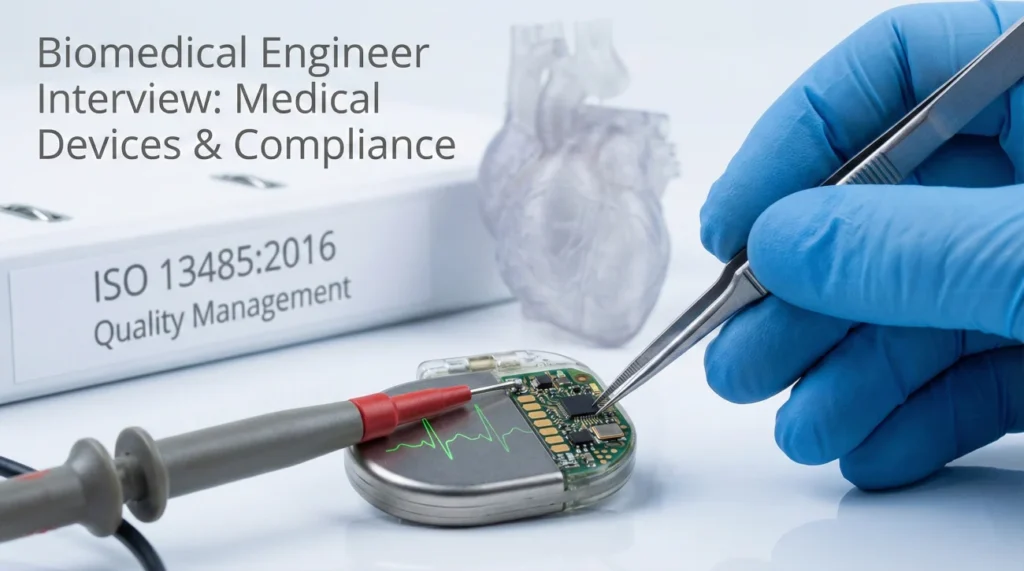
Biomedical engineer interview questions explore the unique intersection of engineering principles and biological systems. Unlike other engineering disciplines where a failure might cost money, a failure in biomedical engineering can cost a life. Hiring managers are looking for candidates who can navigate the rigorous “Design Controls” required by the FDA while solving complex physiological problems.
Whether you are designing a next-generation pacemaker, a robotic surgical arm, or a diagnostic imaging system, you will be tested on your understanding of regulatory pathways (510(k) vs PMA), quality management systems (ISO 13485), and risk management (ISO 14971). You must demonstrate that you can translate “Clinical Needs” into “Engineering Specifications” and validate that your device is safe and effective for human use.
This guide dives deep into the technical and regulatory core of the profession. We cover the nuances of biocompatibility testing, the lifecycle of medical device software, and the critical difference between Verification (Did we build the device right?) and Validation (Did we build the right device?).
Regulatory & Quality Fundamentals
Q: Explain the difference between FDA 510(k) and PMA pathways.
This is the most critical regulatory strategy question. 510(k) (Pre-market Notification) is used for Class II devices (moderate risk) that are “Substantially Equivalent” to a predicate device already on the market (e.g., a new digital thermometer). The goal is to prove safety and effectiveness by comparison.
PMA (Pre-market Approval) is for Class III devices (high risk, life-sustaining/supporting) like implantable heart valves. It requires rigorous clinical trials to independently prove safety and efficacy because no predicate exists. PMA is significantly more expensive and time-consuming (years vs. months) than a 510(k).
Q: What is the purpose of Design Controls (21 CFR Part 820.30)?
Design Controls are the FDA’s mandate to ensure a device is designed safely. It prevents the “inspect quality in” mentality. The core elements are:
1. Design Input: Defining user needs (e.g., “Must be handheld”).
2. Design Output: The engineering specs (e.g., “Weight < 200g”).
3. Design Review: Formal checks at milestones.
4. Verification: Testing outputs against inputs.
5. Validation: Testing the final device with users.
6. DHF (Design History File): The documentation proving all this happened.
Q: Describe the ISO 14971 Risk Management process.
ISO 14971 is the global standard for risk management for medical devices. It is an iterative lifecycle process, not a one-time event.
1. Risk Analysis: Identify hazards (e.g., electric shock, bio-contamination) and estimate risk (Severity x Probability).
2. Risk Evaluation: Is the risk acceptable?
3. Risk Control: If not acceptable, implement mitigations (safe design, protective measures, labeling).
4. Residual Risk Evaluation: Is the risk acceptable after mitigation?
5. Post-Production Monitoring: Collecting field data to update the risk file.
Q: Differentiate between Verification and Validation (V&V).
Verification answers: “Did we build the device right?” It is objective bench testing against engineering specifications. Example: A drop test confirms the casing withstands 10G force.
Validation answers: “Did we build the right device?” It is subjective testing with actual users (clinicians/patients) in a simulated or real environment. Example: A surgeon uses the device in a cadaver lab to confirm the handle grip is comfortable and ergonomic. You can pass Verification but fail Validation if the user hates the product.
Technical Design & Testing
Q: Biocompatibility (ISO 10993)
Any material contacting the human body must be biocompatible. ISO 10993 defines the tests based on contact duration (limited, prolonged, permanent) and nature (skin, blood path, bone). Basic tests include Cytotoxicity (cell death), Sensitization (allergic reaction), and Irritation. For implants, we test for Genotoxicity and Carcinogenicity. I select materials with a proven history (like 316L Stainless Steel or PEEK) to minimize testing burdens.
Q: Software as a Medical Device (SaMD)
Software is regulated under IEC 62304. We classify it by safety class: Class A (No injury), B (Non-serious injury), C (Serious injury/Death). Class C requires rigorous code reviews, unit testing, and integration testing. I must manage SOUP (Software of Unknown Provenance) – third-party libraries – by validating them or wrapping them in defensive code. Cybersecurity is now a critical part of this, ensuring the device cannot be hacked to harm a patient.
Q: Sterilization Methods
I choose the method based on material compatibility. Autoclave (Steam) is standard for reusable surgical steel tools but melts plastics. Ethylene Oxide (EtO) is a gas for sensitive plastics/electronics but requires long aeration to remove toxic residuals. Gamma Radiation is fast for single-use disposables but yellows certain polymers (like standard Polypropylene) and can degrade electronics. Vaporized Hydrogen Peroxide (VHP) is a surface sterilant.
Q: Electrical Safety (IEC 60601-1)
This is the bible for electromedical equipment. Key concept: Applied Parts (parts touching the patient).
Type B: Grounded (e.g., hospital bed).
Type BF: Floating (e.g., blood pressure cuff).
Type CF: Cardiac Floating (e.g., ECG leads direct to heart).
Type CF has the strictest leakage current limit (10 microamps). I design isolation barriers (transformers/optocouplers) to protect the patient from mains voltage shock.
Q: Human Factors Engineering (IEC 62366)
HFE (Usability Engineering) prevents use errors. The FDA rejects devices if users can’t figure them out intuitively. I perform Formative Testing (early prototypes) to iterate the UI. Then Summative Testing (final validation) with representative users to prove safe use. A classic example: designing a connector so it cannot be plugged into the wrong port (Poka-Yoke), preventing a gas line from being connected to an IV line.
Q: CAPA System (Corrective & Preventive Action)
CAPA is the immune system of Quality. If a non-conformance occurs (e.g., high failure rate in manufacturing), we open a CAPA.
1. Containment: Quarantine bad parts.
2. Root Cause Analysis: Fishbone/5 Whys to find the systemic flaw.
3. Correction: Fix the immediate issue.
4. Corrective Action: Change the process to prevent recurrence (e.g., update the fixture).
5. Effectiveness Check: Audit 3 months later to ensure the fix worked.
Clinical & Ethical Scenarios
A prototype fails verification testing (e.g., the housing cracks at 50 cycles instead of 100). The deadline is tomorrow. What do you do?
I cannot ship a failing device. In biomedical engineering, “close enough” can mean a patient injury. I immediately notify the Project Manager and Quality Engineer. I initiate a Failure Analysis.
I verify the test method: Did we test it correctly? If the failure is real, I assess the risk. Does the crack affect safety or function? If it’s purely cosmetic, we might revise the spec (if clinically justifiable). If it’s structural, we must redesign (add ribs, change material) and re-test. I present the delay as a necessary safety step, not an option.
Marketing wants to claim your device “Reduces Pain” on the label. The clinical data only shows it is “Equivalent to Standard Care.”
This is a regulatory violation (“Misbranding”). Claims must be substantiated by data. If we claim “Pain Reduction,” the FDA requires clinical evidence proving superiority, not just equivalence.
I would explain to Marketing that making an unsubstantiated claim opens us to Warning Letters and massive fines. I would propose alternative wording that matches our data, such as “Effective for Pain Management.” If they insist, I would escalate to Regulatory Affairs legal counsel to protect the company.
During a clinical trial, a surgeon uses your device incorrectly (“Off-Label”) and the patient has a complication.
This is an Adverse Event. I must document it immediately. Even though it was “user error,” I must investigate why they used it incorrectly. Was the Instructions for Use (IFU) unclear? Did the device look like another tool?
We are required to report this to the IRB (Institutional Review Board) and potentially the FDA (MDR – Medical Device Reporting) depending on severity. We might need to update the training protocol or modify the device design to prevent that specific misuse (User Error mitigation) before continuing the trial.
Advanced Innovation & Trends
Q: What is “Personalized Medicine” and how does it affect device design?
Personalized medicine moves away from “one size fits all.” In devices, this often means Patient-Specific Implants (PSI). We take a CT/MRI scan of the patient, convert it to a 3D model (segmentation), and 3D print (additive manufacturing) a titanium implant that fits their unique anatomy perfectly.
The regulatory challenge is that we cannot validate every single implant. Instead, we validate the Process Envelope (the range of sizes and shapes the printer can safely produce). Design controls focus on the software workflow that converts the scan to the print file.
Q: Explain the concept of “Closed-Loop Control” in drug delivery (e.g., Artificial Pancreas).
A closed-loop system automates therapy based on real-time feedback. It consists of a Sensor (Continuous Glucose Monitor), an Algorithm (Controller), and an Actuator (Insulin Pump). The sensor reads the glucose, the algorithm calculates the dose, and the pump delivers it, without patient intervention.
The critical engineering challenge is Lag Time (interstitial fluid glucose lags behind blood glucose) and Safety Limits. The algorithm must have hard stops (“hypoglycemia guardrails”) to prevent overdose if the sensor drifts or fails. Validation of the algorithm involves massive “in-silico” trials (computer simulation) before human testing.
Q: How do you design for MRI Safety?
MRI scanners use massive magnetic fields (1.5T or 3.0T). Ferromagnetic materials (iron, nickel, cobalt) become dangerous projectiles (“Missile Effect”). Conductive loops can heat up and burn the patient due to RF energy.
I design with non-magnetic materials: Titanium, Nitinol, Ceramics, or special Stainless Steel. We test for displacement force, torque, and RF heating (ASTM F2503). The device is labeled “MR Safe” (non-conductive/non-magnetic), “MR Conditional” (safe under specific conditions like 1.5T only), or “MR Unsafe.”
Q: What is a “Combination Product”?
A combination product blends two regulated components: Drug-Device (Drug-eluting stent), Biologic-Device (Scaffold with stem cells), or Drug-Biologic. The challenge is jurisdiction. The FDA determines the “Primary Mode of Action” (PMOA) to decide which center leads the review (CDRH for devices, CDER for drugs).
As an engineer, I must account for the drug’s stability. For example, the sterilization method (Gamma) must not degrade the drug coating. The shelf life is dictated by the component that expires first.
Biomedical Engineering Knowledge Check
Test Your Regulatory IQ
1. Which FDA classification applies to a simple tongue depressor?
- Class I (Low Risk)
- Class II (Moderate Risk)
- Class III (High Risk)
- Unclassified
2. ISO 13485 is the quality standard specifically for:
- Automotive Industry
- Medical Devices
- Aerospace
- General Manufacturing (ISO 9001)
3. “UDI” stands for:
- User Device Interface
- Unique Device Identification (Tracking code on label)
- Universal Design Input
- Under Development Item
4. A “Predicate Device” is used in which submission?
- PMA
- 510(k)
- De Novo
- HDE
5. Which test evaluates if a material kills cells?
- Sensitization
- Cytotoxicity
- Hemolysis
- Pyrogenicity
6. In a clinical trial, “IDE” stands for:
- Initial Design Evaluation
- Investigational Device Exemption (Permission to test on humans)
- Internal Data Entry
- Integrated Development Environment
7. The “DMR” (Device Master Record) contains:
- The history of one specific batch
- The “Recipe” for how to build the device (Drawings, BOMs, Work Instructions)
- The history of the design process
- The complaints file
8. What material is commonly used for hip implants due to osseointegration?
- Stainless Steel 304
- Titanium Alloy (Ti-6Al-4V)
- Aluminum
- Copper
9. “Nitinol” is famous for which property?
- High conductivity
- Shape Memory and Superelasticity
- Magnetic strength
- Brittleness
10. A “Sentinel Event” in a hospital involves:
- A minor delay
- Unexpected death or serious physical/psychological injury
- Equipment maintenance
- A shift change
11. IEC 60601-1-2 standard covers:
- Mechanical Safety
- Electromagnetic Compatibility (EMC)
- Radiation Safety
- Biocompatibility
12. “Design Validation” ensures the device meets:
- Design Outputs
- User Needs and Intended Uses
- Manufacturing Specs
- Cost targets
13. Which organization manages CE Marking for Europe?
- FDA
- Notified Bodies (e.g., TUV, BSI)
- ISO
- WHO
14. “Luer Lock” is a standard connector for:
- Electrical cables
- Fluid/IV lines and Syringes (ISO 80369)
- Gas cylinders
- Orthopedic screws
15. “Usability Engineering” focuses on:
- Making the device look pretty
- Minimizing user error and maximizing safety/efficacy interactions
- Lowering manufacturing cost
- Marketing claims
16. “Post-Market Surveillance” (PMS) is:
- Spying on competitors
- Proactively collecting data on device safety/performance after it is sold
- Testing prototypes
- Auditing suppliers
17. Which sterilization method leaves toxic residues if not aerated?
- Steam
- Ethylene Oxide (EtO)
- Gamma
- E-Beam
18. “Bioburden” refers to:
- The weight of the implant
- The number of bacteria living on a surface before sterilization
- The cost of biological testing
- Medical waste
19. A “Humanitarian Device Exemption” (HDE) is for:
- Devices sold in war zones
- Devices treating rare diseases (fewer than 8,000 patients/year in US)
- Free devices
- Veterinary devices
20. “Traceability” in manufacturing means:
- Being able to draw the part
- Ability to track every component back to its raw material lot and supplier
- Following the production line
- Copying a competitor
❓ FAQ
📜 Do I need a PE license?
Generally, No. The medical device industry relies on FDA regulations, not state engineering boards. However, a PE can be useful if you work in facilities engineering for hospitals (Clinical Engineering) or consult on public safety matters.
🔬 Do I need a PhD?
For R&D scientist roles or advanced tissue engineering, a PhD is often required. For Product Development Engineer, Quality Engineer, or Manufacturing Engineer roles, a BS or MS is the standard. Industry experience with Design Controls is often valued more than a PhD for these roles.
🏢 Start-up vs. Big Pharma?
Start-ups: You wear many hats (R&D, Quality, Regulatory). Fast-paced, high risk/reward. Big MedTech (Medtronic, J&J): Specialized roles, structured training, stability, slower pace. Start-ups teach you how to build a company; Big corps teach you how to follow a mature process.
💻 What software skills matter?
SolidWorks is king for mechanical design. Minitab for statistical analysis (Process Capability, DOE). MATLAB/LabVIEW for testing and signal processing. Familiarity with eQMS systems (like Greenlight Guru or MasterControl) is a bonus.
❤️ Is it emotional?
It can be. You might meet the patients whose lives were saved by your device. Conversely, you might analyze failures where patients were hurt. You need resilience and a strong ethical compass to prioritize patient safety above business pressure.
The Patient is Waiting
To succeed with biomedical engineer interview questions, you must embrace the “dual citizenship” of the role: you are an engineer, but you are also a regulatory professional.
Focus on your systematic approach to safety. Don’t just talk about the cool technology; talk about how you validated it. Explain how you navigated the tradeoffs between usability and sterility. Show them that you understand that at the end of every schematic, code, or CAD drawing, there is a human being trusting you with their life.
⚠️ Disclaimer: The interview strategies, sample answers, and negotiation tips provided in this guide are for educational purposes only. Hiring decisions are subjective and vary by company and industry. While these strategies are based on professional HR standards, they do not guarantee a specific job offer or result.