The Countdown to Bid Day
Construction estimator interview questions live in the hourglass of pre-construction. You are pricing a building that does not exist yet, and your number decides whether the company wins work or absorbs loss.
Hiring managers want proof you can see scope gaps, normalize bids, and explain your logic under pressure. They are also testing whether you understand time risk: general conditions, temporary works, and the small “support” costs that explode when the schedule stretches.
This guide walks through structured takeoffs, bid leveling, productivity assumptions, contingency thinking, and the way experienced estimators document clarifications so the bid is competitive and defensible.
Core Estimating Principles
Q: Explain the difference between “Direct Costs”, “Indirect Costs”, and “General Conditions”.
This distinction is the foundation of a bid structure. Direct Costs are the “hard costs” of materials, labor, and equipment permanently installed in the building (e.g., concrete, steel, drywall, the electrician’s contract). They scale directly with the size of the building.
Indirect Costs (often synonymous with General Conditions in a project budget) are the costs required to support the construction process but not part of the final building. This includes the site trailer, the superintendent’s salary, temporary utilities, fencing, and cranes. These are time-dependent. If the schedule slips by a month, Direct Costs might stay the same, but General Conditions increase significantly. Understanding this helps in “General Conditions” estimating, which is often where GCs make or lose their fee.
Q: Describe your process for a systematic Quantity Takeoff (QTO).
Accuracy comes from structure. I follow the CSI MasterFormat (Divisions 1-50) to ensure nothing is missed. I start with the structural basics: Foundations (concrete/rebar), then Superstructure (steel/framing), then Enclosure (skin/roof), and finally Interiors (finishes). I measure “Net in Place” quantities first (what is geometrically shown on the drawing).
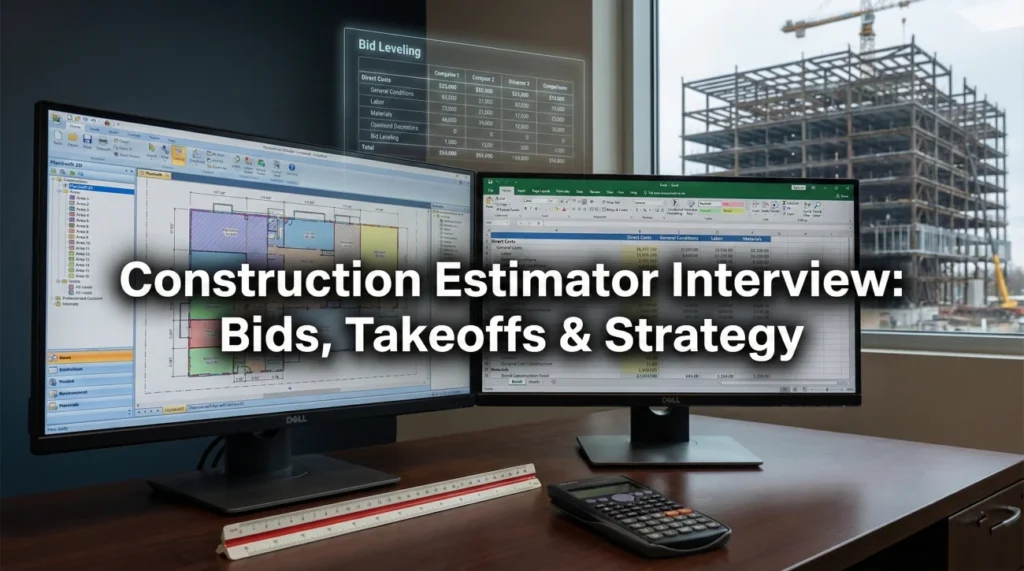
Crucially, I then apply a Waste Factor appropriate to the material. For example, carpet might have a 10-15% waste factor due to cutting and pattern matching, while concrete might only need 3-5% for spillage and over-excavation. I highlight drawings as I go (using Bluebeam or PlanSwift) to prevent “double-dipping” or missed areas. A disorganized takeoff is a recipe for a budget bust.
Q: How do you determine Labor Productivity Rates for self-performed work?
Labor is the most volatile component of an estimate. I don’t just use a generic “$50/hour” rate. I calculate Man-Hours per Unit based on historical data and specific site conditions. For example, hanging drywall on a 10-foot straight wall might take 0.04 man-hours/sf.
However, I adjust this “base rate” for complexity. Is it a 20-foot ceiling (needs scaffolding)? Is it a curved wall (slower)? Is the site congested (material handling delays)? I multiply the base rate by a difficulty factor. Then, I apply the “Labor Burden” (taxes, insurance, union benefits) to the base wage to get the fully burdened hourly cost. Total Cost = (Quantity × Man-Hours/Unit × Difficulty) × Fully Burdened Rate.
Q: What is a “Scope Gap” and how do you prevent it?
A Scope Gap is work required by the design but missing from every subcontractor’s bid. For example, the plumber excludes the concrete housekeeping pads for pumps, and the concrete sub excludes them because they weren’t on the structural drawings. If I miss this, the GC has to pay for it out of profit.
To prevent this, I use a rigorous Bid Leveling Sheet (Scope Sheet). I line up all the bids for a specific trade side-by-side. I have a master checklist of “grey area” items (core drilling, firestopping, backing, hoisting, cleanup). I force every sub to explicitly state “Included” or “Excluded” for these items. If everyone excludes it, I create a “Plug Number” in the estimate to cover the cost.
Bidding Strategy & Analysis
Q: Bid Leveling (Normalization)
You can’t compare the bottom line numbers of two bids until you normalize the scope. Sub A might bid $100k but exclude sales tax and hoisting. Sub B bids $120k but includes everything. I add “Plugs” to Sub A’s bid for the missing items to make an “Apple-to-Apple” comparison. Often, the lowest initial bidder is not the true lowest cost provider once scope gaps are filled. I present this analysis to the client to justify selecting a more complete, higher initial bidder.
Q: Conceptual Estimating (Romberg Method)
When drawings are only 10-20% complete (Napkin sketch), I use Conceptual Estimating. I rely on parametric data: Cost per Bed (Hospital), Cost per Key (Hotel), or Cost per Stall (Parking Garage). I use historical data from similar past projects and adjust for inflation (using ENR indices) and location (City Cost Index). I clearly state the “Assumptions and Clarifications” to define what this rough number includes (e.g., “Assumes standard finishes, excludes hazmat remediation”).
Q: Value Engineering (VE) in Pre-Con
Real VE happens before the bid is finalized. I look for high-cost drivers that don’t add program value. Examples: “Can we switch from copper feeder wire to aluminum?” (saves 40% on material). “Can we change the facade from precast to EIFS?” I price these options as “Alternates” below the base bid. This gives the owner a menu of savings to choose from to get the project back on budget without redesigning the whole building.
Q: Surety Bonds (Bid vs. Performance)
A Bid Bond guarantees that if we are low bidder, we will sign the contract. If we walk away, the surety pays the difference to the next bidder. A Performance & Payment Bond guarantees we will finish the job and pay subs. I must calculate the bond premium (usually 0.75% – 1.5% of contract value) and include it in the estimate. On public work, this is mandatory; on private work, it’s a risk management decision by the owner.
Q: Escalation Clauses
In a volatile market, material prices (lumber, steel) can spike 20% between bid day and purchase day. I assess the project duration. If it’s a multi-year project, I add an Escalation Contingency (e.g., 3-5% per year) based on market forecasts. Alternatively, I qualify the bid stating that “Steel prices are valid for 30 days only,” shifting the long-term risk back to the owner.
Q: CM-at-Risk vs. Hard Bid
In Hard Bid (Design-Bid-Build), the plans are 100% done. I give a fixed price. The risk is high; if I missed something, I pay for it. Competition is solely on price. In CM-at-Risk (CMAR), I am hired early to help design. I provide a GMP (Guaranteed Maximum Price) usually around 60-90% design. The fee is fixed, but the cost of work is reimbursable. I include a “Construction Contingency” within the GMP to cover design evolution and minor gaps.
Bid Day Pressure & Scenarios
It’s 1 hour before the bid deadline. A major subcontractor sends a new price that is 40% lower than the others. Do you use it?
This is the classic “Bid Day Terror.” A number that is 40% low is likely a mistake, not a miracle. If I use it and they back out, I’m screwed. If I don’t use it and a competitor does, I lose the job.
My strategy: I call the sub immediately. I ask specific questions: “Did you include the addendum 3 changes? Did you see the high ceilings in the lobby?” I do not tell them their number, but I tell them, “You are significantly low, please re-check your takeoff.” If they stand by it, I might use it but add a “risk reserve” to my bid to cover the potential gap if they fail. Or, if it’s too risky, I use the second-lowest bidder to sleep at night.
The Architectural drawings show a high-end finish, but the Specs call for a standard finish. How do you price it?
The standard rule of contract interpretation is that Specifications usually govern over Drawings (though contracts vary). However, relying on this is risky. If I price the low end, and the architect meant the high end, I have a fight on my hands.
I would submit an RFI (Request for Information) immediately during the bid phase. If there is no time for an answer, I typically price the more expensive option to cover the risk, and list it as a clarification: “Base bid assumes High-End Finish per Drawing A501.” I might also offer the Standard Finish as a deduct alternate to show I’m competitive.
You are estimating a renovation project with no “As-Built” drawings available. How do you handle the uncertainty?
Unknowns are budget killers. I would conduct a thorough site walk, bringing the Superintendent if possible. I would look above ceilings and open access panels. However, I can’t see inside walls.
I would include specific Allowances for foreseeable unknowns. For example: “Includes Allowance of $20,000 for unforeseen MEP conflicts or asbestos abatement.” I would clearly qualify the bid: “Excludes structural repairs to existing framing unless specifically noted.” Transparency protects the relationship; hiding the risk leads to Change Order fights later.
Advanced Estimating & Technology
Q: How do you utilize BIM (5D Estimating) in your workflow?
5D Estimating links cost data to the 3D model. Instead of clicking 100 times to count doors in 2D, the model exports a schedule of 100 doors instantly. It allows for rapid iteration; if the architect changes a wall type, the estimate updates automatically. However, I never trust the model blindly. Designers often model “generic” elements that lack the detail needed for pricing (e.g., missing rebar overlap). I use the model for the bulk QTO but verify complex details manually.
Q: Describe your method for estimating General Conditions (GCs) on a delayed project.
GCs are time-driven. If a project extends, the cost of the trailer, the dumpsters, the fence rental, and the staff salaries continues. I build the GC estimate as a detailed monthly burn rate. Staffing Plan (Project Manager @ 50%, Super @ 100%, PE @ 100%) + Monthly Fixed Costs (Rent, Utilities). If the schedule is 12 months, I multiply the burn rate by 12. If the schedule is risky, I analyze the “cost per day” of delay to understand our exposure to Liquidated Damages.
Q: How do you maintain a Historical Cost Database?
Every completed project is a data mine. After a job closes, I don’t just file it away. I perform a “post-mortem” analysis. I compare the original estimate vs. the final buyout vs. the actual cost. I extract unit costs: Cost/CY of concrete, Cost/Ton of steel, Cost/SF of finishes. I normalize these costs for time (inflation) and location. This database is my secret weapon for validating future estimates and creating quick conceptual budgets for clients.
Q: What is “Front Loading” a Schedule of Values, and is it ethical?
Front Loading involves assigning higher values to early activities (Mobilization, Demolition, Concrete) and lower values to later activities (Painting, Punchlist) to improve cash flow. It helps the contractor finance the job without borrowing money.
Ethically, it’s a grey area but common. It becomes unethical (and dangerous) if you over-bill significantly beyond the value of work in place, putting the owner at risk if you default. As an estimator, I ensure the Schedule of Values is balanced enough to be defensible to the bank inspector while still protecting our cash position.
Construction Estimator Knowledge Check
Test Your Bidding IQ
1. In the CSI MasterFormat, Division 03 always refers to:
- Masonry
- Concrete
- Metals
- Site Work
2. What is a “Plug Number”?
- The final profit margin
- An estimated cost used as a placeholder for a missing scope item in a bid
- The cost of electrical plugs
- A discount given to the owner
3. “Buyout” refers to:
- The owner buying the land
- The process of awarding subcontracts and purchase orders after winning the job
- Buying lunch for the team
- The final payment from the bank
4. Which of these is an “Indirect Cost”?
- Structural Steel Columns
- Jobsite Security Guard
- Ceramic Tile
- Copper Piping
5. “Swell” factor refers to:
- The increase in lumber size due to moisture
- The increase in soil volume when excavated from its natural banked state
- The profit margin expansion
- The inflation of material prices
6. A “GMP” contract stands for:
- General Material Purchase
- Guaranteed Maximum Price
- Gross Margin Percentage
- Global Market Price
7. What does “F.O.B. Jobsite” mean?
- Freight On Board – Buyer pays shipping
- Free On Board – Seller pays shipping and owns goods until they arrive at the site
- Full Of Bricks
- Fixed Over Budget
8. A “Quantity Takeoff” (QTO) measures:
- The time it takes to build
- The physical amount of materials required from the drawings
- The quality of the materials
- The number of workers needed
9. “Labor Burden” includes:
- The weight the worker carries
- Payroll taxes, insurance (FICA, FUTA, Workers Comp), and benefits added to the base wage
- The cost of the tools
- The transportation to the site
10. An “Addendum” is issued:
- After the contract is signed
- During the bidding period to modify the drawings or specs
- At the end of the project
- To fire a subcontractor
11. What is the difference between an Allowance and a Contingency?
- They are the same
- Allowance is for known items with undefined scope; Contingency is for unknown/unforeseen risks
- Allowance is profit; Contingency is cost
- Contingency is taxable; Allowance is not
12. “Self-Perform” means:
- The owner builds it themselves
- The General Contractor uses their own labor force to do the work instead of subcontracting
- The work performs itself automatically
- Working alone without a team
13. The “Davis-Bacon Act” relates to:
- Food safety on site
- Prevailing wage requirements for public works projects
- Steel tariffs
- Environmental protection
14. Which unit is used to estimate masonry blocks (CMU)?
- Cubic Yards (CY)
- Square Feet (SF) or Piece Count (EA)
- Linear Feet (LF)
- Tons
15. “Bid Shopping” is considered:
- A smart business practice
- Unethical practice of sharing a sub’s price with competitors to drive the price down
- Buying supplies at the store
- Shopping for new software
16. A “Deduct Alternate” is:
- A mistake in the math
- A proposal to reduce the scope or quality to lower the bid price
- A tax deduction
- A cheaper subcontractor
17. Which software is widely used for on-screen takeoff?
- Photoshop
- PlanSwift or Bluebeam Revu
- Microsoft Word
- QuickBooks
18. “Mobilization” costs cover:
- Gas for the trucks
- Getting equipment, trailers, and personnel to the site to start work
- Phone bills
- Advertising
19. If the “Drawings” and “Specs” conflict, which typically governs?
- The Drawings (because they are visual)
- The Specifications (usually, though contracts vary)
- Whichever is cheaper
- The Subcontractor’s opinion
20. What is “Overlay” in estimating software?
- Putting a roof on the building
- Superimposing a new drawing revision over an old one to identify changes
- Sleeping in the office
- Adding profit on top of cost
❓ FAQ
⏳ A subcontractor is suddenly 40% lower than everyone else. What do you do?
Treat it as risk until proven otherwise. Call them, confirm addenda and key scope items, and ask them to recheck quantities. If you use the number, protect yourself with clear scope confirmation and a reserve for the likely gap.
🏗️ What are “general conditions” and why do they matter so much?
They are the time-driven support costs: supervision, trailers, temp power, cranes, fencing, cleanup, and logistics. When time increases, these costs climb fast even if quantities stay the same.
🧰 What takeoff tools should I know?
Know at least one modern takeoff and markup workflow plus spreadsheet comfort. Tools vary by company, but the real skill is disciplined scope tracking and a clean audit trail for quantities.
📉 How do you set contingency without pricing yourself out?
Base it on uncertainty, not fear. Higher unknowns deserve contingency. When documents are tight, contingency can shrink. Explain your rationale clearly so it reads like control, not guessing.
📝 What is the best way to write assumptions and clarifications?
Be specific and measurable. State what is included and excluded, reference the drawing or spec location, and avoid vague phrases. A clean clarification list prevents disputes later.
Win Work Without Guessing
If you want extra reps beyond this page, jump to our complete set of construction interview questions and drill a few questions out loud until your answers sound natural, not memorized.
In interviews, the best estimator is not the person with the biggest spreadsheet, it is the person who can explain the story behind the number. Show how you structure takeoffs, catch gaps, and make bid decisions you can defend.
⚠️ Disclaimer: The interview strategies, sample answers, and negotiation tips provided in this guide are for educational purposes only. Hiring decisions are subjective and vary by company and industry. While these strategies are based on professional HR standards, they do not guarantee a specific job offer or result.