- Big idea: Engineering projects always juggle scope, time, and cost, so every “simple” change forces a trade-off somewhere else.
- Hidden fourth constraint: Quality sits in the middle, and when people try to lock all three corners, quality is usually what quietly gets squeezed.
- Scope control: Clear deliverables, requirements, exclusions, and assumptions prevent confusion, and formal change control stops “while you’re at it” requests from blowing up the plan.
- Time and cost discipline: Break work down, track the critical path and milestones, estimate realistically with contingency, then correct variances early before they compound.
- Make it practical: Use value engineering to keep required function and safety while managing constraints, and in interviews, explain your trade-offs with concrete impacts instead of vague optimism.
The Triple Constraint Challenge
Engineering projects exist within fundamental tension between scope (what you’ll deliver), time (when you’ll complete it), and cost (resources you’ll consume). Effective engineering project management requires understanding that these constraints interdepend: expanding scope increases time and cost, accelerating schedule typically raises expenses or reduces deliverables, cutting budget forces scope reduction or timeline extension. Managing this balance while maintaining quality standards represents core challenge separating successful projects from failures.
The challenge intensifies because stakeholders naturally want maximum scope delivered quickly at minimum cost: clients demand comprehensive solutions on tight deadlines within constrained budgets, management pushes aggressive targets, and technical teams resist compromises affecting quality. Meanwhile, incomplete requirements emerge during execution, unforeseen problems consume contingency, and changing conditions force adaptation. Project managers must navigate these competing pressures through systematic planning, proactive risk management, and disciplined change control.
This guide establishes foundational project management principles for engineering professionals. You’ll learn the project management triangle and constraint relationships, systematic scope definition and change control, time management through scheduling techniques, cost estimation and budget control, and frameworks for balancing quality against competing priorities without compromising safety or fitness for purpose.
The Project Management Triangle
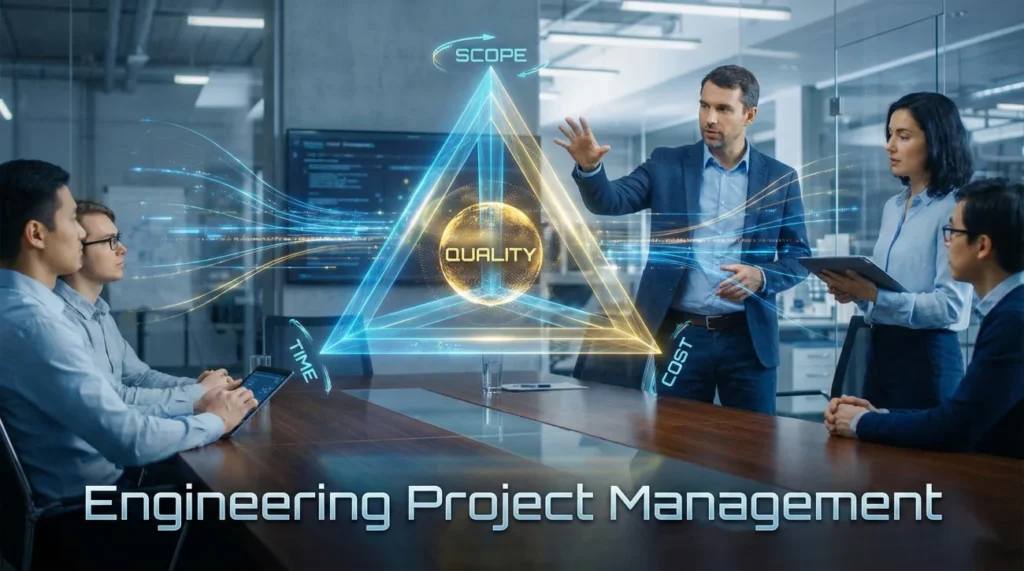
The project management triangle (also called triple constraint or iron triangle) visualizes fundamental trade-offs governing all engineering projects.
Understanding Constraint Interdependencies
Changes to any constraint affect the others predictably, requiring conscious trade-off decisions.
| Constraint | Definition | Impact When Changed |
|---|---|---|
| Scope | Deliverables, features, requirements, work to be completed | Adding scope increases time and cost. Reducing scope enables faster delivery or cost savings. Unclear scope causes rework. |
| Time (Schedule) | Project duration, milestones, delivery deadlines | Compressing schedule increases cost (overtime, expediting) or reduces scope. Extending timeline may reduce cost pressure but risks market changes. |
| Cost (Budget) | Financial resources, labor, materials, equipment, overhead | Reducing budget forces scope cuts or timeline extension. Adding budget enables scope expansion or schedule acceleration. |
| Quality (center) | Standards, performance, reliability, compliance, fitness for purpose | Quality sits at triangle center: cutting any constraint without adjusting others typically degrades quality. Maintaining quality requires balanced constraint management. |
💡 Pro tip: When stakeholders demand changes affecting constraints, make trade-offs explicit: “We can add Feature X (scope increase), but that will extend delivery by 3 weeks (time impact) or require 2 additional engineers (cost increase). Which constraint should we adjust?” Forcing conscious choice prevents impossible expectations where everyone assumes others will absorb impacts.
Quality: The Hidden Fourth Constraint
While not always explicitly discussed, quality represents non-negotiable baseline in professional engineering despite pressure to compromise.
- <li⚖️
Balancing act:
- Quality must satisfy minimum standards (codes, safety, performance) while staying within scope/time/cost reality
- 🚫 Non-negotiable minimums: Safety, code compliance, and fitness for purpose cannot be traded away regardless of other pressures
- 📊 Quality levels: Beyond minimums, quality involves trade-offs: gold-plated solutions vs. adequate performance, over-engineering vs. optimization
- 💰 Cost of quality: Prevention (good design) costs less than inspection (testing), which costs less than failure (rework or liability)
Expert advice: The most dangerous project management mistake is accepting unrealistic constraints hoping you’ll somehow make it work. If client demands scope that legitimately requires 12 months and $500K but insists on 6 months and $300K, you have three choices: negotiate realistic constraints, reduce scope to match constraints, or decline the project. Accepting impossible constraints sets up failure where you’ll be blamed despite mathematical impossibility of success.
Scope Definition and Control
Systematic scope time cost balance begins with crystal-clear scope definition preventing misunderstanding and uncontrolled growth.
Defining Project Scope
Comprehensive scope documentation establishes boundaries preventing disputes and expectation mismatches.
| Scope Element | What to Define | Why It Matters |
|---|---|---|
| Deliverables | Specific outputs, documents, hardware, systems to be provided | Clear deliverable list prevents disputes about what’s included, enables progress tracking, defines completion criteria |
| Requirements | Performance specifications, codes/standards, constraints, acceptance criteria | Objective requirements prevent subjective judgment disputes, enable verification, protect from arbitrary rejection |
| Exclusions | Work explicitly NOT included, assumptions, dependencies on others | Stating exclusions prevents “I thought that was included” arguments, clarifies interfaces, manages expectations |
| Assumptions | Site conditions, existing work, client-furnished items, schedule dependencies | Documenting assumptions creates basis for adjustments when assumptions prove invalid, allocates risk appropriately |
| Constraints | Budget limits, schedule restrictions, resource availability, regulatory requirements | Acknowledging constraints upfront enables realistic planning, prevents retroactive blame for predictable limitations |
Managing Scope Creep
Uncontrolled scope expansion (scope creep) represents primary cause of project failures exceeding budgets and missing deadlines.
- Change control process: Formal procedure evaluating scope changes for impact on time/cost before approval, no informal “small favors”
- Documentation discipline: Every change documented with impact assessment, approval, and adjustment to baselines
- Client education: Explaining that changes have consequences, helping stakeholders prioritize truly essential additions
- Saying no appropriately: Declining out-of-scope requests politely but firmly, offering alternatives within constraints
- Gold-plating prevention: Stopping engineers from adding unnecessary features “improving” design beyond requirements
Beware “while you’re at it” requests: client asks for minor addition “since you’re already there.” These accumulate into major scope expansion consuming contingency and profit. Each request merits formal evaluation regardless of apparent simplicity. Twenty “small” additions collectively represent major scope increase deserving proper change order and compensation.
Time and Cost Control Strategies
Effective schedule and budget management requires systematic planning, tracking, and proactive variance correction.
Time Management Fundamentals
Schedule development and control enable predicting completion and identifying delays requiring corrective action.
| Scheduling Technique | Purpose and Application | Key Concepts |
|---|---|---|
| Work Breakdown Structure (WBS) | Decompose project into manageable work packages for assignment and tracking | Hierarchical decomposition, deliverable-oriented, bottom-up estimation, clear ownership |
| Critical Path Method (CPM) | Identify sequence of activities determining minimum project duration | Activity dependencies, critical path (zero float), float/slack for flexibility, focus resources on critical activities |
| Milestone tracking | Monitor progress against key decision points and deliverable completions | Objective completion criteria, client review points, payment triggers, go/no-go decisions |
| Earned Value Management (EVM) | Integrate scope, schedule, and cost for comprehensive progress assessment | Planned value, earned value, actual cost, schedule/cost variance analysis, forecasting |
Cost Estimation and Budget Management
Accurate estimation and disciplined spending control prevent budget overruns destroying project profitability.
- Bottom-up estimating: Detailed cost buildup from work package level, most accurate but time-intensive
- Analogous estimating: Using similar past projects as basis, faster but less precise, appropriate for early planning
- Parametric estimating: Statistical relationships (cost per square foot, labor per ton), reliable for repetitive work
- Contingency reserves: Budget buffer for known risks, typically 10-20% depending on uncertainty, not profit or padding
- Management reserves: Additional buffer for unknown unknowns, held by management, released as needed for true emergencies
Tracking and Correcting Variances
Regular monitoring enables early detection and correction before small variances become major problems.
- 📊 Weekly progress tracking: Compare actual vs. planned progress, identify trends, forecast impacts
- 🚨 Early warning thresholds: Define variance levels triggering investigation and corrective action
- 🔧 Corrective actions: Resource reallocation, scope adjustment, schedule compression, or cost trade-offs
- 📝 Lessons learned: Document what caused variances, how corrected, prevention for future projects
Expert advice: Projects rarely get back on track spontaneously: schedule delays and budget overruns compound without intervention. When variances emerge, take corrective action immediately rather than hoping things improve. Small course corrections early prevent crisis management later. Most failed projects showed warning signs months before collapse but teams ignored signals hoping problems would resolve themselves.
Integrating Quality with Constraints
Engineering quality control requires balancing technical excellence against practical constraints without compromising safety or fitness.
Defining Appropriate Quality Levels
Quality exists on continuum from minimally acceptable to gold-plated excellence: determining appropriate level prevents over or under-engineering.
| Quality Aspect | Minimum Acceptable | Optimal Balance | Over-Engineering Risk |
|---|---|---|---|
| Safety factors | Code-minimum factors of safety, standard practice | Industry standard factors with appropriate uncertainty margins | Excessive conservatism increases cost without proportional safety improvement |
| Material selection | Materials meeting minimum specifications and durability | Materials optimized for life-cycle cost and maintainability | Premium materials exceeding actual requirements waste budget |
| Documentation | Regulatory required documents, essential maintenance info | Documentation supporting operation, maintenance, future modifications | Excessive documentation nobody reads wastes resources |
| Testing and inspection | Code-required testing, critical path verification | Risk-based testing focusing on high-consequence failures | Testing everything equally ignores risk prioritization |
Value Engineering Process
Systematic approach to maintaining required functionality while reducing costs through creative alternatives.
- Function analysis: Identify essential functions vs. nice-to-have features, focus cost reduction on non-essential elements
- Alternative generation: Brainstorm different approaches achieving same results, challenge assumptions about “how it’s always done”
- Life-cycle costing: Evaluate total cost of ownership, not just initial installation: cheaper upfront may cost more long-term
- Risk assessment: Verify alternatives don’t increase risk unacceptably, some cost savings create future liabilities
- Stakeholder buy-in: Ensure changes acceptable to client and users, cheapest solution that nobody wants wastes money
💡 Pro tip: Engage entire project team in value engineering, not just management. Field crews and junior engineers often spot cost-saving opportunities invisible to senior staff removed from implementation details. Create culture where everyone suggests improvements, evaluate ideas fairly, and recognize contributors. Best ideas often come from unexpected sources.
For additional project management frameworks relevant to technical interviews, explore our engineering career resources covering coordination strategies and technical leadership scenarios.
❓ FAQ
🎯 What happens when all three constraints are fixed?
Fixed scope, time, and cost creates high-risk situation where quality becomes only flexible variable. This often results in corner-cutting, safety compromises, or burnout as team works unsustainable hours trying to meet impossible constraints. Professional approach: negotiate at least one constraint or adjust expectations about achievable quality level. Accepting truly fixed constraints only works when they’re genuinely realistic based on similar past projects, not wishful thinking.
💼 How do I prevent scope creep without appearing inflexible?
Frame as protecting project success rather than refusing help: “I want to accommodate that request. Adding it will extend delivery by X weeks or require additional budget of $Y. Would you like me to prepare formal change proposal, or should we discuss alternatives within current scope?” This makes trade-offs visible while showing willingness to help. Most scope creep stems from stakeholders not realizing impact of “small” requests. Education, not refusal, prevents unrealistic expectations.
⏰ Should contingency be shared with client?
Depends on contract type and relationship. For fixed-price contracts, contingency typically stays confidential: client pays fixed price regardless of actual costs, contractor keeps savings or absorbs overruns. For cost-plus or time-and-materials contracts, transparent contingency allocation builds trust and prevents disputes. General principle: be transparent about risks and risk management approach even if not revealing exact contingency amounts. Clients appreciate honesty about uncertainty more than false confidence.
📋 How detailed should project planning be?
Plan to appropriate detail level for project size and complexity. Small projects (weeks, under $50K) need basic schedule and budget tracking. Medium projects (months, $100K-$1M) benefit from formal WBS, CPM schedule, and earned value tracking. Large projects (years, $1M+) require comprehensive planning with detailed risk management, resource leveling, and formal change control. However, avoid analysis paralysis: perfect plan never executed loses to adequate plan implemented immediately. Start simple, add rigor as complexity demands.
✨ How do I demonstrate project management skills in interviews?
Share specific project examples using STAR method: describe scope/timeline/budget context, explain your role, detail actions managing constraints, quantify results (delivered on time, 5% under budget, zero safety incidents). Discuss how you handled scope changes, schedule delays, or budget pressures showing systematic approach not panic. Mention tools and techniques used (CPM scheduling, earned value, risk registers). Strong candidates discuss both successes and lessons learned from challenges, showing growth and realistic understanding that projects rarely go perfectly according to plan.
Final Thoughts
Mastering engineering project management requires understanding that scope, time, and cost exist in fundamental tension: you cannot arbitrarily optimize all three simultaneously. Professional project management involves making trade-offs explicit, negotiating realistic constraints, and maintaining quality standards despite pressure to compromise. The project management triangle isn’t limitation to overcome but reality to work within through systematic planning, disciplined execution, and proactive variance management.
The challenge is resisting unrealistic expectations: stakeholders naturally want comprehensive solutions delivered yesterday at minimal cost. Success requires education about constraint relationships, transparent communication about trade-off implications, and courage declining impossible commitments. Better to negotiate realistic constraints upfront than accept impossible targets setting up predictable failure where you’ll be blamed despite mathematical impossibility of success.
Develop disciplined project management practices: define scope comprehensively including exclusions and assumptions, create realistic schedules with appropriate contingency, estimate costs systematically using proven methods, implement formal change control preventing scope creep, track progress regularly enabling early variance correction, and balance quality appropriately against practical constraints without compromising safety or fitness. These practices distinguish successful projects from failures, protecting both project outcomes and your professional reputation throughout your engineering career.
⚠️ Disclaimer: The interview strategies, sample answers, and negotiation tips provided in this guide are for educational purposes only. Hiring decisions are subjective and vary by company and industry. While these strategies are based on professional HR standards, they do not guarantee a specific job offer or result.