The Architects of Efficiency
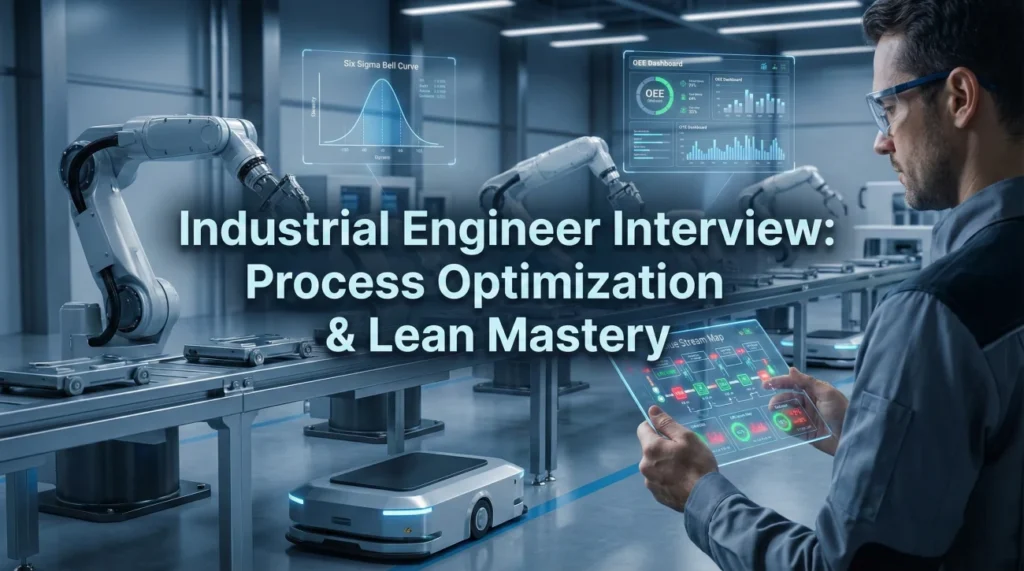
Industrial engineer interview questions focus on one core objective: optimization. Unlike mechanical engineers who design the machine, or civil engineers who build the factory, industrial engineers design the system that makes the factory run. Hiring managers are looking for candidates who see waste where others see work, and who can mathematically prove that a proposed change will save time, money, or energy.
The modern Industrial Engineer (IE) is a hybrid professional – part engineer, part business analyst, and part psychologist. You must demonstrate technical proficiency in statistical analysis (Six Sigma) and layout design, but equally important is your ability to manage change on the shop floor. Operators often resist new processes; a successful IE knows how to get buy-in.
This guide dives deep into the methodologies that define the profession: Lean Manufacturing, the Theory of Constraints, Ergonomics, and Data Analytics. From calculating Takt Time to simulating complex supply chains in Arena, these questions will test your ability to streamline operations in a chaotic real-world environment.
Lean & Six Sigma Methodologies
Q: Differentiate between Lean and Six Sigma. When do you use each?
While often grouped together, they solve different problems. Lean focuses on Speed and waste elimination. It looks at the flow of value and removes anything that stops it (Muda). If a process is slow, full of bottlenecks, or has too much inventory, I apply Lean tools like Kanban or 5S. Six Sigma focuses on Quality and variation reduction. It uses statistical methods to identify the root cause of defects. If a process is fast but produces 10% scrap, I apply Six Sigma (DMAIC). Ideally, I use Lean first to streamline the flow, then Six Sigma to refine the process capability.
Q: Explain the concept of Takt Time vs. Cycle Time vs. Lead Time.
This is the holy trinity of line balancing. Takt Time is the “heartbeat” of the customer demand. It is calculated as $$Available Production Time / Customer Demand$$. It is a target rate we must meet. Cycle Time is the actual time it takes to complete one unit at a specific station. If Cycle Time > Takt Time, we have a bottleneck and will miss shipments. Lead Time is the total time from order receipt to delivery, including all processing and waiting times. My goal is to reduce Cycle Time to just below Takt Time (for a safety buffer) and shrink Lead Time to improve cash flow.
Q: How do you implement 5S, and which “S” is the hardest?
5S is a workplace organization method: Sort (remove unneeded items), Set in Order (a place for everything), Shine (clean and inspect), Standardize (create rules), and Sustain (maintain discipline). In my experience, Sustain is the hardest by far. It’s easy to clean a shop once; it’s hard to change the culture so that operators clean it every shift without being told. To solve this, I implement visual management audits and involve the team in the design of the layout so they feel ownership of the space.
Q: What is the Theory of Constraints (TOC)?
TOC states that every system is limited by at least one constraint (the bottleneck). Improving non-bottlenecks is a mirage – it creates local efficiency but doesn’t increase total throughput. I use the “Five Focusing Steps”: 1) Identify the constraint. 2) Exploit it (ensure it never stops). 3) Subordinate everything else to it (don’t feed it faster than it can eat). 4) Elevate it (buy more capacity). 5) If the constraint moves, Repeat. This prevents “whack-a-mole” optimization.
Technical Proficiency & Analysis Tools
Q: DMAIC Framework
DMAIC is the roadmap for Six Sigma projects. Define the problem and goal (Project Charter). Measure the current baseline (collect data). Analyze the data to find root causes (ANOVA, Regression). Improve the process by piloting solutions (DOE). Control the new process to prevent regression (Control Charts). I strictly follow this order to avoid “jumping to solutions” based on gut feeling.
Q: OEE Calculation
Overall Equipment Effectiveness (OEE) measures how effectively a manufacturing operation is utilized. The formula is $$OEE = Availability \times Performance \times Quality$$. Availability tracks downtime (breakdowns/setups). Performance tracks speed loss (slow cycles/micro-stops). Quality tracks scrap (defects). A world-class OEE is typically 85%. I use OEE to pinpoint exactly where we are losing productivity – is the machine down, running slow, or making bad parts?
Q: Value Stream Mapping (VSM)
VSM visualizes the flow of materials and information. Unlike a simple flowchart, a VSM includes data like cycle times, changeover times, and inventory levels (WIP) at each step. It distinguishes between Value-Added (VA) and Non-Value-Added (NVA) activities. My goal with VSM is to create a “Future State” map that reduces the NVA ratio, typically by linking disjointed processes into a continuous flow cell.
Q: Kanban System Design
Kanban is a “pull” system that controls inventory. Production is triggered only when a downstream process consumes a unit. To design it, I calculate the number of cards ($$N$$) needed: $$N = (Daily Demand \times Lead Time \times Safety Factor) / Container Size$$. The key is sizing the loop correctly. Too many cards hide problems (inventory buffer); too few cards cause line stoppages. I adjust the number of cards dynamically based on demand volatility.
Q: Fishbone (Ishikawa) Diagram
This is a root cause analysis tool. When a defect occurs, I don’t just blame the operator. I categorize potential causes into the 6 Ms: Man (Training/Fatigue), Machine (Calibration/Wear), Material (Defects/Specs), Method (SOPs/Process), Measurement (Gauge error), and Mother Nature (Environment/Humidity). This structured brainstorming ensures we don’t overlook systemic issues like poor lighting or ambiguous work instructions.
Q: Little’s Law
Little’s Law is a fundamental theorem of queuing theory: $$WIP = Throughput \times Cycle Time$$. It means that if you want to reduce Cycle Time (lead time) without reducing Throughput (output), you must reduce Work-In-Progress (WIP). This is the mathematical proof behind Lean’s obsession with lowering inventory. I use this to quickly estimate the lead time of a factory simply by counting the inventory on the floor and knowing the daily output.
Change Management & Field Scenarios
You design a more efficient workstation layout, but the veteran operators refuse to use it. What do you do?
I failed if I designed it in a vacuum. The best layout on paper is useless if the human element rejects it. I would stop pushing and start listening. I’d go to the “Gemba” (the actual place) and ask them to show me why the new layout is harder. Maybe I missed a detail like lighting angles or reach distance for a specific tool.
Then, I would co-design the modification with them. I’d ask, “How would you place this bin to make it faster?” When they contribute the idea, they own the solution. I focus on “making their job easier” (ergonomics) rather than “making them work faster.” Once they see the physical strain reduction, the efficiency gains follow naturally.
Management wants to increase production by 20% without buying new machines. How do you approach this?
This is a capacity utilization problem. I would start with a Time Study and OEE analysis of the bottleneck machine. If the bottleneck is running at 60% OEE, there is hidden capacity. I would look at the “Six Big Losses” – specifically changeover times.
I would implement SMED (Single-Minute Exchange of Die) techniques to convert internal setup steps (done while machine is stopped) to external steps (done while machine is running). If we reduce setup time from 1 hour to 10 minutes, we gain 50 minutes of production per shift. I’d also look at micro-stops; are operators waiting for materials? A “water spider” (material handler) could keep the machine fed so the skilled operator never leaves the station.
You have a choice: reduce the defect rate by 0.5% or increase line speed by 5%. Which do you prioritize?
I prioritize the Defect Rate. Increasing speed on a process that produces defects simply creates waste faster. The cost of a defect isn’t just the scrap material; it’s the wasted machine time, the rework labor, and potentially the loss of a customer if it escapes the plant.
Furthermore, a 5% speed increase is meaningless if the downstream process cannot handle it (building inventory). A 0.5% quality improvement drops straight to the bottom line as pure profit and improves OEE. Once the process is stable (capable), then we can safely ramp up the speed.
Advanced Optimization & Systems
Q: Describe the use of Discrete Event Simulation (e.g., Arena, Simio, FlexSim).
Spreadsheets assume averages, but factories live in variance. A spreadsheet says “Average arrival: 10 mins, Average process: 9 mins” means no queue. Simulation reveals that random variation will cause massive backups. I use simulation for expensive “what-if” scenarios. Before buying a $5M robotic cell, I model the line to see if the robot actually increases throughput or if it just moves the bottleneck downstream. It allows us to fail virtually for free rather than physically at great cost.
Q: How do you address the “Bullwhip Effect” in a supply chain?
The Bullwhip Effect is the amplification of demand variability as you move upstream in the supply chain (from customer to factory to raw material supplier). A small blip in sales leads to panic buying at the wholesale level and massive overproduction at the factory. As an IE, I mitigate this by increasing Visibility. I integrate ERP systems so the factory sees actual Point-of-Sale (POS) data, not just the distributor’s orders. I also reduce Batch Sizes and Lead Times, as smaller, more frequent orders smooth out the demand signal.
Q: Explain the NIOSH Lifting Equation and its role in job design.
Ergonomics is about safety and sustainability of the workforce. The NIOSH equation calculates the Recommended Weight Limit (RWL) for a specific lifting task. It considers horizontal distance, vertical height, asymmetry (twisting), and frequency. If the Lifting Index (Load/RWL) > 1.0, the task is risky. If > 3.0, injuries are likely. I use this to justify capital spend on lift assists or manipulators. It’s not just “being nice”; back injuries are the most expensive workers’ comp claims in industry.
Q: What is a “Poka-Yoke” and give an example.
Poka-Yoke means “mistake-proofing.” It is a mechanism that makes it physically impossible to make a mistake, or makes the mistake immediately obvious. A behavior-based warning (“Be careful!”) is weak. A Poka-Yoke is strong. Example: A fixture that only accepts the part in the correct orientation because of a guide pin. If the operator tries to load it backward, it won’t fit. Another example: USB plugs (Type A) only fit one way. This eliminates the need for inspection because quality is built into the process.
Industrial Engineering Knowledge Check
Test Your Optimization IQ
1. In Lean Manufacturing, “Muda” refers to:
- Unevenness in production flow
- Waste or any activity that consumes resources without adding value
- Overburdening of equipment or people
- Continuous improvement
2. Which distribution is most commonly used in Six Sigma to describe process variation?
- Poisson Distribution
- Binomial Distribution
- Normal (Gaussian) Distribution
- Exponential Distribution
3. The “Pareto Principle” suggests that:
- Work expands to fill the time available
- 80% of effects come from 20% of the causes (the vital few)
- Everything that can go wrong will go wrong
- Productivity increases with observation
4. In a VSM, the “Sawtooth” line at the bottom represents:
- The physical path of the operator
- The timeline distinguishing Value-Added time from Non-Value-Added time
- The electricity usage of the plant
- The mood of the workers
5. “Heijunka” is a Lean technique for:
- Quick changeover
- Production leveling or smoothing (mixing models to balance volume)
- Root cause analysis
- Visual management
6. A $C_{pk}$ value of 1.33 generally indicates:
- The process is incapable and producing defects
- The process is capable (approx 4 Sigma) and fits well within spec limits
- The process is exactly at the specification limit
- The process mean is shifted significantly
7. The “Andon” cord is used to:
- Tie bundles of finished goods together
- Stop the production line immediately when a problem is detected
- Connect the computer network
- Measure the length of the product
8. Which chart controls a process by tracking the mean over time?
- Pareto Chart
- X-bar Chart (Control Chart)
- Scatter Plot
- Gantt Chart
9. “Gemba” translates to:
- The boss’s office
- The real place (where the work happens)
- The meeting room
- The warehouse
10. In queueing theory, “M/M/1” describes a system with:
- Markovian arrival, Deterministic service, 1 server
- Markovian (Poisson) arrival, Markovian (Exponential) service, 1 server
- Multi-channel arrival, Multi-service, 1 server
- Manual arrival, Manual service, 1 hour wait
11. What is the primary goal of “Line Balancing”?
- To make sure the conveyor belt is straight
- To equalize the workload across all stations to minimize idle time and meet Takt
- To ensure everyone gets paid the same
- To balance the budget
12. “Just-in-Time” (JIT) production relies heavily on:
- Large warehouses to store safety stock
- Reliable suppliers and stable processes to deliver parts only when needed
- Predicting the future perfectly
- Ignoring customer demand
13. The “Hawthorne Effect” implies that:
- Better lighting improves productivity permanently
- People improve their performance simply because they know they are being observed
- Productivity drops when managers leave
- Noise levels don’t affect work
14. Which inventory valuation method assumes the oldest stock is sold first?
- LIFO (Last In, First Out)
- FIFO (First In, First Out)
- WAC (Weighted Average Cost)
- JIT (Just In Time)
15. “Kaizen” refers to:
- A radical, one-time overhaul of the system
- Continuous, incremental improvement involving everyone from CEO to assembly workers
- A Japanese management title
- Firing underperforming employees
16. An “Ergonomic Assessment” focuses primarily on:
- The cost of the chair
- Fitting the task to the human capabilities to prevent musculoskeletal disorders
- Testing the IQ of the worker
- Ensuring the worker is fast enough
17. In Linear Programming, the “Objective Function” defines:
- The constraints of the problem
- The goal to be maximized (profit) or minimized (cost)
- The variables to be solved
- The graphical region of feasibility
18. Which ISO standard relates to Quality Management Systems?
- ISO 14001
- ISO 9001
- ISO 45001
- ISO 27001
19. A “Bottleneck” is easily identified by:
- The machine making the most noise
- A pile of inventory (WIP) accumulating in front of it and starving stations behind it
- The newest machine on the line
- The highest paid operator
20. “Standard Work” is:
- Doing the same thing every day until you are bored
- The current best documented method to perform a task safely and efficiently
- A target that is impossible to hit
- A rule that can never be changed
❓ FAQ
📜 Do I need a Lean Six Sigma belt certification?
It is highly recommended. A Green Belt is often the baseline requirement for mid-level roles, showing you can lead small projects. A Black Belt is expected for senior process improvement roles. However, demonstrated project experience (money saved) is always more valuable than just the certificate.
💻 What software skills are essential?
Minitab is the standard for statistical analysis. Visio or Lucidchart for process mapping. Proficiency in Excel (VBA, Pivot Tables) is non-negotiable. For simulation, Arena, Simio, or FlexSim are valuable niche skills. Knowledge of ERP systems (SAP, Oracle) is also a plus.
🏭 Is this role only for manufacturing?
No. Industrial engineering principles are universally applicable. IEs are in high demand in Healthcare (reducing ER wait times), Logistics (Amazon warehouse optimization), Banking (streamlining loan processing), and even Disney World (managing lines).
🤝 How do I handle resistance from workers?
Empathy and involvement. Don’t be the engineer in the ivory tower. Spend time on the floor, do the job yourself to understand the pain points, and involve the operators in the solution design. When they see that your changes make their day easier, resistance turns into collaboration.
📈 What is the career path for an IE?
IEs often advance quickly into management because they understand the “big picture” of the business. Common paths include Operations Manager, Plant Manager, Supply Chain Director, or specialized roles like Master Black Belt consultant.
Optimizing Your Career Path
To succeed with industrial engineering interview preparation, you must prove you are a catalyst for improvement. The interviewer doesn’t just want to know if you can calculate standard deviation; they want to know if you can use that calculation to save the company $100,000.
Focus on your portfolio of projects. Quantify your results: “I used SMED to reduce setup time by 40%, increasing capacity by 15%.” Show that you possess the technical rigor to analyze complex systems and the soft skills to lead the cultural transformation required to sustain those improvements.
⚠️ Disclaimer: The interview strategies, sample answers, and negotiation tips provided in this guide are for educational purposes only. Hiring decisions are subjective and vary by company and industry. While these strategies are based on professional HR standards, they do not guarantee a specific job offer or result.