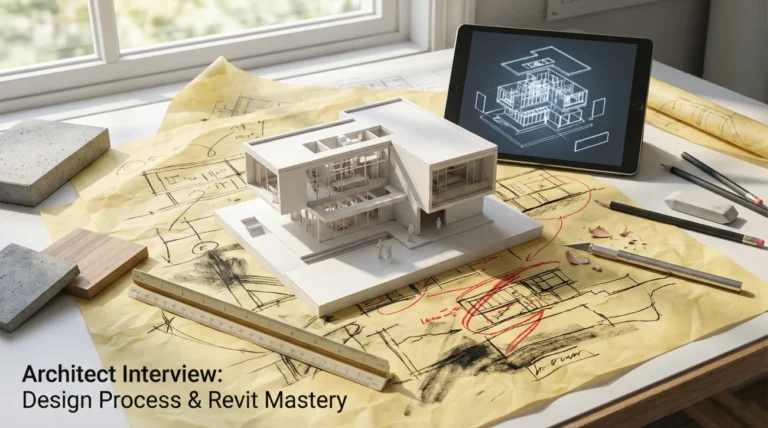
- Blueprints are a universal construction language: They communicate scope, intent, and constraints, so “reading” means understanding decisions, not just lines.
- Know what each drawing set is responsible for: Architectural shows layout and finishes, Structural shows load paths and framing, MEP shows power, HVAC, plumbing, and fire protection routes.
- Decode symbols and line conventions fast: Legends, section cuts, grids, and line weights tell you what is cut, what is hidden, and what matters most.
- Trust dimensions and the correct scale: Use the right scale ruler and notation style, and avoid scaling PDFs as a substitute for stated dimensions.
- Review drawings with a repeatable scan: Check title block and revisions, then plans, sections, and details, and actively hunt for clashes like clearances, access needs, penetrations, and overlapping utilities.
The Universal Construction Language
Blueprints represent the universal language translating design intent into buildable reality across construction trades, engineering disciplines, and geographical boundaries. Proficiency in reading blueprints enables construction professionals to understand project scope, coordinate work sequences, identify conflicts before building, verify compliance with specifications, and communicate precisely about spatial relationships and technical requirements without ambiguity.
The challenge is that blueprints compress enormous information into standardized symbols, abbreviations, and conventions requiring learned interpretation. A single line’s thickness conveys meaning, dimension placement follows systematic rules, symbol variations indicate different materials or systems, and drawing types serve distinct purposes. Without systematic blueprint literacy, construction professionals misinterpret intent, make costly errors, overlook critical details, and struggle coordinating with other trades.
This guide establishes foundational blueprint reading skills for construction and engineering professionals. You’ll learn common drawing types and their purposes, standard symbol systems across disciplines, scale and dimension interpretation techniques, strategies for quick blueprint review identifying key information, and systematic approaches preventing misreading errors.
Understanding Drawing Types and Purposes
Construction documentation includes multiple drawing types, each serving specific function and containing distinct information.
Primary Drawing Categories
Professional construction sets organize information across standardized drawing types enabling efficient navigation.
| Drawing Type | Purpose | Key Information |
|---|---|---|
| Site Plans | Show building placement on property, existing conditions, utilities | Property boundaries, topography, drainage, access roads, utility connections, setbacks |
| Floor Plans | Horizontal cut through building showing room layouts and dimensions | Wall locations, door/window placement, room sizes, circulation, structural grid |
| Elevations | Exterior views showing vertical relationships and finishes | Building height, finish materials, openings, roof slopes, grade relationships |
| Sections | Vertical cut through building revealing construction assembly details | Floor-to-floor heights, foundation depth, roof construction, wall assemblies, vertical clearances |
| Details | Enlarged views of complex conditions showing precise construction methods | Connection details, waterproofing, material transitions, assembly sequences, fastening |
| Schedules | Tabular information about repetitive elements | Door types/sizes/hardware, window specifications, finish schedules, equipment lists |
Discipline-Specific Drawing Sets
Large projects separate drawings by discipline, each with specialized symbols and conventions.
- 🏛️ Architectural (A): Building layout, finishes, door/window schedules, room relationships, vertical circulation
- 🏗️ Structural (S): Foundation, framing, load-bearing elements, connections, reinforcing, beam/column sizes
- ⚡ Electrical (E): Power distribution, lighting layouts, panel locations, circuits, switches, outlets
- 🔧 Mechanical (M): HVAC systems, ductwork, equipment, controls, piping (sometimes separate plumbing set)
- 💧 Plumbing (P): Water supply, drainage, fixtures, pipe sizes, slopes, cleanouts, venting
- 🔥 Fire Protection (FP): Sprinkler layouts, standpipes, fire alarm devices, coverage zones
💡 Pro tip: Always check drawing title block for revision dates and numbers. Using outdated drawings causes expensive rework. Mark your personal set with revision dates prominently, verify you’re working from current version before making decisions. Many coordination failures stem from different trades using different drawing revisions rather than true design conflicts.
Expert advice: Experienced professionals develop systematic blueprint review sequences: start with site plan for overall context, review floor plans understanding layout, check sections for vertical relationships, examine details for construction methodology, then study discipline-specific drawings for your trade. This progression builds understanding from general to specific, preventing detail fixation missing bigger picture issues.
Standard Symbols and Conventions
Blueprint symbols guide enables quick interpretation of standardized graphic language used across construction documentation.
Common Architectural Symbols
Architectural drawings use standardized symbols representing walls, openings, fixtures, and features.
| Symbol Category | Common Representations | Interpretation Notes |
|---|---|---|
| Walls | Thick parallel lines for exterior, thinner for interior, diagonal hatching shows masonry, single line for partition | Line weight indicates wall type and importance, section cuts show material composition |
| Doors | Quarter-circle swing showing operation, rectangle in wall opening, arrow shows push direction | Door tag references schedule for size/material/hardware, swing direction critical for clearances |
| Windows | Three parallel lines in wall opening, thin lines show glazing, tag references schedule | Elevation drawings show sill and head heights, sections show installation details |
| Stairs | Parallel lines with arrow showing up direction, text indicates rise/run | Arrow points upward direction, number of risers noted, landing locations shown |
| Fixtures | Standardized shapes for toilets, sinks, equipment, shown in floor plan view | Dashed lines show swing or operational clearances, dimensions to centerlines typical |
Structural and MEP Symbols
Engineering disciplines use specialized symbols for systems and components.
- Structural grids: Numbered/lettered bubbles at column lines creating coordinate system for location reference
- Section cuts: Heavy line with directional arrows and reference bubbles indicating where section view taken
- Electrical outlets: Circle with lines for duplex, circle with “GFI” for ground fault, different symbols for voltage/amperage
- Lighting fixtures: Various shapes indicating fixture type, switch legs shown with curved lines
- HVAC equipment: Rectangles for units, single lines for ductwork, double lines for supply/return runs
- Plumbing: Different line styles for supply vs. waste, arrows show flow direction, valve symbols at control points
Line Types and Weights
Line characteristics convey information hierarchy and object properties.
- ━━ Heavy solid lines: Cut walls, primary objects, important features requiring emphasis
- ─── Medium solid lines: Objects in elevation beyond section cut, secondary features, non-structural elements
- – – – Dashed lines: Hidden objects, items above cut plane, removed existing conditions, future work
- ─ ─ ─ Centerlines: Symmetry axis, column centerlines, equipment centerpoints, dimension references
- · · · · Property lines: Legal boundaries, easements, setback limits (varies by standard)
Regional and disciplinary variations exist: architectural standards may differ from civil engineering conventions. Always check drawing legend or general notes for project-specific symbol definitions. When uncertain about symbol meaning, ask project engineer or architect rather than guessing: clarification prevents costly errors.
Scale and Dimension Interpretation
Accurate construction drawing interpretation requires understanding scale relationships and dimension notation systems.
Reading Scales
Drawings reduce real-world size proportionally, requiring scale conversion for actual measurements.
| Scale Type | Common Scales | Usage and Interpretation |
|---|---|---|
| Architectural (Imperial) | 1/8″ = 1′-0″, 1/4″ = 1′-0″, 1/2″ = 1′-0″ | Floor plans typically 1/4″, details at 1/2″ or larger, site plans 1/8″ or smaller |
| Engineering (Imperial) | 1″ = 10′, 1″ = 20′, 1″ = 50′ | Civil and site work, larger areas requiring smaller scale ratios |
| Metric | 1:50, 1:100, 1:200, 1:500 | Ratio indicates drawing size to actual (1:100 means 1cm = 100cm), smaller numbers = larger detail |
| Full size (1:1) | Shop drawings, templates, critical details | Used for fabrication requiring exact dimensions, no scaling calculation needed |
Dimension Notation Systems
Understanding dimension placement and notation prevents measurement errors.
- String dimensions: Continuous dimension line with multiple measurements, read individual segments, verify sum equals total
- Running dimensions: Single baseline with cumulative measurements from origin point, prevents error accumulation
- Centerline dimensions: Measurement to center of wall, column, or object; adjust for actual width/thickness
- Face-to-face dimensions: Measurement between finished surfaces, most common for construction layout
- Elevation dimensions: Height above datum (often finished first floor = 0′-0″), prefix with + or – for above/below
Practical Scaling Techniques
Quick methods for extracting measurements from scaled drawings.
- 📐 Architect’s scale ruler: Multiple scales on single tool, align correct scale with drawing, read directly
- 📏 Dimension verification: Always use written dimensions over scaled measurements, scaling only when dimensions missing
- 🔍 Proportion checking: Compare known dimensions with adjacent spaces verifying reasonable relationships
- ⚠️ Never scale PDF: Digital files may be resized affecting scale accuracy, use dimensions only unless confirmed accurate scale
Expert advice: Develop habit of checking dimensions for consistency: if floor plan shows 10′ ceiling and section shows 9′-6″, investigate discrepancy before building. Most coordination failures revealed through dimension conflicts. When dimensions contradict, always verify with design team: don’t assume which is correct or split the difference. Wrong assumption could mean demolition and rework.
Quick Blueprint Review Strategies
Efficient blueprint review focuses attention on information relevant to specific needs while avoiding information overload.
Systematic Review Process
Structured approach ensures comprehensive understanding without missing critical information.
| Review Phase | Focus Areas | Key Questions |
|---|---|---|
| Title block review | Project name, drawing number, revision date, scale, discipline | Is this current revision? What discipline? What scale? What sheet in set? |
| General notes | Project-specific standards, material specifications, reference standards | What standards apply? Any special requirements? Material assumptions? |
| Legend/symbols | Project-specific symbol definitions, abbreviations, conventions | Any non-standard symbols? Clarifications needed? Reference standards cited? |
| Overall layout | General arrangement, major systems, spatial relationships | What’s the overall concept? Where’s my work area? How does this fit together? |
| Specific details | Dimensions critical to your work, connection details, material specifications | What are exact dimensions? How does this connect? What materials specified? |
Trade-Specific Review Priorities
Different construction roles require focusing on specific drawing elements relevant to their scope.
- Structural trades: Grid lines, column locations, beam/joist sizes and spacing, load paths, connection details, foundation dimensions
- MEP trades: Equipment locations, routing pathways, clearance requirements, penetrations, access panels, control locations
- Finish trades: Room dimensions, finish schedules, ceiling heights, door/window locations, trim details, material transitions
- Site work: Grading, drainage slopes, utility locations, access routes, staging areas, underground conflicts
Coordination Conflict Identification
Quick checks revealing common coordination issues between disciplines.
- ⚠️ Vertical clearances: Verify ductwork, conduit, piping, and structure fit within ceiling space shown
- 🚧 Access requirements: Confirm equipment access for installation, maintenance, and eventual replacement
- 🔌 Utility conflicts: Check for overlapping routing between electrical, plumbing, HVAC, fire protection
- 📏 Dimension conflicts: Flag when architectural, structural, and MEP dimensions don’t align
- 🧱 Penetration conflicts: Identify where services penetrate structural members requiring engineering approval
For deeper dive into technical documentation skills, review our interview preparation guides covering construction coordination and technical communication strategies.
❓ FAQ
🎯 What’s the difference between blueprints and shop drawings?
Blueprints (or construction documents) created by design team show design intent: what to build, general dimensions, and specifications. Shop drawings created by contractors/fabricators show how they’ll build it: specific fabrication details, exact dimensions, connection methods, and installation sequences. Shop drawings require design team review/approval before fabrication. Think blueprints as “what and why,” shop drawings as “how exactly.” Both critical but serve different purposes in construction process.
💼 How do I handle dimension conflicts between drawings?
Never guess or split the difference. Document conflict clearly with specific sheet numbers and dimension locations. Submit RFI (Request for Information) to design team asking for clarification. Continue work on non-conflicted areas while awaiting response. If conflict affects critical path, escalate to project manager for expedited response. Most contracts specify dimension priority order (e.g., detail dimensions trump floor plan dimensions) but always verify rather than assume. Wrong assumption creates expensive rework.
⏰ Do I need to memorize all blueprint symbols?
Focus on symbols relevant to your trade rather than memorizing everything. Common architectural symbols become second nature with exposure. Keep reference guide handy for unfamiliar symbols. Always check project-specific legend as symbols vary between firms and regions. Understanding symbol logic (e.g., line weights indicating hierarchy, dashed lines for hidden elements) helps decode unfamiliar symbols. Experience builds recognition naturally: year one requires frequent reference checking, year five most symbols are automatic recognition.
📋 How accurate is scaling from blueprints?
Never rely on scaled measurements when dimensions provided: drafting imperfections, printing variations, and paper expansion/contraction affect accuracy. Use written dimensions always. Only scale when dimension genuinely missing, and note this as “scaled dimension” in documentation. Digital PDFs especially problematic: files may be resized during printing destroying scale accuracy. Professional practice: if critical dimension missing, submit RFI rather than assuming scaled measurement sufficient. Scaled dimensions acceptable for preliminary estimates but not final fabrication or construction.
✨ How do I demonstrate blueprint reading skills in interviews?
Bring drawing samples (with proprietary information removed) from previous projects showing your markups, coordination notes, or RFIs. Discuss specific example where careful blueprint review prevented costly error or identified coordination conflict. Explain your systematic review process showing methodical approach. If interviewer provides sample drawing, describe what you notice: title block information, scale, key symbols, potential conflicts, questions you’d ask. Strong candidates discuss both what drawings show and what might be missing or ambiguous requiring clarification.
Final Thoughts
Proficiency in reading blueprints represents foundational skill distinguishing construction professionals from laborers, enabling independent problem-solving, coordination with other trades, and verification that work meets design intent. Blueprint literacy isn’t optional knowledge for occasional reference: it’s daily working language for communicating about spatial relationships, technical requirements, and construction sequencing without ambiguity.
The challenge is that blueprint reading requires both memorizing standardized conventions and developing interpretive judgment recognizing when drawings conflict, information appears missing, or design intent unclear. Strong construction professionals don’t just decode symbols mechanically: they think critically about what drawings communicate, identify coordination issues proactively, and ask clarifying questions preventing costly assumptions.
Invest in developing systematic blueprint review habits: always verify revision dates, check dimensions for consistency, review coordination between disciplines, and document questions through proper RFI channels rather than guessing. These practices distinguish professionals who build accurately from those constantly reworking mistakes. Your blueprint reading capability directly affects quality, efficiency, and career advancement: skilled drawing interpretation enables taking on more complex and better-compensated roles throughout construction industry.
⚠️ Disclaimer: The interview strategies, sample answers, and negotiation tips provided in this guide are for educational purposes only. Hiring decisions are subjective and vary by company and industry. While these strategies are based on professional HR standards, they do not guarantee a specific job offer or result.