The Culture Fit Detector
A product manager I coached interviewed at two companies in the same week. At the first, she described her ideal work environment as collaborative, open, with lots of team interaction. The interviewer nodded enthusiastically. At the second, she gave the same answer. The interviewer’s face fell. She later learned that company prided itself on giving people autonomy and quiet focus time.
She got an offer from the first company and a rejection from the second. The rejection was actually a favor. She would have been miserable in an environment that didn’t match her working style. The environment question isn’t a trick. It’s a genuine compatibility check that helps both sides avoid bad matches.
When interviewers ask about your ideal work environment, they’re comparing your preferences against their actual culture. They’re also assessing your self-awareness about where you thrive and whether you’ve thought seriously about what conditions help you do your best work.
Research Before You Answer
The biggest mistake candidates make is answering this question without researching the company’s actual environment. You can discover a lot about culture before walking into the interview.
Where to Find Culture Information
Company websites often have culture pages that describe their values and working style. Read them critically. Look for specifics rather than generic statements everyone claims. “We value work-life balance” is meaningless. “We have core hours from 10am to 3pm and flexibility outside that” is concrete.
Employee reviews on sites like Glassdoor reveal patterns when you read many of them. Individual reviews can be outliers, but consistent themes across dozens of reviews indicate real cultural characteristics. Pay attention to what people mention repeatedly, both positive and negative.
LinkedIn profiles of current employees show career progression and tenure patterns. High turnover might indicate cultural issues. Long tenures often suggest people find the environment satisfying. Employee posts and comments can reveal how people talk about their workplace.
Interview interactions themselves provide data. How did recruiters communicate? Was the process organized or chaotic? Did interviewers seem engaged and happy? The interview experience often reflects broader company culture.
Aligning Your Answer
Once you understand the company’s culture, you can frame your answer to highlight genuine alignment. This isn’t about fabricating preferences. It’s about emphasizing the aspects of your authentic preferences that match their environment.
If you genuinely prefer both collaboration and focused individual work, a startup emphasizing teamwork warrants highlighting your collaborative side, while a research organization might warrant emphasizing your capacity for deep independent work. Both framings are honest if both preferences are genuine.
| Company Culture Signals | Environment Preferences to Emphasize |
|---|---|
| Open floor plan, frequent meetings, team activities | Collaboration, communication, team energy |
| Remote-first, async communication, documentation focus | Autonomy, written communication, self-direction |
| Fast-paced, startup, “move fast” language | Adaptability, comfort with ambiguity, urgency |
| Established processes, clear hierarchies, defined roles | Structure, clarity, process orientation |
Key Dimensions of Work Environment
Work environments vary across multiple dimensions. Understanding these helps you articulate specific preferences rather than vague generalities.
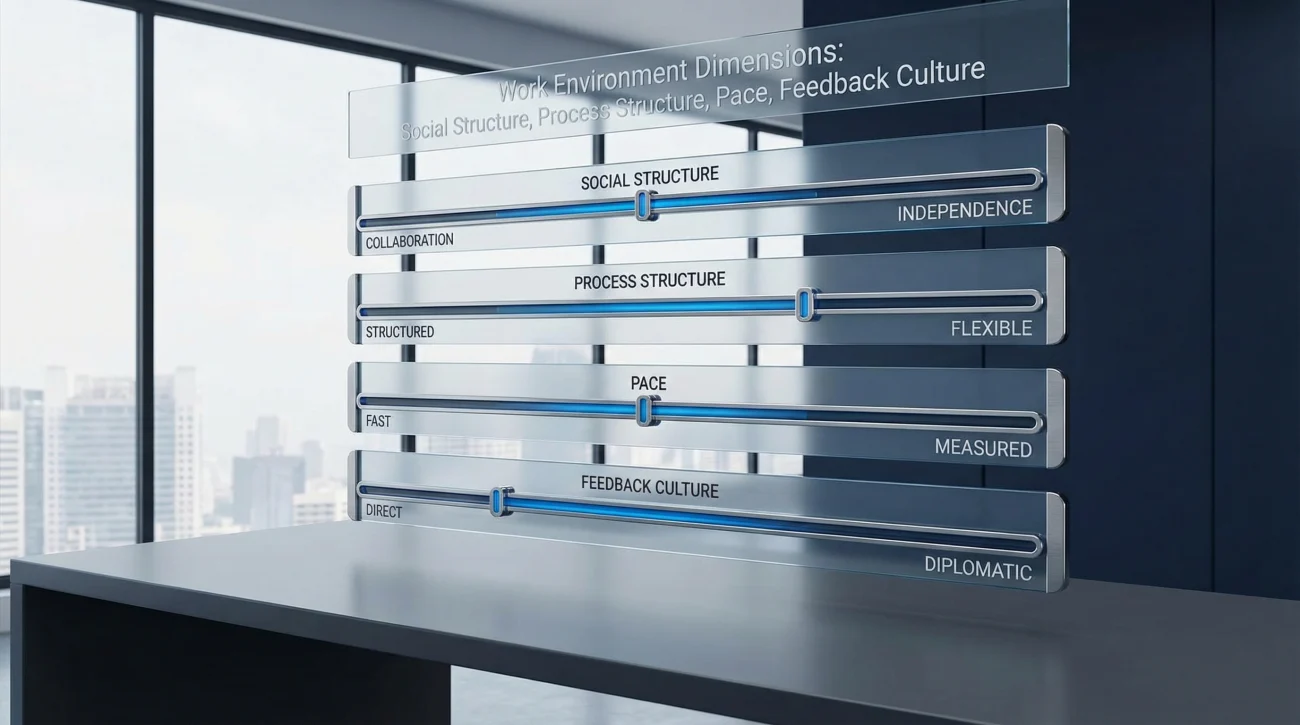
Social Structure: Collaboration to Independence
Some people thrive with constant interaction, team brainstorming, and collaborative decision-making. Others do best with uninterrupted focus time and minimal meetings. Most effective professionals can operate across this spectrum but have a comfort zone.
Think honestly about your patterns. When do you feel most productive? Energized? Do frequent interruptions drain you, or does isolation make you restless? Your genuine preference here matters because misalignment causes ongoing friction.
Process Structure: Structured to Flexible
Some environments have clear processes, defined roles, and established ways of doing things. Others are ambiguous, evolving, and expect people to figure things out. Neither is objectively better. They suit different working styles.
Highly structured people often struggle in chaotic startups. Highly flexible people often chafe at rigid bureaucracies. Assess where you fall and look for environments that match.
Pace: Fast to Measured
Some environments move quickly with tight deadlines, rapid pivots, and constant urgency. Others are measured, with time for thoughtful analysis and careful execution. Both produce excellent work in different contexts.
If you thrive under pressure and get bored without urgency, fast-paced environments energize you. If constant deadline pressure exhausts you and you do best with time to think, measured environments suit you better.
Feedback Culture: Direct to Diplomatic
Some organizations practice radical candor with blunt feedback. Others emphasize diplomacy and softer communication. Your comfort with direct criticism affects how you’ll experience different feedback cultures.
Self-awareness check: Consider your reactions to past feedback. Did direct criticism motivate you or demoralize you? Did diplomatic feedback feel supportive or frustratingly vague? Your honest reactions indicate your preference.
Structuring Your Answer

Show Balance and Flexibility
Extreme answers raise concerns. Saying you only thrive in complete isolation suggests collaboration problems. Saying you need constant interaction suggests inability to focus independently. The most credible answers acknowledge that you can operate across a range while having preferences.
A balanced answer might sound like: “I do my best work when I have a mix of collaborative time and focused individual time. I love brainstorming with colleagues and getting diverse perspectives, but I also need blocks of uninterrupted time to do deep work. In my current role, we’ve found a rhythm where mornings are for focus time and afternoons are for collaboration, which works really well for me.”
Be Specific About Why
Generic preferences like “supportive” or “positive” are meaningless because everyone claims to want them. Specific preferences with reasoning are more credible and useful for fit assessment.
“I work best with clear expectations upfront so I can prioritize effectively and deliver what’s actually needed.”
“I like a good work environment with nice people.”
Sample Answers
For a collaborative culture:
“My ideal work environment combines collaborative energy with space for focused execution. I’m most creative when I can bounce ideas off colleagues, hear different perspectives, and build on each other’s thinking. At the same time, I need some uninterrupted blocks to actually produce work based on those conversations. The environments where I’ve thrived most had regular touchpoints and open communication, but also respected people’s need for focus time. I’m drawn to this role partly because your team structure seems to balance those well.”
For an autonomous culture:
“I thrive in environments that give people ownership and trust them to deliver. I appreciate clear goals and expectations, but I do my best work when I have autonomy over how to achieve them. I’m comfortable working independently, making decisions in my scope, and reaching out for input when I need it rather than having constant oversight. That said, I value having access to colleagues for collaboration when problems benefit from multiple perspectives. From what I’ve learned about your culture, that balance of autonomy with available support seems like a good match.”
For a fast-paced environment:
“I’m energized by environments where things move quickly and there’s always something new to tackle. I’ve found that I actually do better work under some time pressure because it forces prioritization and prevents over-engineering. I’m comfortable with ambiguity and making decisions with incomplete information when necessary. At the same time, I try to build sustainable practices even in fast environments, so the pace stays productive rather than becoming chaotic.”
For more guidance on demonstrating cultural fit, explore our interview answer strategies.
The Honesty Imperative
You might be tempted to tell interviewers exactly what you think they want to hear. This is a mistake. If you pretend to thrive in an environment that actually drains you, you might get the job. Then you’ll be miserable in it.
I’ve seen this pattern repeatedly. Candidates who claimed to love collaborative environments to get the job, then struggled with constant meetings and open floor plans. Candidates who claimed to love autonomy to get the job, then felt isolated and unsupported. The mismatch eventually surfaces, usually through declining performance or departure.
Being honest about your preferred working style protects you from accepting positions where you won’t thrive. A rejection based on genuine culture mismatch is better than an offer that leads to mutual disappointment.
If your honest preferences don’t match the company’s culture, you probably shouldn’t take the job even if offered.
❓ FAQ
🎯 What if I genuinely thrive in any environment?
True adaptability is valuable, but most people have preferences even if they can adapt. Describe your adaptability while sharing where you’ve done your best work. Something like “I’ve been effective across very different environments, but I’ve noticed I do my best creative work in collaborative settings.”
💼 Should I ask about their environment first?
You can turn this into a dialogue by asking clarifying questions: “Could you tell me more about how the team typically collaborates?” This shows genuine interest in fit and gives you information to tailor your response. However, have a genuine answer ready regardless.
⏰ What if their environment sounds problematic?
If what they describe sounds incompatible with how you work, it’s okay to acknowledge that honestly. You might say “That sounds different from environments where I’ve thrived. Can you tell me more about how that works in practice?” This opens conversation without immediate rejection.
📋 How specific should I get about physical environment?
Focus more on working style and culture than physical details like open floor plans versus private offices. Physical preferences matter, but they’re less central than collaboration style, pace, and communication norms.
✨ What if I’m changing what kind of environment I want?
It’s valid to say you’re seeking a different environment than you’ve had. Explain what you’ve learned about yourself and why you’re looking for change. “I’ve spent years in very structured environments and am looking for something with more autonomy and faster pace” is honest and clear.
Find Where You Flourish
Describing your ideal work environment is an opportunity for genuine fit assessment, not a test to pass by saying the right thing. Research the company’s actual culture before interviewing. Reflect honestly on where you’ve done your best work and why. Articulate specific preferences with reasoning while demonstrating flexibility. When your answer authentically matches the company’s environment, you’re positioning yourself for a role where you’ll actually thrive rather than just survive.
⚠️ Disclaimer: The interview strategies, sample answers, and negotiation tips provided in this guide are for educational purposes only. Hiring decisions are subjective and vary by company and industry. While these strategies are based on professional HR standards, they do not guarantee a specific job offer or result.