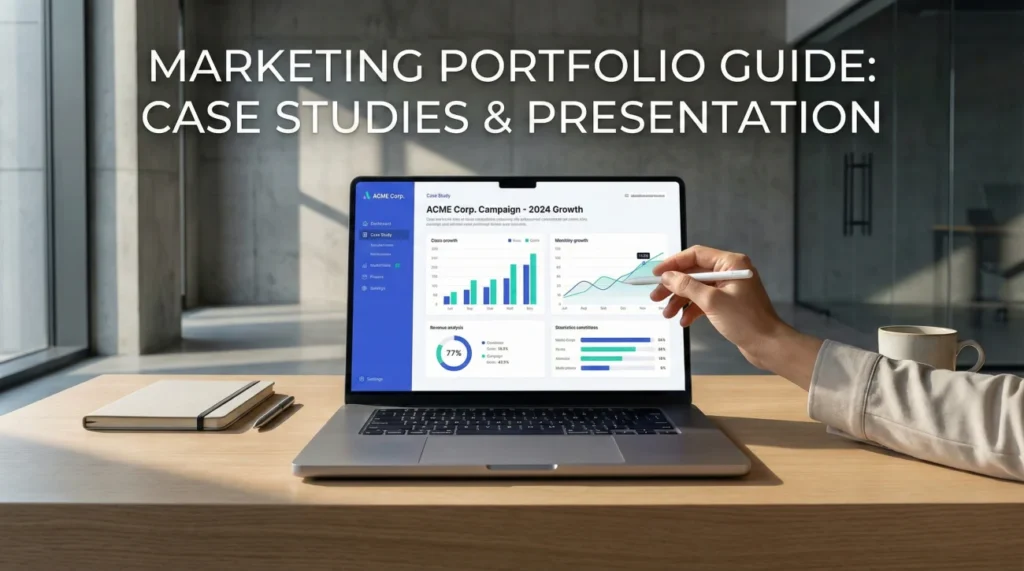
- Why it matters: A marketing portfolio is your proof, if you cannot package your own work into clear impact, employers doubt you can do it for their brand.
- What to include: Pick three to five case studies that show range across channels, goals, budgets, and complexity, quality beats quantity every time.
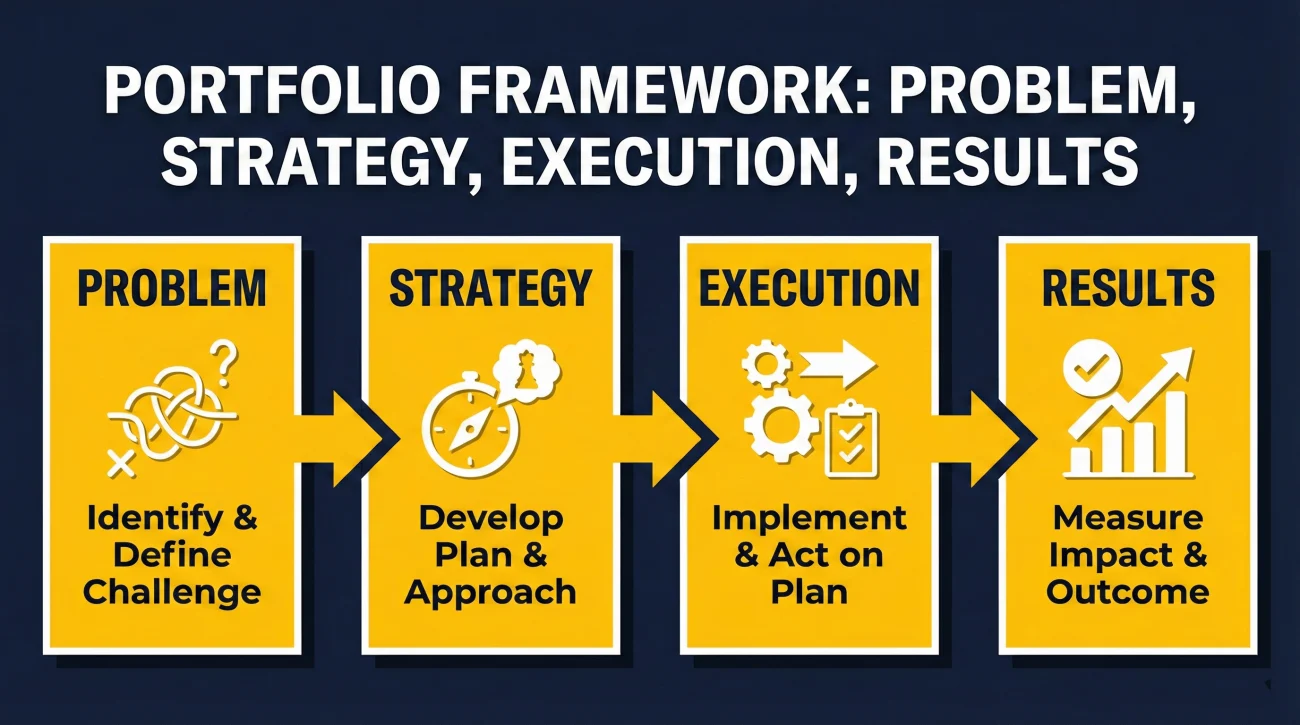
- How to structure: Use Problem, Strategy, Execution, Results so people instantly see the challenge, your thinking, what you did, and what changed because of it.
- How to show results: Lead with business outcomes and add context against targets or benchmarks, then use simple charts that are readable in seconds.
- What makes it feel senior: Write tight, explain the “why” behind decisions, include one honest recovery story, and keep design clean while protecting any confidential details.
Why Marketing Portfolios Make or Break Interviews
Marketing roles require proving strategic thinking and measurable results through concrete examples, making portfolios essential interview tools that separate serious candidates from those who merely claim expertise. Understanding marketing portfolio guide principles determines whether your work history impresses hiring managers or gets dismissed as generic project lists without substance. The portfolio itself serves as proof of your marketing abilities – if you can’t market yourself effectively through compelling case studies, employers question whether you can market their products.
Most candidates make critical mistakes in portfolio construction: drowning viewers in process details without showing results, presenting vanity metrics that don’t connect to business outcomes, or creating visually cluttered presentations that obscure key insights. Strong portfolios tell clear stories about problems faced, strategic approaches taken, and quantifiable impact achieved. When exploring broader interview questions preparation, marketing candidates uniquely benefit from visual proof of past performance that lets results speak louder than rehearsed interview answers.
Selecting Projects That Demonstrate Range
Understanding marketing portfolio examples starts with strategic project selection that showcases different competencies employers value. Quality trumps quantity – three exceptional case studies demonstrating diverse skills beat ten mediocre examples showing repetitive work.
Demonstrating Diverse Capabilities
Choose projects highlighting different aspects of marketing expertise. If you include three SEO projects, you appear one-dimensional. Mixing channel expertise, campaign types, and business objectives shows versatility that appeals to employers needing adaptable marketers.
| Dimension | Project Diversity Examples |
|---|---|
| Channels | Paid search, organic social, email marketing, content |
| Business goals | Lead generation, brand awareness, customer retention, product launch |
| Campaign types | Always-on programs, seasonal campaigns, product launches, crisis response |
| Budget levels | Scrappy grassroots efforts, mid-tier budgets, large-scale campaigns |
| Complexity | Single-channel execution, cross-functional projects, multi-market campaigns |
💡 Pro tip: Include at least one project showing how you recovered from failure or adapted when initial strategy didn’t work. Employers value resilience and learning ability as much as flawless execution. Everyone encounters setbacks – how you respond matters more.
Balancing Recency and Impact
Recent work demonstrates current capabilities, but older projects with extraordinary results often deserve inclusion. Prioritize recent examples unless older work shows significantly stronger outcomes or skills particularly relevant to target roles. Marketing evolves rapidly – work from five years ago may seem outdated even if results were impressive.
- 🎯 Ideal: Projects from past 12-18 months showing current trend awareness
- ⚡ Acceptable: Older work with exceptional results or unique complexity
- 📊 Avoid: Projects using outdated platforms or strategies no longer relevant
- 💡 Update: Refresh older case studies with current context if including them
The Problem-Strategy-Execution-Results Framework
Understanding case study presentation requires consistent structure that lets employers quickly grasp your strategic thinking and measurable impact. This four-part framework works because it mirrors how marketing professionals think through campaigns from inception to measurement.
Problem & Context Setting
Start each case study establishing what business challenge existed and why it mattered. Generic problem statements like “needed more leads” lack substance. Specific context including industry dynamics, competitive pressures, or organizational constraints makes the challenge real and relatable.
Expert advice: Frame problems in business terms, not marketing jargon. “Revenue growth stalled at $5M with existing customer acquisition strategies” resonates better than “needed to optimize funnel conversion metrics.” Connect marketing challenges to business outcomes executives care about.
Strategy & Strategic Thinking
Explain your strategic approach before diving into tactical execution. What insights drove your strategy? Why did you choose specific channels over alternatives? What assumptions did you test? This section demonstrates strategic thinking that separates senior marketers from tactical executors.
- What research or data informed your approach
- Why you prioritized certain tactics over others
- What hypotheses you were testing
- How you expected each component to contribute to goals
Execution Highlights
Provide enough execution detail to show you did the work without drowning readers in process. Highlight interesting creative decisions, technical challenges overcome, or cross-functional collaboration required. Keep this section concise – results matter more than process.
Avoid excessive process detail about meetings attended, approvals sought, or administrative tasks completed. These make you sound junior and distract from strategic impact. Focus on interesting decisions and creative solutions, not bureaucratic navigation.
Results & Business Impact
Lead with business outcomes, not vanity metrics. Impressions and engagement matter less than conversions, revenue, and ROI. Frame results against initial goals and include context showing whether outcomes exceeded expectations, met benchmarks, or fell short with lessons learned.
| Vanity Metrics (Weak) | Business Outcomes (Strong) |
|---|---|
| “Generated 50,000 impressions” | “Drove 347 MQLs at $42 CPL, 23% below target” |
| “Increased social engagement 200%” | “Social drove $120K pipeline, 15% of quarterly total” |
| “Published 25 blog posts” | “Content generated 890 organic leads, reducing CAC 31%” |
| “Grew email list by 5,000” | “Email nurture converted 18% to customers vs 12% prior” |
Data Visualization Best Practices
Understanding portfolio data visualization transforms dense metrics into compelling visual stories that communicate impact instantly. Strong visualizations let hiring managers grasp your results within seconds while weak charts confuse or obscure key insights.
Choosing Appropriate Chart Types
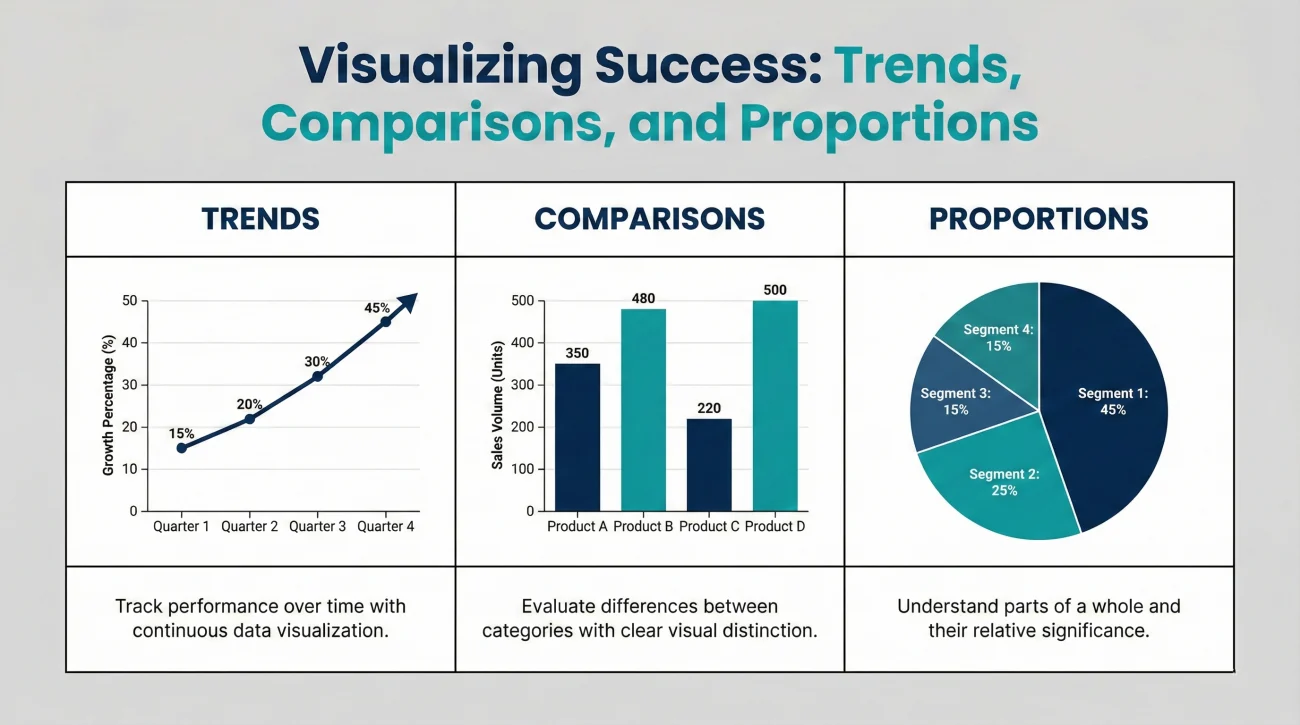
Different data types require different visualization approaches. Trend data needs line charts. Comparisons work with bar charts. Proportions use pie or donut charts. Choosing wrong chart types makes even impressive results hard to interpret.
- 📈 Line charts: Show trends over time, growth trajectories
- 📊 Bar charts: Compare discrete categories, before/after results
- 🥧 Pie charts: Show proportional breakdowns, channel mix
- 🎯 Scatter plots: Demonstrate correlations, optimization opportunities
Design for Instant Comprehension
Hiring managers skim portfolios quickly before deciding deeper engagement. Your visualizations must communicate key insights within 3-5 seconds. This requires ruthless simplification, clear labeling, and strategic use of color to highlight important data points.
Expert advice: Every chart needs a clear title stating the main insight: “Email Campaign Reduced CAC by 31%” not just “Campaign Results.” Label axes clearly. Use color strategically to emphasize success metrics. Remove chart junk that doesn’t add meaning. If viewers need more than 5 seconds to understand your chart, simplify it.
Providing Comparison Context
Results mean nothing without context. Show performance against goals, benchmarks, or previous periods. Absolute numbers rarely impress without frames of reference demonstrating whether outcomes were good, average, or exceptional for the situation.
| Context Element | Example Application |
|---|---|
| Goal comparison | “127% of lead generation target (450 vs 354 goal)” |
| Period over period | “67% increase vs prior quarter (890 vs 533 leads)” |
| Industry benchmarks | “3.2% CTR vs 1.8% industry average” |
| Internal benchmarks | “$42 CPL vs $55 historical average” |
Compelling Narrative and Copywriting
Understanding marketing case studies requires recognizing that even data-driven portfolios need compelling narratives. Your writing demonstrates marketing communication skills while data proves analytical capabilities. Together they show the strategic and creative balance employers seek.
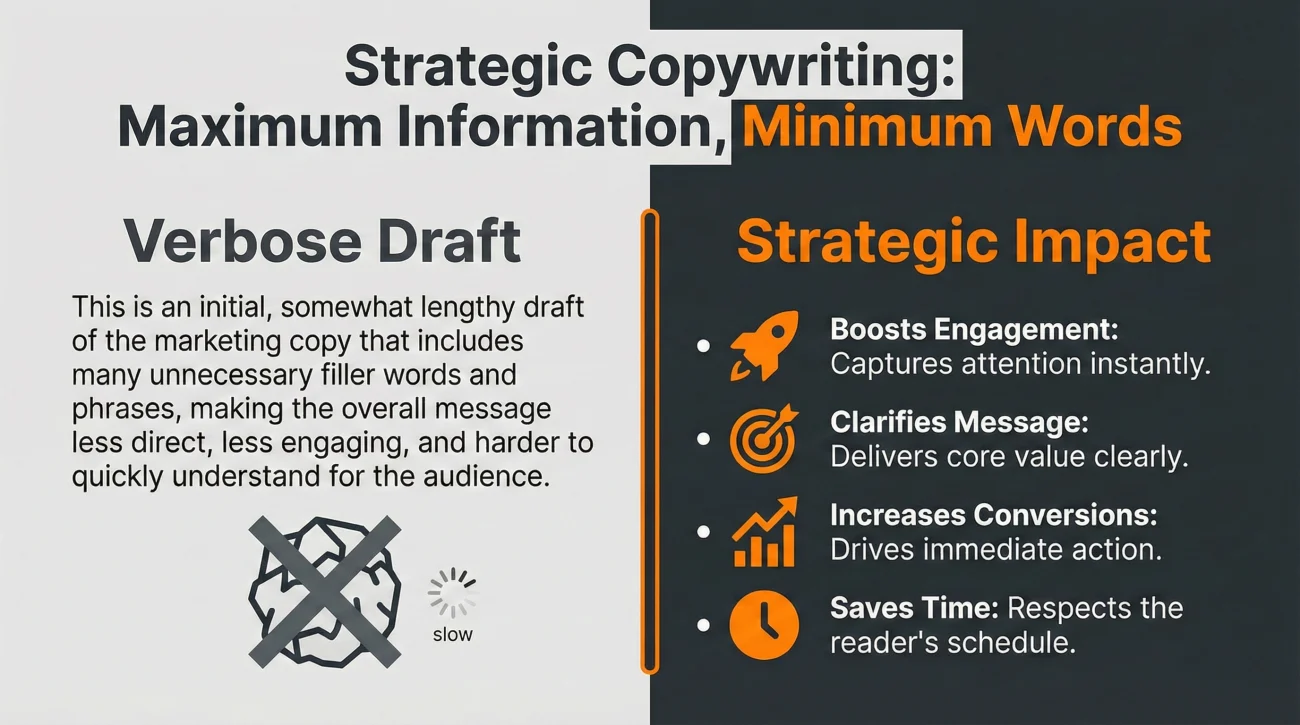
Writing Concisely Without Sacrificing Impact
Every word must earn its place. Hiring managers review dozens of portfolios – verbose explanations lose attention. Strong portfolio copy packs maximum information into minimum words using active voice, specific examples, and strategic emphasis.
💡 Pro tip: Write your case study, then cut it in half. Force yourself to identify what actually matters versus what’s just background noise. The first draft always includes too much. Effective portfolios communicate essential insights efficiently, not exhaustively.
Showing Strategic Thinking Through Writing
Your narrative reveals how you think about marketing challenges. Explain the “why” behind decisions, not just the “what” of execution. Show you understand trade-offs, tested hypotheses, and made data-informed choices rather than following templates blindly.
Addressing Projects That Didn’t Work
Including one case study where initial strategy failed but you adapted demonstrates resilience and learning ability. Frame these honestly – what you expected, what actually happened, why results differed, what you learned, and how you adjusted. This transparency often resonates more strongly than perfect successes because it shows authentic professional growth.
Format and Presentation Design
Portfolio design itself demonstrates your visual communication abilities and attention to detail. Clean professional presentation suggests you’ll produce similar quality work for employers. Cluttered amateurish portfolios raise concerns about judgment and standards.
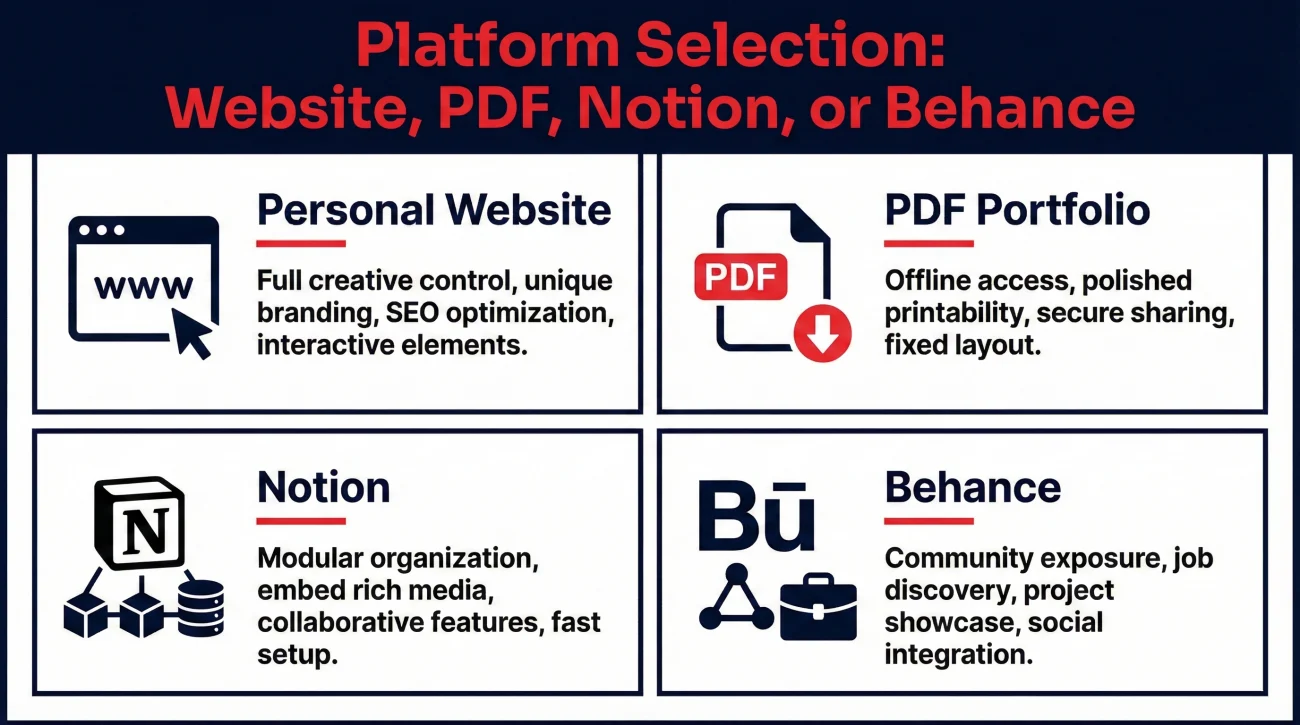
Digital Platform Selection
Choose portfolio platforms matching your technical sophistication and target roles. Personal websites show initiative. PDF portfolios work universally. Google Slides enable easy sharing. Behance or Dribbble suit creative positions. Match platform to industry norms and your comfort level maintaining it.
- Personal website: Maximum control, shows technical capability
- PDF portfolio: Universal compatibility, professional presentation
- Notion/Google Sites: Easy updates, collaborative sharing
- Behance/Dribbble: Visual focus, creative industry standard
Core Design Principles
Consistent typography, ample white space, strategic color use, and clear visual hierarchy create professional polish. Avoid design trends that date quickly. Classic clean layouts age better than trendy designs that look dated within months.
Over-designed portfolios distract from content. Your case studies should shine, not your design skills (unless applying for design roles). Prioritize readability and clarity over visual flair. Clean simple design beats elaborate busy layouts every time.
Handling Confidential Information
Respect NDAs and client confidentiality while still demonstrating your work. Anonymize client names if necessary. Round specific numbers to protect proprietary data while maintaining relative relationships that show impact. Clear case studies using “Company X” beat vague examples avoiding specifics entirely.
❓ FAQ
🎯 How many projects should my portfolio include?
Three to five strong case studies work best. Fewer than three suggests limited experience. More than five dilutes focus unless they’re all exceptional. Quality matters infinitely more than quantity. Three outstanding examples demonstrating diverse capabilities beat ten mediocre projects showing repetitive work. Focus on your best work that showcases range.
💼 What if I don’t have measurable results from past projects?
Focus on process, strategic thinking, and qualitative outcomes if quantitative data isn’t available. Explain why metrics weren’t tracked and what you learned about measurement importance. Consider creating hypothetical projects or personal side projects with full tracking. Entry-level candidates can include school projects, volunteer work, or self-directed campaigns demonstrating capabilities despite limited professional experience.
⏰ How often should I update my portfolio?
Update after completing significant projects or at minimum quarterly. Remove outdated work that no longer represents current capabilities. Marketing evolves rapidly – portfolios older than 18 months without updates signal you’re not staying current. Each job search should trigger portfolio review ensuring all examples remain relevant and impressive.
📋 Should I include failed projects?
Include one project where initial strategy didn’t work if you can show how you adapted and learned. Frame it honestly about what you expected, what happened, and how you responded. This demonstrates resilience and growth mindset employers value. However, don’t include multiple failures or projects you can’t explain thoughtfully. One transparent learning experience resonates; multiple failures raise concerns.
✨ What if my work is under NDA?
Anonymize client details while maintaining case study structure and results. Use “Fortune 500 SaaS Company” instead of specific names. Round numbers to protect proprietary data while showing relative impact. Most employers understand confidentiality constraints and respect your discretion. Clear anonymized examples beat vague descriptions avoiding specifics entirely. If truly nothing can be shared, create personal projects demonstrating capabilities.
Final Thoughts
Mastering marketing portfolio guide principles determines whether work history impresses hiring managers or gets dismissed as generic project lists. Strong portfolios select three to five diverse examples demonstrating range across channels, campaign types, and business objectives. Quality trumps quantity – exceptional case studies showcasing different competencies beat numerous mediocre examples showing repetitive work. Recent projects demonstrate current capabilities, but older work with extraordinary results deserves inclusion when outcomes significantly exceed typical performance.
Effective case study structure follows Problem-Strategy-Execution-Results framework mirroring how marketing professionals think through campaigns. Context establishes business challenges and why they mattered. Strategy sections demonstrate thinking that separates senior marketers from tactical executors by explaining research, prioritization decisions, and hypotheses tested. Execution highlights interesting decisions without drowning readers in process. Results lead with business outcomes rather than vanity metrics, framing performance against goals with comparison context showing whether outcomes were exceptional or merely acceptable.
Data visualization transforms metrics into visual stories communicating impact instantly through appropriate chart types, instant comprehension design, and comparison context. Portfolio writing demonstrates communication skills through concise narrative packing maximum information into minimum words. Clean professional presentation signals attention to detail and judgment about quality standards. Together, strategic project selection, clear case study structure, compelling visualization, and professional presentation create portfolios that prove marketing capabilities more convincingly than any interview answer possibly could.
⚠️ Disclaimer: The interview strategies, sample answers, and negotiation tips provided in this guide are for educational purposes only. Hiring decisions are subjective and vary by company and industry. While these strategies are based on professional HR standards, they do not guarantee a specific job offer or result.