Investment or Empty Words
Every company claims to invest in employee development. It sounds good in job postings and interviews. But the gap between stated commitment and actual support varies enormously. Some organizations provide real resources for growth. Others use development language as marketing while expecting you to grow entirely on your own time and dime.
Asking questions about professional development separates genuine investment from empty promises. You learn whether there’s actual budget for learning, what programs exist, how people have grown within the organization, and whether development is prioritized or just tolerated.
This matters because your growth depends on more than just your own effort. Organizations that genuinely invest in development create environments where people get better faster. Those that don’t leave you to figure everything out yourself while falling behind peers at more supportive companies.
Types of Development Support
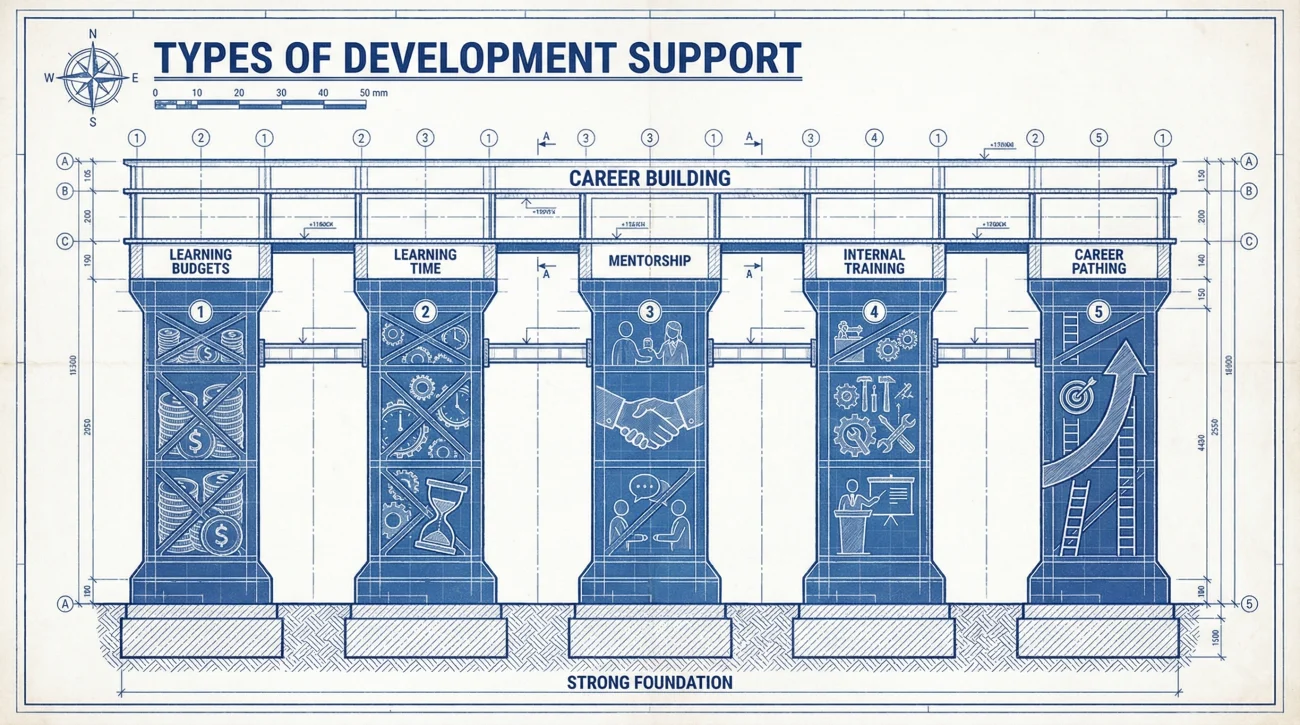
Learning Budgets
Direct financial support for courses, conferences, certifications, or books. The existence and size of this budget reveals organizational commitment. Some companies offer thousands per year; others offer nothing.
Learning Time
Time explicitly allocated for learning, not just budget. Some organizations allow dedicated learning hours during work time. Others expect all development to happen outside of work hours.
Mentorship Programs
Structured connections with more experienced colleagues. Formal mentorship programs suggest organizational investment in knowledge transfer and growth.
Internal Training
Company-created learning programs, workshops, or learning platforms. These represent significant investment in employee capability.
Career Pathing
Clear frameworks showing how roles progress and what’s needed to advance. Good career pathing helps you understand growth trajectories.
Essential Questions to Ask
The Budget Question
“Is there a professional development budget? What does it cover and how much is available?”
Get specific numbers. “We support learning” means nothing without details. Understanding what’s actually available helps you assess real investment. Ask whether the budget is per person, per team, or requires approval.
The Time Question
“Is there dedicated time for learning during work hours, or is development expected to happen on personal time?”
Budget without time is limited support. If all learning must happen outside work, that’s a significant constraint. Some companies allocate specific percentages of time for development.
The Example Question
“Can you give me an example of someone who’s grown significantly here? What did their path look like?”
Real examples prove development happens. If they can’t name specific people who’ve grown, the commitment might be more theoretical than practical. Stories reveal what’s actually possible.
The Program Question
“What formal programs exist for development? Mentorship, training, leadership development?”
Formal programs suggest systematic investment. Ad hoc support varies with individual managers. Understanding what structures exist helps you know what’s reliably available versus what depends on luck.
Decoding the Answers
| What They Say | What It Might Mean |
|---|---|
| Specific budget amount mentioned | Genuine investment; ask about usage process |
| “We support learning opportunities” | Vague; push for specifics about what support means |
| “You can learn from colleagues” | Limited formal support; growth depends on informal relationships |
| Multiple programs described in detail | Strong commitment; verify with actual participants |
| “We’re building out our L&D function” | Currently limited; future unclear |
| Concrete examples of growth provided | Development actually happens here |
Vague answers about development usually mean limited actual support. Organizations genuinely invested in growth can describe their investment specifically.
Going Deeper
Accessibility Questions
- “How do I access the development budget? Is it straightforward or does it require extensive approval?”
- “What percentage of employees actually use available development resources?”
- “Are there any restrictions on what the budget can be used for?”
Mentorship Questions
- “How does mentorship work here? Formal matching or organic connections?”
- “How often do mentors and mentees typically meet?”
- “Is mentoring recognized or rewarded, or is it purely voluntary?”
Advancement Questions
- “What skills or experiences would I need to advance to the next level?”
- “How long do people typically stay at each level before promotion?”
- “Is there a formal promotion process, or is it more ad hoc?”
For additional strategies on evaluating employers, see our guide on good questions to ask interviewers.
Warning Signs

No Specifics Available
If they can’t describe any specific development programs, budgets, or examples of growth, development probably isn’t a real priority. Organizations that invest in development can describe that investment.
All Self-Directed
If all development is described as self-directed with no organizational support, you’re on your own. Self-direction is fine, but some infrastructure shows organizational commitment.
No One Has Time
If responses include comments about being too busy for development, that’s the real culture. Organizations that value learning make time for it. Those that don’t will always have something more urgent.
Flat Growth Stories
If everyone at your level has been there for years without advancement, growth might be structurally limited regardless of development support. Ask about typical trajectories.
❓ FAQ
🎯 Is a development budget more important than mentorship?
Both matter differently. Budget provides access to external learning. Mentorship provides internal knowledge transfer and guidance. The best environments offer both. Prioritize based on your learning style and needs.
💼 What if the company is small and doesn’t have formal programs?
Small companies often can’t support elaborate programs. Focus instead on whether there’s budget available, what informal learning looks like, and whether leadership values and makes time for development.
⏰ Should I ask these questions to HR or the hiring manager?
Both. HR can describe formal programs and policies. The hiring manager can tell you what actually happens on their team and how they personally support development. The combination gives a complete picture.
📋 What’s a reasonable development budget to expect?
This varies significantly by industry and company size. Tech companies often offer thousands per year. Other industries may offer less. The existence of any dedicated budget is more important than the specific amount.
✨ How important is formal career pathing?
It depends on your goals. Clear paths help you understand what’s required to advance. But some people prefer less structured environments with more flexibility. Consider what suits your working style.
Growth Requires Support
Asking questions about professional development reveals whether an organization genuinely invests in growth or just talks about it. Get specific about budgets, time allocation, programs, and examples of people who’ve grown. Watch for warning signs like vague answers, self-directed-only learning, or lack of time for development. Your growth trajectory depends partly on your own effort and partly on the environment you’re in. Organizations that genuinely invest in development accelerate your career. Those that don’t leave you to figure everything out alone while competing against people with better support. Choose environments that multiply your effort rather than just relying on it.
⚠️ Disclaimer: The interview strategies, sample answers, and negotiation tips provided in this guide are for educational purposes only. Hiring decisions are subjective and vary by company and industry. While these strategies are based on professional HR standards, they do not guarantee a specific job offer or result.