

- Why Timing Matters: Asking too early can make you look money-focused, but waiting too long can waste your time, the leverage comes from proving value before talking numbers.
- Simple Framework By Interview Phase: Avoid salary in cold outreach, ask about range in recruiter screens if it is not shared, avoid in early rounds unless asked, raise it by round 2 or 3 if still unclear, negotiate after the offer.
- How To Ask Professionally: Request a range and frame it as alignment, ask about total compensation (bonus, equity, benefits) instead of only base salary.
- When They Ask Your Expectations: Deflect to their budget first, if pressed give a researched range rather than a single number so you keep flexibility and avoid anchoring low.
- Red Flags And What They Reveal: Refusing to share any range, pushing for current salary details, getting defensive, or pressuring fast acceptance often signals below-market pay and poor transparency.
Why Salary Timing Determines Leverage
The question “when should I ask about salary?” causes more interview anxiety than almost any other topic. Ask too early and you seem presumptuous or money-focused. Wait too long and you waste time on opportunities that don’t meet your requirements. Understanding asking about salary in interview strategically requires recognizing that timing determines leverage – candidates who establish value before discussing compensation negotiate from strength, while those who lead with salary requirements negotiate from weakness.
Most job seekers make one of two mistakes: never bringing up compensation until receiving offers (allowing employers to lowball), or leading conversations with salary requirements (appearing mercenary before demonstrating value). The optimal approach involves understanding when compensation discussions serve your interests versus when they damage your negotiating position. When discussing broader interview strategy through questions to ask in an interview, salary timing represents one of the most critical tactical decisions candidates face.
The Salary Timing Framework
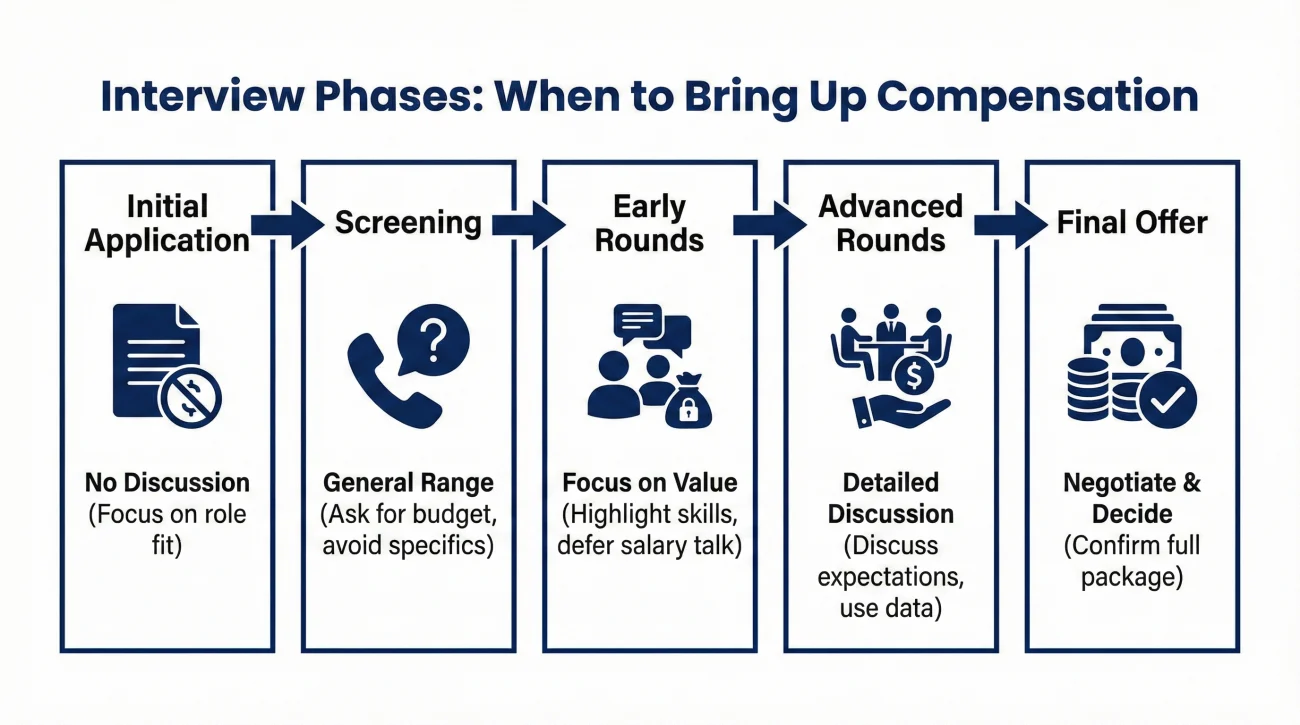
Understanding when to ask about salary requires recognizing distinct interview phases and which party should initiate compensation discussions at each stage. Following this framework prevents premature salary conversations while ensuring you don’t waste time on misaligned opportunities.
Interview Phase Guidelines
Different interview stages warrant different approaches to salary discussions. Early conversations focus on mutual fit assessment. Later stages involve serious negotiations once both parties have established genuine interest.
| Interview Phase | Salary Discussion Approach | Who Initiates |
|---|---|---|
| Initial application/cold outreach | Avoid mentioning salary | Wait for recruiter |
| First recruiter screening | Ask about range if not provided | Recruiter typically initiates |
| Early interviews (rounds 1-2) | Avoid unless asked directly | Let employer bring it up |
| Advanced interviews (rounds 3+) | Appropriate to ask if unclear | Either party can raise it |
| Final stages/offer discussions | Detailed negotiation appropriate | Employer extends offer first |
💡 Pro tip: Let employers bring up salary first in most situations. When they initiate the conversation, you’re responding to their inquiry rather than appearing money-focused. If they haven’t mentioned it by round 2, you can ask professionally.
Establish Value Before Discussing Price
The fundamental principle is demonstrating your value before discussing your price. Companies pay premiums for candidates they want badly and minimize offers for candidates they’re lukewarm about. Build enthusiasm for your candidacy before negotiating compensation.
- 🎯 Early interviews: Focus entirely on fit, capabilities, and value you’d bring
- 💡 Build enthusiasm: Make them excited about hiring you before money discussions
- 📊 Demonstrate uniqueness: Show capabilities that justify premium compensation
- ⚡ Then negotiate: Once they want you, discuss numbers from position of strength
How to Ask About Salary Professionally
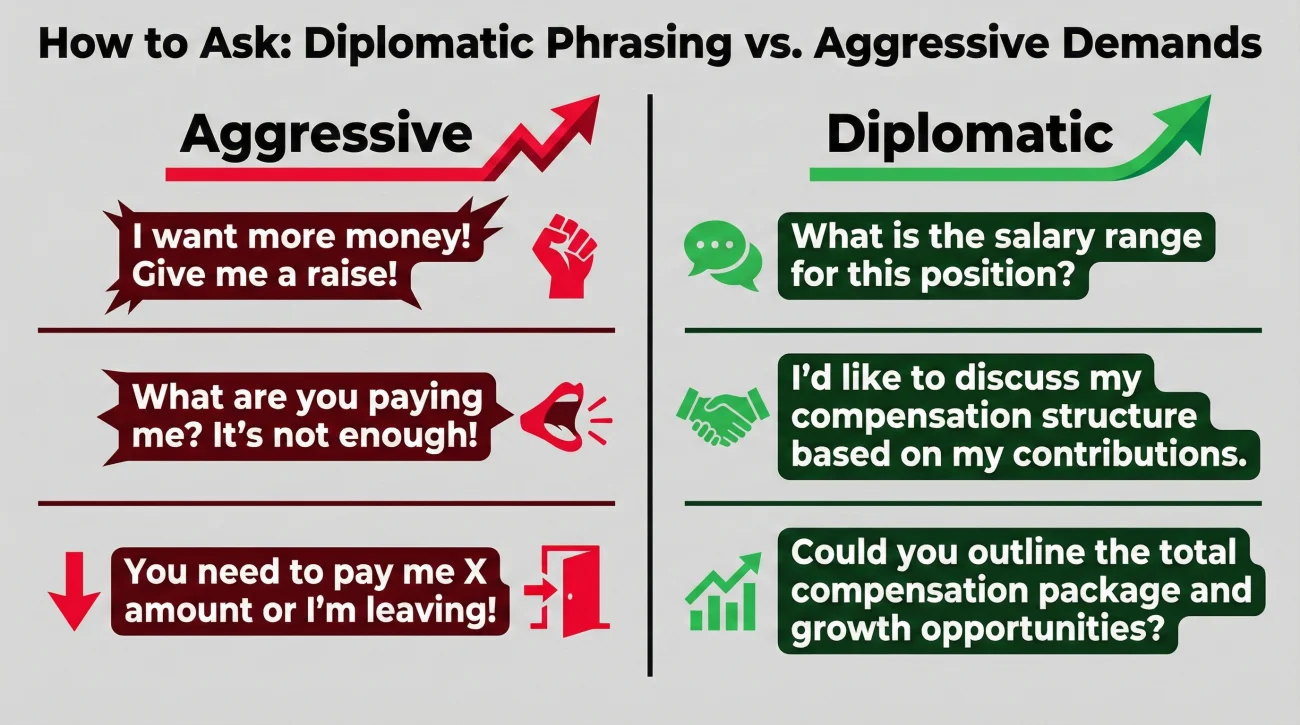
Understanding how to ask salary range requires diplomatic phrasing that gathers necessary information without appearing presumptuous or overly focused on compensation. The language you use matters as much as the timing.
Professional Phrasing Options
Certain phrases inquire about salary professionally while others trigger negative reactions. Frame salary questions around understanding budget alignment rather than demanding specific numbers.
Expert advice: Never ask “How much does this pay?” or “What’s the salary?” These blunt questions sound transactional. Instead, ask “Can you share the salary range for this position?” or “What’s the compensation range budgeted for this role?” These phrasings sound professional and reasonable.
Asking for Ranges vs Specific Numbers
Request salary ranges rather than demanding specific figures. Ranges provide the information you need to assess fit while giving employers flexibility. Specific number requests feel aggressive and put employers on defensive.
| Aggressive Approach (Avoid) | Diplomatic Approach (Use) |
|---|---|
| “What does this pay?” | “Can you share the salary range for this position?” |
| “I need to know the salary” | “To ensure we’re aligned, could you provide the budgeted range?” |
| “What’s my starting salary?” | “What’s the compensation structure for this role?” |
| “How much are you offering?” | “What’s the total compensation package including benefits?” |
Asking About Total Compensation
Base salary represents only part of compensation. Ask about equity, bonuses, benefits, and other components that significantly impact your total package. This shows sophistication rather than just focusing on base pay.
- “What does the total compensation package include?”
- “Is there equity or profit-sharing as part of compensation?”
- “How is performance-based compensation structured?”
- “What benefits are included beyond base salary?”
When Employers Ask Your Salary Expectations
Understanding discussing compensation interview includes handling the dreaded “What are your salary expectations?” question strategically. This question appears early in many processes, forcing candidates to name numbers before establishing value.
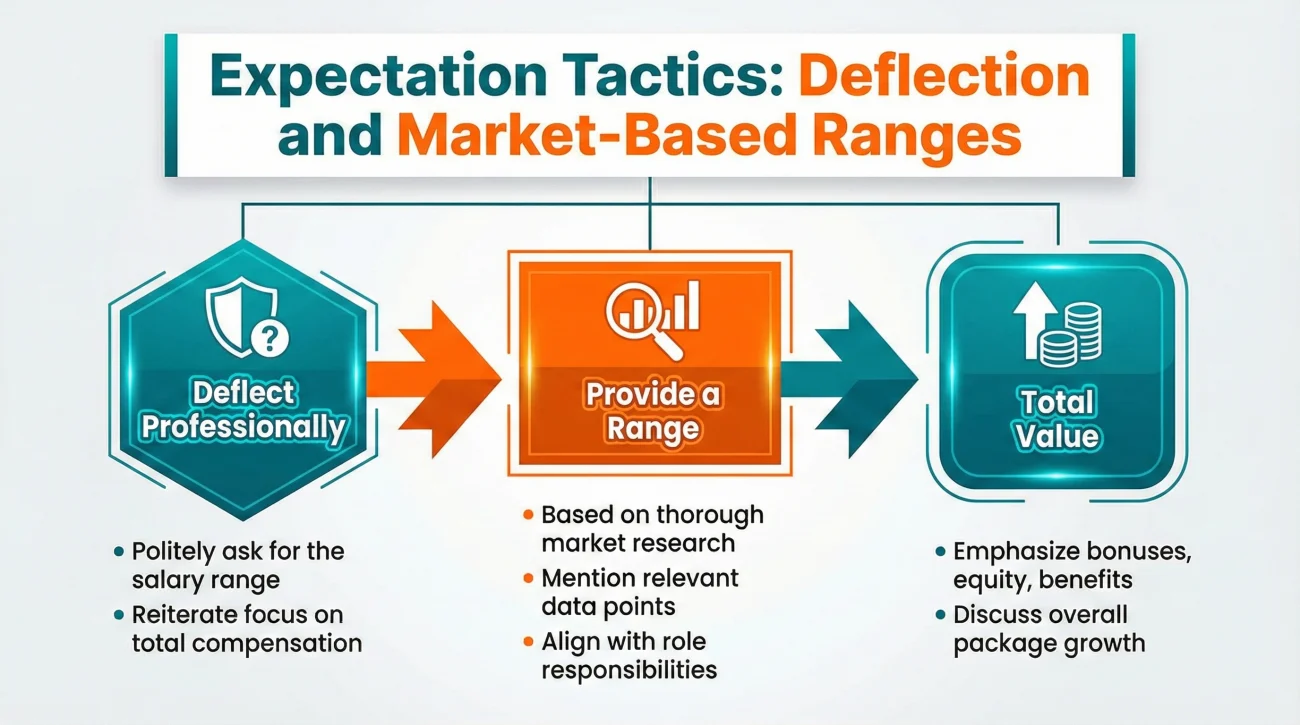
Deflection Strategies
The ideal response deflects back to the employer’s range without refusing to answer or appearing evasive. You want to understand their budget before committing to specific numbers that might be too high or too low.
💡 Pro tip: “I’m happy to discuss compensation once we’ve determined I’m the right fit. Can you share the range you’ve budgeted for this role?” deflects professionally while gathering the information you need.
When You Must Provide Numbers
Some employers insist on salary expectations before proceeding. When pressed, provide a range based on market research rather than a specific number. This gives you flexibility while showing you’ve done homework on market rates.
| Weak Response | Strong Response |
|---|---|
| “I need at least $X” | “Based on market research for this role, I’m targeting $X to $Y” |
| “I currently make $X” | “I’m looking for a package in the $X to $Y range based on my experience” |
| “I don’t know” | “I’m flexible based on the total package, but market rates suggest $X to $Y” |
| “Whatever you’re offering” | “I’m targeting compensation competitive with market rates around $X” |
Handling Current Salary Questions
Many employers ask about current compensation to anchor negotiations low. Several states ban this question, but where legal, you can deflect or provide ranges. Never lie, but recognize you’re not obligated to provide detailed breakdowns.
Expert advice: When asked current salary, you can say “I’m happy to share that I’m currently earning market rate for my role. For this position, I’m targeting $X to $Y based on the increased responsibilities and scope.” This avoids anchoring to potentially lower current pay.
Salary Transparency Laws and Trends
Understanding salary negotiation timing includes recognizing how transparency laws and practices are changing compensation discussions. Many jurisdictions now require salary range disclosure in job postings, fundamentally shifting negotiation dynamics.
How Transparency Changes Conversations
When salary ranges appear in job postings, candidates can assess fit before applying and reference posted ranges during negotiations. This shifts power dynamics by providing information candidates traditionally lacked.
- ✅ Posted ranges: Reference them directly when discussing compensation
- ✅ Aim high: Target the upper end of posted ranges based on your qualifications
- ✅ Ask about flexibility: Inquire whether exceptional candidates can exceed the posted range
When No Range Is Posted
In jurisdictions without transparency requirements or for roles without posted ranges, asking about salary ranges early in the process becomes even more important to avoid wasting time on misaligned opportunities.
If an employer refuses to share any salary information while demanding your expectations, that’s a red flag about transparency and fairness. Companies confident in their compensation readily share ranges.
Red Flags in Salary Discussions
How employers handle salary conversations reveals their fairness, transparency, and respect for candidates. Certain patterns signal problematic compensation practices or cultures worth avoiding.
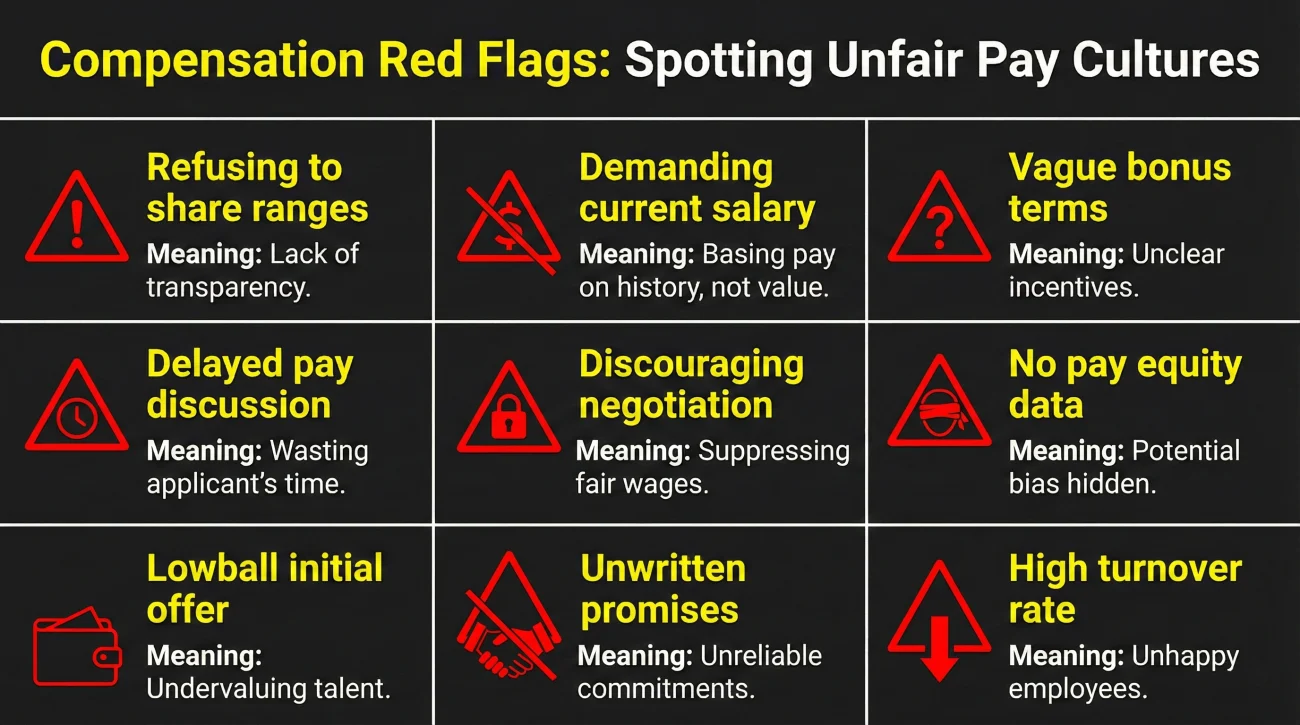
Warning Signs
Companies that refuse to discuss salary until final offers, pressure candidates to provide current compensation, or become defensive when asked about ranges often have below-market pay they’re trying to hide.
| Red Flag Behavior | What It Signals |
|---|---|
| Refusing to share any salary information | Below-market compensation they’re hiding |
| Becoming defensive about salary questions | Unfair practices or poor compensation philosophy |
| Demanding current salary details | Planning to anchor low rather than pay fairly |
| Claiming “it depends” without providing ranges | Inconsistent pay practices or discrimination |
| Pressuring for acceptance without negotiation | Trying to avoid paying market rates |
Transparency as Positive Signal
Employers confident in their compensation readily share ranges, explain their philosophy, and engage in good-faith negotiations. Transparency about salary reflects broader organizational transparency and fairness.
Special Situations
Certain scenarios require adapted approaches to salary discussions while following the same core principles of establishing value before discussing price.
Internal Transfers
When interviewing for internal positions, salary discussions happen earlier since the company already knows your current compensation. Ask about pay ranges for target roles and how internal transfers typically handle compensation adjustments.
When Recruiters Contact You
External recruiters reaching out often lead with compensation discussions since they’re qualifying candidates for specific salary ranges. It’s appropriate to ask about pay early in these conversations since the recruiter initiated contact.
Career Changes and Pivots
Career changers face tricky salary conversations when transitioning to new fields. Research typical entry-level or mid-level pay in target industries rather than expecting to maintain previous compensation immediately. Frame discussions around growth trajectory rather than just starting salary.
❓ FAQ
🎯 When exactly should I ask about salary?
If the employer hasn’t mentioned it by the end of the first full interview round, it’s appropriate to ask “Can you share the salary range for this position?” at that point. Ideally, recruiters provide ranges during initial screenings, but if they don’t, asking after demonstrating your qualifications is reasonable.
💼 What if they ask my salary expectations in the first conversation?
Deflect professionally: “I’m happy to discuss compensation once we’ve determined I’m the right fit. Can you share the range you’ve budgeted for this role?” This gathers information without committing to numbers before establishing value. If pressed, provide a researched range rather than a specific number.
⏰ Should I ask about salary if it’s posted in the job description?
If a clear range is posted, you don’t need to ask about it again. Instead, ask about flexibility for exceptional candidates or what determines placement within the range. Use the posted range as your starting point for eventual negotiations.
📋 What if they refuse to share any salary information?
That’s a red flag about transparency and fairness. You can decide whether to continue the process, but companies confident in their compensation readily share ranges. Refusal often indicates below-market pay they’re trying to hide. Consider whether you want to work somewhere that operates this way.
✨ How do I ask about salary without seeming money-focused?
Frame it around ensuring alignment rather than just money: “To make sure we’re aligned on expectations, could you share the budgeted range for this role?” Also ask about total compensation, growth opportunities, and other factors showing you care about more than just base salary.
Final Thoughts
Mastering asking about salary in interview requires understanding that timing determines leverage. Candidates who establish value before discussing compensation negotiate from strength, while those who lead with salary requirements negotiate from weakness. The fundamental principle is demonstrating capabilities and building employer enthusiasm before money conversations, not avoiding salary discussions entirely.
Professional salary inquiries use diplomatic language that gathers necessary information without appearing presumptuous. Ask about ranges rather than specific numbers, inquire about total compensation beyond base salary, and frame questions around ensuring alignment rather than just demanding to know what you’ll earn. How you ask matters as much as when you ask.
Recognize that employer responses to salary questions reveal organizational values around transparency, fairness, and respect for candidates. Companies confident in their compensation readily share ranges and engage in good-faith negotiations. Those that refuse information, become defensive, or pressure candidates to provide current salary while withholding their own ranges often have problematic pay practices worth avoiding. Salary conversations tell you as much about the employer as they tell employers about your expectations.
⚠️ Disclaimer: The interview strategies, sample answers, and negotiation tips provided in this guide are for educational purposes only. Hiring decisions are subjective and vary by company and industry. While these strategies are based on professional HR standards, they do not guarantee a specific job offer or result.