Your First Act as an Employee
The moment you send your accepting job offer email, you stop being a candidate and start being a future colleague. That shift matters more than most people realize.
I’ve seen new hires begin their employment relationship on the wrong foot simply because their acceptance email was sloppy, overly casual, or missing critical confirmations. One candidate accepted a marketing manager position without confirming the start date we’d discussed. When she showed up a week later than we expected, her first day was spent apologizing rather than onboarding.
Your acceptance email is documentation. It’s relationship-building. And it’s your first impression as someone who will actually work at this company. Get it right.
Before You Hit Send
A proper job acceptance letter requires preparation. Don’t fire off a quick response the moment you decide. Take an hour to do this correctly.
Verify Every Term
Pull up the offer letter. Review every number, every date, every condition. Your acceptance will restate these terms, so you need to be certain you’re confirming what you actually agreed to.
Check the basics:
- Base salary amount and payment frequency
- Start date and location
- Job title exactly as written
- Any signing bonus, relocation assistance, or special arrangements
- Benefits enrollment timeline
A colleague of mine accepted an offer and later discovered she’d mentally rounded her salary up. The offer letter said $78,500. She’d told friends she got $80,000. Small difference, but it created awkwardness when reality didn’t match her expectations.
Check for Conditions
Many offers are conditional on background checks, reference verification, or drug screening. Your acceptance acknowledges these conditions. Make sure you understand what’s required and that you can meet those requirements.
If there’s anything in your background that might cause issues, better to address it proactively than to accept and have the offer withdrawn later. A candidate I worked with had a misdemeanor from college that he’d forgotten about. It surfaced in the background check after he’d already given notice at his current job. The resulting scramble was painful for everyone.
Expert Advice: If you have any concerns about passing background verification, raise them before accepting. Most issues can be explained and resolved, but surprises after acceptance create problems.
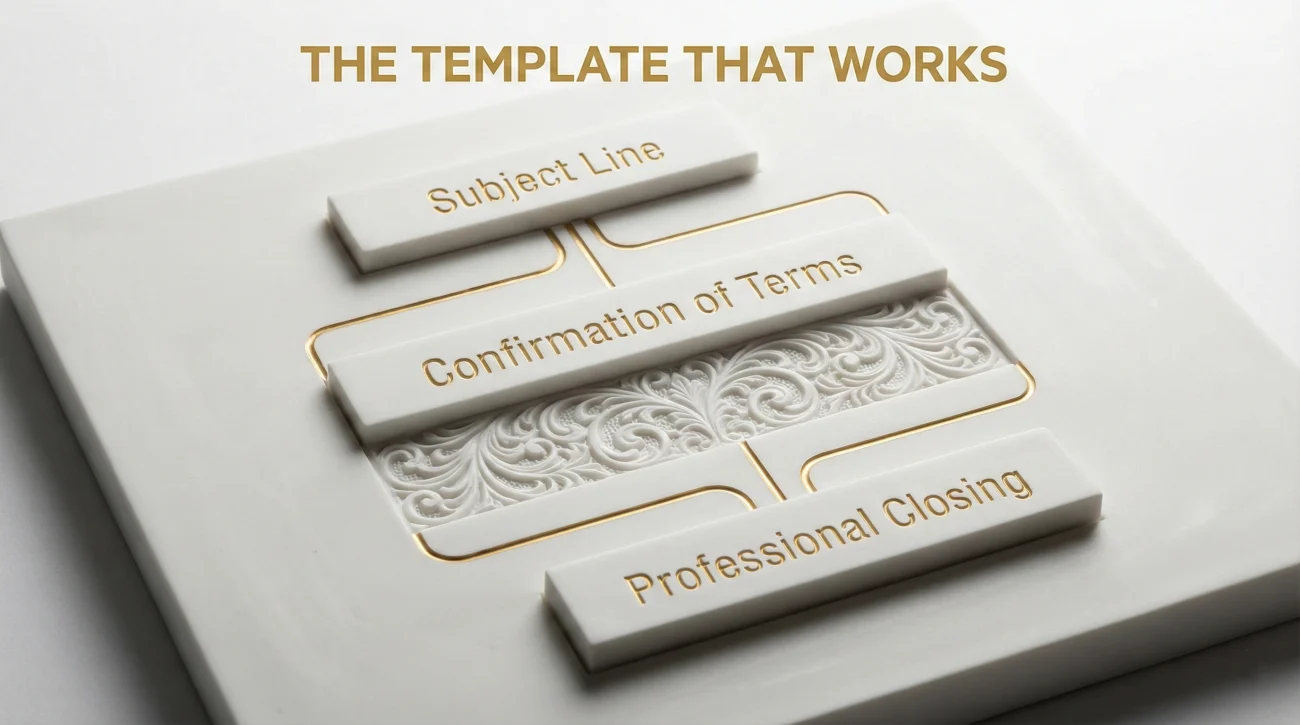
The Template That Works

Here’s an offer acceptance email template structure I recommend after twelve years of receiving these from candidates:
Subject: Acceptance of [Job Title] Position
Dear [Hiring Manager’s Name],
I am pleased to formally accept the offer for the [Job Title] position at [Company Name]. Thank you for this opportunity, and thank you to everyone who participated in the interview process.
I want to confirm my understanding of the offer terms:
• Position: [Exact Title]
• Start Date: [Date]
• Base Salary: [$Amount] per year
• Signing Bonus: [$Amount] (if applicable)
• Remote Work: [Any agreed arrangement] (if applicable)
• Reporting to: [Manager’s Name] (if discussed)
Please let me know if any of the above differs from your records, and please send any paperwork or documentation you need from me before my start date.
I’m looking forward to contributing to [specific team goal or project mentioned in interviews]. If there’s anything I can do to prepare before I begin, I’d welcome the opportunity.
Thank you again for your confidence in me.
Best regards,
[Your Full Name]
[Phone Number]
[Email]
Why This Structure Works
The explicit confirmation of terms creates a written record. If there’s any discrepancy between what you understood and what HR has in their files, this email surfaces it immediately rather than on your first day.
The reference to something specific from the interview process shows this isn’t a generic template. You’re engaged with this particular opportunity, not just accepting any job that came along.
Asking for paperwork and preparation opportunities demonstrates initiative. You’re already acting like an employee who wants to hit the ground running.
Customizing for Your Situation
Not every how to accept a job offer situation is identical. Your email should reflect your specific circumstances.
If You Negotiated Successfully
Reference the negotiated terms specifically. This ensures the updated figures make it into HR’s records:
“I’m pleased to accept based on the revised terms we discussed: base salary of $95,000 with a $5,000 signing bonus and a start date of March 15th.”
Verbal agreements during negotiation sometimes fail to reach the people who prepare paperwork. Your acceptance email acts as a bridge, ensuring everyone has the same numbers.
If You’re Relocating
Confirm relocation assistance details and acknowledge the timeline complexity:
“I understand the relocation package includes [specific terms]. I’ll begin coordinating my move immediately to ensure I’m settled and ready by my start date.”
This signals that you’re taking the logistics seriously and won’t show up unprepared because moving took longer than expected.
If Remote Work Was Agreed
Document the arrangement clearly:
“I’m confirming our agreement that I’ll work remotely three days per week, with Tuesday and Thursday as in-office days.”
Remote work agreements are particularly important to document. Managers change. Policies shift. Having your original agreement in writing protects you later.
Timing Your Acceptance
When you send your formal job acceptance matters almost as much as what it says.
Don’t Rush
Responding within minutes of receiving an offer can seem impulsive. Even if you’ve already decided, wait at least a few hours. This suggests you gave the decision appropriate weight.
The exception is if you verbally accepted during a phone call. In that case, send written confirmation the same day while details are fresh.
Don’t Delay Excessively
If you’ve been given a decision deadline and you know your answer is yes, don’t wait until the last minute. Prompt acceptance signals enthusiasm. Waiting until the deadline suggests hesitation.
I recommend sending your acceptance 24 to 48 hours after making your decision, unless there’s a reason to wait longer.
Send During Business Hours
An acceptance email sent at 2 AM suggests either desperation or poor time management. Send during normal working hours so it arrives when people are actually checking email.
💡 Pro Tips: Mid-morning Tuesday through Thursday tends to get the best response times. Avoid Monday mornings when inboxes are flooded and Friday afternoons when people are wrapping up for the weekend.
What to Avoid
I’ve received acceptance emails that made me cringe and others that made me immediately confident in our hiring decision. Here’s what separates them.
Excessive Enthusiasm
One or two sentences expressing genuine pleasure is appropriate. Three paragraphs about how this is your dream job and you’ve never been so excited about anything in your life is too much.
A candidate once wrote that accepting our offer was “the happiest moment of her professional life.” We hadn’t even started working together yet. It created pressure neither of us needed.
Mentioning Other Offers
Never write anything like “I’m choosing you over Company X” or “Your offer was the best of the three I received.” This serves no purpose except to make you seem like you were playing companies against each other.
Sneaking in Conditions
Your acceptance should be clean. Don’t write “I accept, provided that…” followed by something you never discussed. If there are conditions you need met, negotiate them before accepting, not during your acceptance.
Note: “I accept, but I’ll need to revisit the salary after six months” is not an acceptance. It’s a negotiation disguised as acceptance, and it creates immediate friction.
Oversharing Your Decision Process
The hiring manager doesn’t need to know that you made a pros and cons list, consulted with your therapist, or that your spouse had reservations. Accept cleanly and move forward.
After You Send It
Your acceptance email isn’t the end of the process. There are typically several steps between acceptance and your first day.
Expect a Response
You should receive acknowledgment within one to two business days. If you don’t hear anything, follow up politely: “I wanted to confirm you received my acceptance email. Please let me know if you need anything else from me.”
Complete Paperwork Promptly
You’ll likely receive employment agreements, tax forms, benefits enrollment materials, and background check authorizations. Complete and return these quickly. Delays here can push back your start date.
A friend accepted a job and then sat on the paperwork for two weeks because she was “busy wrapping up” at her current job. The new employer assumed she was having second thoughts. The relationship started with unnecessary tension.
Stay in Appropriate Contact
Between acceptance and start date, an occasional check-in is fine. Ask if there’s reading material to prepare, whether the team has any upcoming events you could join, or if there’s anything you can do to prepare.
Don’t overdo it. Weekly emails asking “anything I can do?” becomes annoying. One or two touchpoints over a few weeks shows engagement without seeming needy.
For guidance on other aspects of starting a new position successfully, explore our career transition resources.
Special Circumstances
Accepting After a Counter-Offer from Current Employer
If you considered a counter-offer from your current employer but decided to accept the new position anyway, your acceptance email doesn’t need to mention any of that. Accept cleanly. The new employer doesn’t need to know about your internal deliberations.
Requesting a Delayed Start Date
If you need more time before starting than originally discussed, address it in your acceptance:
“I’m excited to accept this offer. I’d like to request a start date of April 1st rather than March 15th to allow for a proper transition at my current role. Please let me know if this adjustment works for you.”
Frame it as a request, not a demand. Most companies prefer a candidate who transitions professionally over one who leaves their current employer in a lurch.
Internal Transfers
If you’re accepting an internal position at your current company, the tone can be slightly warmer since you already have an established relationship. Still confirm the terms formally. Internal moves sometimes have more ambiguity than external offers, making documentation even more important.
❓ FAQ
🎯 Should I accept via email or phone?
Either works for the initial acceptance, but always follow up with email confirmation. Written documentation prevents misunderstandings about terms. Many people accept verbally on a call and then send written confirmation within hours.
💼 Do I need to wait for the formal offer letter before accepting?
Ideally yes. Verbal offers can change when translated to paper. Review the written offer letter carefully before sending your acceptance to ensure everything matches what was discussed.
⏰ What if the offer letter has errors?
Don’t accept until errors are corrected. Reply pointing out discrepancies: “Before I formally accept, I noticed the offer letter shows X, but we agreed to Y. Could you send a corrected version?” This is normal and expected.
📋 Should I copy anyone on my acceptance email?
Match whatever CC list was on the offer. If only the hiring manager sent it, reply only to them. If HR was copied, keep them copied. Don’t add people who weren’t part of the process.
✨ Can I change my mind after accepting?
Legally, usually yes, unless you signed a binding contract. Professionally, it burns bridges severely. Only back out for truly compelling reasons, and understand the relationship with that company is likely damaged permanently.
Final Thoughts
Your accepting job offer email marks the transition from candidate to colleague. It deserves more attention than a quick reply dashed off on your phone.
Confirm the terms clearly. Express appropriate enthusiasm without overdoing it. Ask what comes next. These simple elements create a professional foundation for the working relationship ahead.
The job search is over. The job is about to begin. Start it right.
⚠️ Disclaimer: The interview strategies, sample answers, and negotiation tips provided in this guide are for educational purposes only. Hiring decisions are subjective and vary by company and industry. While these strategies are based on professional HR standards, they do not guarantee a specific job offer or result.