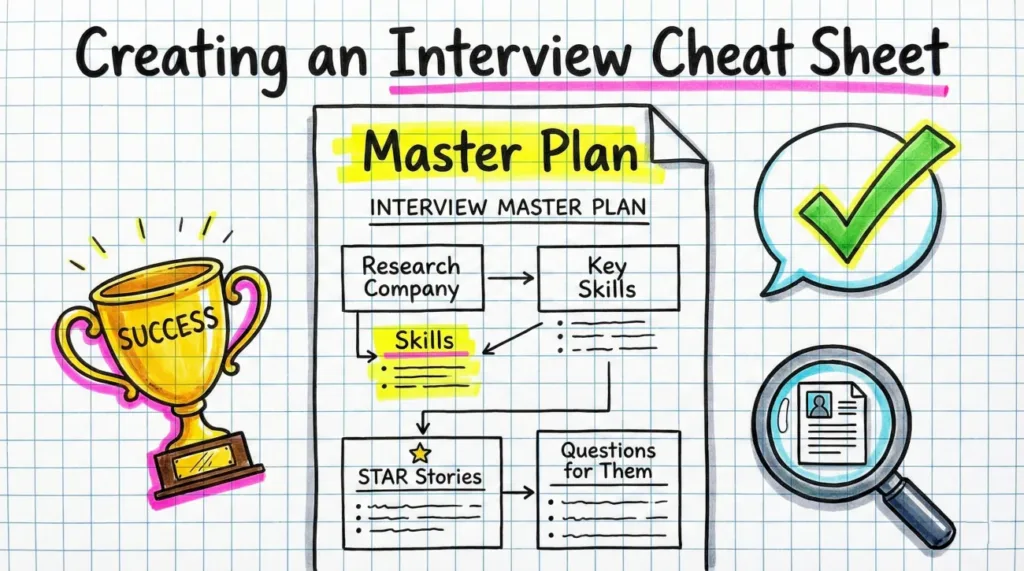
Your Secret Weapon for Phone Interviews
Phone interviews give you something in-person interviews don’t: the ability to have notes in front of you without anyone seeing them.
An interview cheat sheet isn’t cheating. It’s preparation. The candidates who succeed in phone screens aren’t necessarily smarter or more qualified than those who don’t. They’re often just better prepared, with the right information at their fingertips exactly when they need it.
I’ve been on both sides of this equation. As a job seeker early in my career, my cheat sheet helped me land roles I honestly wasn’t sure I was qualified for. It gave me confidence because I knew my key stories and numbers were right there if my mind went blank. As a hiring manager now, I can immediately tell when a candidate has prepared notes versus when they’re improvising everything. The prepared candidates sound sharper, more specific, more confident.
The difference in outcomes is significant enough that I consider cheat sheet preparation non-negotiable for anyone serious about their job search.
What Belongs on Your Cheat Sheet
Not everything. Not your entire work history. Not paragraphs of text you’ll try to read aloud. Your interview notes template should contain triggers and data points, not scripts. The goal is quick reference, not reading material.
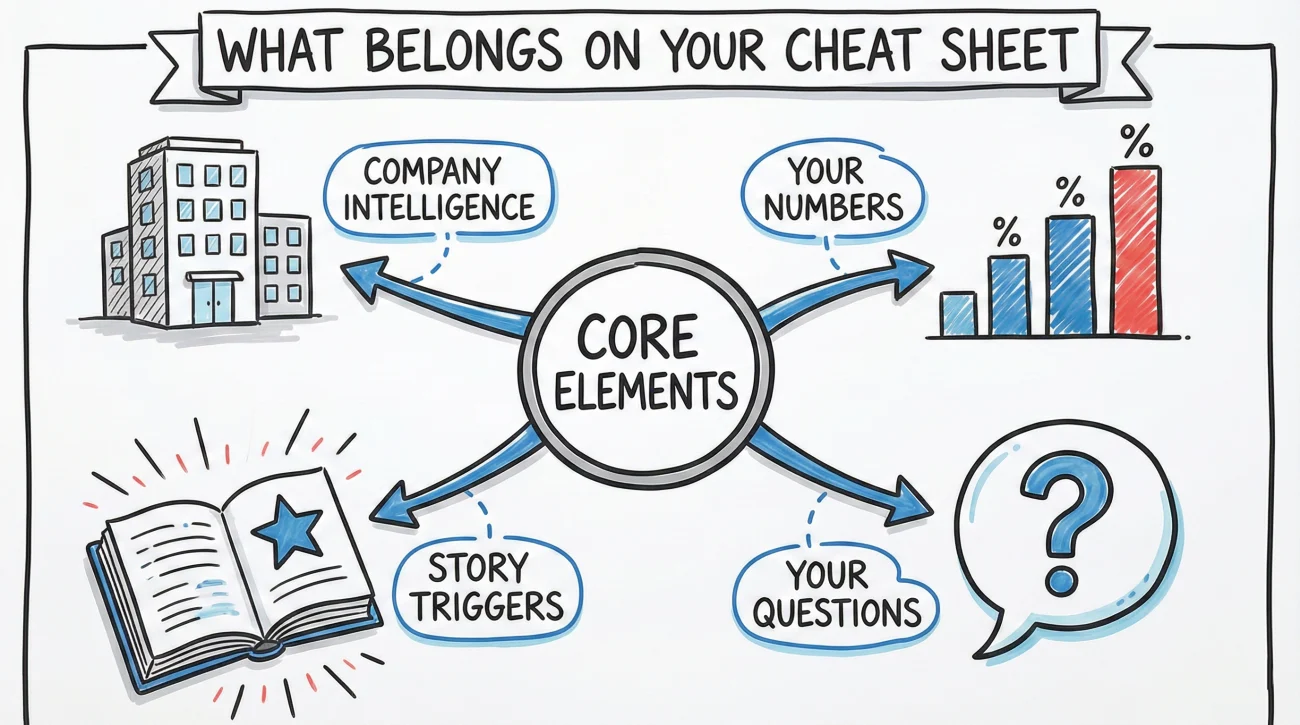
Company Intelligence
The interviewer’s name and title. You’d be surprised how often candidates forget who they’re talking to partway through a call. Having the name visible means you can use it naturally: “That’s a great question, Sarah” sounds personable. Fumbling to remember if you’re talking to Sarah or Susan sounds unprepared.
Recent company news. A product launch. A leadership change. A funding round. A major client win. One or two bullet points that let you demonstrate you’ve done research beyond reading the job posting.
The specific job posting’s key requirements. What skills and experiences did they emphasize? What problems are they trying to solve? Having these visible helps you align your answers to what they’ve explicitly said they need.
Any mutual connections or relevant details you found on LinkedIn. If you noticed the interviewer went to the same university as you, or worked at a company where you know someone, that’s potentially valuable rapport-building information.
Your Numbers
Specific metrics from your experience are powerful but hard to remember under pressure. Revenue generated. Cost savings achieved. Team sizes managed. Percentage improvements. Project budgets. Timeline achievements. Customer satisfaction scores.
Numbers are compelling precisely because they’re specific. “I increased conversion by 23% over six months” is dramatically more convincing than “I significantly improved conversion rates.” But 23% versus 27% versus 32%? You might genuinely not remember which project produced which result. Having your numbers written down means you cite them correctly and confidently.
💡 Pro Tips: Round numbers slightly if the exact figure is awkward. “About 25%” is easier to say naturally than “23.7%,” and the precision difference rarely matters.
Story Triggers
For each major accomplishment or challenge you might discuss, write one or two words that trigger the full memory. Not the complete story. Just enough to remind you which story to tell.
- 📊 Leadership example: “Q3 launch, cross-functional, 2 weeks early”
- 🔥 Challenge overcome: “Budget cut 40%, still delivered MVP”
- 🤝 Conflict resolution: “Marketing disagreement, data resolved it”
- 💡 Innovation story: “Automation idea, saved 10 hrs/week”
When asked about a time you showed leadership, glancing at “Q3 launch” instantly triggers the full story without you needing to read anything. Your answer flows naturally because you’re telling a story you know, not reading one you wrote down.
Your Questions for Them
Have three to five questions ready for when they ask “Do you have any questions for us?” Nothing worse than blanking at this moment. Your questions should show genuine curiosity about the role, team, or company, not just things you could have Googled.
Write them down so you don’t forget them, but also so you can check off ones that got answered during the conversation. Nothing looks worse than asking a question they already addressed.
Answers to Tricky Questions
What’s your greatest weakness? Why are you leaving your current job? What’s your salary expectation? These questions trip people up because the “right” answer requires careful framing. Having your approach written down ensures you don’t fumble through an awkward improvisation.
A Template That Works
Here’s the exact format I recommend for your phone interview cheat sheet. One page maximum. Larger font than you think you need, because you’ll be glancing at it, not reading it carefully.
INTERVIEWER: [Name] | [Title] | [LinkedIn detail]
COMPANY: [Recent news] | [Key initiative from job posting]
MY NUMBERS:
• Revenue/savings: $___
• Team size: ___
• Key metric improvement: ___%
• Project timeline: delivered ___ early/under budget
STORIES:
• Leadership: [2-word trigger]
• Challenge: [2-word trigger]
• Teamwork: [2-word trigger]
• Growth: [2-word trigger]
MY QUESTIONS:
1. [About the role/projects]
2. [About the team/culture]
3. [About growth/development]
TRICKY ANSWERS:
• Why leaving: [One sentence, positive framing]
• Weakness: [Genuine but managed]
• Salary: [Range or deferral approach]
Print this out or display it on a second screen where you can reference it without obviously looking away from your conversation.
Using Your Notes Without Getting Caught
The goal is reference, not reading. If you’re staring at your notes and reading sentences aloud, the interviewer will hear it in your voice. Pauses become unnatural. Inflection flattens. You sound scripted because you are scripted.
The Glance Technique
Look at your notes between questions, not during your answers. When the interviewer finishes asking something, a brief pause while you “think” is expected and natural. Use that moment to glance at relevant triggers or numbers.
Then look away from your notes and answer from memory. Your notes reminded you which story to tell or which number to cite. Your actual answer flows naturally from your own knowledge and experience.
Expert Advice: Practice the glance technique during mock interviews. Have a friend ask you questions while your notes are positioned where they’ll be during the real call. Your eye movement and pause patterns should feel completely natural by interview day.
Positioning Your Notes
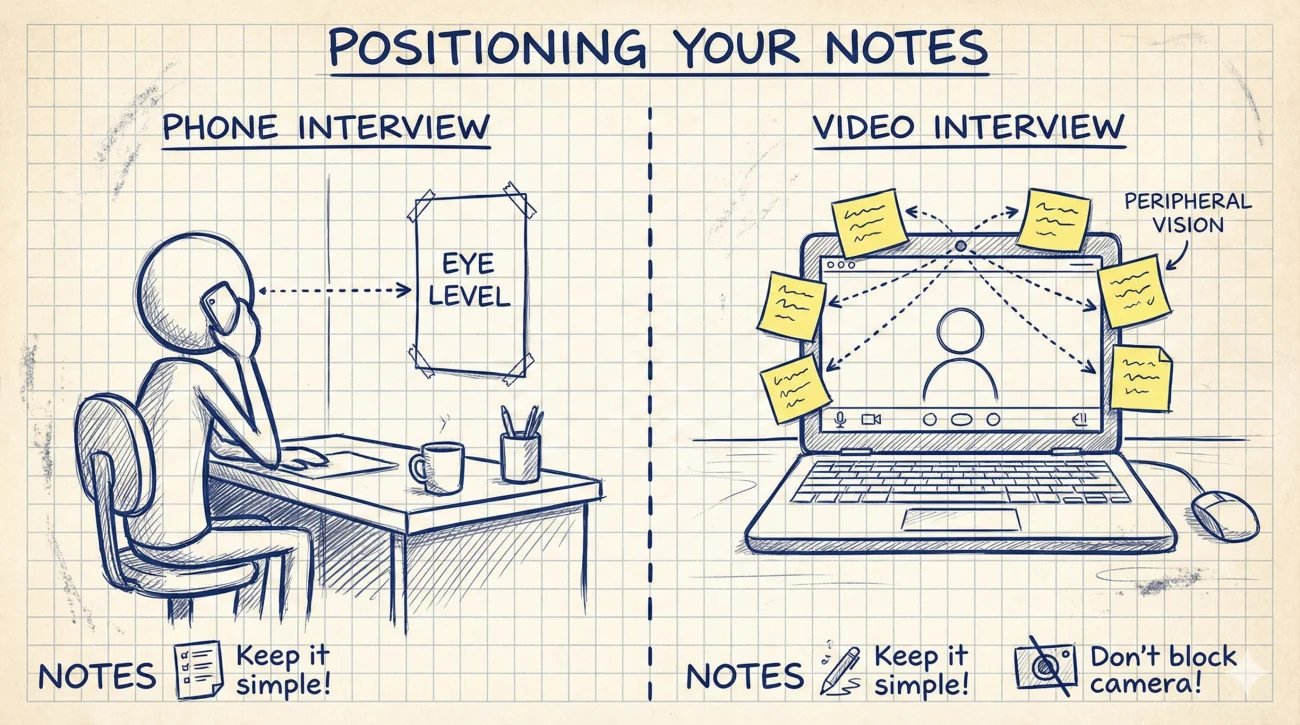
For phone interviews, position your notes directly in front of you, ideally at eye level. Tape them to a wall or prop them against your monitor. Looking down at papers on a desk while talking creates a noticeable change in your voice quality as your head position shifts.
For video interviews where notes might still be useful, position them just below or beside your camera so glancing at them doesn’t look dramatically off-screen. A sticky note on your monitor bezel with three key numbers is subtle. A full page document requiring obvious reading is not.
My own setup for important phone screens: I tape a single page to the wall directly behind my laptop, at eye level. When I glance at it, my head barely moves. To anyone watching, I’d just look like I was thinking.
What NOT to Put on Your Cheat Sheet
More is not better. Your interview preparation notes should be scannable in under two seconds. If you need to search for information, you’ve included too much.
| Don’t Include | Why It Hurts You |
|---|---|
| Full written-out answers | You’ll read them and sound completely scripted |
| Your entire resume | Too much to scan quickly when you need one fact |
| Paragraphs of company research | No time to read during a live conversation |
| Every possible interview question | Overwhelms rather than helps; you’ll freeze searching |
| Information you already know cold | Wastes space better used for things you might forget |
A senior recruiter I know can always tell when candidates are reading full prepared answers: “Their voice changes completely. They go from conversational to monotone. The pacing becomes unnatural. It actually hurts them more than having no notes at all, because now they sound robotic AND I know they’re reading.”
Note: If your cheat sheet is longer than one page, you’ve defeated its purpose. Cut ruthlessly until only the most essential triggers and data points remain.
Cheat Sheets for Video Interviews
Video interviews require more subtlety since the interviewer can see your eyes move. But you can still use notes effectively with the right approach.
The Sticky Note Method
Place small sticky notes around your screen with just a few words each. They’re in your peripheral vision without requiring obvious eye movement to read. One note for your key numbers. One for story triggers. One for questions to ask.
The words should be large enough to read without squinting. Three to five sticky notes maximum, positioned so you can see them while still appearing to look at the camera.
Second Screen Method
If you have a second monitor, position it immediately adjacent to your primary screen so the eye movement between them is minimal. Keep only your most essential notes there, positioned near the top of the screen closest to your camera.
Some candidates use a tablet propped just below their laptop screen, angled so they can glance down slightly without obvious head movement. This works well if the tablet is positioned correctly.
A Question of Honesty
Is it dishonest to use notes during video interviews?
No more than it’s dishonest to use notes during any professional presentation or meeting. Preparation is expected and respected. Executives don’t memorize everything before board meetings. Salespeople have talking points ready for client calls. Lawyers reference case notes during arguments.
The key is that your notes support your natural conversation rather than replacing it. You’re not reading a script. You’re referencing key information while engaging authentically.
For broader preparation strategies covering all aspects of the interview process, explore our comprehensive interview guidance.
Practicing With Your Cheat Sheet
Creating the cheat sheet is only half the work. You need to practice using it so the reference feels natural rather than awkward.
Mock Interview Practice
Have a friend or family member ask you common interview questions while your cheat sheet is positioned exactly where it will be during the real interview. Practice the glance, the pause, the natural delivery that follows.
Ask for feedback specifically about whether your note references were obvious. Could they tell when you were looking at something? Did your voice change? Did your pauses seem natural or stilted?
Record Yourself
Set up your phone to record video of yourself during practice sessions. Watch the playback looking for tells: obvious eye movement, unnatural pauses, changes in vocal quality when referencing notes. These recordings reveal things you can’t notice while you’re doing them.
Refine Based on Practice
After each practice session, adjust your cheat sheet. Maybe you never referenced the company history section but needed your numbers multiple times. Maybe your story triggers were too vague and you needed more detail. Maybe the font was too small to read at a glance.
The cheat sheet should evolve through practice until it contains exactly what you need and nothing you don’t.
❓ FAQ
🎯 Can I use notes during in-person interviews?
Bringing a professional notepad with a few bullet points is acceptable and can even signal preparation. Referring to it constantly is not. Have key numbers and your questions written down, but keep references minimal and subtle.
💼 What if I still blank despite having notes?
Ask for a moment: “Let me think about the best example for that.” Then look at your notes more deliberately. A brief pause to gather your thoughts is far better than a rambling, unfocused answer. Interviewers respect candidates who take a moment to give a quality response.
⏰ Should I update my cheat sheet for every interview?
The company-specific sections absolutely need updating for each interview. Interviewer details, company news, role requirements all change. Your personal metrics and story triggers can stay mostly consistent across interviews.
📋 Do interviewers expect candidates to use notes?
For phone screens, yes. Most experienced interviewers assume candidates have some form of notes nearby and don’t consider it problematic. For video interviews, expectations vary. What matters universally is that you sound natural, not scripted.
✨ What’s the single most important thing to have on my cheat sheet?
Your specific numbers and metrics. Everything else you can probably recall or improvise reasonably well. But forgetting whether you saved $50,000 or $500,000, or whether your team was 5 people or 15, undermines your credibility. Get the numbers right.
Final Thoughts
An effective interview cheat sheet gives you confidence because you know your key facts, stories, and numbers are within reach. You’re not relying entirely on memory under pressure. You’re prepared for the moments when stress might make you forget something important.
Build your cheat sheet before your next phone interview. Keep it short and scannable. Practice using it until glancing at your notes feels as natural as checking the time. That small piece of preparation might be the edge that transforms a good interview into a great one, and a great interview into a job offer.
“`.
Positioning Your Notes
For phone interviews, place notes directly in front of you at eye level if possible. Tape them to a wall, prop them on a stand, or position your laptop screen where you’re looking naturally. The less your eyes need to move, the less likely you’ll sound like you’re reading.
For video interviews where you might use notes, position them just below or beside your camera. Glancing slightly down or to the side is less obvious than looking far off-screen. Some people use sticky notes around their monitor frame with just a few key words each.
Practice Until Natural
Record yourself doing a mock interview with your notes in position. Play it back and listen for moments that sound scripted or where pauses seem unnatural. Adjust your technique until the recording sounds like a normal conversation.
My first few attempts at using interview notes were disasters. I sounded robotic, paused too long while searching for information, and lost my conversational rhythm. It took several practice sessions before I could reference notes smoothly. That practice was worth every minute.
What NOT to Put on Your Cheat Sheet
More is not better. Your interview preparation notes should be scannable in under two seconds. If you need to search for information, you’ve included too much.
| Don’t Include | Why It Hurts You |
|---|---|
| Full written answers to anticipated questions | You’ll read them aloud and sound scripted |
| Your entire resume or work history | Too much information to scan quickly |
| Paragraphs of company research | Won’t have time to read during a live conversation |
| Every possible question they might ask | Overwhelms rather than helps; creates decision paralysis |
| Information you already know cold | Wastes space better used for things you might forget |
A senior recruiter friend told me she can always identify when candidates are reading prepared answers: “Their voice changes completely. They shift from conversational and engaged to flat and monotone. The words might be perfect, but the delivery screams ‘I’m reading this.’ It actually hurts them more than having no notes at all.”
Note: If your cheat sheet is longer than one page, it’s too long. Edit ruthlessly until everything fits on a single sheet with readable font size.
Cheat Sheets for Video Interviews
Video interviews require more subtlety since the interviewer can see your eyes. But you can still use notes effectively with the right approach.
The Sticky Note Method
Place small sticky notes around your screen frame with just a few words each. They’re in your peripheral vision without requiring obvious eye movement to read. One note for your key numbers. One for story triggers. One for questions to ask. One for tricky answer reminders.
Because each note contains only a few words, you’re never obviously reading. A quick glance that might look like you’re thinking is all you need.
The Second Screen Method
If you have a second monitor, position it immediately adjacent to your primary screen so the eye movement between them is minimal. Keep only your most essential notes there. The interviewer sees you glance slightly to the side, which could easily be you checking the time or looking at the video window.
The Tablet Method
Prop a tablet just below your laptop screen, angled so you can see it while looking roughly toward your camera. This keeps your reference material in your natural line of sight.
Is it dishonest to use notes during video interviews?
No more dishonest than using notes during any professional meeting or presentation. Preparation is expected and respected. The key is ensuring your notes support natural conversation rather than replacing it. If you’re having a real dialogue with occasional memory aids, that’s professional preparation. If you’re reading a script while pretending to converse, that’s problematic.
For comprehensive guidance on all aspects of interview preparation, explore our complete interview resources.
Customizing for Different Interview Types
Phone Screens with Recruiters
These calls are often about logistics and basic qualification verification. Your cheat sheet should emphasize: your current situation and availability, salary expectations (or how you plan to defer that question), and clear articulation of why you’re interested in this specific role.
Hiring Manager Interviews
These go deeper into your experience and capabilities. Emphasize story triggers, specific accomplishments with numbers, and thoughtful questions about the team and role. The hiring manager wants to know if you can do the job and if you’ll be good to work with.
Technical or Skills-Based Interviews
Depending on your field, you might need reference material beyond standard interview prep. Key formulas. Technical specifications. Process frameworks. Things that are complex enough that having them written down prevents embarrassing blanks.
❓ FAQ
🎯 Can I use notes during in-person interviews?
Bringing a professional notepad with a few bullet points is acceptable and even shows preparation. Referring to it constantly is not. Have your key numbers and questions written down, but keep usage subtle and minimal. The notepad should be a backup, not a crutch.
💼 What if I blank completely despite having notes?
Ask for a moment openly: “Let me think about the best example for that.” Then look at your notes without trying to hide it. A thoughtful pause is far better than a rambling non-answer. Everyone understands needing a moment to collect thoughts.
⏰ Should I update my cheat sheet for every interview?
Yes. Company information, interviewer details, and specific role requirements change with each opportunity. Your personal metrics and story triggers stay consistent, but the company-specific sections need fresh research and customization.
📋 Do interviewers expect candidates to use notes?
For phone interviews, many assume you have reference material. For video interviews, expectations vary, but most understand candidates may have some notes nearby. What matters is sounding natural and engaged, not whether you have preparation materials.
✨ How detailed should my story triggers be?
Just detailed enough to identify which story you mean. If “Q3 project” uniquely identifies one accomplishment in your mind, that’s sufficient. If you have multiple Q3 projects, add one more distinguishing word. The trigger should spark recognition, not tell the story.
Final Thoughts
An effective interview cheat sheet gives you confidence because you know your key facts, numbers, and stories are within reach if your mind goes blank under pressure. You’re not relying entirely on memory during one of the most stressful professional situations you’ll face.
Build your cheat sheet before every interview. Keep it to one page. Make it scannable at a glance. Practice using it until reference feels natural. That small piece of preparation might be the edge that separates you from equally qualified candidates who didn’t bother.
The goal isn’t to read your way through an interview. It’s to have a safety net that lets you perform at your best, knowing backup is there if you need it. That confidence alone often means you won’t need the notes at all.
⚠️ Disclaimer: The interview strategies, sample answers, and negotiation tips provided in this guide are for educational purposes only. Hiring decisions are subjective and vary by company and industry. While these strategies are based on professional HR standards, they do not guarantee a specific job offer or result.