The Candidate Who Listened Her Way to the Job
Two candidates. Same qualifications. Same experience level. One talked for 80% of the interview. The other listened intently and responded thoughtfully. Guess who got the offer?
The listener. Every single time.
Active listening in interview settings separates memorable candidates from forgettable ones. After twelve years of hiring across industries, I’ve watched brilliant candidates talk themselves out of jobs while quieter ones built genuine connections that led to offers.
Most interview advice focuses on what to say. This guide focuses on something more powerful: how to listen in a way that makes interviewers want to hire you.
Why Listening Wins Interviews
Here’s what most candidates miss: interviewers want to feel heard. They spend their days listening to people pitch themselves. When someone genuinely listens to them, it creates an immediate connection.
My colleague James, a senior recruiter at a tech company, put it this way:
“I can tell within five minutes whether a candidate is actually listening or just waiting for their turn to talk. The listeners ask follow-up questions that show they processed what I said. The others just pivot back to their rehearsed answers.”
The Psychology Behind It
When you listen actively, you trigger reciprocity. The interviewer feels valued, which makes them more positively disposed toward you. Research on hiring decisions consistently shows that likability influences outcomes as much as qualifications, sometimes more.
Listening skills for job interviews also demonstrate critical workplace competencies: attention to detail, respect for others, and the ability to absorb information before responding.
💡 Pro Tips: The interviewer’s questions contain clues about what they value most. Listen for emphasis and repeated themes.
The Mirroring Technique
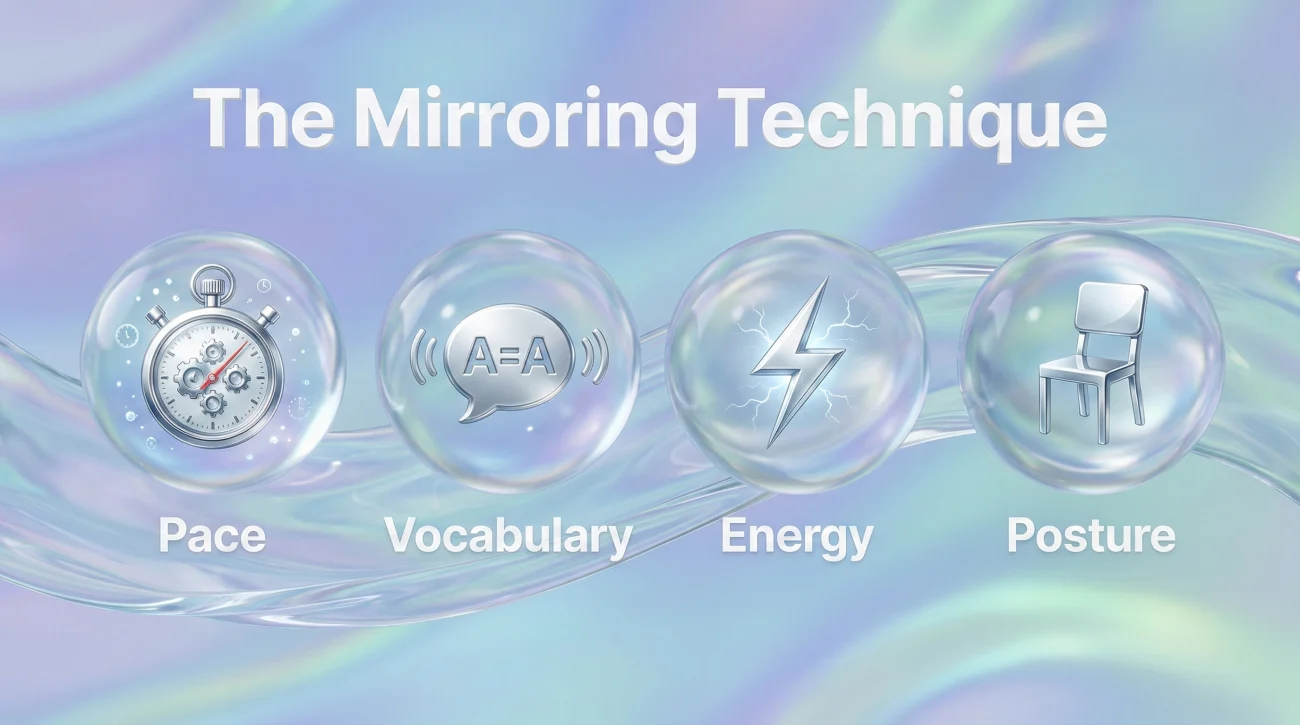
The interview mirroring technique creates unconscious rapport by subtly matching the interviewer’s communication style. This isn’t about mimicking their every move. It’s about finding natural alignment.
Verbal Mirroring
Pay attention to the interviewer’s vocabulary and pace. If they speak quickly and use casual language, slightly increase your pace and relax your formality. If they’re measured and technical, match that energy.
When they use specific terms to describe something, use those same terms in your response. If they call it “the project,” don’t call it “the initiative.” This subtle alignment signals that you’re on the same wavelength.
Posture and Energy Mirroring
Match their general energy level without copying specific movements. If they lean forward with enthusiasm when discussing a topic, lean in slightly yourself. If they sit back in a relaxed posture, don’t perch on the edge of your seat.
Warning: Obvious mirroring backfires. If the interviewer notices you’re copying them, it seems manipulative rather than natural.
- 🔄 Match pace: Speak at roughly the same speed they do
- 📝 Match vocabulary: Use their terminology when relevant
- ⚡ Match energy: Enthusiastic interviewer? Show enthusiasm. Calm interviewer? Stay grounded
- 🪑 Match posture: General alignment, not exact copying
How to Demonstrate You’re Listening
Listening means nothing if the interviewer doesn’t perceive it. You need visible evidence of your attention.
Verbal Acknowledgments
Brief verbal cues confirm you’re tracking the conversation. A simple “I see” or “That makes sense” inserted at natural pauses shows engagement without interrupting.
Avoid overdoing it. Constant “uh-huh” sounds every few seconds become distracting rather than reassuring.
Paraphrasing and Summarizing
Before answering a complex question, briefly paraphrase it. “So you’re asking about how I handled the budget constraints while maintaining quality, is that right?” This confirms understanding and gives you a moment to organize your thoughts.
What if you misunderstood the question?
Better to clarify before answering than to deliver a perfect response to the wrong question. Paraphrasing catches misunderstandings early and shows you care about addressing their actual concern.
Asking Follow-Up Questions
The clearest demonstration of listening is asking questions that build on what was said. These aren’t generic questions from a prepared list. They’re specific questions that could only arise from careful attention.
Expert Advice: Write down a key phrase from the interviewer’s comment and reference it directly in your follow-up question. This proves you were fully present.
What Blocks Good Listening
Understanding barriers helps you overcome them. Most candidates struggle with listening not because they don’t care, but because interview anxiety hijacks their attention.
The Rehearsal Trap
You’re so focused on remembering your prepared answers that you stop processing what the interviewer is actually saying. Their question becomes just a trigger for your script rather than a genuine inquiry to address.
I interviewed a candidate last year who gave a technically perfect answer to a question I didn’t ask. He heard my first few words, assumed he knew where I was going, and launched into rehearsed material. When I redirected him, he was visibly thrown off.
Internal Anxiety Noise
Your inner voice won’t stop critiquing your performance. “Was that answer too long? Did I sound nervous? Are they frowning because I said something wrong?” This running commentary drowns out actual listening.
For techniques to manage this internal chatter, our proven interview techniques guide offers practical strategies for staying present.
Premature Response Preparation
Instead of listening until the question ends, you start formulating your answer halfway through. You miss nuances, qualifiers, and sometimes the actual point of the question.
Note: Jumping to respond before fully understanding wastes everyone’s time and signals poor communication skills.
Building Your Listening Muscles
Rapport building interview skills require practice outside of high-stakes situations. Here’s how to develop them.
Daily Conversation Practice
In everyday conversations, practice waiting a full beat after someone finishes speaking before responding. Notice how often you normally jump in before they’ve completed their thought.
Try summarizing what someone said before adding your perspective. “So you’re frustrated because the deadline changed without warning. I get that.” Watch how this simple habit changes the quality of your interactions.
Mock Interview Listening Drills
Have a friend ask you interview questions, but focus entirely on listening rather than impressing. Rate yourself on how well you paraphrased, whether you asked relevant follow-ups, and how much of their exact wording you remember.
| Listening Level | What It Looks Like | Impact on Interview |
|---|---|---|
| Surface | Waiting for your turn to talk | Generic, disconnected answers |
| Selective | Hearing keywords but missing context | Partially relevant responses |
| Active | Processing content and emotion | Thoughtful, connected dialogue |
| Empathic | Understanding underlying concerns | Responses that address real needs |
Listening Beyond Words
How to listen in interviews extends beyond processing words. Pay attention to tone, emphasis, and what’s not being said.
When an interviewer hesitates before asking a question, that question probably matters more than others. When they spend extra time explaining something, they want to see if you truly understand it.
A hiring manager I know described interviewing a candidate who picked up on subtle cues:
“I mentioned our team had been through some changes recently. Most candidates just nodded and moved on. This one asked, ‘It sounds like the team is still adjusting. What would help most in someone joining right now?’ That question told me she was actually listening to what I wasn’t saying directly.”
That candidate got the job. Her technical skills were average. Her listening skills were exceptional.
❓ FAQ
🎯 How do I listen actively when I’m nervous?
Focus externally on the interviewer rather than internally on your anxiety. Concentrate on their words, expressions, and tone. This external focus naturally reduces self-conscious thoughts.
💼 Is mirroring manipulative?
Natural mirroring happens unconsciously between people who connect well. Conscious mirroring simply accelerates a natural rapport-building process. It becomes manipulative only when used to deceive.
⏰ What if I need time to think after listening?
Pausing before responding demonstrates thoughtfulness, not slow thinking. Say “That’s a great question, let me think about that for a moment” if you need time.
📋 How do I know if I’m listening enough?
After the interview, you should be able to recall specific phrases the interviewer used and the topics they emphasized most. If everything is a blur, you were probably too focused on yourself.
✨ Can good listening compensate for weak answers?
To some extent, yes. An interviewer who feels heard is more forgiving of imperfect answers. They’re also more likely to help you by rephrasing or providing hints.
Final Thoughts
Mastering active listening in interview situations gives you an advantage most candidates overlook. While they focus on what to say, you focus on understanding what’s actually being asked and what the interviewer truly needs to hear.
The best conversationalists aren’t those who talk the most brilliantly. They’re those who make others feel genuinely heard. Bring that skill to your next interview, and watch how differently it goes.
⚠️ Disclaimer: The interview strategies, sample answers, and negotiation tips provided in this guide are for educational purposes only. Hiring decisions are subjective and vary by company and industry. While these strategies are based on professional HR standards, they do not guarantee a specific job offer or result.