The First Five Minutes Decide Everything
Before a single interview question is asked, the interviewer has already formed an impression. The walk from reception to the meeting room, the handshake, the thirty seconds of “how was traffic?” matter more than most candidates realize.
Research on first impressions suggests people form judgments within seconds of meeting someone. Those initial perceptions create a lens through which everything else is interpreted. A warm opening makes your interview answers sound better. An awkward start makes the same answers sound weaker.
Mastering interview small talk is not about being charming or naturally charismatic. It is about knowing what topics work, which ones to avoid, and how to seem relaxed even when your heart is racing.
True Story: “I interviewed two equally qualified candidates back to back. The first walked in nervously, gave one-word answers to my small talk, and sat stiffly until I started the formal questions. The second commented on a book on my shelf, and we had a genuine two-minute conversation before starting. Guess who felt more likeable by minute five?”
Safe Topics That Always Work
Not every topic is appropriate for pre-interview chat. Stick to neutral territory that feels natural and professional.
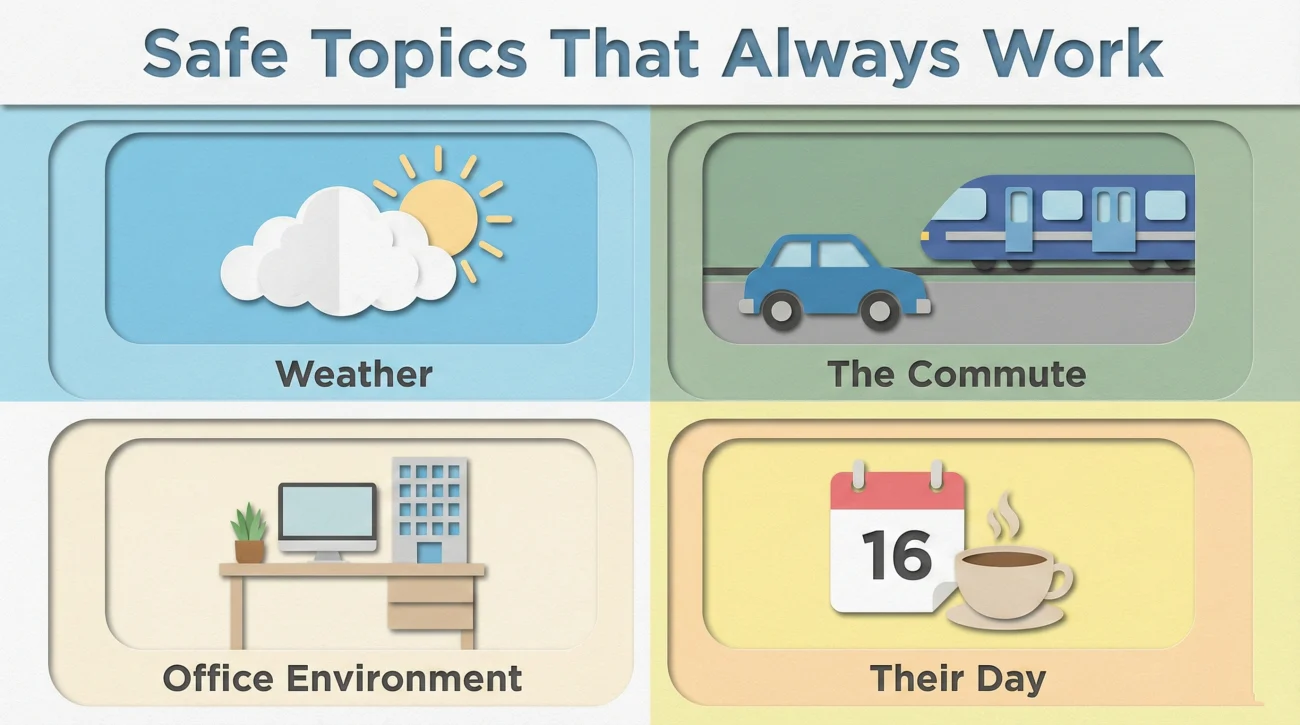
The Commute and Weather
These feel cliché because they are universal. Everyone has opinions about traffic and weather, which makes them safe. Keep it brief and transition naturally.
- “The drive over was smooth. Is parking usually this easy?”
- “Beautiful day out there. Does the office ever do outdoor events?”
- “I took the train in. How do most people commute here?”
The goal is not a deep conversation about meteorology. It is filling silence with something neutral while you both settle in.
The Office Environment
Commenting positively on something you observe shows attentiveness and gives them something easy to respond to.
- “This office space is great. Did you recently renovate?”
- “I noticed the art in the lobby. Is that a company collection?”
- “The view from up here is impressive. Do you ever get used to it?”
💡 Pro Tip: Notice something specific rather than generic. “Great office” means nothing. “Those standing desks look interesting” starts a conversation.
Their Day
Showing interest in the interviewer as a person builds rapport. Simple questions work:
- “How has your day been so far?”
- “Busy morning? I saw the calendar looked packed.”
- “Is this your usual interview day or do they vary?”
Recent Company News
If you did your research, referencing something positive shows preparation without being heavy-handed.
- “Congratulations on the product launch last week. The coverage looked great.”
- “I saw you opened the new office in Denver. Is the team excited about the expansion?”
Topics to Avoid
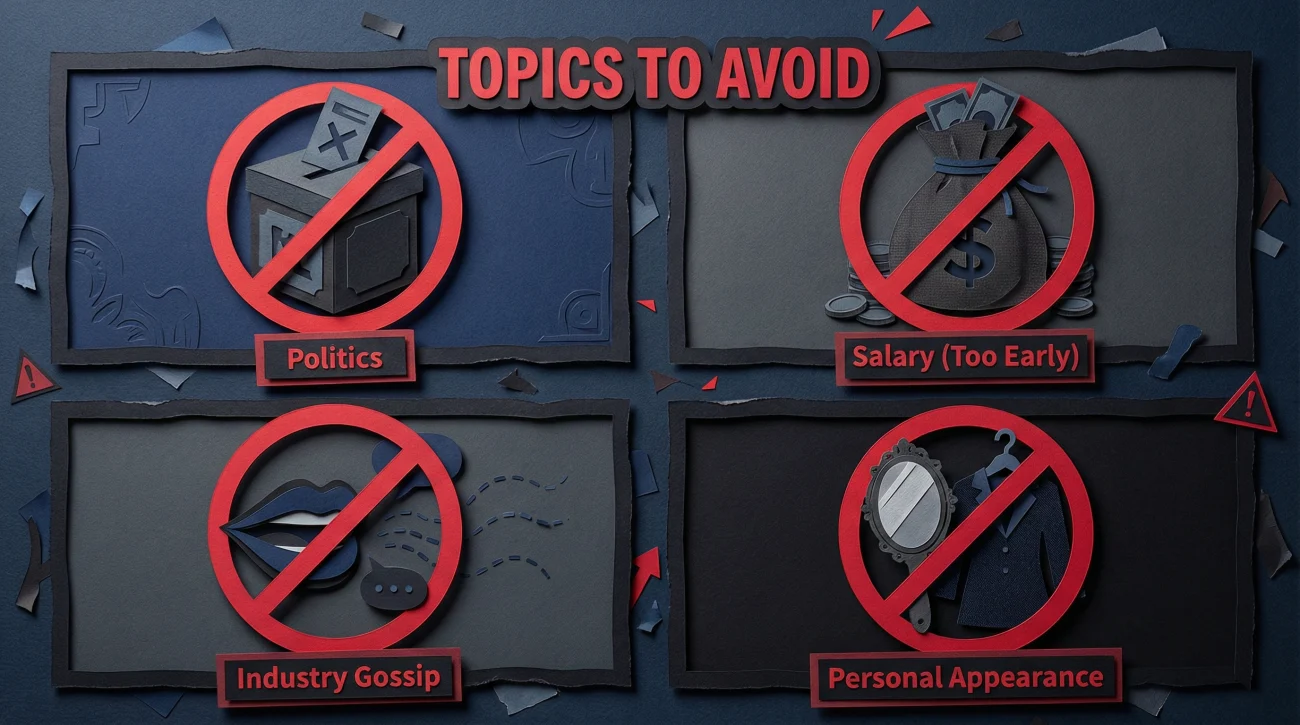
Some subjects derail small talk into uncomfortable territory. Avoid these even if the interviewer brings them up.
Politics and current events
Even seemingly neutral news topics can reveal political leanings that create friction. If they mention something political, respond neutrally and redirect: “Interesting times. So how long have you been with the company?”
Personal compliments on appearance
“Nice suit” might be fine. “You look great” is uncomfortable. Keep compliments focused on professional choices, not personal attributes.
Complaints about anything
Even bonding over shared frustrations sets a negative tone. Avoid complaining about traffic, weather, the economy, or anything else. Stay positive.
Salary or benefits (too early)
Small talk is not the time to ask about compensation, vacation days, or perks. Save those questions for appropriate moments later.
Gossip about the industry
Even if you share industry connections, avoid speaking negatively about other companies or people. You never know who knows whom.
Warning: If the interviewer brings up an inappropriate topic, do not engage deeply. Give a brief neutral response and redirect to safer ground.
Reading Their Cues
Not every interviewer wants extended small talk. Some prefer to get straight to business. Learn to read signals.
Signs They Want to Chat
- They ask open-ended questions about your day or commute
- They share personal anecdotes unprompted
- They seem relaxed and unhurried walking to the room
- They offer coffee and settle in slowly
Signs They Want to Start
- They move briskly to the meeting room
- They check their watch or phone
- They open with “Should we get started?”
- Their responses are brief and functional
Match their energy. If they want to chat, engage warmly. If they want to start, do not force extended conversation.
“I tried making small talk with an interviewer who clearly wanted to jump into questions. She kept giving one-word answers and glancing at her notepad. I should have taken the hint, but I kept trying to warm things up. It just made the start more awkward.”
Transitioning to the Formal Interview
Small talk should flow naturally into the interview, not stop abruptly. Watch for their transition signals and follow smoothly.
Common Interviewer Transitions
- “Well, should we dive in?”
- “So, tell me about yourself.”
- “Let me tell you a bit about the role first.”
- *Opens notepad or laptop*
When you see these signals, shift your posture slightly to show you are ready for business mode. The transition should feel natural, not jarring.
If Small Talk Stalls
Sometimes conversation dies before the interviewer is ready to start. Rather than sitting in awkward silence, you can gracefully prompt the transition:
- “I am excited to learn more about the role. Whenever you are ready.”
- “Thanks for taking the time today. I have been looking forward to this conversation.”
Small Talk in Virtual Interviews
Video interviews change small talk dynamics. You cannot comment on the office, the commute is irrelevant, and the awkward silence while technology connects adds extra tension.
Virtual-Friendly Openers
- “Thanks for setting this up. How is your day going so far?”
- “Nice background. Are you working from home or the office today?”
- “I appreciate the calendar invite details. Made it easy to prepare.”
Handling Technical Awkwardness
If there are audio delays, someone freezes, or backgrounds glitch, acknowledge it lightly: “Technology keeping us on our toes today.” Then move on. Making a big deal of technical issues extends the awkwardness.
Energy Through the Camera
Small talk energy that works in person can seem flat on video. Increase your facial expressiveness and vocal variety slightly. What feels over-the-top to you often reads as normal through a webcam.
Expert Advice: “Virtual small talk is harder because you miss physical cues. I compensate by smiling more deliberately and nodding visibly. It feels exaggerated but comes across as engaged on screen.”
Small Talk at the End
Interviews often end with a few minutes of casual conversation as well. This closing small talk matters too. It is your last impression before they evaluate you.
Keep it positive and forward-looking:
- “This was really helpful. I am even more excited about the opportunity.”
- “Thanks for sharing so much about the team. It sounds like a great environment.”
- “I enjoyed our conversation. Please reach out if you need anything else from me.”
End on warmth, not desperation. Express genuine interest without begging for the job.
❓ FAQ
🤐 I am terrible at small talk. Can I skip it?
Not really. You can keep it brief, but refusing to engage looks cold or nervous. Prepare two or three safe topics in advance so you are not improvising under pressure.
😅 What if I say something stupid?
Laugh it off briefly and move on. A minor stumble in small talk is forgotten quickly if the rest of the interaction goes well. Do not apologize repeatedly or draw more attention to it.
🎭 Should I memorize small talk lines?
Have topics in mind, not scripts. Memorized lines sound robotic. Know what subjects you can comment on, then speak naturally in the moment.
📍 They mentioned something I know nothing about. What do I do?
Ask a question. “I have not heard of that. What is it about?” shows curiosity rather than ignorance. People enjoy explaining things they care about.
⏱️ How long should small talk last?
Two to five minutes is typical. Any shorter feels abrupt; much longer delays the interview purpose. Follow their lead on when to transition.
Final Thoughts
The minutes before formal questions begin are not wasted time. They establish the emotional tone for everything that follows. An interviewer who likes you during small talk is primed to interpret your answers favorably. One who found you awkward or cold starts skeptical.
Effective interview small talk requires knowing safe topics, avoiding landmines, and reading cues about how much conversation they want. Prepare a few observations and questions in advance so you are not scrambling in the moment. The goal is seeming naturally warm and personable, which ironically takes preparation. For more interview strategies across every stage, explore our complete interview preparation guides.
⚠️ Disclaimer: The interview strategies, sample answers, and negotiation tips provided in this guide are for educational purposes only. Hiring decisions are subjective and vary by company and industry. While these strategies are based on professional HR standards, they do not guarantee a specific job offer or result.