Your Voice Carries 100% of the Weight
In face-to-face interviews, your body language does most of the talking. Researchers estimate that up to 55% of communication comes from nonverbal cues: your posture, eye contact, handshake, smile. On a phone interview? All of that disappears. What remains is your voice, carrying the entire burden of making an impression.
This is why mastering phone interview tips starts with understanding one uncomfortable truth: you have roughly fifteen minutes to convince a stranger to like you, and they cannot see your face.
I have screened thousands of candidates over my twelve years in HR. The ones who advance past the phone screen are not always the most qualified. They are the ones who sound confident, engaged, and easy to talk to. A nervous candidate with perfect qualifications often loses to someone with decent qualifications and excellent phone presence.
Expert Advice: “I once interviewed two candidates back-to-back for a marketing role. The first had ten years of experience but spoke in monotone, hesitated constantly, and sounded like she was reading from a script. The second had five years but laughed at the right moments, varied her pitch, and sounded genuinely excited. Guess who got the in-person interview?”
The good news? A phone interview gives you advantages that in-person interviews do not. You can have notes in front of you. You can stand, pace, gesture wildly, and nobody knows. You can control your environment completely. The candidates who use these advantages wisely consistently outperform those who treat the phone screen as less important than the real thing.
Voice Modulation: The Skill Nobody Teaches
Research suggests that 38% of communication impact comes from tone of voice alone. When you remove visual cues, that percentage effectively becomes everything. Yet most candidates spend hours preparing what to say and zero minutes practicing how to say it.
Controlling Your Pace
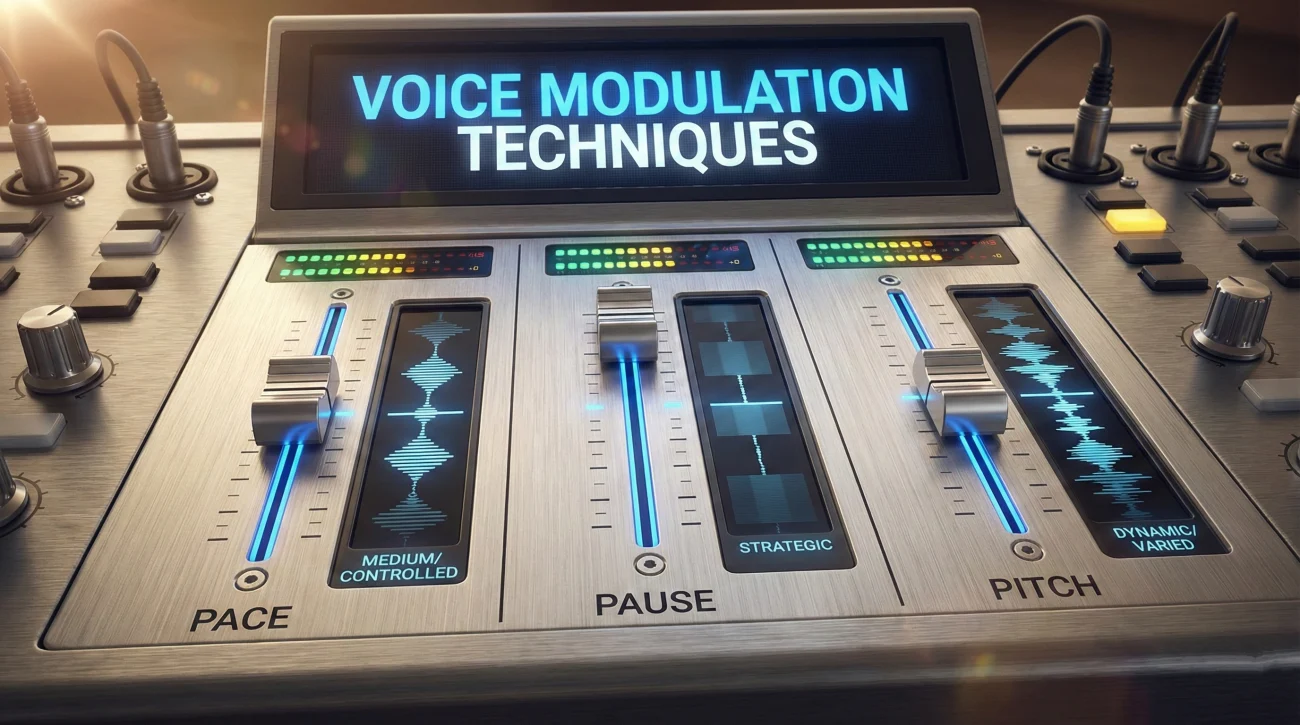
Nervous candidates speak fast. Very fast. They rush through answers, afraid of silence, cramming information into every second. This creates two problems: the interviewer cannot follow along, and the candidate sounds anxious.
The fix is counterintuitive. Slow down for important points, then speed up slightly for background information. This variation keeps your voice interesting. Monotone speed is forgettable. Dynamic pacing is memorable.
💡 Pro Tip: Record yourself answering “Tell me about yourself” and play it back at half speed. If it still sounds rushed, you are talking too fast.
The Power of Strategic Pauses
Most candidates fear silence on a phone call. They fill gaps with “um,” “uh,” “you know,” and other verbal fillers that signal nervousness. But a one-to-two second pause before an important point creates emphasis. It signals confidence. It gives the interviewer time to process what you just said.
A colleague of mine in recruiting calls this the “radio announcer technique.” Professional radio hosts pause constantly. Those pauses make their voices compelling. The same principle applies to phone interviews.
Pitch and Volume Variation
A monotone voice puts interviewers to sleep. Literally. I have caught myself zoning out during phone screens because the candidate sounded like they were reading a phone book. Vary your pitch naturally: slightly higher when expressing enthusiasm, lower when making serious points. Adjust volume for emphasis: louder for achievements, softer for reflective moments.
Here is the simplest trick I know: smile while you talk. It sounds ridiculous, but smiling physically changes your voice. It lifts your pitch slightly and injects warmth into your tone. The interviewer cannot see your smile, but they can absolutely hear it.
The Standing Strategy
Professional voice actors and radio personalities stand while recording. There is a reason. Standing improves your breathing, increases your energy, and projects more confidence through your voice. Your posture directly affects how you sound, even when nobody can see you.
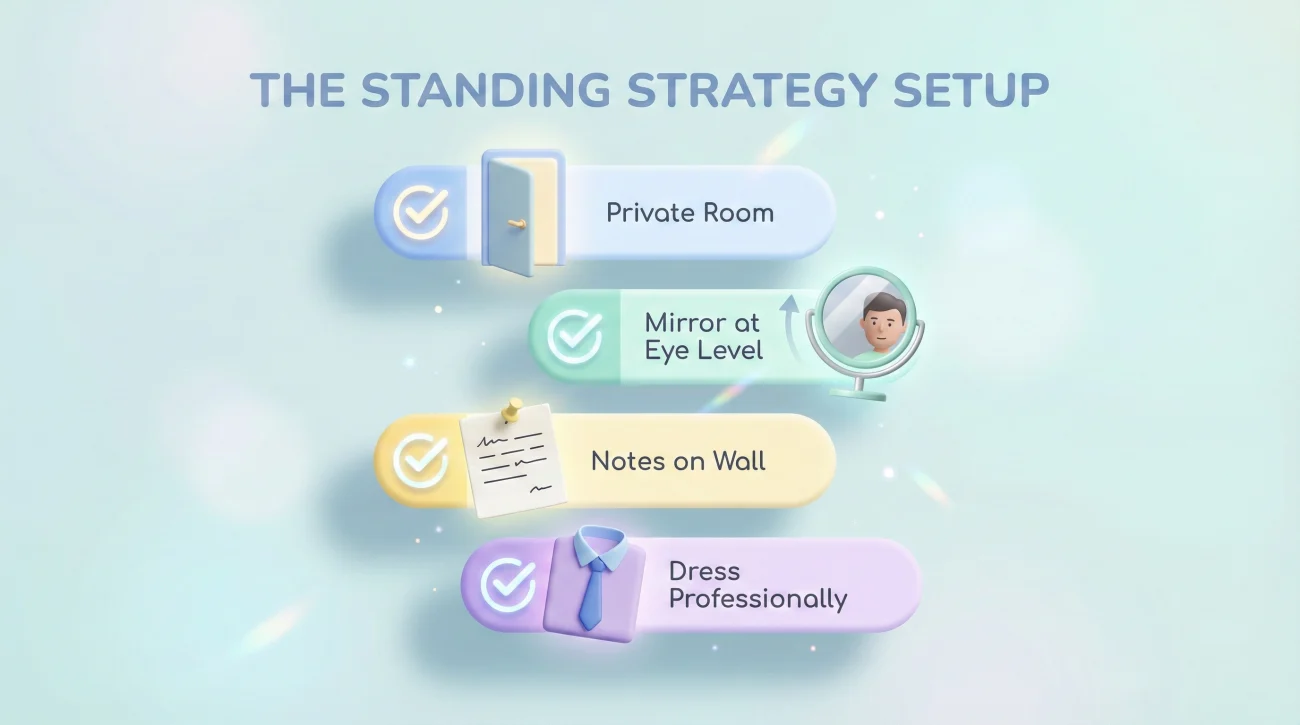
I recommend this setup to every candidate I coach:
- Find a private room where you can stand and move
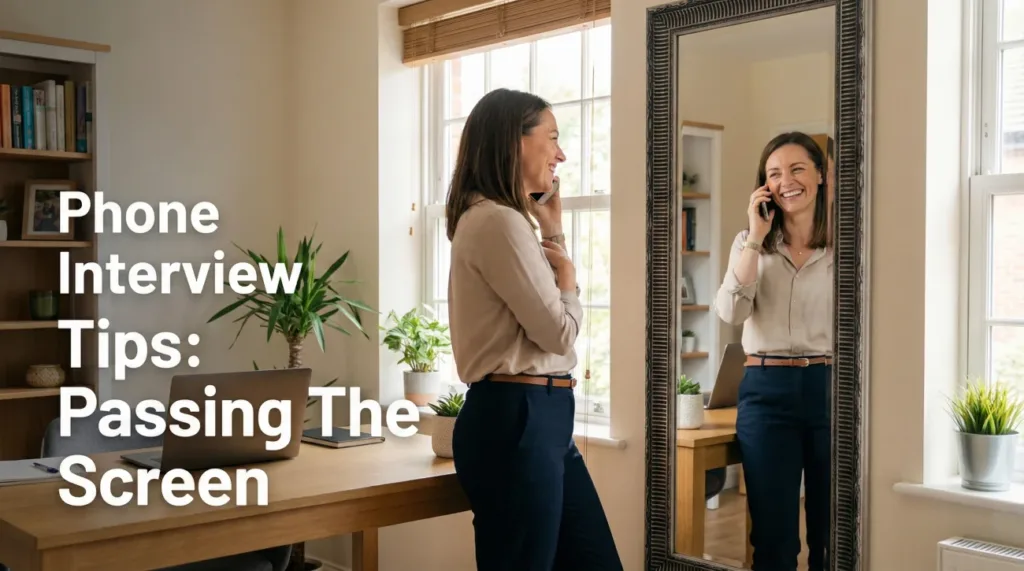
- Place a small mirror at eye level (stick it on the wall or use a vanity mirror on a shelf)
- Keep your notes on a music stand or taped to the wall at eye level
- Dress professionally from the waist up, even though nobody sees you
The mirror serves two purposes. First, it reminds you to smile. Second, it provides visual feedback on your energy level. If you look bored or stiff in the mirror, you sound bored or stiff on the phone.
Expert Advice: “A friend who works in sales told me he does all his important calls while standing in front of a mirror, dressed in a suit. I thought he was crazy until I tried it. The difference in my voice was immediate. Now I recommend it to every nervous candidate.”
Walking slowly while talking also helps. It prevents the stiffness that comes from sitting rigidly and keeps your energy up throughout a thirty-minute call. Just avoid pacing so quickly that you sound breathless.
The Cheat Sheet: Your Secret Weapon
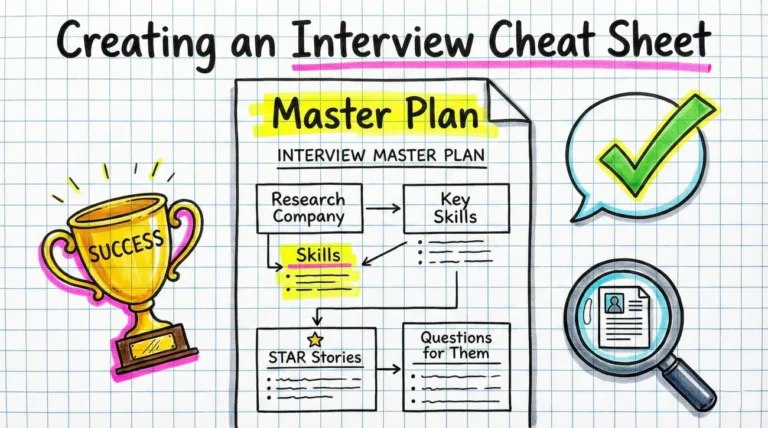
Here is the biggest advantage of a phone screen interview: the interviewer cannot see what you have in front of you. Use this. Create a cheat sheet that keeps you focused and prevents blank-mind moments.
What to Include on Your Cheat Sheet
Keep it to one page. Dense paragraphs defeat the purpose because you will fumble trying to find information. Use bullet points with key phrases, not complete sentences.
| Section | What to Write |
|---|---|
| Top of page | Interviewer’s name, their title, company name |
| Company facts | Recent news, mission statement keywords, competitor names |
| Job keywords | Top three skills from the job description |
| Your stories | Three achievement bullet points with numbers (increased sales 40%, reduced errors 25%) |
| Questions to ask | Three thoughtful questions about the role or team |
| Salary range | Your researched range if asked about expectations |
How to Reference Notes Without Sounding Scripted
The danger of having notes is sounding like you are reading. Interviewers notice immediately when a candidate’s natural conversation suddenly turns into robotic recitation.
Use your notes for keywords only. Glance at them to remind yourself of key numbers or company facts, then look away and speak naturally. Never write out complete answers. If you write “I have five years of experience in project management where I led cross-functional teams,” you will read it word for word and sound rehearsed.
Instead, write: “5 yrs PM, cross-functional, 12-person team, $2M budget.” Those keywords trigger your memory without tempting you to read verbatim.
Common Mistakes That Kill Your Phone Presence
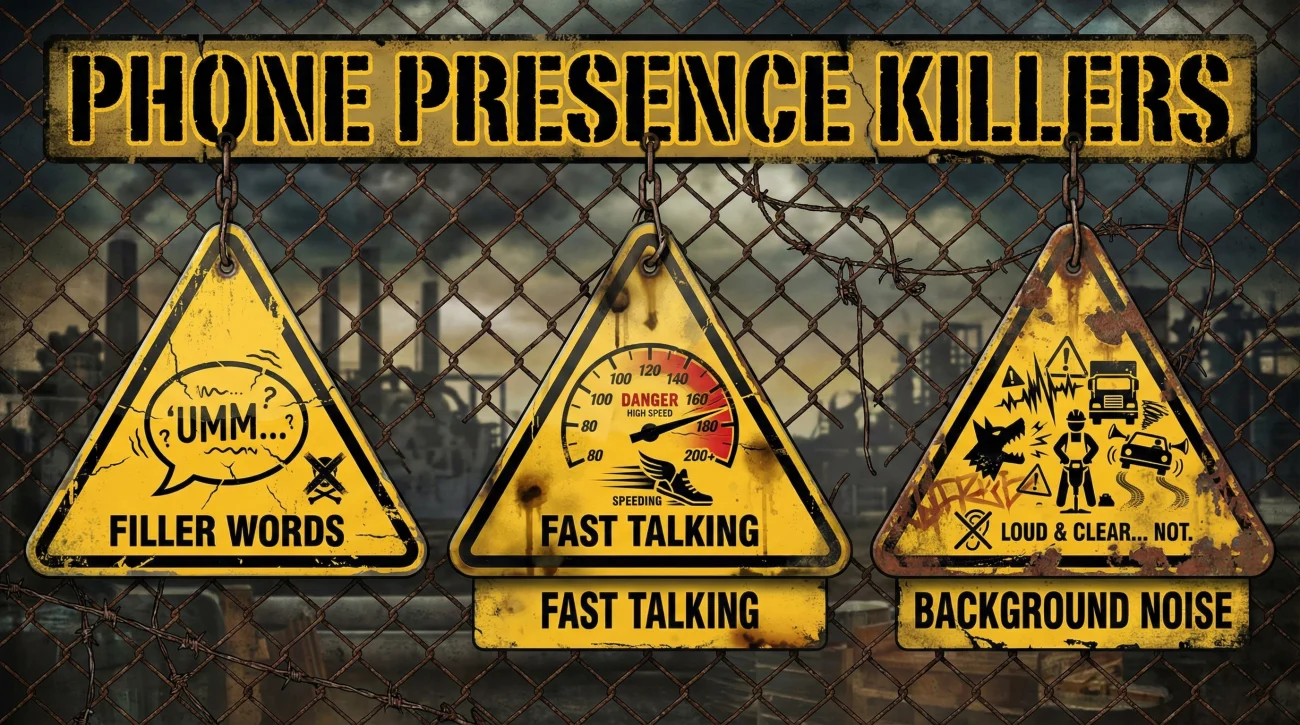
Some candidates prepare their content perfectly but sabotage themselves with bad phone habits. Here are the most common ones I hear:
What happens when I say “um” or “like” too often?
Filler words signal nervousness and make you sound unprepared. Every “um” creates a mental hiccup for the interviewer. The solution is not eliminating pauses but replacing fillers with silence. A brief pause sounds confident. “Um” sounds uncertain.
Does speaking too quickly hurt my chances?
Absolutely. Fast talking makes you hard to follow and suggests anxiety. If the interviewer asks you to repeat yourself more than once, you are speaking too fast. Slow down, especially for complex answers or technical explanations.
What about background noise?
Nothing derails a phone interview faster than a dog barking, roommate talking, or traffic noise. Find a quiet room, close doors and windows, and tell everyone in your household that you need silence for the next hour. If you live somewhere noisy, consider using noise-canceling headphones with a microphone.
Warning: Eating, drinking coffee, or chewing gum during a phone interview is audible and unprofessional. Keep only water nearby for dry mouth.
❓ FAQ
🎯 How long should a phone interview last?
Most phone screens run fifteen to thirty minutes. If yours ends in under ten minutes, it may be a bad sign. If it extends past forty-five minutes with enthusiastic conversation, you are likely moving forward.
📱 Should I use a landline or cell phone?
Use whichever has better call quality. Test your cell signal ahead of time by calling a friend from the location where you plan to interview. If you experience dropped calls or static, find a landline or move to a different room.
⏰ What if the interviewer calls late?
Wait at least fifteen minutes before assuming the call is canceled. If they are more than twenty minutes late, send a polite email asking if they would like to reschedule. Do not let frustration enter your voice if they apologize for the delay.
💼 Can I ask about salary during the phone screen?
Wait for them to bring it up. If they ask about your expectations, give a researched range rather than a single number. If salary is never mentioned, save the question for later interview stages.
✨ How do I end the call strongly?
Thank them for their time, express genuine enthusiasm for the role, and ask about next steps. “Thank you for this conversation. I am very interested in this opportunity. What does the rest of your hiring process look like?” is a solid closer.
Final Thoughts
The phone interview is not a lesser version of the real interview. It is a different skill entirely, one where your voice must compensate for everything your body language normally communicates. The candidates who treat it seriously, who practice voice modulation, who build a proper cheat sheet, and who stand up while they talk consistently outperform those who wing it from their couch.
These phone interview tips work because they address the fundamental challenge: sounding confident, engaged, and likable without any visual cues. Master your voice, prepare your environment, and use the invisibility to your advantage. For more strategies on navigating the interview process, explore our comprehensive guides. The screen call is just the beginning, but it determines whether you get the chance to prove yourself in person.
⚠️ Disclaimer: The interview strategies, sample answers, and negotiation tips provided in this guide are for educational purposes only. Hiring decisions are subjective and vary by company and industry. While these strategies are based on professional HR standards, they do not guarantee a specific job offer or result.