Registered Nurse (RN) Interview Questions: What Employers Test
Registered nurse interviews are built around real bedside decisions: assessment, safety, communication, and prioritization. In registered nurse interview questions, you’ll be asked to apply the nursing process, interpret vital signs for early deterioration, follow medication-safety protocols (the five rights), and use SBAR when escalating concerns to physicians. Interviewers also listen for how you protect patient safety while staying calm and compassionate under pressure.
This guide covers systematic patient assessment, safe medication administration, clinical judgment, and professional communication. For more practice with storytelling/STAR answers, see our Behavioral Interview Questions guide, or explore the full interview resource center.
Nursing Process and Clinical Assessment
Q: Walk me through how you apply the nursing process with a new patient admission.
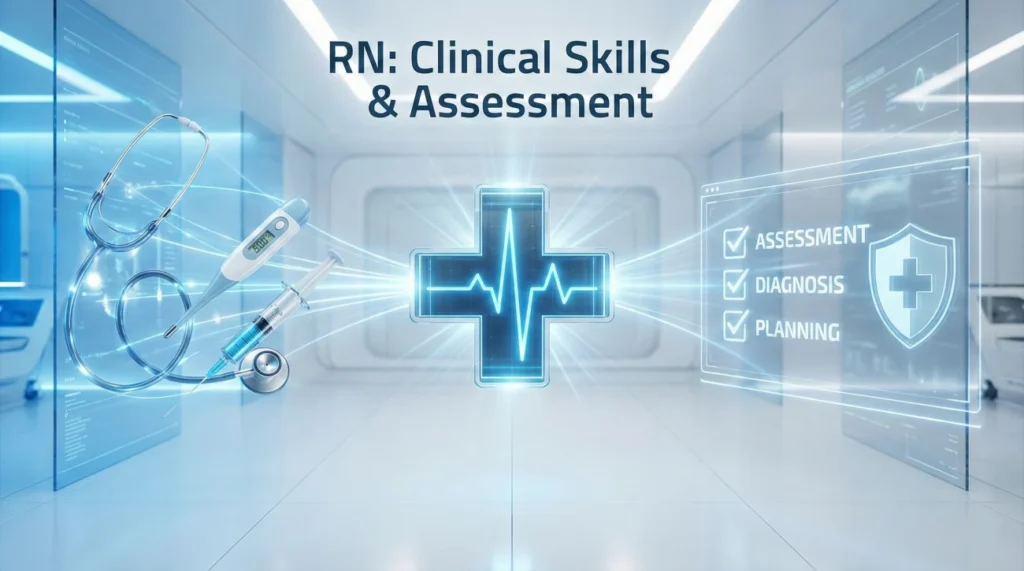
Nursing process follows five systematic steps ensuring comprehensive care. Assessment begins collecting subjective data through patient interview about chief complaint, medical history, current medications, allergies with specific reactions, and objective data measuring vital signs including temperature, pulse, respirations, blood pressure, oxygen saturation, pain scale. I perform head-to-toe physical examination assessing skin condition, lung sounds bilaterally, heart sounds, bowel sounds, extremity strength and sensation.
Diagnosis phase analyzes collected data formulating nursing diagnoses like “Acute pain related to surgical incision” or “Risk for falls related to weakness and unfamiliar environment.” Planning establishes patient-centered goals with measurable outcomes and evidence-based interventions. Implementation executes care plan through medication administration, wound care, patient education, mobilization assistance. Evaluation measures whether interventions achieved desired outcomes, requiring reassessment and plan modification based on patient response. This systematic approach prevents missed care needs and ensures continuity across shifts.
Q: How do you interpret vital signs to recognize early patient deterioration?
Vital sign interpretation extends beyond identifying abnormal individual values to recognizing concerning patterns indicating deterioration. Progressive tachycardia from 88 to 102 to 118 combined with blood pressure dropping from 128/76 to 110/65 to 98/52 suggests hypovolemia from bleeding or sepsis requiring immediate physician notification. Respiratory rate increasing from 18 to 24 to 28 with oxygen saturation declining from 96% to 92% to 88% despite supplemental oxygen indicates respiratory compromise needing urgent intervention.
I assess vital signs within patient context: blood pressure 90/50 may be normal baseline for athletic young adult but concerning for elderly patient on antihypertensives. Fever with tachycardia and altered mental status triggers sepsis alert following facility protocol. I document trends comparing current values to admission baseline and recent measurements, notifying provider when concerning patterns emerge rather than waiting for single critical value. Early recognition prevents deterioration requiring ICU transfer or rapid response activation.
Q: Describe a time you recognized a patient emergency and how you responded.
During night shift, post-operative patient developed sudden weakness in left arm. When physician advised monitoring only, I remained concerned about stroke possibility given symptom acuity. I immediately alerted charge nurse explaining my assessment findings: unilateral weakness onset within past 15 minutes, patient unable to raise left arm against gravity, facial droop on left side noted during reassessment.
Together we initiated stroke alert per hospital protocol. Patient received rapid neurological evaluation, CT scan confirmed ischemic stroke, and received appropriate treatment during critical intervention window. This experience reinforced importance of trusting clinical judgment, advocating persistently for patients when initial provider response seems inadequate, and collaborating with nursing team for timely escalation. I learned systematic stroke assessment using FAST acronym: Face drooping, Arm weakness, Speech difficulty, Time to call emergency response.
Q: How do you prioritize care when managing multiple patients with competing needs?
Prioritization applies ABC framework: airway, breathing, circulation take precedence over all other needs. Patient experiencing chest pain with dyspnea receives immediate assessment before scheduled medication administration for stable patient. I evaluate acuity considering vital sign stability, consciousness level, recent procedures or medication changes, fall risk, required time-sensitive interventions like antibiotic administration within specific windows.
I cluster care combining tasks during single patient visit: performing assessment while administering medications, providing education during wound dressing change, discussing discharge planning while assisting with morning hygiene. I delegate appropriately assigning stable patient vital signs and activities of daily living to certified nursing assistants while I manage higher acuity patients requiring clinical judgment. I remain flexible re-prioritizing when patient conditions change or emergency admissions arrive, communicating transparently with patients about brief delays when critical situations demand attention.
Medication Safety and Error Prevention
Q: Beyond the five rights, what additional medication safety checks do you perform?
Traditional five rights verify right patient using two identifiers and barcode scanning, right medication checking order against MAR and label three times, right dose calculating weight-based dosing accurately, right route confirming IV versus IM administration, right time maintaining scheduled windows. I expand safety verification through additional checks: right assessment measuring blood pressure before antihypertensives or heart rate before beta-blockers, right documentation immediately recording administration with patient response, right education explaining medication purpose and expected effects, right evaluation monitoring therapeutic outcomes and adverse reactions.
For high-alert medications like insulin, heparin, warfarin, I obtain independent double-check from second nurse verifying dose calculation and concentration. I question orders seeming excessive or contradicting patient allergies, consulting pharmacy when uncertain about drug interactions or appropriate dosing. I never administer medications I don’t recognize, researching unfamiliar drugs before administration to understand mechanism, side effects, monitoring requirements.
Q: Walk me through your process when you discover you’ve made a medication error.
Patient safety becomes immediate priority upon discovering error. I assess patient for adverse effects based on medication involved: monitoring vital signs after wrong dose, performing focused assessment for medication-specific reactions, preparing emergency interventions if needed like naloxone for opioid overdose. I notify physician immediately using SBAR format describing situation, background of order and what was administered, assessment findings, recommendation for monitoring or intervention.
I complete incident report documenting facts objectively without defensive language, participate in root cause analysis identifying system failures contributing to error rather than individual blame. I inform patient and family honestly about error and monitoring plan, maintaining transparency despite discomfort. I use error as learning opportunity examining what led to mistake, implementing personal safeguards like additional verification steps, sharing lessons with colleagues during safety huddles to prevent similar errors system-wide.
Q: Describe a situation where you questioned a physician’s medication order.
Physician ordered morphine for patient showing oversedation signs from previous opioid dose: respiratory rate 10 breaths per minute, difficult to arouse, oxygen saturation 91% on room air. I recognized additional opioid would increase respiratory depression risk potentially requiring reversal agent or ICU transfer. I called physician explaining assessment findings and pain currently controlled at 4/10 not requiring immediate intervention.
When physician initially insisted on order, I respectfully explained concern about respiratory compromise using specific vital sign data. I suggested alternative plan: reassess pain in one hour, consider non-opioid analgesics like acetaminophen, continue close respiratory monitoring. Physician agreed to modified approach. Patient’s respiratory status improved without additional opioids. This taught me advocacy requires supporting clinical judgment with objective data, maintaining professional tone during disagreement, offering solutions rather than just identifying problems.
Q: How do you educate patients about their medications effectively?
Medication education integrates with administration rather than separate teaching session. I explain medication purpose using patient-friendly language avoiding jargon: “This medication helps lower your blood pressure to protect your heart” versus “This is an antihypertensive agent.” I describe expected timeline like “Pain should improve within 30 minutes” and common side effects to anticipate versus concerning symptoms requiring notification.
I use teach-back method asking patient to explain in their own words rather than yes/no questions verifying understanding. For discharge medications, I provide written instructions including drug name, dosing schedule, important precautions, follow-up requirements. I identify adherence barriers like cost concerns, complex regimens, difficulty swallowing pills, working with pharmacy and provider to find solutions. I document education provided and patient comprehension level guiding continued teaching needs.
SBAR Communication and Team Collaboration
Explain how you use SBAR when escalating patient concerns to physicians.
SBAR provides structured communication ensuring critical information reaches providers efficiently. Situation states problem concisely: “I’m calling about Mr. Johnson in room 412 who has developed increased shortness of breath.” Background provides relevant context: “He’s post-op day 2 from hip replacement, has history of CHF, received 2 liters IV fluids during surgery.” Assessment shares clinical findings: “Current vital signs show respiratory rate 28, oxygen saturation 88% on 2L nasal cannula down from 95% this morning, bibasilar crackles on lung auscultation, patient reports feeling like he can’t catch his breath.”
Recommendation suggests specific action: “I’m concerned about possible fluid overload given his CHF history and IV fluids received. Could you evaluate him for diuretic therapy and consider chest x-ray?” This framework organizes my thinking before calling, demonstrates clinical reasoning, and respects provider time by presenting organized data rather than scattered observations. I prepare vital signs, recent lab results, medication list before calling ensuring I can answer anticipated questions. Effective SBAR communication establishes professional credibility and improves patient outcomes through timely interventions.
How do you handle conflict with nursing colleagues affecting patient care?
Colleague consistently provided incomplete shift handoffs leaving me uncertain about patient status, pending lab results, family concerns requiring follow-up. This delayed my medication administration and assessments while I gathered missing information. Rather than complaining to charge nurse or tolerating problem silently, I addressed situation privately with colleague using non-confrontational language: “I’ve noticed I’m missing some information during handoff. Can we work together to make sure I have everything I need?”
Colleague explained feeling rushed by last-minute admissions during their shift. We collaborated creating structured handoff checklist covering vital sign trends, pain management effectiveness, pending diagnostic results, family dynamics, patient teaching completed. I offered assistance with their end-of-shift tasks when possible allowing adequate handoff time. This resolved issue improving care continuity and our working relationship. Experience taught me addressing conflicts directly with empathy and solution-focus resolves problems more effectively than avoiding confrontation, and systems improvements often benefit entire team beyond individual situation.
Describe managing an anxious family during patient crisis.
Patient experienced sudden deterioration requiring ICU transfer. Family members were frightened asking rapid questions about prognosis, treatment plan, whether they had caused problem by encouraging ambulation. I first acknowledged their emotions: “I understand how scary this is. It’s completely normal to feel worried right now.” I provided private consultation area away from bedside chaos, maintained calm demeanor despite urgent situation.
I explained situation using clear language avoiding medical jargon: “Your mother’s oxygen levels dropped suddenly. We’re doing everything possible to help her breathe more easily.” I gave frequent brief updates every 15-20 minutes even when no significant changes occurred, which reduced anxiety from feeling forgotten. I identified their primary concern about patient comfort, reassuring them about pain management and sedation provided. I connected them with social services and pastoral care for additional support. Effective family communication requires empathy, transparency without false reassurance, regular updates, and recognizing anxiety often manifests as demanding behavior requiring patience rather than defensiveness.
Professional Standards and Documentation
Q: What makes nursing documentation legally defensible and clinically useful?
Documentation serves legal protection, clinical communication, and quality improvement requiring specific standards. Legally sound documentation is timely charted in real-time or immediately after events while details remain fresh, accurate recording exactly what occurred without speculation, complete including all relevant assessment findings and interventions, objective describing observable facts rather than interpretations. I avoid vague terms like “patient tolerated procedure well” instead documenting specific observations: “Vital signs remained stable, no bleeding noted at insertion site, patient denied pain or discomfort.”
I use approved abbreviations per facility policy preventing misinterpretation. I document chronologically with date/time stamps for each entry. I never chart for others, backdate entries, or leave gaps allowing information insertion later. I document all provider notifications including time called, information provided, orders received, actions taken. I understand documentation may be reviewed years later during litigation when memory has faded, making thorough contemporaneous charting essential for legal defense and patient care continuity.
Q: How do you maintain patient confidentiality per HIPAA requirements?
HIPAA compliance requires limiting information sharing to healthcare team members with legitimate treatment relationship. I provide shift report in private area away from visitors and other patients. I avoid discussing patients in public spaces like elevators, cafeteria, parking lots where conversations could be overheard. I verify identity of phone callers requesting patient information ensuring they have authorization before sharing details.
I follow computer security protocols logging out of workstations when stepping away, never sharing passwords, positioning screens away from public view. I keep patient information face-down, shred documents properly rather than discarding in regular trash. I educate patients about their privacy rights including who accesses their records and their ability to restrict certain disclosures. I never post about patients on social media even without identifying information, understanding de-identified details could still breach confidentiality. Privacy violations carry severe penalties and destroy patient trust making compliance non-negotiable.
Q: Describe your approach to continuing education and professional development.
Nursing requires lifelong learning as evidence-based practices evolve. I maintain licensure through required continuing education selecting courses relevant to my practice area: critical care, medical-surgical, emergency nursing. I subscribe to nursing journals reading research studies about clinical topics I encounter, applying evidence to practice when studies support changing current approaches. I pursue specialty certification like CCRN demonstrating advanced knowledge and commitment to excellence.
I attend hospital in-services learning about new equipment, updated protocols, recently approved medications. I participate in unit-based education committees, quality improvement initiatives, evidence-based practice councils contributing to nursing research and protocol development. I seek preceptor opportunities mentoring new graduates reinforcing my own knowledge through teaching. I request feedback from charge nurses and managers identifying growth areas, creating action plans addressing skill gaps. Professional development ensures I provide current best-practice care benefiting patient outcomes and career advancement.
Q: How do you prevent burnout while managing nursing’s emotional demands?
Nursing’s emotional toll requires intentional self-care preventing compassion fatigue. I process difficult patient outcomes through peer debriefing discussing feelings with colleagues who understand unique stresses rather than suppressing emotions. I maintain work-life boundaries not checking work communications on days off, allowing complete mental disengagement for recovery. I practice stress management techniques like exercise, meditation, hobbies providing outlets unrelated to healthcare.
I recognize burnout warning signs: increased cynicism, emotional detachment from patients, physical exhaustion, decreased job satisfaction. I seek support through employee assistance programs when needed, discussing mental health openly without shame. I advocate for healthy staffing ratios and collaborative team environments addressing systemic factors contributing to burnout. I celebrate patient successes and meaningful moments remembering why I chose nursing. Sustainable career requires prioritizing self-care ensuring I can provide compassionate quality care long-term.
RN Clinical Knowledge Test
20 Practice Questions
1. The first step in the nursing process is?
- Assessment
- Planning
- Implementation
- Evaluation
2. SBAR communication stands for?
- Situation, Background, Assessment, Recommendation
- Safety, Baseline, Action, Response
- Symptoms, Biology, Analysis, Results
- Status, Behavior, Alerts, Report
3. Which vital sign change most urgently requires intervention?
- Temperature 99.0°F in afternoon
- Oxygen saturation 88% with respiratory rate 28
- Heart rate 92 after walking
- Blood pressure 132/84
4. The five rights of medication administration do NOT include?
- Right patient
- Right dose
- Right insurance
- Right time
5. Before administering antihypertensive medication, you should?
- Check blood pressure
- Obtain urine sample
- Draw blood glucose
- Assess pupil response
6. Which patient requires immediate attention?
- Scheduled medication due in 30 minutes
- New onset confusion with oxygen saturation 89%
- Family requesting update
- Discharge planning needed
7. When you discover a medication error, first priority is?
- Complete incident report
- Assess patient for adverse effects
- Notify supervisor
- Document in chart
8. Documentation should be?
- Completed at end of shift
- Timely, accurate, complete, objective
- Brief with minimal detail
- Focused only on abnormal findings
9. Early signs of sepsis include?
- Fever, tachycardia, altered mental status
- Bradycardia and hypothermia
- Hypertension and slow pulse
- Normal vitals with mild fatigue
10. HIPAA protects?
- Patient health information confidentiality
- Nurse employment records
- Hospital financial data
- Physician licensing information
11. When physician order seems unsafe, you should?
- Administer as ordered
- Clarify concerns with physician
- Refuse without explanation
- Ask patient’s opinion
12. Teach-back method assesses?
- Patient understanding of education
- Nurse teaching effectiveness only
- Family involvement
- Hospital policy compliance
13. ABC prioritization addresses?
- Assessment, Baseline, Communication
- Airway, Breathing, Circulation
- Advocacy, Boundaries, Competence
- Admission, Bedside, Charting
14. Delegation to nursing assistants appropriately includes?
- Vital signs for stable patients
- Medication administration
- Patient assessment
- Changing sterile dressings
15. Fall risk assessment should occur?
- Only after patient falls
- On admission and with condition changes
- Once per hospital stay
- For elderly patients only
16. Which lab value requires urgent physician notification?
- Glucose 110 mg/dL
- Potassium 6.9 mEq/L
- Sodium 140 mEq/L
- Hemoglobin 12.5 g/dL
17. Informed consent requires patient understanding of?
- Procedure risks, benefits, alternatives
- Hospital billing procedures
- Physician credentials
- Insurance coverage details
18. Pressure injury prevention includes?
- Repositioning every 8 hours
- Frequent turning, skin assessment, pressure relief
- Bed rest for all patients
- Massage over bony prominences
19. Chain of command is used for?
- Unresolved patient safety concerns
- Requesting time off
- Ordering supplies
- Changing assignments
20. Professional boundaries mean?
- Avoiding all patient interaction
- Maintaining therapeutic relationship focused on patient needs
- Becoming friends with patients
- Sharing personal problems with patients
❓ FAQ
🎯 How should new graduate nurses answer experience questions?
Draw from clinical rotations providing specific patient care examples. Describe scenarios from student nursing explaining your assessment process, interventions under supervision, and outcomes achieved. Emphasize willingness to learn and seeking feedback for growth.
💼 What makes behavioral answers effective using STAR method?
STAR structures responses clearly: Situation establishes context, Task describes responsibility, Action explains your steps, Result shares outcome plus learning. Include specific details and measurable results like “Pain decreased from 8 to 3” demonstrating impact.
📊 Should I discuss mistakes when asked about errors?
Yes, discussing mistakes demonstrates accountability and learning from experience. Choose examples where you caught error before harm or took immediate corrective action. Focus on what you learned and changes implemented preventing recurrence.
🔧 How do I address employment gaps or career changes?
Address gaps honestly and briefly, then redirect to qualifications. Explain activities during gap maintaining nursing skills like volunteer work, courses, or family caregiving. For career changers, connect transferable skills to nursing competencies.
✨ What thoughtful questions should I ask interviewers?
Ask about nurse-patient ratios, orientation length, specialty certification opportunities, and unit culture. Avoid questions easily answered through website research. Listen during interview identifying topics for deeper exploration demonstrating genuine interest.
Final Thoughts
Success with registered nurse interview questions requires demonstrating clinical competence through nursing process application, medication safety verification, and vital signs interpretation combined with professional maturity through patient advocacy, collaborative problem-solving, and compassionate communication. Prepare specific examples illustrating how you’ve prioritized competing demands, recognized deterioration early, and maintained therapeutic boundaries while delivering quality care.
⚠️ Disclaimer: The interview strategies, sample answers, and negotiation tips provided in this guide are for educational purposes only. Hiring decisions are subjective and vary by company and industry. While these strategies are based on professional HR standards, they do not guarantee a specific job offer or result.