The Question Nobody Wants to Answer
Sara Blakely, founder of Spanx and a self-made billionaire, credits her success partly to a childhood ritual. Every night at dinner, her father asked her and her brother: “What did you fail at today?” If they had nothing to report, he was disappointed. He was teaching them that failure meant they were trying new things.
When interviewers ask tell me about a time you failed, they are channeling the same philosophy. They want to see how you respond to setbacks, whether you take accountability, and what you learned. Paradoxically, a well-told failure story can be more impressive than a success story. The trap is either denying you have ever failed (unbelievable) or sharing something so catastrophic it raises concerns.
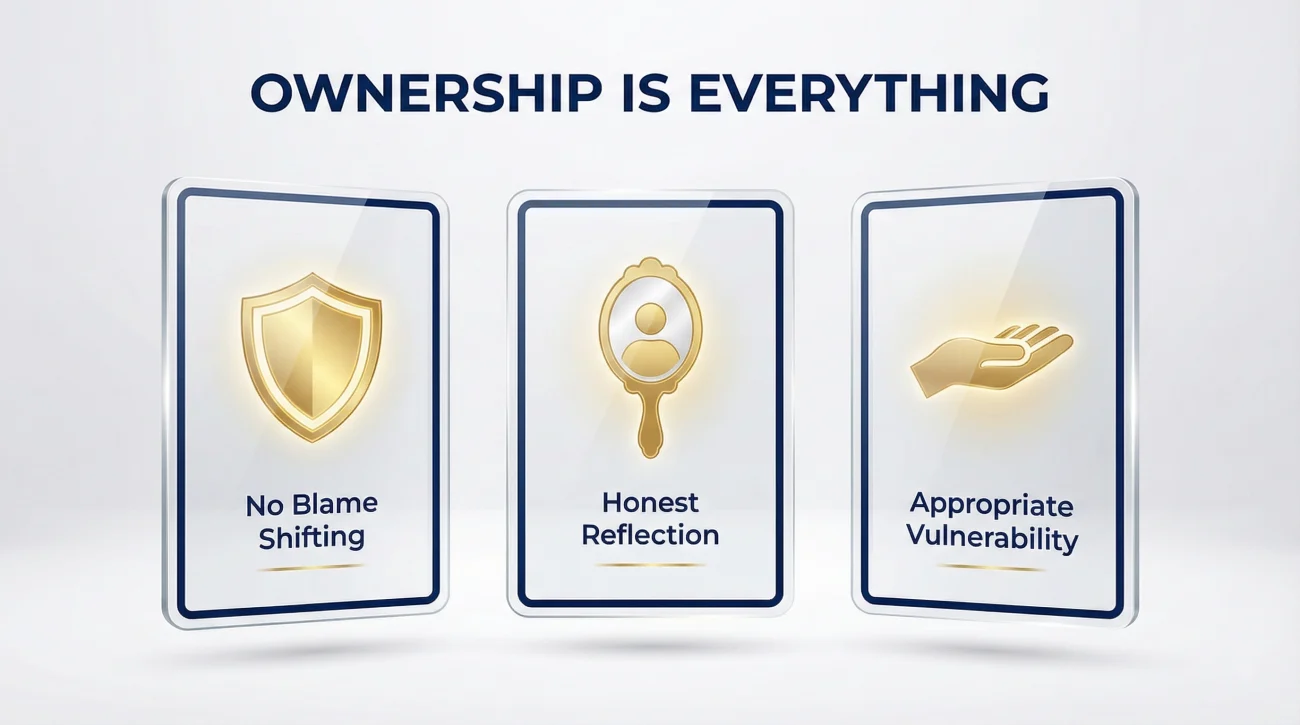
Ownership is Everything
Resist the Blame Reflex
The most common mistake in failure stories is subtle blame-shifting. Phrases like “the project failed because…” followed by external factors signal that you do not truly own your failures. Even when circumstances contributed, interviewers want to hear what you could have done differently.
“The project failed because the client kept changing requirements” shifts blame externally.
“I failed to establish clear change management processes upfront” demonstrates ownership.
Be Genuinely Honest
Interviewers detect when candidates describe “failures” that are actually humble brags: “I worked too hard” or “I cared too much about quality.” These non-answers suggest you cannot acknowledge real weaknesses. Choose an actual failure with real consequences.
A recruiter at Microsoft shared her frustration: “I once had a candidate tell me his biggest failure was ‘being too passionate about the product.’ I wanted to ask him to leave the interview right there. Compare that to a candidate who told me about a product launch that flopped because he ignored user research that contradicted his assumptions. He cost the company six months and significant budget. But he told me exactly what he learned and how he approaches decisions differently now. I hired him. He’s been promoted twice.”
Show Appropriate Vulnerability
Admitting failure requires vulnerability, which builds connection when done appropriately. You do not need to be dramatic or emotional, but showing that you genuinely learned from a difficult experience demonstrates the self-awareness interviewers value.
Failure Stories That Won and Lost Jobs
After twelve years of asking this question, I can tell within the first thirty seconds whether a candidate truly understands failure. Here are real stories that influenced my hiring decisions.
The Product Launch That Taught Humility
A product manager named Eric described launching a feature that bombed. User adoption was near zero despite months of development. When I asked what happened, he did not blame the market or the timing or his team. He said: “I fell in love with my own idea. I had data suggesting users wanted this, but I ignored signals during beta that they didn’t actually need it the way I’d built it. I filtered feedback to hear what I wanted to hear.”
Eric then described what he learned. He implemented a “kill metric” on his next project: if user engagement did not hit a specific threshold by week three of beta, they would pivot or kill the feature regardless of sunk cost. His next three launches were successful.
What made Eric’s answer powerful was the specificity of his self-criticism and the concrete change in behavior. He did not give me a vague “I learned to listen better.” He gave me a specific process change that prevented the same failure from recurring.
The Manager Who Lost Her Best Employee
A team lead named Catherine told me about losing her top performer to a competitor. The employee had given no warning signs. Catherine only learned about the resignation when it was too late to counter-offer.
Catherine did not blame the employee or the competitor’s offer. She said: “I failed to have real conversations about her career. I assumed she was happy because she performed well. I never asked what she wanted next or if she was being challenged. I managed her output but not her growth.”
Catherine revamped how she managed her team. Monthly one-on-ones now include explicit questions about career satisfaction and development needs. She creates growth opportunities proactively rather than waiting for requests. In the three years since, she has not had another surprise resignation.
I hired Catherine because her failure made her a better manager. She did not just feel bad about losing a good employee. She diagnosed the root cause and fixed it systematically.
The “Failure” That Was Actually a Humblebrag
Contrast those with a candidate who told me his biggest failure was “taking on too much responsibility.” He explained that he volunteered for extra projects, worked eighty-hour weeks, and burned out temporarily. The “failure” was caring too much about the company.
I asked follow-up questions trying to find real failure. Had any project actually gone wrong? Had he made a decision that backfired? Had he damaged a relationship through his actions? Every answer deflected to external factors or reframed negatives as positives.
I did not extend an offer. A candidate who cannot acknowledge genuine failure either lacks self-awareness or lacks the trust to be vulnerable. Neither works on my team.
The Sales Rep Who Owned a Million-Dollar Loss
A senior sales rep named Michael told me about losing a million-dollar account he had managed for four years. The client left for a competitor offering similar services at a lower price point.
Michael’s analysis was brutally honest: “I got complacent. I assumed the relationship would carry us through. I missed warning signs: they started asking for competitive pricing, they stopped accepting my meeting requests, their procurement team got more involved. By the time I realized what was happening, they’d already made their decision.”
He now treats every renewal as a new sale. He tracks engagement metrics and flags accounts showing early warning signs. He proactively provides competitive analysis to show clients why they should stay. His retention rate improved significantly after that loss.
Michael got the job because he owned the failure completely and turned it into a competitive advantage. His answer showed me he would not make the same mistake with our clients.
Structuring Your Failure Story
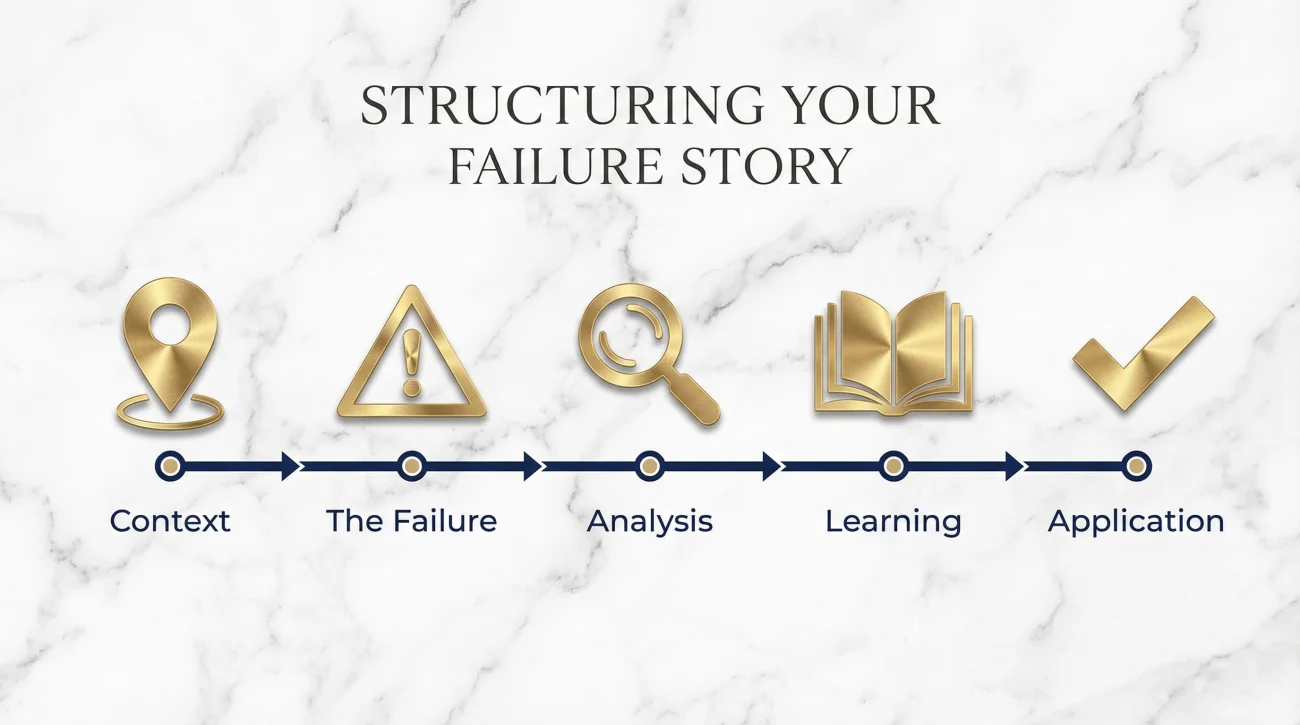
- 📍 Context: Brief setup explaining what you were trying to achieve
- ❌ Failure: What specifically went wrong and your role in it
- 🔍 Analysis: Why it happened and what you could have done differently
- 📚 Learning: Specific lessons you took from the experience
- ✅ Application: How you have applied those lessons since
Spend roughly equal time on the failure itself and the learning that followed. A failure without demonstrated growth is just a mistake. A failure with clear lessons applied is evidence of professional development.
Sample Answer
Situation: Early in my career, I was leading a small project to implement a new reporting system. I was confident in the technical solution and eager to prove myself, so I moved quickly without spending enough time understanding stakeholder needs.
What Failed: I delivered the system on time, but when users started working with it, they found it did not match their actual workflow. The reports looked different from what they expected, and key metrics they needed were missing. We had to essentially redo three weeks of work, and I had to tell my manager that my “successful” delivery was actually a failure.
My Role: Looking back, I failed in two ways. First, I was so focused on the technical challenge that I treated stakeholder input as a checkbox rather than genuinely seeking to understand their needs. Second, I did not set up checkpoints during development where users could see progress and give feedback. I was building in isolation.
What I Learned: This experience taught me that technical success means nothing if it does not solve the actual problem. I learned to invest more time upfront in understanding requirements and to build in feedback loops throughout projects. I also learned that asking clarifying questions is not a sign of weakness but a sign of thoroughness.
How I Have Applied It: On every project since, I start with stakeholder interviews and create prototypes or mockups for early feedback before building anything substantial. On my most recent project, this approach caught a major misunderstanding in week one rather than after delivery. The extra upfront time saves rework every time.
Choosing the Right Failure
| Good Failure Choices | Poor Failure Choices |
|---|---|
| Professional judgment errors you learned from | Ethical failures or serious misconduct |
| Projects that did not achieve desired outcomes | Failures that harmed others significantly |
| Communication or process breakdowns | Ongoing patterns you have not fixed |
| Skill gaps you have since addressed | Failures in core requirements for the role |
Choose a failure significant enough to be genuine but not so catastrophic it raises red flags. The failure should be far enough in the past that you have had time to learn and demonstrate change. For more strategies on discussing setbacks professionally, explore our detailed guides.
❓ FAQ
🎯 How recent should my failure example be?
A failure from one to five years ago works well. Recent enough to be relevant but far enough that you have had time to learn and apply lessons. Very recent failures may not yet show demonstrated growth.
💼 What if the failure was not entirely my fault?
Focus on your contribution to the outcome, not external factors. Even in team failures, you can discuss what you personally could have done differently. Taking partial ownership for shared failures demonstrates maturity.
⏰ Can I describe a failure that turned into a success?
Yes, recovery stories work well. Just ensure the failure portion is genuine and the recovery required real effort and learning, not just luck. The growth from failure to success can be compelling.
📋 How do I discuss failure without seeming incompetent?
Everyone fails. What matters is how you respond. Confident delivery, clear learning, and demonstrated improvement show competence through growth rather than despite the failure. Self-awareness is a strength.
✨ Should I mention if others were also responsible?
Briefly acknowledging team context is fine, but do not use it to dilute your ownership. Interviewers notice when candidates deflect. Take clear responsibility for your portion while maintaining appropriate perspective.
Failure as Evidence of Growth
Answering tell me about a time you failed effectively transforms a potentially awkward question into a showcase of professional maturity. By taking ownership, demonstrating genuine learning, and showing how you have applied those lessons, you prove that failure makes you stronger rather than defining you. That resilience is exactly what employers need.
⚠️ Disclaimer: The interview strategies, sample answers, and negotiation tips provided in this guide are for educational purposes only. Hiring decisions are subjective and vary by company and industry. While these strategies are based on professional HR standards, they do not guarantee a specific job offer or result.