When Right and Easy Diverge
Warren Buffett once told Berkshire Hathaway managers: “Lose money for the firm and I will be understanding. Lose a shred of reputation for the firm and I will be ruthless.” This captures why ethical dilemma interview questions matter so much. A single ethical lapse can destroy decades of built reputation. Companies want to know your moral compass works before they give you access to their trust.
An ethics officer at Johnson & Johnson shared her interview philosophy: “I’m not looking for people who’ve never faced temptation. I’m looking for people who faced it and chose harder right over easier wrong. The candidate who tells me about a genuine ethical struggle, where they lost something by doing the right thing, that’s who I want. Perfect people make me nervous. Tested people I can trust.”
Common Ethical Dilemma Categories
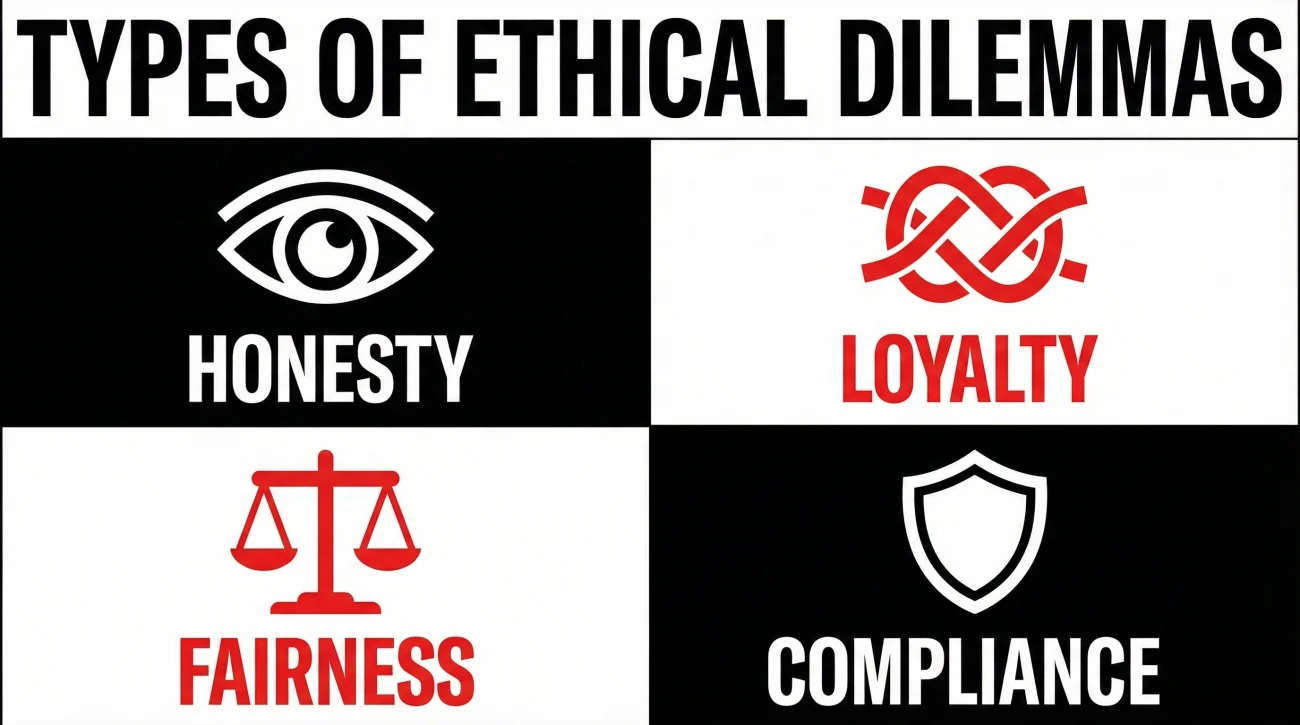
Honesty Dilemmas
Situations requiring truth-telling when honesty has costs: admitting mistakes, reporting problems, or correcting misinformation even when silence would be easier or more personally beneficial.
Loyalty Dilemmas
Conflicts between loyalty to different parties: your team versus the company, a colleague versus a customer, or personal relationships versus professional obligations.
Fairness Dilemmas
Situations involving equitable treatment: resource allocation, opportunity distribution, or decisions affecting people differently based on factors beyond their control.
Compliance Dilemmas
Pressure to bend rules, cut corners on safety or quality, or overlook violations. These often pit short-term convenience against long-term integrity and risk.
Ethics Stories That Defined Character
These questions reveal character under pressure. Here are real interview stories that showed me who candidates truly are when the right choice costs them something.
The Data That Was “Adjusted”
A data analyst named Kevin discovered that his manager had been adjusting metrics in their quarterly reports to make performance look better than it was. The adjustments were subtle, defensible if questioned, but Kevin knew they were misleading leadership about the true state of the business.
Kevin faced a difficult choice. His manager was well-liked and politically powerful. Reporting the issue could destroy Kevin’s career at the company. Staying silent made him complicit. He chose a middle path first: he raised his concerns directly with his manager, documenting the conversation.
The manager dismissed his concerns and implied that Kevin should focus on his own work. Kevin then faced the harder choice. He scheduled a meeting with the compliance team, bringing his documentation. The investigation that followed confirmed the pattern. His manager was terminated.
Kevin told me the aftermath was brutal. Some colleagues treated him as a snitch. He was passed over for one promotion he deserved. But he also received quiet thanks from executives who had been making decisions based on false data. He eventually was promoted, and the company specifically cited his integrity as a factor.
Kevin’s answer showed me something crucial: he tried the least damaging path first (direct conversation) before escalating. He documented everything. And he accepted the professional consequences rather than compromising his values.
The Safety Shortcut He Refused
A construction project manager named Carlos described being pressured by a client to skip a safety inspection that would delay the project by three days. The inspection was technically required but rarely enforced in that jurisdiction. The client offered a significant bonus for on-time completion.
Carlos declined. He told the client: “I understand the pressure you’re under, and I wish I could help you meet that deadline. But I can’t sign off on something that puts workers at risk. If something happens on this site, it won’t matter that we saved three days.”
The client was furious and complained to Carlos’s leadership. His company initially tried to pressure him to reconsider. Carlos held firm, citing both the legal requirements and his personal values. His company eventually backed him, conducting the inspection and delivering three days late.
Carlos told me: “That client never hired us again. But I sleep fine at night. And honestly, my company started trusting me with more sensitive projects because they knew I wouldn’t cut corners under pressure.”
The Colleague Behavior She Could Not Ignore
A team lead named Amanda described discovering that a peer was padding his expense reports. The amounts were small, maybe a few hundred dollars per month, but the pattern was clear: personal meals claimed as client dinners, mileage inflated, receipts that did not match the claims.
Amanda wrestled with what to do. She liked this colleague personally. The amounts seemed trivial compared to his salary. Reporting it felt petty. But she also knew that if she ignored it, she was implicitly approving the behavior.
She chose to raise it with her manager first, framing it as a question rather than an accusation: “I noticed some expense patterns that looked unusual. I want to make sure I understand our policies correctly.” Her manager investigated and discovered the fraud, which turned out to be more extensive than Amanda had seen.
Her colleague was terminated. Amanda never told him she was the one who raised the flag. She told me: “I didn’t do it to punish him. I did it because I couldn’t be part of covering up dishonesty, even small dishonesty. Once you start deciding which ethical violations are okay to ignore, you’ve already lost something important.”
What impressed me about Amanda’s answer was her thoughtfulness about the process. She did not immediately escalate but brought concerns through proper channels. She protected confidentiality afterward. And she was honest about the discomfort she felt, which made her ethical choice more credible.
A Framework for Ethical Decisions
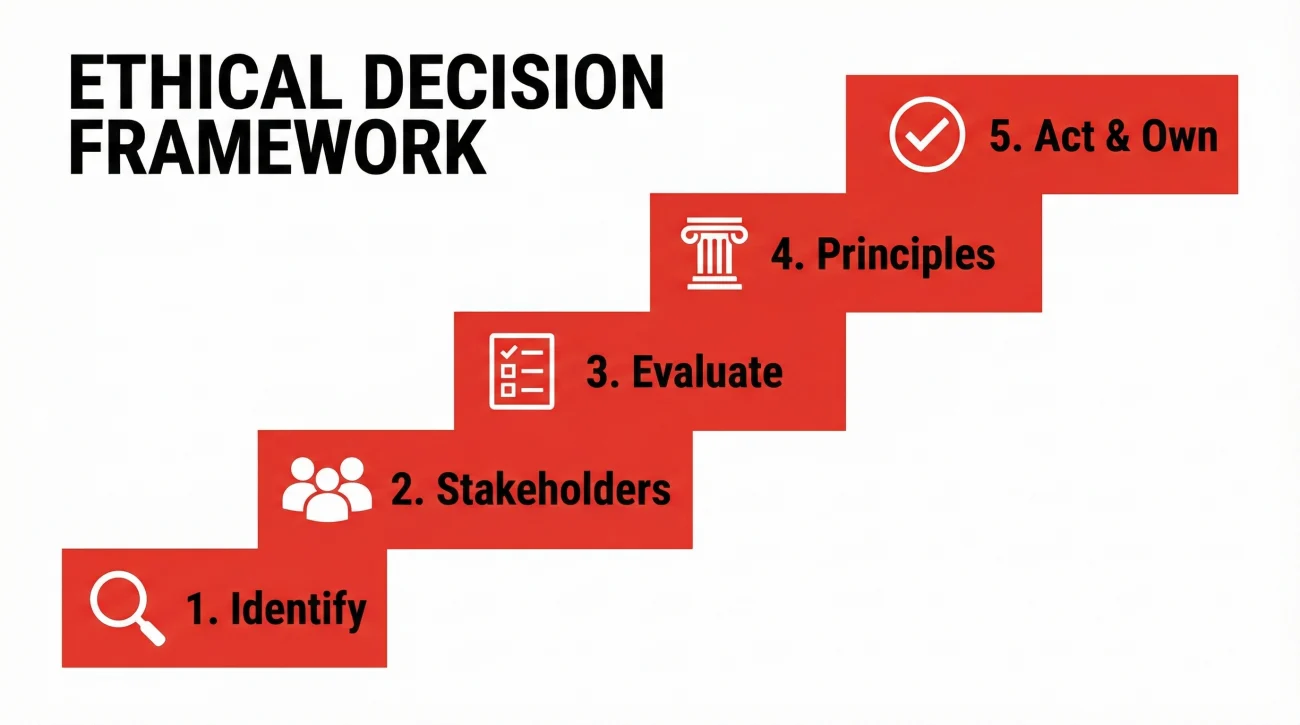
- 🔍 Identify the Conflict: What values or obligations are in tension?
- 👥 Consider Stakeholders: Who is affected and how?
- 📋 Evaluate Options: What choices exist and what are their consequences?
- ⚖️ Apply Principles: What do your values and professional standards require?
- ✅ Act and Own: Make the decision and accept responsibility for it
Mentioning a deliberate decision-making process shows interviewers you approach ethics thoughtfully rather than impulsively. Having a framework demonstrates maturity about complex moral situations.
The question “would I be comfortable if this decision were public?” often clarifies the right path.
Sample Answer
I noticed a colleague on a shared project was inflating hours billed to a client. The amounts weren’t huge, but the pattern was consistent and seemed intentional. The situation was uncomfortable because this person was well-liked and had been personally helpful to me, so addressing it risked creating awkwardness and tension.
I needed to handle the issue responsibly and protect the client relationship and the company, while giving my colleague a fair chance to correct the behavior before it became a formal escalation.
I considered the options carefully: ignoring it to avoid conflict, reporting it immediately, or addressing it privately first. I asked myself what I would want if roles were reversed and what I could live with long-term. Even small-scale fraud put the company at risk and didn’t align with my values, so I decided I couldn’t ignore it.
I asked to speak privately with my colleague. I kept the conversation factual and calm, explaining what I had noticed and asking if there was context I was missing. They were defensive at first, but eventually acknowledged the pattern.
I was clear about the boundary: the behavior needed to stop immediately, and if it continued I would have to report it. At the same time, I tried to handle it in a constructive way by offering to help address any workload or resourcing issues that might have contributed to the temptation to inflate hours.
The billing irregularities stopped. Our relationship was strained for a period, but it eventually recovered after they acknowledged I had handled it fairly by coming to them first.
I didn’t have to escalate, but I was prepared to if necessary. Most importantly, I protected the client and the company, maintained my integrity, and gave my colleague an opportunity to correct course without immediate formal consequences.
Delivering Your Ethics Answer
Show the Genuine Struggle
Easy ethical decisions do not demonstrate much. Your answer should acknowledge that the right choice was difficult, that you weighed competing considerations, and that you accepted real costs or risks. This makes your ethics credible rather than performative.
Avoid Preaching
Describe your decision without moralizing about others who might choose differently. Sanctimonious answers can backfire. Present your values and reasoning clearly while maintaining humility about complex situations.
Own the Consequences
If your ethical choice had costs, acknowledge them without complaint. Willingness to accept consequences for principled decisions is part of what makes the story compelling. For more guidance on demonstrating character in interviews, explore our comprehensive resources.
❓ FAQ
🎯 What if I have never faced a major ethical dilemma?
Ethical dilemmas can be subtle. Consider situations where you had to choose honesty over convenience, fairness over favoritism, or long-term integrity over short-term benefit. Most professionals have navigated these even if they did not feel dramatic at the time.
💼 Should I report on others’ wrongdoing in my answer?
Be careful with this. You can describe situations involving others’ behavior if relevant, but avoid seeming like someone eager to report colleagues. Focus on your reasoning and actions rather than cataloging others’ faults.
⏰ What if my ethical choice did not have a happy ending?
Ethical decisions sometimes have difficult outcomes. You can describe situations where doing the right thing was costly if you show you would make the same choice again. Integrity despite consequences demonstrates strong values.
📋 How do I discuss ethics without seeming judgmental?
Focus on your own decision-making process rather than evaluating others. Use “I” statements about your values and reasoning. Acknowledge complexity and competing considerations rather than presenting situations as black and white.
✨ Can I use a hypothetical ethical scenario?
Real examples are always stronger than hypotheticals. If you genuinely cannot identify a real situation, describe how you would approach a common dilemma while acknowledging you have not faced this specific situation. But try hard to find a real example first.
Integrity Is Non-Negotiable
Answering ethical dilemma interview questions effectively shows that you have clear values and the courage to act on them. By demonstrating thoughtful reasoning, willingness to face difficult choices, and acceptance of consequences for principled decisions, you prove that your integrity is not situational. That reliability is exactly what organizations need from every team member.
⚠️ Disclaimer: The interview strategies, sample answers, and negotiation tips provided in this guide are for educational purposes only. Hiring decisions are subjective and vary by company and industry. While these strategies are based on professional HR standards, they do not guarantee a specific job offer or result.