- Why It Matters: Your manager’s style shapes your daily work more than title or pay, so smart questions help you avoid bad-fit teams before you accept.
- Know The Spectrum: Micromanagers control details and approvals, absentee managers vanish and leave chaos, and the “right” middle depends on your experience level and needs.
- Ask Diplomatically: Use open-ended prompts about working relationship, autonomy, decisions, and check-in cadence so you learn the truth without sounding accusatory.
- Verify With Evidence: Use behavioral questions about mistakes, delegation, and disagreement, then cross-check with teammates and watch real interactions for unscripted signals.
- Choose Fit Over Hope: Trust patterns over promises, align style with how you work best, and do not take the role expecting the manager to fundamentally change later.
Why Management Style Determines Your Daily Reality
Your manager’s leadership approach affects your work more than job title, salary, or company reputation. Micromanagers destroy autonomy and create dependency. Hands-off managers leave teams directionless without support. Somewhere between these extremes lies the management style that matches how you work best. Asking about management style during interviews reveals whether you’re walking into a partnership or a nightmare.
The challenge is probing management approach without seeming accusatory or high-maintenance. Direct questions like “Are you a micromanager?” put interviewers on defense and yield dishonest answers. Strategic candidates learn to ask about management style tactfully, gathering real information while maintaining professional rapport. Understanding broader questions to ask in an interview provides context for these sensitive management discussions.
Understanding the Management Style Spectrum
Before learning how to ask about management style, understand what you’re evaluating. Management approaches range from excessive control to complete autonomy, with most effective managers operating somewhere in the productive middle.
Micromanagement Red Flags
Micromanagers insert themselves into every decision, require constant updates, and struggle to delegate meaningful work. They create bottlenecks where their approval gates all progress and destroy team morale by signaling they don’t trust anyone’s judgment.
- 🔍 Excessive oversight: Wanting updates on minor tasks multiple times daily
- 📊 No delegation: Keeping all interesting work and decision authority
- ✏️ Constant revisions: Redoing work that met stated requirements
- ⏰ Process obsession: Caring more about how work happens than outcomes
Hands-Off Management Problems
The opposite extreme creates different dysfunction. Absent managers provide no direction, feedback, or support. Teams flounder without clear priorities, struggle to make decisions, and lack the air cover needed to navigate organizational politics.
| Management Style | Characteristics | Best For | Worst For |
|---|---|---|---|
| Micromanagement | High oversight, detailed control | Junior employees needing structure | Experienced professionals wanting autonomy |
| Delegative | Clear goals, autonomy on execution | Self-directed experts | People needing guidance or unclear direction |
| Coaching | Regular feedback, development focus | Growth-oriented professionals | Those wanting minimal interaction |
| Absentee | Minimal involvement or support | No one – this is dysfunction | Everyone, especially new team members |
💡 Pro tip: The best management style for you depends on your experience level and preferences. Junior professionals often benefit from more structured oversight, while senior experts thrive with autonomy.
Diplomatic Questions That Reveal Style
These questions about manager style gather information without putting interviewers on defense. They invite managers to describe their approach rather than defend against accusations.
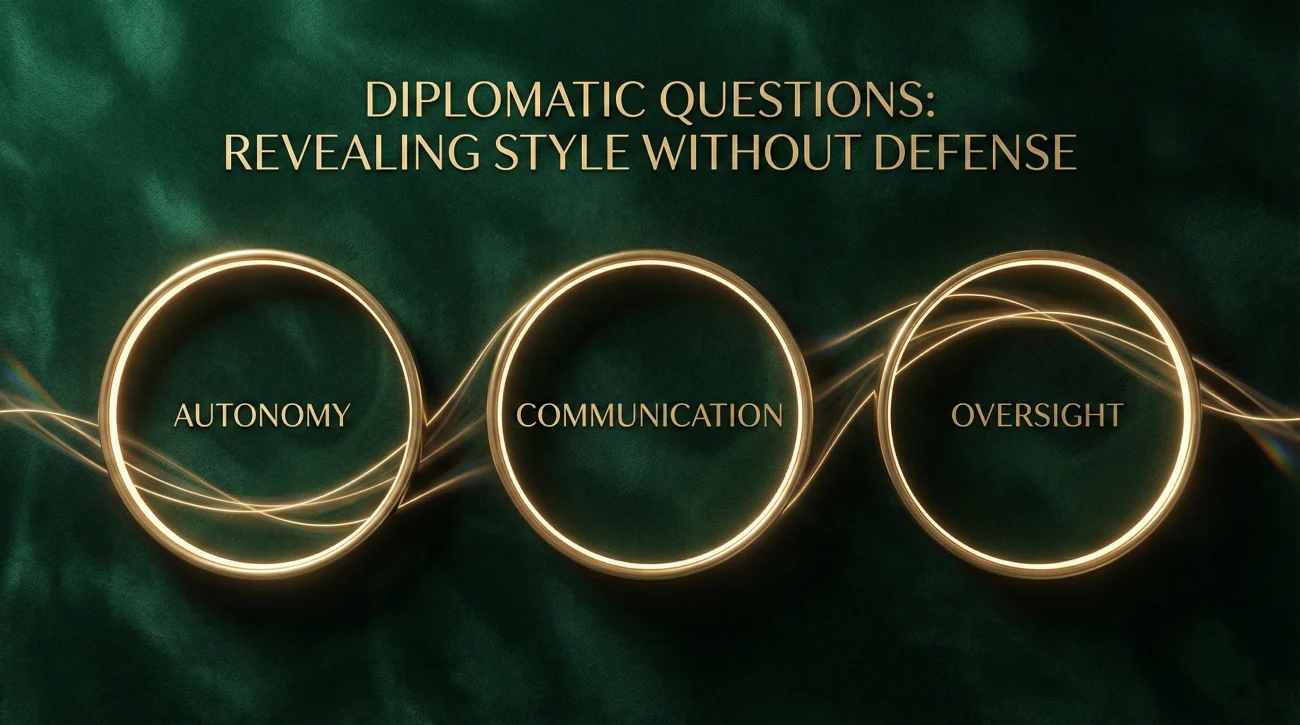
Open-Ended Style Questions
Start with questions that invite managers to describe their approach in their own words. How they frame their style reveals both their self-awareness and actual practices.
- 🎯 “How would you describe your management style?” – Opens conversation without judgment
- 💬 “What does your ideal working relationship with team members look like?” – Reveals expectations
- 📋 “How involved do you typically get in day-to-day work?” – Uncovers oversight level
- 🤝 “How do you prefer to communicate with your team?” – Shows interaction frequency
Expert advice: Pay attention to whether managers describe their style in terms of outcomes (results-focused) or processes (control-focused). Process obsession often signals micromanagement tendencies.
Questions About Autonomy and Decision-Making
Understanding where decision authority lies reveals how much independence you’ll actually have. Managers who claim to delegate but then list extensive approval requirements aren’t really delegating.
- “What decisions can I make independently in this role?”
- “What types of decisions would require your approval or input?”
- “How do you balance providing guidance with allowing team autonomy?”
- “Tell me about a time when you had to let go and trust someone’s approach even though you’d have done it differently”
Managers who struggle to articulate what decisions you can make independently or who claim “everything needs approval for alignment” are likely micromanagers.
Questions About Feedback and Check-Ins
Frequency and format of feedback reveal management intensity. Weekly one-on-ones suggest engaged management. Daily status updates signal micromanagement. No regular feedback suggests absent management.
| Question | What It Reveals |
|---|---|
| “How often do you meet one-on-one with team members?” | Investment in development and coaching |
| “What does your typical feedback look like – formal reviews or ongoing conversations?” | Whether feedback is constructive or just criticism |
| “How do you help team members grow and develop?” | Commitment to development versus treating people as resources |
| “What format do you use for project updates – written reports, meetings, or something else?” | Communication overhead and meeting burden |
Behavioral Questions That Expose Real Patterns
When interviewing your future boss, behavioral questions reveal actual management practices better than hypothetical descriptions. Past behavior predicts future management style more accurately than self-assessment.
How They Handle Mistakes
Manager reaction to mistakes reveals whether they create psychological safety or fear-based cultures. Supportive managers treat mistakes as learning opportunities. Toxic managers assign blame and create environments where people hide problems.
- 🎯 “Tell me about a time when someone on your team made a mistake. How did you handle it?”
- 💡 “Describe a situation where a team member’s approach differed from what you would have done. What happened?”
- 🔄 “Can you share an example of when you had to course-correct a project that wasn’t going as planned?”
💡 Pro tip: Listen for whether their examples focus on fixing problems collaboratively or assigning blame and “holding people accountable” as code for punishment.
Real Delegation Examples
Managers who truly delegate can describe specific examples of empowering team members. Those who claim to delegate but can’t provide examples likely confuse task assignment with actual delegation.
Expert advice: Ask “Tell me about a project where you delegated significant authority to someone on your team. What was the outcome?” Genuine delegators light up sharing these stories. Micromanagers struggle to recall examples.
Handling Disagreements and Pushback
Healthy managers welcome constructive disagreement and different perspectives. Insecure managers view questioning as insubordination. Questions about handling disagreements expose which type you’re dealing with.
- “Tell me about a time when someone on your team disagreed with your approach. How did you handle it?”
- “Describe a situation where a team member pushed back on your direction. What happened?”
- “Can you share an example of when someone convinced you to change your mind about an approach?”
Getting Team Member Perspectives
Effective management style questions extend beyond the manager themselves. Team members often provide more honest assessments of management reality versus aspirational self-description.
Questions for Peer Interviewers
When interviewing with potential teammates, ask about their experience with the manager. Peers typically offer more candid insights about daily management reality than the manager provides about themselves.
- 💼 “How would you describe working with [manager name]?” – Open-ended invitation to share
- 🎯 “What’s the best thing about having [manager] as your manager?” – Positive framing yields honest positives
- ⚡ “What’s something I should know about [manager]’s working style?” – Diplomatic way to surface concerns
- 📊 “How does [manager] support the team when things get difficult?” – Reveals support under pressure
Reading Team Member Reactions
How team members respond reveals as much as what they say. Hesitation before answering, forced positivity, or carefully worded responses suggest they’re being diplomatic about problematic management.
| Team Response | Interpretation |
|---|---|
| Enthusiastic, specific examples of support | Genuinely positive management relationship |
| Generic positives without specifics | Trying to be professional about mediocre manager |
| Long pause before carefully worded response | Choosing words diplomatically to avoid saying something negative |
| Deflection to company or role instead of manager | Avoiding discussing problematic manager directly |
If multiple team members give vague, carefully worded answers about the manager without specific examples, that’s a significant red flag about management quality.
Observing Manager-Team Interactions
Beyond questions, observe how managers interact with their teams during the interview process. These unscripted moments reveal more than prepared answers.

Meeting and Presentation Dynamics
If you observe team meetings or presentations during your interview, watch how the manager interacts with team members. Do they interrupt constantly? Do they let others speak? How do they respond to questions or concerns?
- Managers who dominate meetings and interrupt others lack respect for team input
- Those who dismiss questions or concerns create environments where people stop asking
- Managers who credit team members and share recognition foster healthy cultures
- Those who criticize or correct team members publicly create fear-based dynamics
Casual Interactions and Asides
Pay attention to casual comments and side interactions. How does the manager speak about team members when they’re not present? Do they roll their eyes at questions? Do they make disparaging comments disguised as jokes?
Expert advice: Notice how managers speak about former team members who left. Those who badmouth people who departed will do the same to you eventually. Respectful managers maintain professional regard even after people leave.
Matching Style to Your Preferences
No management style is universally good or bad. The question is whether the manager’s approach aligns with your working preferences and career stage.
Understanding Your Preferences
Before evaluating managers, understand what you need. Junior professionals often benefit from more structured management. Senior experts typically prefer autonomy. Some people thrive with frequent feedback. Others prefer quarterly check-ins and independent work.
💡 Pro tip: Think about previous managers and identify what worked well versus what frustrated you. These patterns reveal your management style preferences.
Career Stage Considerations
Your ideal management style changes as your career progresses. Entry-level roles benefit from coaching and structure. Mid-career professionals want autonomy with strategic guidance. Senior leaders need managers who provide air cover and remove obstacles rather than directing work.
| Career Stage | Ideal Management | Red Flags |
|---|---|---|
| Junior (0-2 years) | Structured coaching, clear expectations, regular feedback | Hands-off management with minimal guidance |
| Mid-Level (3-7 years) | Autonomy on execution, strategic direction, development support | Micromanagement or complete absence |
| Senior (8+ years) | Goal alignment, obstacle removal, strategic partnership | Detailed oversight or lack of organizational influence |
❓ FAQ
🎯 Can I directly ask if they micromanage?
No. Direct accusatory questions put interviewers on defense and yield dishonest answers. No manager admits to micromanaging. Instead, ask about decision authority, typical involvement levels, and request specific examples of delegation. Their answers reveal management style without forcing them to self-diagnose negatively.
💼 What if the manager’s self-description conflicts with team member feedback?
Trust team member perspectives over manager self-assessment. Managers often lack self-awareness about their actual management impact. If a manager claims to delegate but team members describe heavy oversight, believe the people experiencing the management daily. The gap reveals lack of self-awareness, which is its own red flag.
⏰ How many management style questions should I ask?
Ask 2-3 direct management questions of the hiring manager, plus behavioral questions about mistakes and delegation. Ask additional questions of team members if you interview with peers. The manager’s approach affects your daily reality more than job responsibilities, so investing time understanding their style is worthwhile.
📋 What if I need more structure than the manager provides?
Be honest about your preferences during interviews. If you’re junior and need coaching but the manager describes a hands-off approach, that’s a mismatch regardless of other job aspects. Better to identify incompatibility during interviews than struggle for months after joining. Not every management style fits every person, and that’s okay.
✨ Can management style change over time?
Slightly, but core tendencies remain stable. A micromanager might learn to delegate more with coaching, but fundamental approaches to control and trust rarely transform completely. Don’t accept a role hoping the manager will change. Evaluate whether you can work with their current style, not their potential future development.
Final Thoughts

Learning asking about management style tactfully protects you from miserable working relationships and career setbacks. Your manager determines your daily experience, growth opportunities, and career trajectory more than any other single factor. The wrong management match creates frustration, limits development, and often forces premature job changes.
Strategic questioning reveals management reality without putting interviewers on defense. Focus on behavioral examples rather than hypothetical descriptions. Observe manager-team interactions during interviews. Seek team member perspectives to validate or contradict what managers claim about themselves. Trust patterns over promises.
Remember that no management style is universally good or bad. The goal is finding alignment between how you work best and how the manager leads. Micromanagement might suit someone needing structure while frustrating an experienced professional wanting autonomy. Hands-off management works for self-directed experts but fails those needing guidance. Know yourself, evaluate honestly, and prioritize fit over title or compensation when management styles conflict with your preferences.
⚠️ Disclaimer: The interview strategies, sample answers, and negotiation tips provided in this guide are for educational purposes only. Hiring decisions are subjective and vary by company and industry. While these strategies are based on professional HR standards, they do not guarantee a specific job offer or result.