What Brand Manager Interviews Evaluate
Brand manager interview questions assess your ability to develop cohesive brand identities, measure equity, and manage customer perception across touchpoints. Interviewers test strategic vision, creative execution, and data-driven brand stewardship. This article covers brand identity frameworks, equity measurement approaches, positioning methodologies, crisis management protocols, and ensuring brand consistency across organizations.
Brand Identity & Development
Q: How do you develop a brand identity from scratch?
Brand identity development starts with understanding the business strategy and target audience deeply. I conduct stakeholder interviews to clarify company mission, values, and competitive positioning. Then I research audience psychographics beyond demographics, uncovering emotional drivers, aspirations, and pain points that shape how they perceive brands.
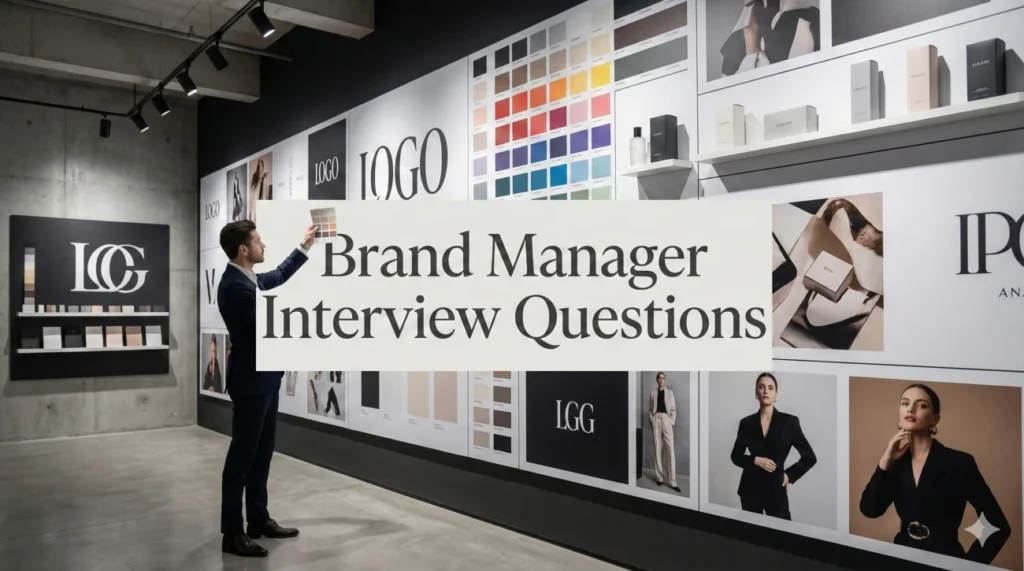
The identity framework addresses multiple elements working in harmony. Visual identity includes logo, color palette, typography, and imagery style. Verbal identity covers brand voice, tone, messaging hierarchy, and storytelling approach. Experiential identity defines how customers interact with the brand across touchpoints, from website navigation to customer service protocols.
I validate identity concepts through customer testing before full implementation. Showing target audiences identity options reveals which elements resonate emotionally and communicate intended positioning. An identity that looks sophisticated internally but confuses customers in testing needs refinement regardless of executive preferences.
Q: What makes a brand identity strong versus weak?
Strong identities are distinctive, memorable, and meaningful. Distinctive means visually differentiated from competitors so customers recognize you instantly. Memorable creates mental availability through consistent exposure and emotional resonance. Meaningful connects to something customers care about beyond functional benefits.
Weak identities suffer from generic execution or inconsistent application. If your logo could work for any company in your industry, it lacks distinctiveness. When different departments interpret brand guidelines differently, inconsistency erodes recognition. Identities built around clever internal concepts that don’t resonate with customers fail the meaningful test.
Flexibility without chaos separates strong from rigid identities. Strong systems adapt across contexts while maintaining recognizability. A logo that only works at large sizes or color palette unusable for digital applications creates implementation headaches. The best identities provide clear guidelines with enough flexibility for practical application.
Q: Describe leading a rebranding initiative that successfully shifted market perception.
We rebranded a financial services company perceived as outdated and transactional. Market research revealed target audiences associated traditional bank imagery with bureaucracy and impersonal service. They wanted approachable expertise that simplified complex financial decisions.
The new identity moved from formal corporate aesthetic to warm professional positioning. Color palette shifted from navy and gold to accessible blues and greens conveying trust without stuffiness. Photography showed real customer moments instead of stock image perfection. Messaging emphasized partnership language over institutional authority.
Implementation required organizational change beyond visual updates. We trained customer-facing teams on new brand voice principles. Updated branch design reflected welcoming aesthetic. Digital experiences prioritized clarity over feature complexity. Post-rebrand, brand perception studies showed clear improvement in “approachable” and “trustworthy” attributes. More importantly, consideration among target demographics rose meaningfully within the following months.
Expert Advice: “The strongest brand identities aren’t just visually beautiful – they’re strategically sound. Every color choice, typography decision, and imagery style should ladder back to your positioning strategy and resonate with target customer psychology.”
Brand Equity & Performance Measurement
Q: How do you measure and track brand equity?
Brand equity measurement combines quantitative metrics and qualitative insights. Quantitatively, I track aided and unaided brand awareness through regular surveys. Aided awareness measures recognition when prompted with brand name. Unaided captures top-of-mind recall when asking about category solutions without prompting. Growth in unaided awareness signals strengthening mental availability.
Brand perception attributes reveal how customers view you relative to competitors. I survey target audiences on dimensions like quality, innovation, trustworthiness, and value. Tracking these over time shows whether brand initiatives shift perception as intended. Price premium customers willingly pay compared to generic alternatives quantifies brand value.
Customer lifetime value and retention rates indicate brand loyalty strength. High retention with growing purchase frequency suggests strong emotional connection beyond transactional relationships. Net Promoter Score measures advocacy likelihood, revealing whether customers become brand evangelists. These metrics collectively paint brand health picture guiding strategic decisions.
Q: What’s your framework for conducting brand health tracking?
I establish baseline measurements before initiatives launch. This includes current awareness levels, perception attributes, preference versus competitors, and customer satisfaction scores. Without baselines, attributing changes to specific initiatives becomes guesswork rather than analysis.
Ongoing tracking happens on a regular cadence for most brands, and more frequently for rapidly evolving categories. Surveys measure key metrics consistently using same methodology for trend analysis. I segment results by customer cohorts, channels, and geographic markets to identify where brand performs strongly versus opportunities requiring attention.
Competitive benchmarking provides context beyond internal trends. Discovering our awareness grew sounds positive until learning competitors grew faster. I track share of voice in earned and paid media, social sentiment compared to category leaders, and consideration set inclusion rates showing whether we make customer shortlists.
Q: How do you calculate return on brand investment?
Direct attribution challenges exist since brand building creates long-term value difficult to isolate in quarterly results. I use multi-touch attribution models showing brand touchpoints’ role in customer journeys alongside performance marketing. Brand campaigns often assist conversions even when performance ads get last-click credit.
Price premium analysis reveals brand value concretely. If customers consistently pay more for our product versus generic alternatives, that premium can reflect brand equity. Multiplied across sales volume, this quantifies brand contribution to revenue and margin.
Customer acquisition cost comparison validates brand investment efficiency. When organic traffic and direct visits are more efficient than paid acquisition while converting well, strong brand awareness drives measurable ROI. Brand-driven leads typically show higher lifetime value and lower churn than performance marketing leads lacking brand familiarity.
⚠️ Common mistake: Focusing exclusively on short-term conversion metrics while neglecting brand health indicators. This creates long-term vulnerability when brand equity erodes silently while performance marketing masks underlying problems.
Q: Describe using data to pivot brand strategy successfully.
Brand tracking revealed declining perception scores among our core younger-adult segment despite stable overall metrics. Deeper analysis showed this segment associated our brand with their parents’ generation. Social listening confirmed younger customers viewed us as reliable but unexciting.
We tested messaging pivots through social campaigns before full replatforming. Content highlighting innovation and cultural relevance resonated far better than heritage-focused messaging. Based on these results, we shifted brand expression to emphasize forward-thinking values while maintaining quality foundations.
Partnership strategy evolved to include younger-skewing collaborations and influencer relationships. Product packaging received subtle modernization without alienating existing customers. Results over the following months included a clear perception lift on “innovative” among the target segment, improved consideration, and much stronger engagement in that audience.
Managing Brand Perception & Consistency
How do you ensure brand consistency across multiple touchpoints?
Comprehensive brand guidelines form the foundation, but guidelines alone don’t ensure consistency. I create tiered documentation serving different needs. Executive summary provides strategic overview and core principles. Creative teams receive detailed specifications for visual and verbal expression. Sales and customer service get practical application examples for their contexts.
Regular training sessions educate teams on brand thinking, not just mechanical guideline adherence. When employees understand why certain colors evoke specific emotions or why voice principles matter, they make better on-brand decisions in unscripted situations. I conduct quarterly brand workshops reviewing examples of excellent and poor applications.
Brand governance includes review processes for major initiatives while empowering teams for everyday decisions. Marketing campaigns undergo brand review before launch. Sales presentations get template libraries ensuring consistency without bottlenecking productivity. Digital teams use design systems with pre-approved components enabling fast iteration within brand guardrails.
What’s your approach to managing brand perception during crises?
Crisis preparedness starts before issues emerge. I maintain crisis communication playbooks addressing likely scenarios, from product failures to leadership controversies. These outline response team structures, approval chains, holding statements, and channel-specific tactics. Pre-approved frameworks enable faster response when minutes matter.
During crises, brand values guide response tone and content. A brand positioned on transparency can’t suddenly become evasive. One valued for innovation might acknowledge failures as learning opportunities. The response must feel authentic to established brand personality while addressing stakeholder concerns seriously.
Post-crisis, I monitor sentiment recovery through social listening and brand tracking surveys. Has trust returned to baseline? Do negative associations persist requiring active rehabilitation? Crisis response becomes case studies for future employee training, reinforcing values through how we handled challenges.
How do you collaborate with product teams to align brand and product strategy?
I join product planning discussions early, not after features are built. When product teams understand target customer psychology and brand positioning, they make better product decisions. A luxury brand and value brand build different feature sets for similar functional needs because customer expectations differ.
Product naming and packaging become brand touchpoints requiring collaboration. Names that sound clever internally but confuse customers in testing need revision. Packaging communicates brand through materials, structure, and graphics. Premium positioning demands premium physical experience or risk perception misalignment.
Go-to-market alignment ensures product launches reinforce rather than contradict brand narrative. Launch messaging connects new capabilities to overarching brand promise. If our brand means simplification, product launches emphasize ease-of-use over technical specifications. This consistency strengthens brand associations over time.
Expert Advice: “Brand consistency doesn’t mean repetitive sameness. It means every touchpoint feels unmistakably like your brand even when executions vary by context. Think of it like recognizing someone’s personality across different situations – consistent character expressed through appropriate behavior.”
Brand Management Knowledge Assessment
20 Practice Questions
1. Brand equity primarily represents what?
- Logo design quality
- Value a brand adds beyond functional product attributes
- Marketing budget size
- Number of social followers
2. Aided brand awareness measures what?
- Unprompted brand recall
- Recognition when brand name is mentioned
- Purchase intent
- Customer satisfaction
3. What does NPS stand for in brand measurement?
- New Product Sales
- Net Promoter Score
- National Positioning Standard
- Network Performance System
4. Strong brand identity requires which combination?
- Only visual elements
- Only verbal elements
- Visual, verbal, and experiential elements aligned
- Logo alone
5. Price premium customers pay versus generic alternatives measures what?
- Marketing waste
- Quantified brand equity value
- Customer gullibility
- Distribution efficiency
6. Brand guidelines should be created in how many tiers?
- One document for everyone
- Multiple tiers for different stakeholder needs
- Only for designers
- Guidelines aren’t necessary
7. When should brand crisis communication playbooks be developed?
- During the crisis
- After the crisis ends
- Before crises occur
- Never needed
8. Unaided brand awareness is also called what?
- Prompted recall
- Top-of-mind awareness
- Brand preference
- Market share
9. Brand perception tracking should happen how frequently for most brands?
- Once annually
- Quarterly
- Every five years
- Never needed
10. What’s a key indicator of brand loyalty?
- First-time purchase rate
- Customer retention and repeat purchase frequency
- Website traffic
- Social media likes
11. Brand identity testing with target audiences should happen when?
- After full implementation
- Before finalizing and implementing identity
- Testing isn’t necessary
- Only if executives disagree
12. Multi-touch attribution reveals what about brand campaigns?
- Only last-click value
- Brand campaigns have no value
- Brand touchpoints’ role across customer journey
- Social media engagement only
13. What makes a brand identity weak?
- Being memorable
- Generic execution indistinguishable from competitors
- Clear guidelines
- Consistent application
14. Brand voice and tone fall under which identity element?
- Visual identity
- Verbal identity
- Experiential identity
- Strategic identity
15. Share of voice tracks what compared to competitors?
- Product quality
- Employee count
- Earned and paid media presence
- Office size
16. When collaborating with product teams, brand managers should engage when?
- After products are built
- Early in planning discussions
- Only for naming
- Never needed
17. Brand-driven leads typically show what versus performance marketing leads?
- Higher acquisition cost, lower value
- Higher lifetime value, lower churn
- Same performance
- Worse conversion rates always
18. Crisis brand responses should align with what?
- Whatever minimizes legal exposure
- Competitor responses
- Established brand values and personality
- CEO personal preferences
19. Mental availability refers to what brand concept?
- Physical distribution
- How easily brand comes to mind in buying situations
- Website load speed
- Store locations
20. Rebranding success is best measured through what?
- Executive opinions only
- Design awards won
- Shifted perception attributes and consideration growth
- Social media buzz alone
❓ FAQ
🎨 Do brand managers need design skills?
Not execution skills, but design literacy matters. Brand managers should understand design principles enough to evaluate quality and provide strategic direction to creative teams. Ability to articulate why designs work or don’t work matters more than creating them personally.
📊 How long does rebranding typically take?
Full rebrands often take substantial time from research through implementation. Smaller refreshes typically move faster. Timeline depends on organizational complexity, touchpoint quantity, and stakeholder alignment challenges. Rush rebrands sacrifice strategic rigor for speed.
💼 What’s the career path for brand managers?
Many start as assistant brand managers or marketing coordinators. Progression moves to brand manager, senior brand manager, then director of brand or CMO roles. Some transition into product marketing, general marketing leadership, or brand consulting careers.
🔍 How do brand managers differ from marketing managers?
Brand managers own brand strategy, identity, and equity long-term. Marketing managers execute campaigns and tactics driving near-term business results. Brand managers guard brand consistency; marketing managers optimize channel performance. Both collaborate closely but have distinct focuses.
💰 What salary should brand managers expect?
Compensation varies widely by company, industry, level, and location. In interviews, I anchor expectations on scope (ownership, budget responsibility, team leadership, and measurement expectations) and local market context.
Final Thoughts
Brand manager interview questions evaluate your strategic brand thinking, equity measurement capabilities, and organizational leadership. Prepare examples demonstrating identity development, perception management, crisis navigation, and cross-functional collaboration. Strong candidates connect brand decisions to measurable business outcomes and customer psychology.
Continue your marketing interview preparation with comprehensive role-specific guidance and strategy frameworks.
⚠️ Disclaimer: The interview strategies, sample answers, and negotiation tips provided in this guide are for educational purposes only. Hiring decisions are subjective and vary by company and industry. While these strategies are based on professional HR standards, they do not guarantee a specific job offer or result.