Building the Bridge
Career changers face a unique challenge: you need to make two seemingly different chapters of your professional life feel like one coherent story. The interviewer is looking at your resume wondering how a teacher became a product manager, or why an accountant wants to work in user research.
A strong career change interview script builds a bridge between your past and your future. It shows the connecting threads that aren’t obvious from your resume, explains why this transition makes sense, and demonstrates that your previous experience actually accelerates rather than hinders your success in the new field.
The script that follows gives you language for each element of that bridge. Adapt it to your specific transition, practice until it flows naturally, and you’ll handle the inevitable questions about your career change with confidence.
Finding Your Connection Points
Every successful career change has connection points. Skills, interests, or values that run through both your old path and your new one. Your first job is identifying what yours are.

Transferable Skills
What capabilities from your previous career apply directly to the new one? Project management transfers everywhere. Communication skills work in any field. Analysis, problem-solving, and stakeholder management are universal.
Unique Perspective
What will you see that someone from a traditional background won’t? A nurse entering healthcare consulting understands patient experience in ways MBAs never will. A journalist entering marketing knows what makes stories actually interesting.
Underlying Theme
What thread runs through both careers even if the surface looks different? Maybe both involve solving complex problems. Maybe both require translating between technical and non-technical audiences. Find the theme that unifies your story.
| Career Transition | Obvious Disconnect | Hidden Connection |
|---|---|---|
| Teacher → Corporate Trainer | Different industries | Same core skill: making complex ideas accessible |
| Military → Project Manager | Different environments | Same core skill: coordinating people under pressure |
| Lawyer → Compliance Officer | Different career identity | Same core skill: navigating complex regulations |
| Chef → Operations Manager | Different status level | Same core skill: managing time-sensitive processes |
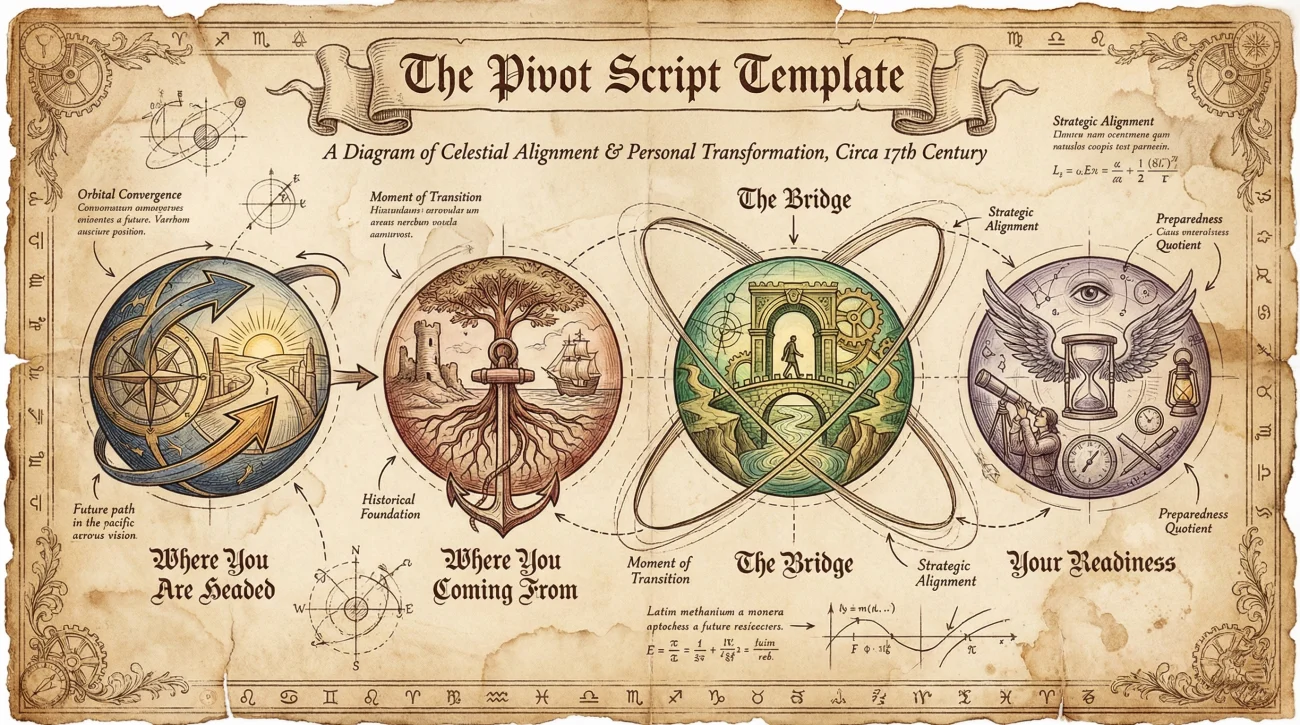
The Pivot Script Template
This structure works for most career transitions. The key is showing intentionality rather than randomness in your path.
Where You’re Headed
"I'm transitioning into [new field] because [genuine reason that shows thought and commitment]."
Example:
“I’m transitioning into UX research because I’ve always been more interested in understanding why people behave certain ways than in just observing that they do.”
Where You’re Coming From
"I spent [timeframe] in [previous field], where I developed [transferable skill] and learned [relevant insight]."
Example:
“I spent eight years as a clinical psychologist, where I developed deep skills in qualitative interviewing and learned how to help people articulate thoughts and feelings they can’t easily express.”
The Bridge
"What I realized is that [insight that connects old to new]. The skills I built in [old field] directly apply to [new field] because [specific connection]."
Example:
“What I realized is that the core of both clinical psychology and user research is the same: helping people articulate their true needs and motivations. The interviewing techniques I developed with patients work just as well with research participants, and I can often get to insights that pure UX researchers miss because I’m trained to listen differently.”
Your Readiness
"I've prepared for this transition by [specific actions taken]. I'm ready to [contribution you can make] while continuing to develop [skills you're still building]."
Example:
“I’ve prepared for this transition by completing a UX research certificate, taking on pro bono research projects for two startups, and immersing myself in the methodology literature. I’m ready to run research studies independently while continuing to develop my understanding of how research insights feed into product roadmaps.”
Complete Script Examples
Finance to Product Management
“I’m making the move into product management after a decade in investment banking. The transition might seem unusual, but here’s how I think about it.
In banking, my job was ultimately about understanding what clients actually needed versus what they said they wanted, then structuring solutions that addressed the real problem. That’s fundamentally what product management is too.
I spent ten years analyzing companies, understanding how they create value, and learning to communicate complex ideas to non-technical stakeholders. Those skills transfer directly. What I bring that traditional PM candidates might not is a deep understanding of how business decisions actually get made at the executive level.
I’ve prepared for this shift by completing a product management certificate, building a side project from concept to launch, and having dozens of conversations with PMs across industries. I know I have more to learn about the technical and design sides, but I’m confident my analytical foundation and stakeholder skills will help me contribute quickly.”
Teaching to Corporate Learning
“I spent twelve years as a high school science teacher, and I’m transitioning into corporate learning and development. The move actually makes a lot of sense when you think about what both roles require.
As a teacher, I had to take complex material and make it accessible to people who didn’t want to be there. I had to design curricula that actually produced learning outcomes, not just checked boxes. I had to manage classroom dynamics, read when people were confused, and adjust in real time. That’s exactly what good corporate training requires.
What made me want to switch is scope. I could only reach about 150 students a year. In corporate L&D, I can design programs that impact thousands of employees and actually measure whether they’re working. The feedback loop is tighter and the stakes feel more directly connected to real outcomes.
I’ve spent the last year getting certified in instructional design, learning the corporate L&D landscape, and freelancing with a training company to understand how the corporate side works. I’m ready to bring my teaching expertise into a new context.”
For more on handling career transition questions throughout the interview, see our introduction framework guide.
Handling Follow-Up Questions
“Why are you leaving your current field?”
Frame as moving toward something, not running from something. Even if you’re burned out or frustrated, lead with the pull of the new field rather than the push of the old one.
“I’m drawn to product because I want to own outcomes end-to-end rather than contributing pieces to someone else’s vision.”
“Why should we hire you over someone with traditional experience?”
This is where your unique perspective becomes your advantage. What do you see that insiders miss?
“Someone who’s only worked in product might miss the financial implications of roadmap decisions. My banking background means I naturally think about unit economics and ROI in ways that pure product people sometimes don’t.”
“How do we know you’re serious about this change?”
Point to actions you’ve already taken. Education, projects, networking, research. The more you’ve invested before getting hired, the more credible your commitment becomes.
“I’ve spent the last eighteen months preparing. I completed a certificate, built two portfolio projects, and talked to over forty people in the field. I’m not exploring a casual interest. I’ve already made the commitment.”
❓ FAQ
🎯 How long should my career change explanation be?
Your initial introduction should run sixty to ninety seconds. Be prepared to expand on any piece if they ask follow-up questions. Don’t try to cover everything upfront.
💼 What if my transition seems really random?
Find the thread that connects them, even if it’s not obvious. Values, skills, or interests that run through both. Every transition has a logic if you look for it. Your job is making that logic visible to others.
⏰ Should I lead with my old career or my new direction?
Lead with where you’re going. Open with your new direction, then explain how your background supports it. The old career provides context, but the new direction is what matters to this interviewer.
📋 What if I haven’t had time to prepare extensively?
Be honest about where you are while showing genuine commitment. Any preparation is better than none. But also consider whether you’re ready to interview, or whether more preparation would strengthen your candidacy.
✨ How do I address the salary cut that often comes with career changes?
If it comes up, acknowledge it matter-of-factly. “I understand I’m resetting in some ways, and I’m comfortable with that because I’m prioritizing long-term fit over short-term compensation.” Don’t dwell on it.
One Story, Two Chapters
Your career change interview script transforms what looks like a disconnected resume into a coherent professional narrative. Find your connection points. Explain why the transition makes sense. Demonstrate the preparation you’ve done. Show how your unusual background becomes an advantage rather than a liability.
Career changers who land great opportunities are those who make the interviewer see what they see: not two separate careers, but one continuous story where the current chapter builds naturally on everything that came before.
⚠️ Disclaimer: The interview strategies, sample answers, and negotiation tips provided in this guide are for educational purposes only. Hiring decisions are subjective and vary by company and industry. While these strategies are based on professional HR standards, they do not guarantee a specific job offer or result.