They’ll Remember the Story
Three months from now, the hiring manager won’t remember your job titles. They won’t recall the percentages you quoted or the methodology you described. But they’ll remember the story about how you turned around a failing project against impossible odds. They’ll remember the moment you described discovering your passion for this work.
Facts inform decisions. Stories create connections. The storytelling interview examples that follow show how to structure your introduction as a narrative that engages emotionally while still communicating your qualifications.
This approach works especially well in creative fields, sales, marketing, and any role where influence and communication matter. It’s also effective whenever you’re interviewing with senior leaders who’ve heard countless candidates recite credentials and are hungry for someone memorable.
The Story Structure
Great stories follow patterns that human brains are wired to follow. The hero’s journey, simplified for interview purposes, moves through four stages that create natural engagement.
The Ordinary World
Where you started. The context that makes everything else meaningful. This grounds your story in relatable reality.
The Challenge
The problem, obstacle, or opportunity that called you to action. This creates tension that pulls listeners forward.
The Journey
What you did, what you learned, how you grew. This demonstrates your capabilities through action rather than claims.
The Transformation
Who you are now because of that journey. This connects your past to your present and implies your future value.
| Stage | What It Accomplishes | Time |
|---|---|---|
| Ordinary World | Establishes context, creates relatability | 15 sec |
| Challenge | Creates tension, shows what’s at stake | 20 sec |
| Journey | Demonstrates capabilities through action | 40 sec |
| Transformation | Connects to present, implies future value | 15 sec |
Story One: The Accidental Discovery
This story arc works when your career path emerged unexpectedly. It shows openness to opportunity and ability to recognize potential.
“I never planned to become a data scientist. I was three years into a biology PhD, spending my nights running statistical analyses on gene expression data, when I realized I was more excited about the analysis than the biology.
The challenge was figuring out what to do with that realization. I was halfway through a doctoral program, my advisor was counting on me, and I had no formal computer science background. Walking away felt irresponsible. Staying felt dishonest.
I spent six months exploring both paths in parallel. I took online courses in machine learning. I started contributing to open source data projects. I had dozens of conversations with people who’d made similar transitions. Eventually, I designed a thesis project that was primarily computational, which let me finish the degree while building the portfolio I needed for a career pivot.
That experience taught me something important about myself: I’m someone who follows genuine interest even when it’s inconvenient. It also gave me a combination that’s turned out to be valuable. I bring scientific rigor to data problems because I was trained as a scientist, but I’m also excited about the engineering and implementation side in ways that pure scientists often aren’t. That combination is what I’d bring to your team.”
Story Two: The Crucible Moment
This story arc works when a defining professional challenge shaped who you are today. It demonstrates resilience and capability under pressure.
“Three years ago, I was running marketing for a consumer brand when we discovered our primary advertising channel was about to become illegal due to new regulations. Eighty percent of our customer acquisition came through that single channel. We had six months to completely reinvent how we reached customers or watch the business collapse.
The challenge wasn’t just tactical. Our whole team was built around expertise that was becoming obsolete. The skills that made us successful were suddenly the wrong skills. We had to transform ourselves while simultaneously keeping the business running.
I led that transformation. We mapped what skills we actually needed versus what we had. We made some difficult decisions about roles. We brought in new capabilities. We tested aggressively and killed approaches that weren’t working fast enough. We found new channels that eventually outperformed what we’d lost.
By the time the regulations hit, we were actually in a better position than before because we’d diversified our approach. But more importantly, I learned how to lead transformation under existential pressure. That’s now what I seek out. Give me a marketing challenge where the old playbook doesn’t work anymore, and I come alive. That’s why I’m excited about what you’re facing here.”
For more structured introduction formats, see our complete introduction framework.
Story Three: The Pattern Recognition
This story arc works when you’ve noticed a theme across your experiences that reveals your core value. It shows self-awareness and strategic thinking about your career.
“Looking back at my career, there’s a pattern I didn’t notice until recently. Every role I’ve loved, I was the person translating between people who didn’t understand each other.
It started in my first job as a customer support rep, where I realized I was essentially translating between frustrated customers and an engineering team that couldn’t understand why their product confused people. I got pulled into product meetings because I could explain user problems in ways engineers found actionable.
That led to a product role, where I was again translating: between business goals that executives cared about and technical constraints that developers faced. Then consulting, where every engagement was fundamentally about helping different parts of an organization understand each other well enough to work together.
Now I understand that translation is my superpower. I get genuine satisfaction from taking something complex and making it clear, or from helping two groups who think they disagree realize they actually want the same thing. That’s why I’m interested in this solutions consulting role. It’s the same translation work I’ve been gravitating toward my whole career, just in a new context.”
Crafting Your Story

Finding Your Story
Start by listing defining moments in your career. Times when something changed, when you faced a significant challenge, when you discovered something about yourself. The best interview stories usually hide in those moments.
Shaping the Narrative
Once you have raw material, shape it using the four-stage structure. Make sure each stage flows into the next. Cut anything that doesn’t serve the story’s movement forward.
Practice for Natural Delivery
Stories only work when they feel spontaneous. Practice enough that you can tell yours conversationally, maintaining eye contact, responding to listener reactions. If it sounds rehearsed, it loses the emotional power that makes stories work.
- 🎯 Specific details: Name the company, the year, the specific challenge. Vague stories don’t land.
- 💭 Internal experience: What you thought and felt, not just what happened. This creates connection.
- 🔄 Transformation: How the experience changed you. This is the payoff of the story.
- 🎁 Gift to listener: What this means for them. Why does your story matter for this role?
When Stories Work Less Well
Storytelling isn’t always the right choice. Consider your audience and context.
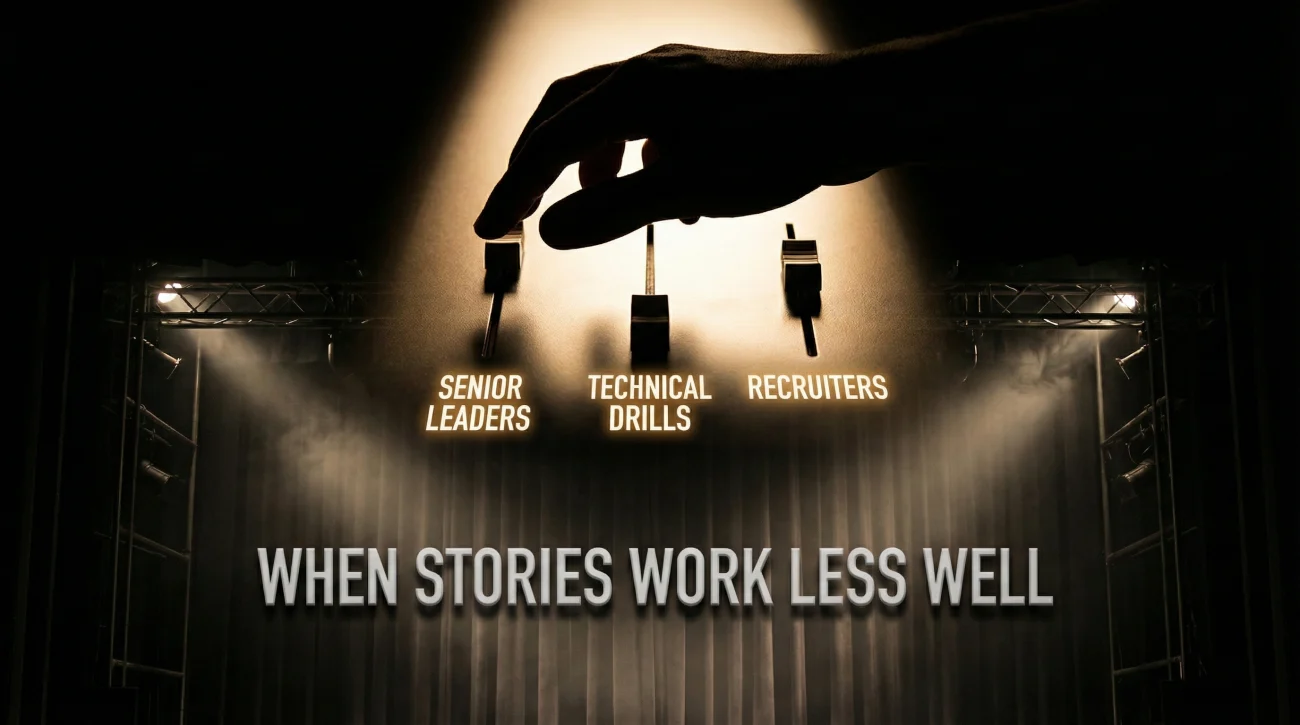
Highly technical interviews may require more structured, credential-focused introductions. Read the room.
If the interviewer seems impatient or is clearly working through a checklist, pivot to a more concise format. Some cultures and industries value directness over narrative. And early screening interviews with recruiters may not be the place for your most elaborate story.
Save your best storytelling for conversations with senior leaders, final-round interviews, or situations where you need to be memorable among many similar candidates.
❓ FAQ
🎯 How long should a story-based introduction be?
Ninety seconds to two minutes for the core story. You can expand if engagement is high, but have a condensed version ready if time is limited. Stories need enough detail to land but not so much that they drag.
💼 What if I don’t have a dramatic story?
Most good interview stories aren’t dramatic. They’re moments of realization, quiet challenges overcome, or patterns recognized. The drama comes from honest reflection, not external events.
⏰ Can I use the same story for every interview?
You can use the same core story, but adjust the ending to connect to each specific role. The transformation should lead naturally to why you’re interested in this particular opportunity.
📋 What if I get emotional telling my story?
Authentic emotion can be powerful, but overwhelming emotion makes interviewers uncomfortable. Practice until you can tell your story with feeling but maintain composure. A moment of genuine emotion followed by a steady finish is often memorable in a good way.
✨ Should I start with “Let me tell you a story”?
Usually no. Just start telling the story. “Three years ago, I was…” pulls people in more naturally than announcing you’re about to tell a story. Let the narrative structure do its work without calling attention to it.
Be Remembered
The storytelling interview examples above show how narrative structure creates memorable introductions. Find your defining moment, shape it using the hero’s journey framework, practice until it flows naturally, and connect the transformation to what you offer this employer.
In a world where most candidates recite credentials, the one who tells a genuine story stands out. Be that candidate when the situation calls for it.
⚠️ Disclaimer: The interview strategies, sample answers, and negotiation tips provided in this guide are for educational purposes only. Hiring decisions are subjective and vary by company and industry. While these strategies are based on professional HR standards, they do not guarantee a specific job offer or result.