When Interests Collide
The Association of Certified Fraud Examiners reports that organizations lose an estimated 5% of revenue annually to fraud, much of it stemming from unmanaged conflicts of interest. This is why interview questions about conflict of interest examples probe your ethical compass. What do you do when personal relationships, financial interests, or other considerations create tension with your professional duties?
A compliance officer at JPMorgan Chase explained her interview approach: “I don’t just ask if candidates have faced conflicts of interest. I assume they have. The real question is whether they recognized the conflict, how quickly they disclosed it, and what they prioritized when the choice was hard. The candidate who says ‘I’ve never faced a conflict’ either hasn’t thought about it deeply or isn’t being honest with me.”
Types of Conflicts You Might Describe
Personal Relationships
Hiring decisions involving friends, family members receiving preferential treatment, or romantic relationships affecting professional judgment all create relationship conflicts. Strong answers show you recognized the conflict and took steps to ensure fairness.
Financial Interests
Side businesses, investments in competitors, or personal financial benefit from professional decisions create financial conflicts. Demonstrating transparency and recusal when appropriate shows you understand proper boundaries.
Competing Loyalties
Former employers, professional associations, or personal values that conflict with company directives create loyalty tensions. Your answer might show how you navigated between genuine obligations without compromising integrity.
| Conflict Type | Example Scenario |
|---|---|
| Personal relationship | Friend applies for position you influence hiring for |
| Financial interest | Vendor offers gift during contract negotiations |
| Competing loyalty | Asked to share confidential info from previous employer |
| Self-dealing | Opportunity to benefit personally from business decision |
Conflict of Interest Stories That Revealed Character
These questions probe integrity in ways that hypotheticals cannot. The best answers come from candidates who faced real tension between personal interest and professional duty. Here are stories that shaped my hiring decisions.
The Vendor Gift That Tested Boundaries
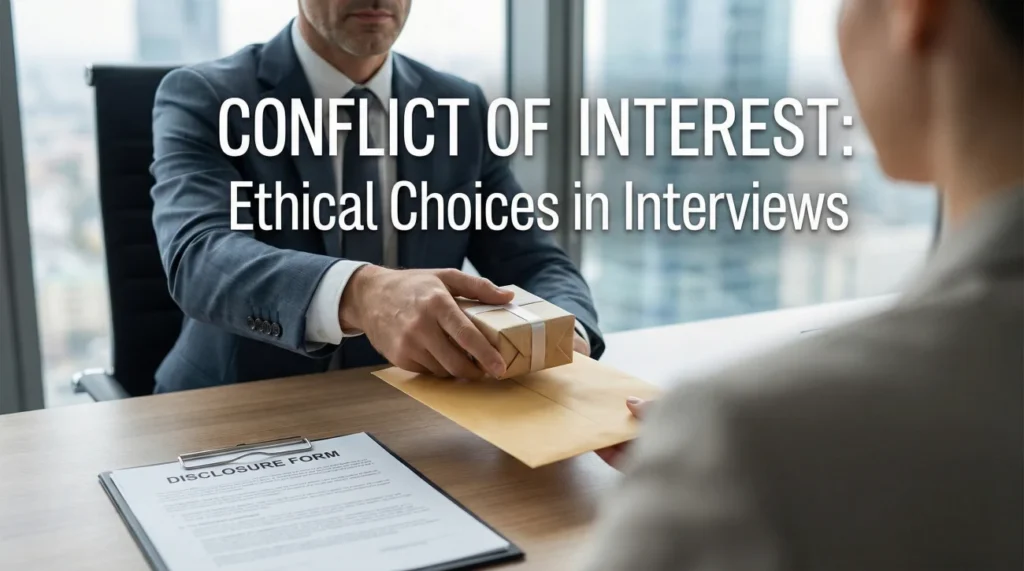
A procurement manager named Daniel told me about a vendor who sent him two tickets to the Super Bowl during contract renewal negotiations. The tickets were worth thousands of dollars. The vendor framed it as appreciation for their “partnership” with no explicit strings attached.
Daniel returned the tickets with a polite note explaining company policy. But what impressed me was what he did next. He disclosed the gift attempt to his manager and documented it in their vendor file. He then recused himself from being the sole decision-maker on the renewal, asking a colleague to independently evaluate the competing bids.
The vendor actually won the renewal on merit. But Daniel told me: “I needed the decision to be beyond question. Not just for the company, but for me. If I’d kept those tickets and they won anyway, I’d always wonder if my judgment was influenced, even unconsciously.”
The Friend Who Applied for a Role
A director named Samantha was hiring for a senior position on her team. A close friend from business school applied. The friend was qualified but so were other candidates. Samantha faced a choice: recuse entirely or try to be objective.
She chose transparency over recusal. She disclosed the relationship to HR and her VP, then proposed a solution: she would participate in interviews but another director would make the final hiring decision. All candidates would go through identical processes, and her friend would receive no information about the process that other candidates did not have.
Her friend did not get the job. The other director chose a candidate with more relevant industry experience. Samantha told me the hardest part was the conversation with her friend afterward: “I had to explain that I couldn’t advocate for her without compromising my integrity. Real friends understand that. She did.”
The Sales Target vs. Client Interest Dilemma
An account executive named Raj described being pressured by his sales director to push a client into an enterprise contract they did not need. The client was a small nonprofit that would have been better served by a smaller package. But it was end of quarter, and the enterprise deal would hit Raj’s quota and his director’s bonus target.
Raj recommended the smaller package to the client. His director was furious. Raj missed his quarterly quota and received a smaller bonus. But the nonprofit became a long-term customer and eventually grew into that enterprise tier naturally. They also referred two other organizations.
When Raj told me this story, I asked if he would do it again knowing the career consequences. He said: “I have to sleep at night. And honestly, the referrals from that client made up for the missed commission within a year. Doing right usually works out, even when it doesn’t feel like it in the moment.”
That long-term thinking and willingness to accept short-term consequences for ethical behavior is exactly what I look for when hiring.
Demonstrating Ethical Judgment
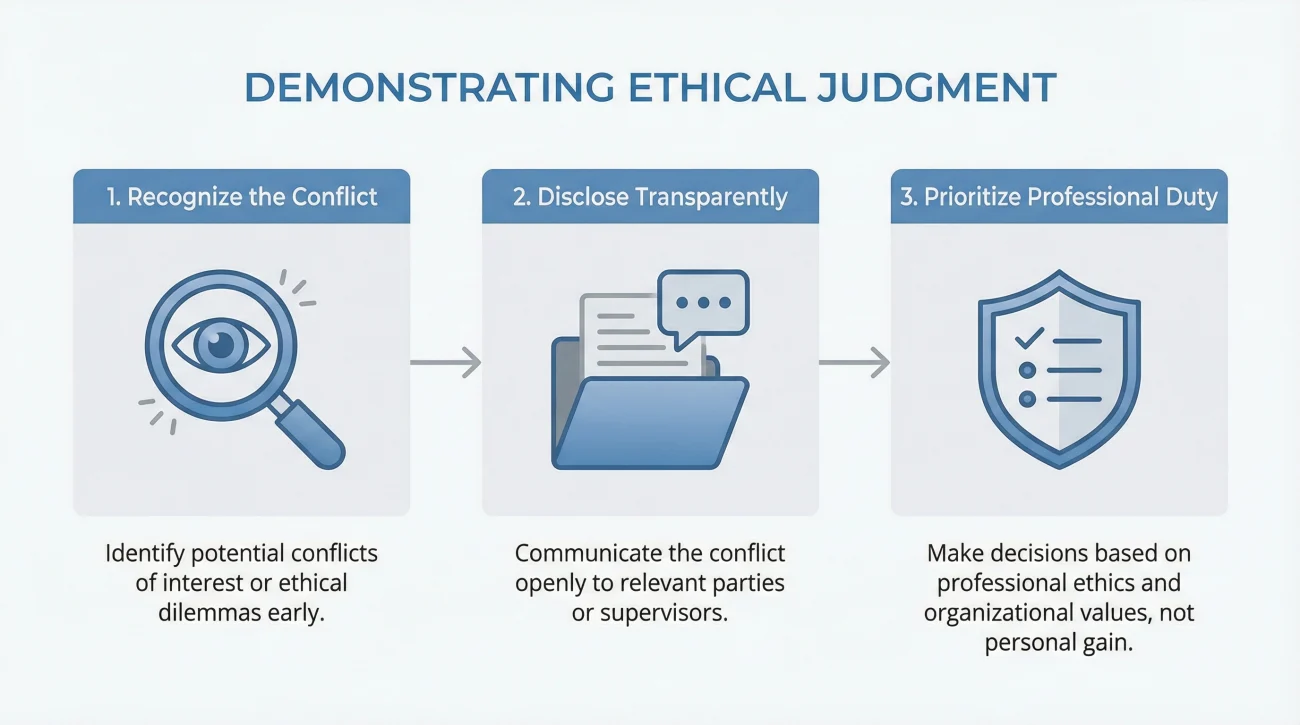
Recognize the Conflict
The first sign of strong ethics is recognizing conflicts of interest when they arise. Many people miss them entirely. Your answer should show you identified the ethical tension rather than stumbling into it unknowingly.
Proactively identifying a potential conflict demonstrates stronger ethics than just responding when caught.
Disclose Transparently
Once recognized, conflicts require disclosure to appropriate parties. This might mean informing your manager, recusing yourself from decisions, or documenting the situation. Transparency is the antidote to conflict of interest suspicion.
Prioritize Professional Duty
Strong answers show you ultimately prioritized professional obligations over personal interests. Even when this created discomfort or disadvantage for you personally, you chose the ethical path. This is what interviewers most want to see.
Sample Answer
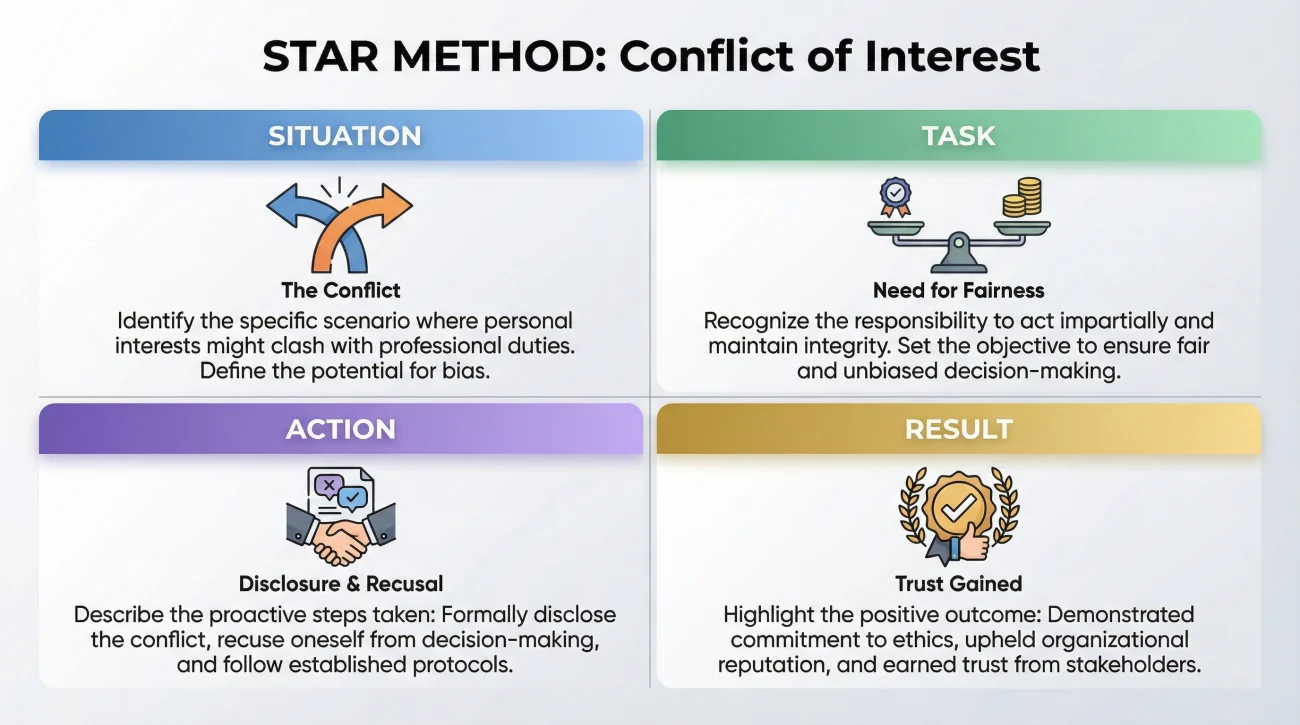
Situation
A close friend applied for an open position on my team. I was involved in the hiring process and had meaningful influence over who advanced. My friend was qualified, but so were other candidates, so there was a real risk of perceived bias.
Task
I needed to keep the decision fair and transparent, be upfront about the relationship, and make sure neither my friend nor other candidates were disadvantaged by the situation.
Action
Before any interviews began, I disclosed the relationship to my manager and our HR partner. I laid out two clear options: I could either recuse myself entirely, or I could participate only in early-stage screenings for my technical perspective while being removed from final deliberations and the hiring decision, with documentation of the rationale.
My manager chose the second option, so I joined the initial interviews and provided structured feedback, but I was excluded from final candidate discussions and from the ultimate decision.
I also had a direct conversation with my friend. I explained that I had disclosed our relationship and that they would be assessed against the same criteria as everyone else, without any advantage from knowing me. Setting that expectation upfront reduced the chance of misunderstandings later.
Result
Another candidate was ultimately hired based on slightly stronger experience in a critical area. My friend was understandably disappointed, but they accepted the outcome because the process was clear and fair.
My manager later told me my handling of the situation increased their trust in my judgment, and the friendship stayed intact because I had been transparent from the start.
When the Right Choice Was Hard
The most compelling conflict of interest stories involve genuine difficulty. If doing the right thing was easy, it does not demonstrate much. Interviewers want to see you navigated real tension between competing considerations and chose integrity despite personal cost or discomfort.
Consider Sarah’s experience at a pharmaceutical company. Her brother-in-law ran a medical supply business that submitted a bid for a contract she was evaluating. His pricing was competitive, and awarding him the contract would have helped her sister’s family financially. “I disclosed the relationship immediately and removed myself from the evaluation,” she recalls. “My brother-in-law was upset. He thought family should help family. But I explained that my credibility depended on being above reproach. His company ended up winning the bid anyway, evaluated by others, which actually meant more because everyone knew it was fair.”
For more guidance on demonstrating integrity in interviews, explore our detailed guides.
❓ FAQ
🎯 What if I have never faced a conflict of interest?
Think more broadly. Conflicts can be subtle: knowing information that could benefit a friend, being asked to favor one vendor over another, or navigating competing obligations between teams. Most professionals have encountered some form of competing interests.
💼 Should I describe a time I failed to handle it well?
Only if you clearly learned from it and would handle it differently now. A story about recognizing an ethical blind spot and changing your approach can be powerful. But avoid examples where the failure reflects fundamentally poor judgment.
⏰ How significant does the conflict need to be?
Choose something meaningful enough to require active management. Declining a vendor’s coffee mug is too trivial. But you do not need a dramatic ethical crisis. Everyday professional conflicts that required judgment and integrity work well.
📋 What if the company culture expected me to ignore conflicts?
You can acknowledge challenging environments while emphasizing your own ethical standards. Be careful not to extensively criticize former employers. Focus on how you maintained integrity regardless of surrounding culture.
✨ Can I use a hypothetical example?
Real examples are always stronger than hypotheticals. If you truly lack experience, describe how you would approach a conflict while acknowledging you have not faced this specific situation. But try hard to find a real example first.
Integrity Under Pressure
Questions about conflict of interest examples reveal character in ways that technical questions cannot. Your answer demonstrates whether you can recognize ethical tensions, disclose them transparently, and ultimately prioritize professional duty over personal advantage. That integrity is foundational to trust, and trust is what every employer needs from their team.
⚠️ Disclaimer: The interview strategies, sample answers, and negotiation tips provided in this guide are for educational purposes only. Hiring decisions are subjective and vary by company and industry. While these strategies are based on professional HR standards, they do not guarantee a specific job offer or result.