When You Are Not the Conflict, But the Solution
Google’s Project Aristotle research found that psychological safety, the ability to take risks without feeling insecure, was the top predictor of high-performing teams. When conflict within a team goes unresolved, that safety erodes quickly. This is why interviewers ask about mediation: they want people who restore team function, not just manage their own conflicts.
A tech lead at Spotify described her favorite interview answer: “A candidate told me about two designers on her team who couldn’t agree on anything. Instead of complaining to management, she invited both to coffee separately, found out one was stressed about a sick parent and the other felt undervalued. The ‘design conflict’ was really about feeling unsupported. She didn’t solve a process problem. She saw the human problem underneath.” That kind of insight signals leadership potential at any level.
The Mediator Role
When to Intervene
Not every team disagreement requires intervention. Your answer should show good judgment about when conflict becomes disruptive enough to warrant involvement. Signs include missed deadlines, communication breakdown, team morale suffering, or the dispute affecting work quality.
Jumping into minor disagreements makes you look like someone who creates drama. Waiting too long while conflict escalates shows poor situational awareness. The sweet spot is intervening when the issue affects the team but before it becomes entrenched.
Maintaining Neutrality
Effective mediators avoid taking sides. Even if you privately agreed with one party, your story should demonstrate that you facilitated a fair process rather than advocating for a predetermined outcome. Both colleagues should feel heard and respected throughout your intervention.
Taking sides turns mediation into lobbying and often makes conflicts worse.
Refocusing on Shared Goals
The most powerful mediation technique is redirecting attention from the disagreement to the common objective both parties share. When colleagues remember they are on the same team with the same goals, positional conflicts often dissolve into collaborative problem-solving.
Mediation Stories That Changed My Hiring Decisions
When candidates describe mediating conflicts they were not part of, I learn whether they have genuine leadership instincts or just manage their own problems adequately. These real interview stories illustrate the difference.
The Engineering Team Feud
A tech lead named Amir told me about two senior engineers on his team who had stopped speaking to each other. The conflict started over code architecture decisions but had become personal. One engineer would reject the other’s pull requests with minimal feedback. Team velocity had dropped noticeably.
Amir’s approach impressed me. He did not jump in immediately. First, he observed for a week, noting specific instances of the dysfunction. Then he talked to each engineer separately, not about the conflict directly, but about their career goals and what frustrated them about the project. Through these conversations, he discovered that one engineer felt his expertise was being dismissed, while the other felt micromanaged by excessive code review comments.
Amir then proposed a structural change: they would own different components with clear boundaries, collaborating at defined integration points rather than reviewing each other’s work constantly. He framed it as improving team efficiency, not resolving their conflict. Within a month, the tension had dissipated. They were not friends, but they were functional colleagues.
What made this answer exceptional was that Amir solved the problem without forcing a confrontation or emotional resolution. He changed the system so the conflict became irrelevant.
The Sales vs. Marketing War
A regional manager named Diana described inheriting a team where sales and marketing coordinators were in open conflict. Sales blamed marketing for poor lead quality. Marketing blamed sales for not following up properly. Both had been complaining to the previous manager for months with no resolution.
Diana did something simple but effective. She pulled data on lead-to-close rates and sat both coordinators down together with the numbers. She asked: “What does this data tell us?” Seeing the actual conversion rates by lead source, both realized the problem was more nuanced than either had assumed. Some lead types converted well when sales followed up within two hours. Others needed nurturing sequences marketing was not providing.
They co-created a new lead handoff process with clear SLAs for both sides. Diana told me: “I didn’t solve their conflict. I gave them a shared problem to solve together. By the time they figured out the process, they’d stopped being adversaries.”
The Mediation That Taught Me When to Escalate
Not every mediation story needs a happy ending. A candidate named Robert told me about trying to mediate between two colleagues where one was genuinely undermining the other through subtle sabotage: withholding information, taking credit in meetings, excluding her from relevant emails.
Robert tried the usual approaches: separate conversations, facilitated discussion, finding common ground. Nothing worked because one party was acting in bad faith. Eventually, he documented specific instances and brought them to his manager, recommending that this was beyond peer mediation.
I appreciated his honesty about the limits of mediation. Some conflicts require management intervention. Recognizing when you have reached that point, and escalating appropriately rather than letting the situation fester, is also a valuable skill. Robert got the job partly because he knew the difference between conflicts he could resolve and conflicts that needed authority to address.
A Mediation Process That Works
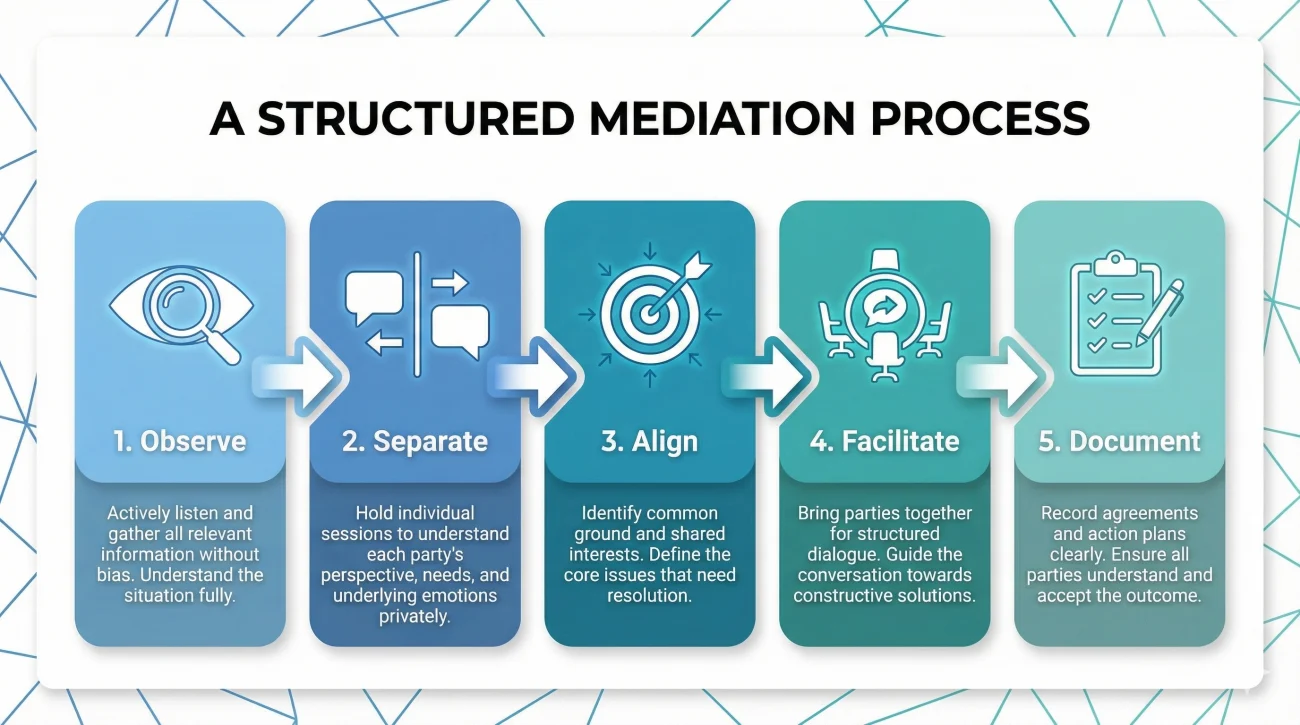
- 🔍 Observe: Understand the conflict before intervening by listening and gathering context
- 🤝 Separate: Talk to each person individually first to understand their perspective privately
- 🎯 Align: Identify the shared goal both parties care about achieving
- 💬 Facilitate: Bring them together with a focus on problem-solving rather than blame
- 📋 Document: Help establish clear agreements and next steps to prevent recurrence
This structured approach shows interviewers that you have a methodology rather than just winging conflict situations. Having a framework demonstrates the kind of thoughtful approach they want handling team dynamics.
Sample Answer
Two colleagues on my project team had an ongoing disagreement about code review standards. One preferred thorough reviews with detailed feedback, while the other felt the process was slowing development. The tension started bleeding into meetings and made collaboration harder for the whole team.
Even though I wasn’t their manager, I wanted to help resolve it because it was impacting productivity and morale, and we needed a workable approach the team could actually stick to.
I started by speaking with each person separately over lunch and asked open-ended questions to understand what they were protecting. I learned the thorough reviewer had dealt with a serious production bug caused by rushed code in a previous role, and the other teammate was under intense pressure from stakeholders to deliver quickly. That helped me see they weren’t being stubborn, they were responding to different risks.
After that, I asked if they’d be open to a short conversation together with me facilitating. In the discussion, I kept bringing us back to a shared goal: shipping quality code on time. I used questions like, “What would an efficient review process look like that still catches critical issues?” and “Which types of changes genuinely need deeper review?” Instead of debating positions, I guided us into brainstorming options and writing down what “good enough” meant for different scenarios.
We agreed on a tiered review approach: quick reviews for low-risk changes and more thorough reviews for critical components. Both colleagues felt their concerns were addressed, and the new approach reduced friction while keeping quality safeguards in place.
Our workflow improved, our manager later adopted the tiered approach as a team standard, and the two colleagues now collaborate smoothly, even joking about the disagreement afterward.
Keys to Strong Mediation Answers
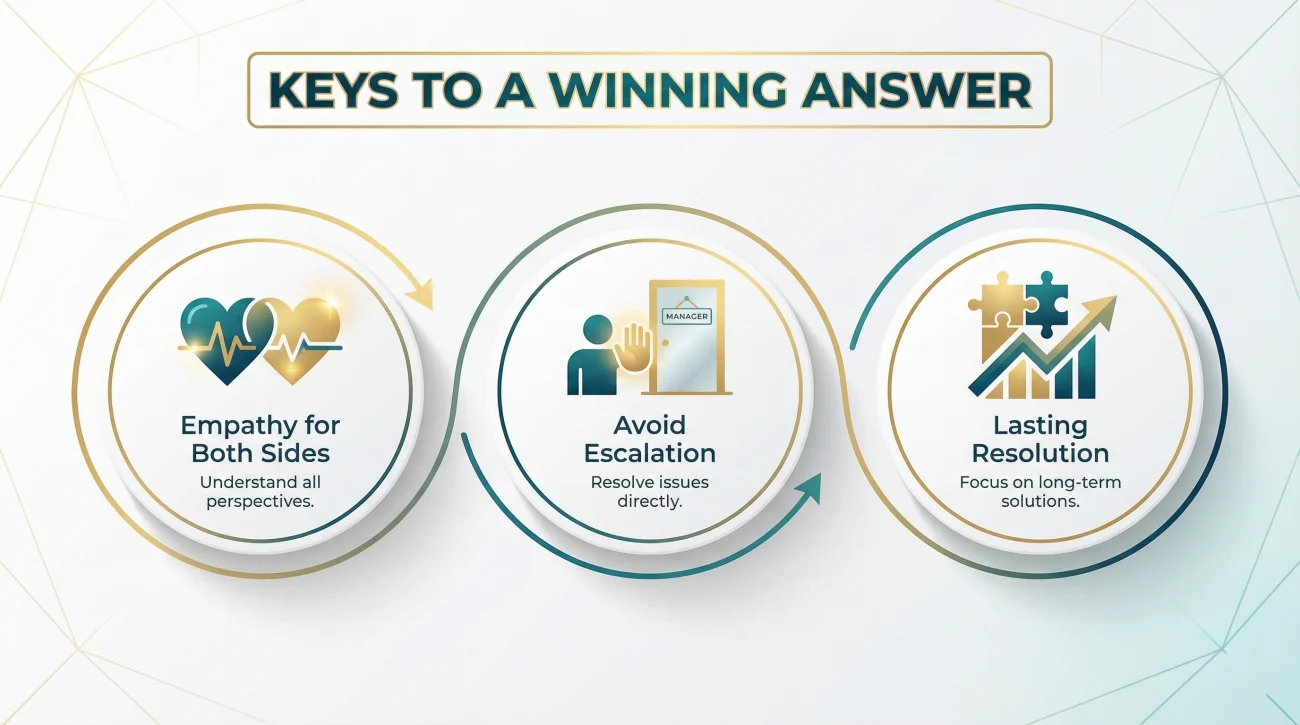
Demonstrate Empathy for Both Sides
Your answer should show you understood why each person held their position. One-sided understanding suggests bias. Articulating both perspectives demonstrates the emotional intelligence that makes effective mediators.
Avoid Unnecessary Escalation
The best answers show you resolved the issue without requiring management intervention. If you did involve a manager, explain why that was necessary and what you had already attempted. Going straight to management signals you passed the problem rather than solving it.
Achieve Lasting Resolution
Strong answers describe improved relationships and processes, not just temporary truces. If your story ends with colleagues avoiding each other or continuing to simmer, it demonstrates incomplete resolution. Look for examples where the relationship actually improved.
For more approaches to demonstrating leadership in interviews, explore our detailed guides.
❓ FAQ
🎯 What if I was not successful in resolving the conflict?
You can describe an unsuccessful mediation if you focus on what you learned and how you would approach it differently. Some conflicts genuinely require management involvement. Show that you tried appropriate steps first and knew when to escalate.
💼 Should I mention if I privately agreed with one side?
Generally no. Your role as mediator was to facilitate resolution, not to judge who was right. Mentioning private agreement suggests you may not have been fully neutral in your facilitation.
⏰ What if the conflict was between me and two others?
That is a different question about personal conflict, not mediation. For team mediation questions, choose an example where you were genuinely a third party helping others resolve their dispute.
📋 Can I use an example from outside work?
Academic group projects, volunteer organizations, or sports teams can provide valid examples, especially for entry-level candidates. The mediation skills demonstrated are transferable regardless of context.
✨ How do I show mediation skills without sounding self-important?
Focus on the process and outcome rather than your personal heroism. Describe what you did specifically and give credit to the colleagues for their willingness to work through the issue. Humble framing is more credible.
Leadership Without the Title
Answering questions about conflict within a team where you played mediator demonstrates leadership skills that transcend job titles. The ability to facilitate productive dialogue, maintain neutrality, and guide colleagues toward shared goals is exactly what organizations need at every level. A strong mediation story positions you as someone who improves team dynamics rather than contributing to dysfunction.
⚠️ Disclaimer: The interview strategies, sample answers, and negotiation tips provided in this guide are for educational purposes only. Hiring decisions are subjective and vary by company and industry. While these strategies are based on professional HR standards, they do not guarantee a specific job offer or result.