

When Doing Everything Yourself Becomes the Problem
Presenting difficulty delegating as a weakness works well for leadership interviews because it implies high standards while being clearly improvable. The struggle to let go of tasks often stems from caring deeply about outcomes. Interviewers understand this. The key is showing you recognize why delegation matters and demonstrating concrete progress toward trusting your team.
Delegation failures destroy more management careers than any other skill gap. Leaders who can’t let go become bottlenecks. Leaders who let go without support set teams up for failure. The art is finding balance between involvement and autonomy.
The New Team Lead Who Burned Out
A recently promoted team lead shared her story:
“When I was promoted, I kept doing my individual contributor work while adding management responsibilities. I told myself the team wasn’t ready to handle the critical tasks. Within three months, I was working seventy-hour weeks and my health was suffering.”
“My manager intervened and made me delegate specific projects completely. I was terrified, but the team handled them well. Some things weren’t done exactly as I would have done them, but the outcomes were fine.”
“That experience taught me my perfectionism was creating a bottleneck, not protecting quality. I now use a rule: if someone can do it at eighty percent of my standard, I delegate and coach them to improve.”
This answer shows genuine struggle, external help that worked, and a practical framework for improvement.
The Experienced Manager Who Still Struggles
A senior manager admitted an ongoing challenge:
“Delegation remains my greatest weakness even after ten years of management. My instinct when something is critical is still to handle it myself. I’ve learned to override that instinct, but it takes conscious effort every time.”
“I ask myself three questions before taking on any task: Is this the best use of my time? Could someone else learn from doing this? Am I creating a bottleneck by keeping this?”
“If I can’t answer yes, yes, and no, I force myself to delegate. I’ve also started treating delegation as a development opportunity for my team rather than a risk to manage. That reframe helps me let go.”
Mature self-awareness: Acknowledging an ongoing struggle while showing systematic management of it demonstrates growth without overclaiming.
Why This Weakness Works
| What You’re Admitting | What Interviewers Hear |
|---|---|
| I struggle to let go | You have high standards for outcomes |
| I sometimes do too much myself | You’re personally accountable |
| I’m learning to trust my team | You’re self-aware and growing |
| I’ve developed systems to delegate better | You solve your own problems |
This weakness implies positive qualities while being clearly addressable through awareness and practice.
Building Your Answer
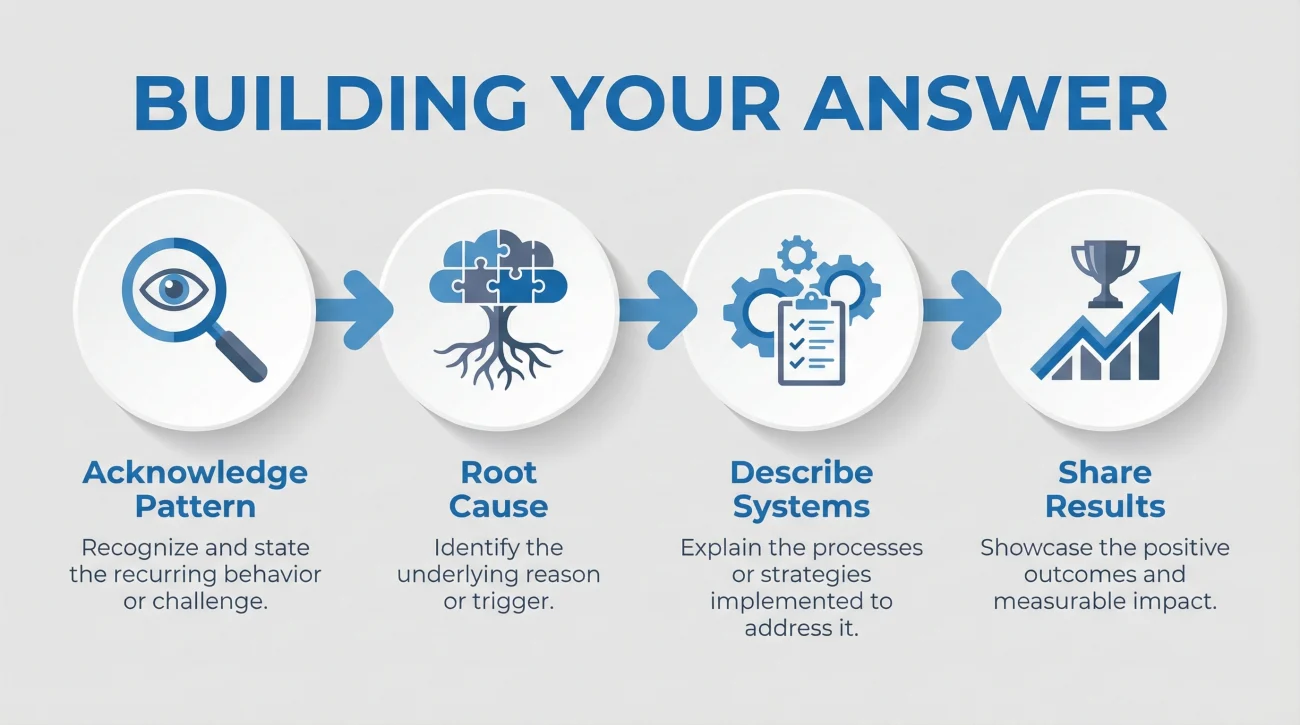
Acknowledge the Pattern
Describe specific situations where delegation was difficult. Did you redo others’ work? Check constantly? Keep tasks you should have assigned? Concrete examples make the weakness real.
Explain the Root Cause
Why do you struggle? Perfectionism, past delegation failures, or identity tied to individual contribution? Understanding your specific driver shows self-awareness.
Describe Your Systems
What approaches help you delegate more effectively? Decision frameworks, trust-building practices, or accountability structures demonstrate systematic improvement.
Share Results
How has your team grown because of improved delegation? Team members promoted, expanded responsibilities, or developed new capabilities show the impact of your growth.
For more leadership development strategies, explore our behavioral interview resources.
❓ FAQ
🎯 Is this appropriate for individual contributor roles?
Less so, unless the role involves project leadership or mentoring. For pure IC roles, choose a weakness more relevant to that context. Delegation makes most sense for management positions.
💼 What if I haven’t had direct reports yet?
Delegation happens without direct reports too. You might delegate to peers, coordinate with other teams, or share project responsibilities. If you struggle with sharing work, discuss it in that context.
⏰ How do I avoid sounding like a micromanager?
Focus on the struggle to let go rather than the behavior of constant checking. Emphasize your improvement journey and current practices for building trust.
📋 Can this seem like lack of trust in my team?
It can, which is why framing matters. Present it as your personal development area rather than a judgment of others’ capabilities. The struggle is about your need for control, not team inadequacy.
✨ What results show delegation improvement?
Team member growth: promotions, expanded responsibilities. Your own capacity: able to take on bigger scope. Team performance: outcomes achieved through others rather than your personal effort.
Learn to Lead Through Others
Presenting difficulty delegating as a weakness shows you understand that leadership requires achieving results through others. Describe your specific struggle, the root cause you’ve identified, and the systems you use to delegate more effectively. When interviewers see a high performer consciously developing trust in their team, they see someone ready to scale their leadership impact.
⚠️ Disclaimer: The interview strategies, sample answers, and negotiation tips provided in this guide are for educational purposes only. Hiring decisions are subjective and vary by company and industry. While these strategies are based on professional HR standards, they do not guarantee a specific job offer or result.