When High Standards Turn Inward
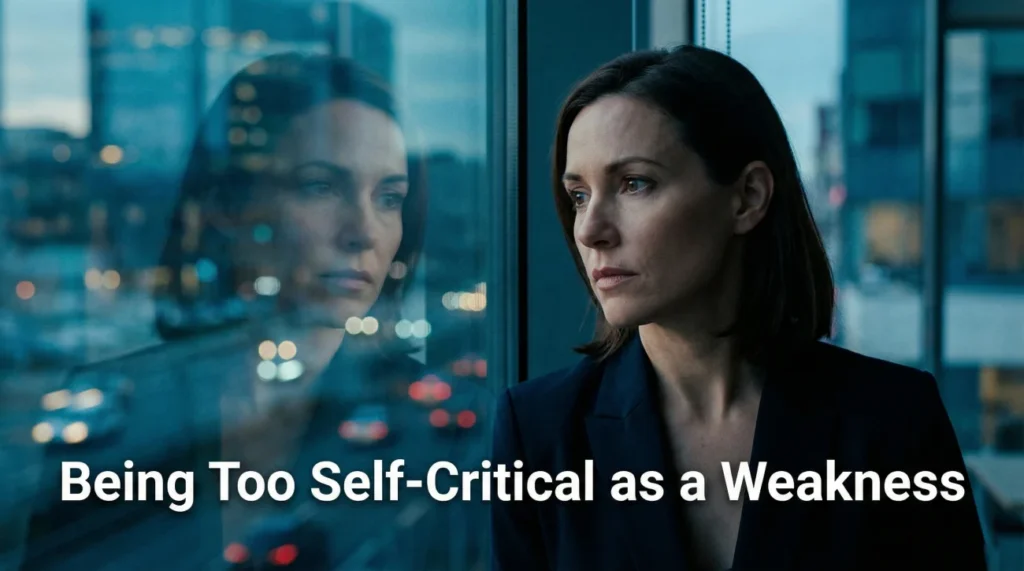
Presenting being too self-critical as a weakness refers to judging your own performance more harshly than external standards require. This weakness implies high personal standards while acknowledging those standards can become counterproductive. Self-criticism at extreme levels leads to burnout, anxiety, and inability to recognize genuine accomplishment.
This weakness is difficult to fake, which makes it powerful when genuine. Candidates who truly struggle with self-criticism describe specific thought patterns and their consequences. The authenticity comes through in the details.
The Analyst Who Burned Out
A financial analyst shared her experience:
“My greatest weakness is being too critical of myself. I hold myself to standards that are unrealistic and then beat myself up when I don’t meet them. I’ve worked nights and weekends trying to make deliverables perfect, only to have managers tell me the original version was already excellent.”
“This led to burnout last year. I was physically and emotionally exhausted from the constant pressure I put on myself.”
“I worked with a coach who helped me recognize that my inner critic was actually hurting my performance, not improving it. I’ve learned to ask: ‘Would I judge a colleague this harshly for the same work?’ Usually, the answer is no. That perspective helps me calibrate my self-assessment more reasonably.”
This answer shows real consequences and professional help for a genuine struggle.
The Manager Who Couldn’t Celebrate
A product manager described his pattern:
“My weakness is being too hard on myself, specifically the inability to recognize success. When projects go well, I focus on what could have been better rather than what we achieved. My team celebrated a successful launch while I was already listing everything I would do differently next time.”
“A mentor observed this pattern and told me: ‘Your team takes cues from you. If you can’t acknowledge success, they won’t feel successful either.’ That feedback hit hard because I was affecting team morale with my relentless self-criticism.”
“I’ve started a practice of explicitly naming three things that went well before analyzing what could improve. It’s still uncomfortable, but my team’s energy has improved noticeably.”
Leadership impact: Self-criticism doesn’t just affect you. It shapes how your team experiences their own work.
The Developer Who Catastrophized Mistakes
A software developer described her thought patterns:
“Being too critical of myself is my greatest weakness. When I make a mistake, my mind immediately goes to catastrophic outcomes. A bug in my code becomes evidence that I’m not competent. A piece of critical feedback becomes proof I’ll never succeed.”
“Rationally I know this is distorted thinking, but in the moment it feels completely real.”
“I’ve worked hard on this with cognitive techniques. When I notice catastrophic thinking, I write down the actual evidence for and against my worst-case interpretation. Usually, there’s very little evidence for catastrophe and lots of evidence that I’m a competent professional who occasionally makes normal human mistakes.”
“This practice doesn’t eliminate the self-criticism, but it gives me tools to challenge it.”
How Self-Criticism Shows Up
| Pattern | Example | Impact |
|---|---|---|
| Dismissing praise | “They’re just being nice” | Can’t internalize positive feedback |
| Dwelling on mistakes | Replaying errors for days | Anxiety, reduced confidence |
| Moving goalposts | “That wasn’t good enough” | Never feeling satisfied |
| Catastrophizing | “This proves I’m not competent” | Disproportionate negative reactions |
Identify which pattern describes you and build your answer around that specific manifestation. For additional interview strategies, explore more examples of answering difficult questions.
❓ FAQ
🎯 Does this weakness sound like lack of confidence?
It can, which is why framing matters. Emphasize high standards rather than self-doubt. The issue is excessive internal criticism, not lack of capability.
💼 Is this too personal for interviews?
Keep the focus professional. Discuss how self-criticism affects work performance rather than diving into personal psychology. Mention coaching or strategies without oversharing.
⏰ What if I actually have low confidence?
Self-criticism and low confidence are different. Self-criticism involves harsh internal judgment despite objective competence. If you genuinely lack confidence, this might not be the right weakness to highlight.
📋 How do I avoid sounding fragile?
Emphasize that you’re functional and effective despite the self-criticism. Focus on management strategies that work rather than dwelling on emotional difficulty.
✨ Can this apply to any role?
Generally yes, because self-criticism affects performance in any context. Just ensure your improvement story emphasizes professional impact and practical strategies.
Calibrate Your Inner Critic
Presenting being too self-critical as a weakness shows emotional intelligence about your own psychology while demonstrating practical management strategies. Describe your specific patterns, acknowledge their real costs, and explain how you calibrate your self-assessment to be more accurate. When interviewers see someone with high standards who has learned to apply them constructively rather than destructively, they see capability combined with resilience.
⚠️ Disclaimer: The interview strategies, sample answers, and negotiation tips provided in this guide are for educational purposes only. Hiring decisions are subjective and vary by company and industry. While these strategies are based on professional HR standards, they do not guarantee a specific job offer or result.