Executives Are Evaluated Differently
The higher you climb, the less anyone cares about what you do and the more they care about what happens because of you. A manager describes their responsibilities. An executive describes their impact.
This shift changes everything about how you introduce yourself. The executive bio template that worked when you were a director won’t work when you’re interviewing for VP or C-suite roles. Board members and fellow executives evaluate candidates on a completely different set of criteria.
They want to know: What’s your vision? What outcomes have you driven at scale? How do you think about building organizations? Can you operate at a strategic level while also ensuring execution happens?
The template that follows addresses those questions directly, positioning you as a leader rather than a high-level doer.
The Executive Mindset Shift
Before looking at templates, understand how executive communication differs from everything you’ve done before.
| Manager/Director Level | Executive Level |
|---|---|
| I managed a team of fifteen | I built an organization from five to sixty |
| I was responsible for marketing | I repositioned the brand and grew revenue 3x |
| I improved operational efficiency | I transformed a cost center into a competitive advantage |
| I led the product team | I defined the product vision that captured new markets |
| I reported to the CEO | I partnered with the CEO on strategic decisions |
Notice the pattern: executive language emphasizes transformation, outcomes, and strategic choices rather than responsibilities, tasks, and reporting structures.
The Executive Introduction Template
Executive introductions typically run two to three minutes when delivered fully, though you should also have a condensed sixty-second version. The structure prioritizes impact and vision over chronological history.
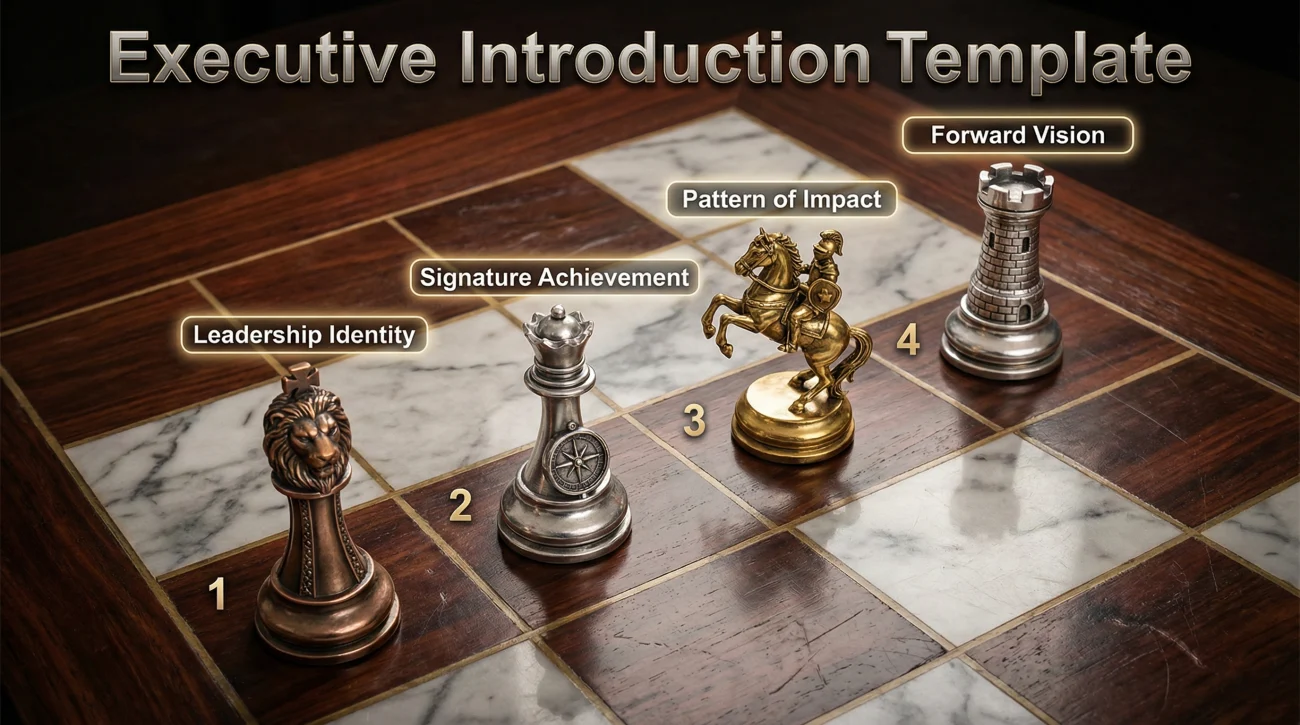
Leadership Identity
"I'm a [type of leader] who [your distinctive approach or philosophy]. Over [timeframe], I've [scope of impact: revenue, scale, transformation]."
Example:
“I’m an operational leader who builds high-performance cultures in complex, fast-changing environments. Over the past fifteen years, I’ve led organizations through hypergrowth phases, taking companies from regional players to national leaders in their categories.”
Signature Achievement
"Most recently at [company], I [specific achievement with measurable outcome]. The key to that success was [insight or approach that made it work]."
Example:
“Most recently at Northwind Industries, I led the turnaround of their consumer division, moving it from a forty million dollar loss to profitability within eighteen months while rebuilding the leadership team and launching a new product line that’s now their fastest growing segment. The key to that success was focusing the organization on three priorities rather than twenty, and building an execution culture that could move faster than our larger competitors.”
Pattern of Impact
"This continues a pattern from my earlier work at [previous company], where I [another significant achievement]. What connects these experiences is [theme or capability]."
Example:
“This continues a pattern from my work at Meridian Corp, where I scaled the operations function from supporting fifty million in revenue to over three hundred million. What connects these experiences is my ability to build the systems and teams that allow organizations to scale without breaking.”
Forward Vision
"What I'm looking for now is [type of opportunity]. I'm drawn to [this company/role] because [specific strategic reason]."
Example:
“What I’m looking for now is a platform where I can apply this transformation experience to a company ready for its next growth phase. I’m drawn to Apex because you have strong fundamentals but haven’t yet built the operational infrastructure to scale beyond where you are. That’s exactly the challenge I’m built for.”
Complete Executive Scripts
Chief Marketing Officer
“I’m a brand-building CMO who combines creativity with commercial discipline. I believe marketing should be a growth engine, not a cost center, and I’ve consistently built teams that deliver measurable revenue impact.
At my most recent company, I repositioned a legacy brand that was losing relevance with younger consumers. We rebuilt the brand identity, shifted the channel mix toward digital, and launched a campaign that became genuinely cultural. The result was a thirty-five percent increase in brand consideration among our target demographic and revenue growth of twenty-two percent in a flat market.
Before that, at a consumer tech company, I built the marketing function from scratch as we scaled from startup to IPO. I hired the team, established the brand, and created the demand generation engine that drove our growth from eight million to over a hundred million in ARR.
What connects these experiences is my ability to translate brand vision into business outcomes. I’m looking for a CMO role at a company where marketing can genuinely change the trajectory of the business.”
Chief Operating Officer
“I’m an operations leader who scales companies through their most chaotic growth phases. My focus is building systems and teams that can execute at increasing scale without losing speed or quality.
At Horizon Health, I took over operations during a period when the company was growing forty percent annually but breaking internally. Customer satisfaction was falling, costs were spiraling, and we were losing good people to burnout. I rebuilt the operational core, implementing systems that let us double again while actually improving margins and employee satisfaction.
Earlier in my career at a logistics company, I led the transformation from a regional operator to a national player. That meant building entirely new capabilities in technology, distribution, and talent while maintaining the customer relationships that were our foundation.
I’m looking for a COO role at a company facing that inflection point where the things that got you here won’t get you to the next level. I’m most valuable in situations where the answer isn’t incremental improvement but fundamental capability building.”
For guidance on adapting your introduction to different interview formats, see our comprehensive introduction guide.
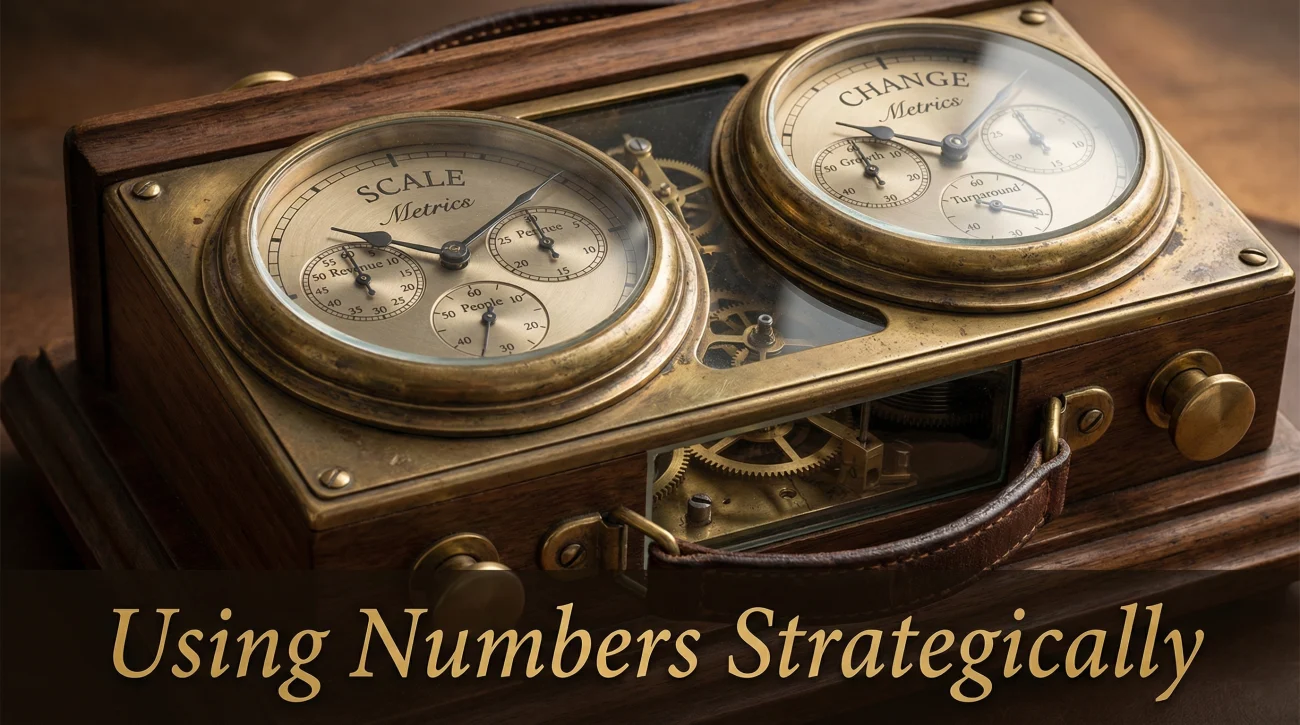
Using Numbers Strategically
Executives are expected to speak in terms of measurable impact. But not all numbers are equally impressive.
Scale Numbers
Revenue you’ve influenced, budgets you’ve managed, people you’ve led, customers you’ve served. These establish the scope of your experience.
Change Numbers
Growth percentages, improvement rates, turnaround figures. These demonstrate impact rather than just participation.
What to Avoid
Numbers that sound impressive in isolation but don’t translate to business impact. “Increased social media engagement by 500%” means nothing if it didn’t affect the business. Executives focus on outcomes that connect to revenue, cost, or strategic position.
- ✅ “Grew revenue from 40M to 120M over three years”
- ✅ “Reduced customer acquisition cost by forty percent”
- ✅ “Built and led an organization of two hundred fifty people”
- ❌ “Launched fifteen new initiatives”
- ❌ “Managed a cross-functional project”
Board and Investor Contexts
When presenting to boards or investors rather than hiring committees, adjust your focus further.
Board Presentations
Emphasize governance experience, strategic thinking, and your ability to contribute to board-level discussions. What perspective do you bring that the current board lacks?
Investor Conversations
Focus on value creation, market understanding, and track record of building shareholder value. Investors evaluate executives differently than hiring committees do.
❓ FAQ
🎯 How long should an executive introduction be?
Two to three minutes for a full version, sixty seconds for a condensed version. Executive conversations often allow more time than junior interviews, but you should still be able to deliver impact quickly if asked.
💼 Should I mention specific company names?
Yes, if those names carry weight in your industry. Well-known companies add credibility. If your companies aren’t recognizable, briefly contextualize them: “a three hundred million dollar manufacturing company” rather than just the name.
⏰ How do I handle confidential information?
Speak in general terms when specifics are sensitive. “I improved profitability significantly” works when you can’t share exact numbers. Executive interviewers understand confidentiality constraints.
📋 What if my biggest achievements were team efforts?
At the executive level, everything is a team effort. Use language that shows you led and enabled rather than did everything yourself. “I built the team that…” or “Under my leadership, we…” properly credits the collective while establishing your role.
✨ Should I mention my leadership philosophy?
Briefly, if it differentiates you. A one-sentence philosophy can be memorable, but don’t spend significant time on abstract leadership concepts. Evidence of impact matters more than articulated philosophy.
Lead With Impact
Your executive bio template should position you as a leader who creates measurable transformation. Lead with your leadership identity and distinctive approach. Highlight signature achievements with concrete outcomes. Show the pattern of impact across your career. Connect your trajectory to what this opportunity needs.
At the executive level, your introduction isn’t about impressing with credentials. It’s about demonstrating that you see the strategic challenge clearly and have the track record to address it. The executives who get hired are those who make interviewers think: this person understands what we need and has done it before.
⚠️ Disclaimer: The interview strategies, sample answers, and negotiation tips provided in this guide are for educational purposes only. Hiring decisions are subjective and vary by company and industry. While these strategies are based on professional HR standards, they do not guarantee a specific job offer or result.