Design Starts With Constraints
Fashion designer interview questions are not trying to discover whether you can draw. They are trying to confirm whether you can build a product that survives the real world: fabric behavior, fit, cost targets, production limits, and the customer who buys with emotion but returns with logic.
A strong designer thinks in two directions at once. You look forward to what a collection should feel like, and you look backward to what has to be true for it to be manufactured on time. Interviewers listen for how you translate a vibe into specifics, like silhouette decisions, a color story that supports the brand, and a construction plan that does not collapse during sampling.
This guide helps you answer like a working designer, not a student. You will practice how to talk about research, tech packs, collaboration with pattern and merchandising, and the small decisions that protect margin without killing the design. If your answers sound like a process, you will come across as someone a studio can trust.
Creative Process & Trends
Describe your research process for a new collection.
I start broad. I look at macro-trends in art, architecture, and pop culture, not just other fashion brands. I subscribe to WGSN but also people-watch in key neighborhoods.
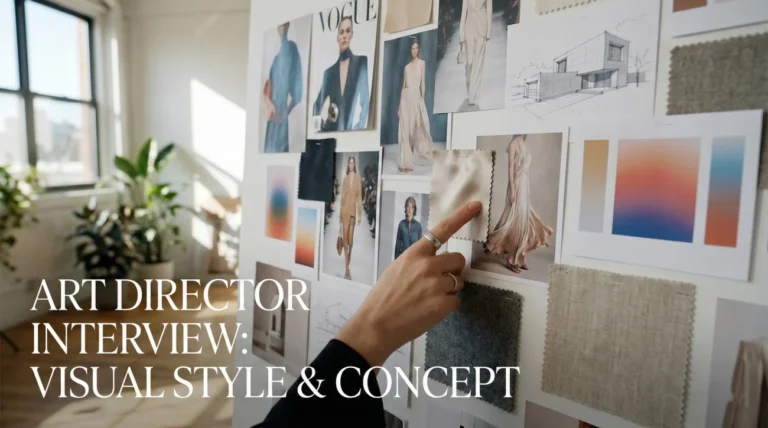
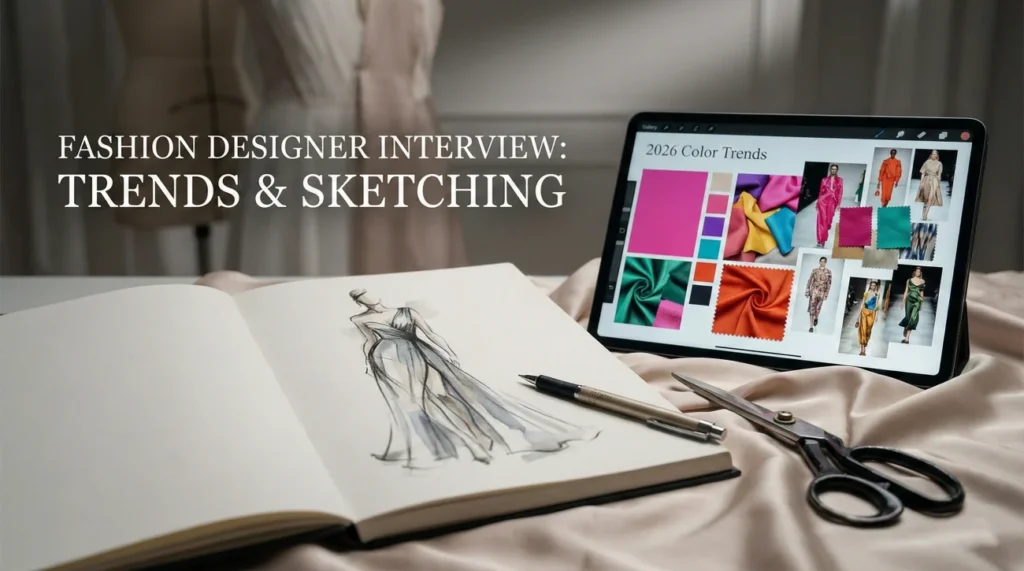
I gather textures and color swatches before I sketch. I create a “Muse” for the season – who is she, where is she going? This narrative grounds the collection. I then distill these inspirations into a cohesive mood board that aligns with the brand’s DNA.
How do you predict trends 18 months in advance?
I analyze the “Zeitgeist.” If the world is chaotic, fashion tends toward comfort and protection (cocooning). If the economy is booming, hemlines rise and colors get brighter.
I look at fabric innovations at trade shows like Première Vision. I trust data from previous best-sellers but layer intuition on top. Predicting trends is about connecting the dots between sociological shifts and aesthetic desires.
You have a creative block. How do you break it?
I change my medium. If I’m stuck on the computer, I drape fabric on a dress form. The tactile feedback of silk or wool often sparks a silhouette idea.
I also go to vintage stores. Looking at how garments were constructed in the past (a unique buttonhole, a weird seam) often solves a modern design problem. I believe in “working through it” rather than waiting for inspiration to strike.
Technical Skills & Production
Q: What is a “Tech Pack” and why is it vital?
A Tech Pack is the blueprint for the factory. It contains the technical sketch (flat), measurements (graded for sizes), bill of materials (BOM), and construction details.
Without a precise Tech Pack, the factory is guessing, which leads to costly samples and delays. I treat it as a legal contract; if it’s not in the pack, it won’t be on the garment.
Q: Explain “Grading” in fashion.
Grading is the process of turning a sample size (e.g., Medium) into a full size range (XS-XL). It is not just scaling up uniformly.
A size XL body has different proportions than an XS. I work with pattern makers to ensure the design integrity holds across sizes. Bad grading is why clothes fit poorly, so I review the graded specs carefully.
Q: Draping vs. Flat Pattern Drafting: Which do you prefer?
I use Draping for organic, fluid designs (eveningwear, soft tops) because gravity dictates the shape. I can see the volume immediately.
I use Flat Pattern for tailored, structured items (trousers, jackets) where precision and geometry are key. A complete designer should understand both to communicate effectively with the pattern room.
Q: How do you choose fabrics (sourcing)?
I balance aesthetics, function, and cost. A fabric might look beautiful but pill instantly or be too expensive for the target price point.
I check the weight (GSM) and drape. I perform wash tests on swatches. I also consider the supply chain lead time; if the fabric takes 6 months to weave, it might miss the season.
Q: What is your experience with 3D Design software?
I use CLO3D (or Browzwear) to prototype. It allows me to test fit and fabric drape virtually before cutting a single yard of fabric.
This reduces physical waste and speeds up the approval process. I can change a print scale or hemline in seconds during a meeting, rather than waiting weeks for a new physical sample.
Q: How do you handle a “Fit Session”?
I lead the session with the technical designer. I look for drag lines, balance, and ease. I ask the fit model how it feels (is it tight when sitting?).
I am decisive. “Raise the armhole 1/2 inch, release the hip 1 inch.” I document every change with photos and pins. The goal is perfection before production.
Commercial Viability & Merchandising
Q: How do you balance creativity with commercial needs?
I design according to the “Pyramid” model. The top 10% is the “Fashion/Image” product – high design, press-worthy, risky. The middle 30% is key items.
The bottom 60% is “Volume/Basics” – the bread and butter. I channel my wild creativity into the top tier, but I ensure the bottom tier is perfect in fit and price. A brand needs both hype and sales volume to survive.
Q: How do you work with Merchandisers?
I view them as my strategic partners. They provide the “Line Plan” (we need 5 dresses, 3 tops). They give me the sales data: “Last year’s floral print didn’t sell, but stripes did.”
I use this data to inform my creative choices. I don’t fight the numbers; I design into them. If they say we need a $50 price point, I engineer the garment (fabric choice, construction) to hit that target without looking cheap.
Q: How do you incorporate sustainability into mass production?
I design for “yield efficiency” to minimize fabric waste (zero-waste pattern cutting). I choose mono-materials (100% cotton vs. poly-blend) to make recycling easier.
I advocate for digital sampling to reduce shipping emissions. I believe designers have a responsibility to solve the waste problem at the creation stage, not just the disposal stage.
Q: Why do you want to be a Fashion Designer?
I love the immediacy of fashion. It is the only art form that people live their lives in. I enjoy the puzzle of translating a mood into a tangible object that solves a functional need (warmth, modesty) while fulfilling an emotional desire (confidence, beauty). I want to create clothes that become a person’s favorite item, the one they reach for when they want to feel their best.
Portfolio & Presentation
Q: Walk me through your portfolio layout.
I structure it by project. For each collection, I show the journey: Inspiration/Mood Board -> Sketches/Process -> Fabric Swatches -> Tech Packs/Flats -> Final Editorial Photos.
I include the tech packs to prove I can execute, not just draw. I tailor the portfolio to the brand I’m interviewing for; if you are a denim brand, I highlight my denim projects first.
Q: Sketching by hand vs. Illustrator (CADs)?
I sketch by hand for initial ideation because it’s fluid and fast. It captures the energy.
However, for the final presentation and factory handoff, I use Adobe Illustrator to create accurate technical flats. These show stitch details, closures, and proportions exactly. My portfolio shows both to demonstrate artistic flair and technical competence.
Q: How do you handle critique of your designs?
I detach my ego from the garment. If a Creative Director says “This doesn’t work,” I ask “Why? Is it the silhouette or the fabric?”
I view critique as a way to sharpen the product. Fashion is collaborative. If the sales team says it won’t sell, or the tech team says it can’t be sewn, I listen. I am flexible enough to pivot while fighting for the elements that define the style.
Fashion Design Competency Quiz
Take the 20-Question Challenge
1. A “Flat” (Technical Sketch) is typically drawn:
- On a model posing dramatically
- Symmetrically, laid flat, showing all seams/stitching details
- In watercolor
- From the side view only
2. “GSM” measures:
- Garment Size Metric
- Grams per Square Meter (Fabric weight)
- Global Sourcing Management
- Gold Silver Metal
3. The “Grainline” runs:
- Diagonally
- Parallel to the selvage (warp yarns)
- Perpendicular to the selvage
- In a circle
4. A “Line Sheet” is used for:
- Drawing lines
- Sales (Wholesale), showing sketches/photos, prices, and sizes available
- Sewing patterns
- Fabric testing
5. “Bias” cut fabric offers:
- Stiffness
- Natural stretch and fluid drape
- Lower cost
- Waterproofing
6. A “Strike-Off” is:
- Firing an employee
- A fabric sample printed with the custom pattern for approval
- Hitting the fabric
- A discounted item
7. “Haute Couture” means:
- Expensive clothes
- High Sewing (custom-fitted clothing made by hand in Paris under specific rules)
- Hot Culture
- Ready to Wear
8. “Prêt-à-Porter” translates to:
- Pretty Porter
- Ready-to-Wear (standard sizing, mass production)
- Print and Pattern
- Made to Measure
9. A “Toile” (or Muslin) is:
- A type of perfume
- A prototype garment made from cheap fabric to test the fit/pattern
- A bathroom
- A finished dress
10. “Pantone” (TCX/TPX) helps designers:
- Pick pants
- Communicate exact color standards to factories
- Design logos
- Draw figures
11. A “Croquis” is:
- A French pastry
- A quick sketch of a fashion figure used as a template
- A crocodile print
- A sewing tool
12. “Seam Allowance” is:
- Money for sewing
- The fabric between the stitching line and the raw edge
- The length of the seam
- A mistake
13. A “Dart” helps to:
- Add volume
- Shape flat fabric to fit body curves (bust/waist)
- Hold the fabric down
- Decorate the hem
14. “Fast Fashion” is characterized by:
- Slow production
- Rapid production cycles, low cost, and trend replication
- Running shoes
- High quality materials
15. The “BOM” in a tech pack stands for:
- Bottom Of Material
- Bill Of Materials (list of all components needed)
- Best Of Mode
- Basic Operation Method
16. “Warp” and “Weft” refer to:
- Sounds
- The vertical and horizontal yarns in weaving
- Knitting needles
- Sewing machines
17. A “Notion” includes:
- An idea
- Small objects attached to a garment (buttons, zippers, snaps, elastic)
- The fabric
- The sketch
18. “Interfacing” is used to:
- Connect computers
- Stiffen or strengthen fabric (e.g., collars, cuffs)
- Color the fabric
- Remove stains
19. “Upcycling” means:
- Cycling uphill
- Transforming waste materials/old clothes into new products of better quality
- Recycling plastic
- Throwing away clothes
20. A “Sample” is:
- A small piece of fabric
- The first physical version of the design produced by the factory for approval
- A drawing
- A stolen idea
❓ FAQ
🎓 Do I need a fashion degree to get hired?
Not in every role, but you do need proof you understand construction, fit, and production language. If you do not have a degree, your portfolio and process have to do the heavy lifting: clear projects, technical flats, and evidence you can take a concept through sampling.
🧵 Do I need to know how to sew?
You do not need to run a factory line, but you should understand how garments are built. If you can drape, pin, and communicate seam and closure decisions, you will collaborate better with pattern and technical teams and you will catch problems earlier.
💻 What tools should I be ready to discuss?
Expect questions about flats and technical communication. Adobe Illustrator is common for tech sketches and packs, spreadsheets help with BOM and costing, and many teams value some level of 3D prototyping. The key is not the tool name, it is how you use tools to reduce sampling mistakes and speed decisions.
🗂️ How many projects should my portfolio include?
Bring fewer projects, but make them complete. A small set of collections with inspiration, development, flats, fabric choices, and at least one technical proof point will outperform a huge gallery of sketches. Hiring managers want to see finish, not only ideas.
🏷️ What is the difference between commercial design and high fashion in interviews?
Commercial roles care about speed, price points, and repeatable best-sellers. High fashion roles care about innovation, craft, and brand image. Your answers should match the business model: talk margin and line plans for commercial, talk storytelling and construction depth for luxury.
Final Thoughts
Interviews reward designers who can explain decisions, not just aesthetics. When you answer fashion designer interview questions, show how you move from research to sketch, from sketch to tech pack, and from tech pack to a sample that actually works on a body and in a budget.
If you highlight strong collaboration, clean technical communication, and a habit of designing with constraints instead of fighting them, you will sound like the designer who can ship collections, not just imagine them.
⚠️ Disclaimer: The interview strategies, sample answers, and negotiation tips provided in this guide are for educational purposes only. Hiring decisions are subjective and vary by company and industry. While these strategies are based on professional HR standards, they do not guarantee a specific job offer or result.