Uncovering Truth Under Deadline
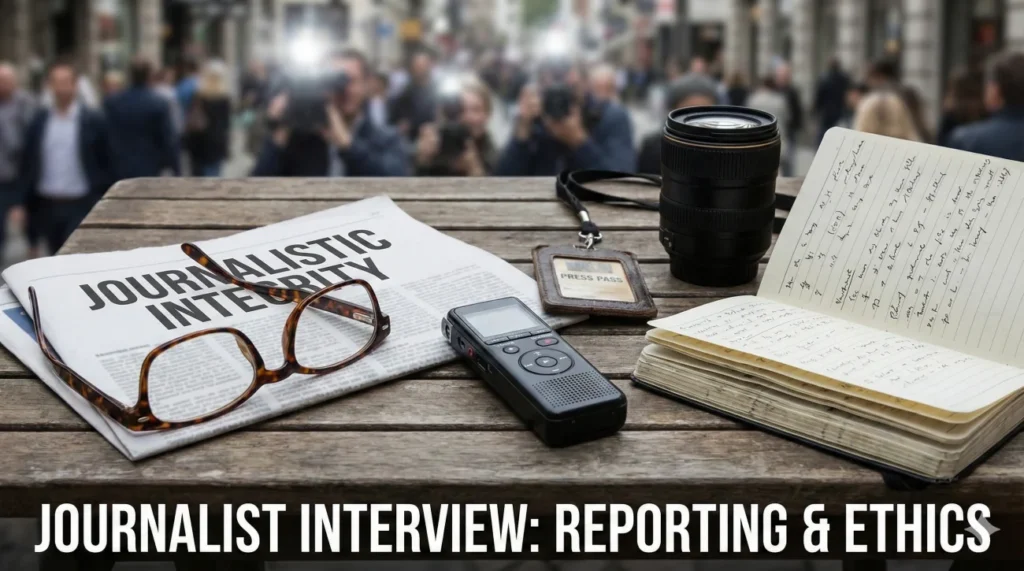
Journalist interview questions evaluate your ability to find stories, verify facts, conduct interviews, and write compelling reports under time pressure. You are not creating marketing messages or advocating for clients; you are informing the public about matters that affect their lives. Your commitment to accuracy, fairness, and ethical practice defines your credibility and your publication’s trustworthiness.
Hiring managers want reporters who can cultivate sources, verify information rigorously, and produce accurate stories quickly. They need someone who navigates ethical dilemmas thoughtfully, protects sources when necessary, and maintains objectivity even when covering controversial topics. The best journalists combine curiosity and tenacity with the judgment to know when a story is ready to publish.
This guide covers reporting and research methods, source cultivation and interviewing, verification and accuracy, ethical decision-making, and writing effectively under deadline pressure.
Reporting & Research
Q: Describe your approach to developing a story from initial tip to publication.
I start by assessing newsworthiness and feasibility. Is this story significant to our audience? Can I verify the claims and access necessary sources within deadline? I conduct preliminary research to understand the landscape, identify key players, and formulate questions. This preparation ensures I use interview time efficiently and recognize significant information when I hear it.
I gather information from multiple sources, seeking diverse perspectives and corroborating facts independently. I verify claims against documents, records, and additional sources rather than relying on any single account. As the picture develops, I reassess my initial assumptions and adjust my approach. Writing begins only when I am confident the story is accurate and complete enough to publish responsibly.
Q: How do you find stories and develop story ideas?
I cultivate sources who provide tips and insights unavailable through public channels. I monitor public records, government meetings, court filings, and regulatory actions for newsworthy developments. I pay attention to social media and community discussions that signal emerging issues. I read widely, including competitors, to identify angles others may have missed.
I ask questions constantly: what are people talking about that is not being covered? What official explanations do not add up? What patterns emerge from seemingly unrelated events? Story ideas come from everywhere, but the best ones address significant public interest and reveal something readers would not otherwise know. I pitch ideas regularly and collaborate with editors to develop promising leads.
Q: What types of journalism have you practiced?
I have experience across daily news, feature writing, and investigative reporting. Daily news requires rapid verification and concise writing under tight deadlines. Features allow deeper exploration of human stories and require stronger narrative craft. Investigative work demands patience, meticulous documentation, and the ability to connect disparate information into coherent accounts of wrongdoing or systemic problems.
Each type develops different skills that strengthen overall journalism. Daily deadlines build speed and efficiency. Features develop storytelling ability. Investigation teaches rigorous verification and document analysis. I value versatility while recognizing that different stories and publications emphasize different approaches. I adapt my methods to match what each story requires.
Q: Describe your most challenging story and how you approached it.
I investigated allegations of misconduct within a local institution where sources feared retaliation and documentation was deliberately obscured. Initial sources provided leads but lacked proof. I built trust gradually, demonstrating reliability through smaller accurate stories before sources shared more sensitive information. I pursued documents through public records requests and cultivated contacts who could verify claims independently.
The reporting took months of patient work. I maintained detailed notes documenting every source and verification step. Before publication, I contacted all parties for response, ensuring fairness even to those accused. The story ultimately prompted official investigation and policy changes. The experience reinforced that significant stories require persistence, meticulous verification, and absolute commitment to accuracy even when conclusions are uncomfortable for powerful people.
Sources & Interviewing
Q: How do you cultivate and maintain sources?
I build relationships based on reliability and trust. I follow through on commitments, protect confidentiality when agreed, and demonstrate accuracy in my reporting. Sources talk to journalists they trust; that trust develops over time through consistent professional behavior. I maintain contacts even when not actively working on stories involving them.
I develop diverse sources across different perspectives and positions. Relying on a narrow range of sources produces skewed coverage. I seek out voices that are underrepresented in public discourse and work to include perspectives that challenge easy narratives. Good source relationships are reciprocal: I help them understand how journalism works while they help me understand their areas of expertise.
Q: How do you prepare for and conduct interviews?
I research thoroughly before interviews, understanding the subject, the interviewee’s background, and the context for our conversation. I prepare questions but remain flexible, following unexpected revelations rather than rigidly adhering to my list. I start with easier questions to build rapport before moving to sensitive topics. I listen actively, pursuing interesting threads rather than racing through prepared questions.
I clarify ground rules at the start: is this on record, on background, or off record? I explain how information will be used so sources understand what they are agreeing to. I take detailed notes and record when possible and permitted. After interviews, I follow up to clarify confusion and verify quotes. I treat interviewees respectfully even when asking difficult questions, understanding that my behavior affects whether they or others will talk to journalists in the future.
Q: How do you handle sources who want to remain anonymous?
I grant anonymity sparingly and only when necessary for important stories that cannot be told otherwise. I explain to sources what anonymity means and does not mean. I verify their information independently rather than publishing unverified claims from anonymous sources. I describe sources as specifically as possible while protecting identity so readers can assess credibility.
I document identities internally even when granting anonymity, so editors know who sources are. I consider motivation: why does this source want anonymity, and does that motivation affect their reliability? I honor commitments to protect sources, understanding that breaking confidence destroys trust that extends beyond any single source relationship. Protecting sources is a serious obligation, not a casual accommodation.
Q: How do you interview reluctant or hostile subjects?
I approach reluctant subjects with professionalism and persistence. I explain why their perspective matters and how the story will proceed regardless of their participation. I offer fair opportunity to respond, making clear that silence will be noted. I am patient, sometimes returning multiple times as circumstances change or they reconsider.
With hostile subjects, I remain calm and focused on information rather than personal conflict. I ask direct questions and do not let deflection prevent me from seeking answers. I document interactions carefully in case accuracy is later disputed. I give subjects fair opportunity to respond to specific allegations before publication. Hostility does not excuse me from fairness, but neither does it entitle subjects to avoid legitimate questions.
Verification & Ethics
Explain your fact verification process.
I verify facts through multiple independent sources whenever possible. I do not publish claims based solely on single sources unless extraordinary circumstances justify it and I disclose the limitation. I trace information to primary sources rather than relying on other media reports that may contain errors. I verify documents for authenticity and context.
I distinguish between what sources claim and what I can independently verify. I attribute information appropriately so readers understand what is established fact versus what is alleged. I am especially rigorous with information that supports my initial assumptions, guarding against confirmation bias. When I cannot verify something to my satisfaction, I either do not include it or clearly identify it as unverified.
Describe an ethical dilemma you faced in reporting and how you resolved it.
I obtained documents through a source that may have violated confidentiality agreements in sharing them. The documents revealed significant public interest information about safety failures. I faced tension between using important information and potentially encouraging or rewarding policy violations by sources.
I consulted with editors and our legal team. We verified the documents independently and assessed their authenticity. We determined that the public interest in the information outweighed concerns about how it was obtained, since we did not participate in the obtaining. We published while protecting the source. The decision was not easy, but we documented our reasoning and believed we acted responsibly.
How do you maintain objectivity when covering controversial topics?
I seek out and fairly represent multiple perspectives, especially those that challenge my initial assumptions. I distinguish between balance, which may falsely equate unequal positions, and fairness, which gives appropriate weight to evidence and expertise. I present facts and let readers draw conclusions rather than advocating for particular outcomes.
I acknowledge my own potential biases and actively guard against them. I consult editors when I feel too close to a story to maintain appropriate distance. I use precise language that informs without inflaming. I give subjects fair opportunity to respond to criticism. I recognize that objectivity is an aspiration requiring constant vigilance, not an achievement I can assume.
When is it appropriate to publish information that could harm individuals?
I weigh public interest against potential harm. Information that exposes wrongdoing, protects public safety, or holds powerful people accountable may justify harm to individuals whose actions warrant scrutiny. Information that merely satisfies curiosity or entertains without serving significant public interest does not justify causing harm.
I consider who might be harmed and whether they are public figures who have accepted scrutiny or private individuals who have not. I consider whether harm is proportionate to the significance of the information. I consult editors and sometimes legal counsel for significant decisions. I do not publish lightly when harm is possible, but I also do not let fear of discomfort prevent publication of legitimate news.
Deadline Writing & Workflow
Q: How do you produce quality work under tight deadlines?
I prepare thoroughly before deadline pressure begins. I gather information efficiently, knowing what I need and pursuing it directly. I write as I report when possible, drafting sections as information becomes available rather than waiting until everything is gathered. I know my writing process and manage time accordingly.
I prioritize ruthlessly. I focus on essential elements first, adding context and color if time permits. I verify the most important facts first. I communicate with editors about what is realistic within available time. I have learned when stories are ready and when additional time would significantly improve them versus marginally polish them. Speed and accuracy are both non-negotiable.
Q: How do you structure a news story effectively?
I use the inverted pyramid for breaking news: most important information first, with decreasing importance as the story continues. This serves readers who may not finish and editors who may need to cut from the bottom. I lead with what is new and significant, answering the essential questions quickly.
For features and longer pieces, I use narrative structures that engage readers and sustain attention. I open with scenes or details that draw readers in, building to key information and insight. I vary sentence structure and paragraph length to maintain rhythm. I end with memorable images or quotes that leave lasting impressions. Structure serves storytelling; I choose approaches that best serve each story’s needs.
Q: How do you handle breaking news situations?
I verify before publishing, even under pressure. Getting it first means nothing if we get it wrong. I report what I know confidently and acknowledge what remains uncertain. I update as information develops, correcting errors promptly and transparently. I resist speculating beyond available facts.
I communicate constantly with editors about what I know, what I am pursuing, and when updates will come. I monitor multiple information streams while focusing on verification. I prepare to write quickly when confident of facts. I understand that breaking news creates enduring records and that errors in initial reports can persist despite corrections. Speed is valuable only when accuracy is maintained.
Journalism Knowledge Quiz
20 Practice Questions
1. Verification requires:
- Trusting credible-sounding sources
- Multiple independent sources and primary documentation when possible
- Publishing quickly to be first
- Official statements only
2. Anonymous sources should be:
- Used whenever convenient
- Granted sparingly with independent verification of their claims
- Never used under any circumstances
- Identified to readers
3. The inverted pyramid structure:
- Saves the most important information for last
- Presents most important information first with decreasing importance
- Is only used for features
- Eliminates background information
4. When sources request off-the-record conversations:
- Agree automatically
- Clarify terms before the conversation begins
- Refuse all such requests
- Publish anyway
5. Objectivity in journalism means:
- Having no opinions
- Fairly representing perspectives and guarding against bias
- Equal time for all viewpoints regardless of merit
- Avoiding controversial topics
6. Story ideas come from:
- Editor assignments only
- Sources, public records, observation, and questioning official narratives
- Other media reports exclusively
- Press releases
7. Before interviewing, journalists should:
- Avoid preparation to stay neutral
- Research the subject and prepare questions while remaining flexible
- Share all questions in advance always
- Assume they know the answers
8. Publishing information that could harm individuals:
- Is never appropriate
- Requires weighing public interest against potential harm
- Is always acceptable if true
- Depends on whether they are likeable
9. Source relationships should be:
- Entirely transactional
- Built on trust, reliability, and consistent professional behavior
- As close as personal friendships
- Limited to official spokespersons
10. Breaking news verification:
- Can wait until later updates
- Must occur before publishing even under time pressure
- Is less important than speed
- Only applies to controversial topics
11. Ethical dilemmas should be:
- Decided alone quickly
- Discussed with editors and documented with reasoning
- Avoided by not pursuing difficult stories
- Resolved by always publishing
12. Hostile interview subjects require:
- Matching hostility
- Calm professionalism and fair opportunity to respond
- Avoiding direct questions
- Excluding their perspective
13. Tight deadlines require:
- Sacrificing accuracy
- Efficient gathering, prioritization, and maintained accuracy standards
- Publishing without verification
- Avoiding complex stories
14. Diverse sources ensure:
- Longer stories
- Multiple perspectives and resistance to skewed coverage
- Confusion for readers
- Equal treatment of all viewpoints
15. Investigative journalism requires:
- Quick turnaround
- Patience, meticulous documentation, and rigorous verification
- Official cooperation
- Anonymous sources exclusively
16. Errors in published stories should be:
- Hidden when possible
- Corrected promptly and transparently
- Blamed on sources
- Ignored if minor
17. Document verification includes:
- Assuming official documents are accurate
- Checking authenticity and understanding context
- Using any available document
- Trusting source characterization
18. Feature writing differs from news by:
- Lower accuracy standards
- Using narrative structures that engage and sustain attention
- Avoiding facts
- Eliminating sources
19. Source confidentiality commitments:
- Can be broken for important stories
- Must be honored as serious obligations
- Expire after publication
- Apply only to named sources
20. Balance in reporting means:
- Equal space for opposing views regardless of merit
- Appropriate weight to evidence and expertise while representing perspectives fairly
- Avoiding controversial topics
- Always including official responses
❓ FAQ
🎓 What education do journalists need?
Many journalists have degrees in journalism or communications, but strong writers from any background can succeed. What matters most is demonstrated writing ability, curiosity, ethics, and willingness to learn. Specialized knowledge in areas like business, science, or law can open doors to beat reporting.
📰 How is journalism different from PR?
Journalists serve the public by reporting facts and holding power accountable. PR professionals serve clients by shaping perception and promoting interests. Journalists seek truth regardless of who it benefits; PR advocates for specific organizations or causes. The roles require different ethics, loyalties, and measures of success.
📈 What career paths exist for journalists?
Paths include specialization in beats like politics, business, or sports; advancement to senior reporter, editor, or bureau chief; transition to investigative units or long-form journalism; or moves into related fields like documentary, podcasting, or media criticism. Some journalists become authors, educators, or media entrepreneurs.
💻 How has digital media changed journalism?
Digital platforms enable faster publication, direct audience engagement, and multimedia storytelling. They also create pressure for constant output, challenge traditional business models, and increase misinformation. Core skills remain essential: verification, clear writing, ethical judgment. Digital fluency is now required alongside traditional journalism skills.
⚠️ What are the biggest challenges facing journalists?
Challenges include declining trust in media, financial pressures on news organizations, threats to press freedom, harassment of journalists especially online, and the speed of misinformation spread. Successful journalists adapt while maintaining commitment to accuracy, fairness, and public service that defines quality journalism.
Final Thoughts
Success with journalist interview questions requires demonstrating your commitment to accurate, ethical reporting. Show that you can find and develop stories, cultivate sources, verify information rigorously, and write effectively under deadline pressure. Employers want journalists who pursue truth with tenacity while maintaining fairness and professional judgment.
The best journalists combine curiosity and skepticism in service of informing the public. Highlight your verification methods, your ethical decision-making process, and your ability to produce quality work under pressure. In an era of misinformation and media distrust, demonstrating your commitment to accuracy and integrity matters more than ever.
⚠️ Disclaimer: The interview strategies, sample answers, and negotiation tips provided in this guide are for educational purposes only. Hiring decisions are subjective and vary by company and industry. While these strategies are based on professional HR standards, they do not guarantee a specific job offer or result.