Sound Is the Shortcut to Emotion
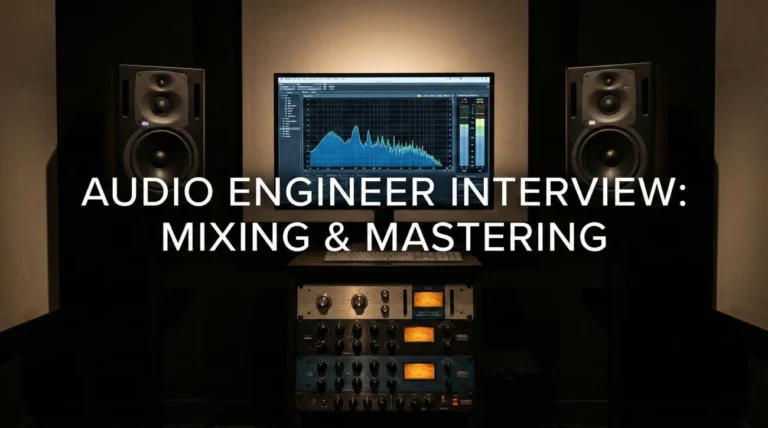
Audience members will forgive a soft focus shot before they forgive bad audio. That is why sound designer interview questions are less about buzzwords and more about whether you can shape feeling with sound. When a creature hits the ground, the weight has to land in the chest. When a hallway feels unsafe, the air has to feel tight even if nothing is on screen.
Interviewers are listening for how you think. Do you start with the story beat, then choose tools? Can you explain your layers, your choices, and your restraint? A strong sound designer knows when to build a dense soundscape, and when one detail, like a distant hinge creak, is enough.
This guide helps you speak like someone who can deliver both craft and clarity. You will practice how to describe your workflow from spotting to final mix, how you handle messy production audio, and how you translate abstract feedback into a deliverable that fits the world of the project.
Creative Process & Storytelling
Q: Walk me through your process for designing a sound from scratch (e.g., a sci-fi weapon).
I start by analyzing the visual and the narrative function. Is it a heavy plasma cannon or a quick laser? I layer organic sounds with synthesized ones. For a laser, I might record a slinky being hit (organic) and layer it with a synth wave (digital).
I use pitch shifting and time stretching to shape the envelope. I focus on the “Transient” (the initial hit) and the “Tail” (the decay). I never rely on a single library effect; I stack layers to create a unique sonic signature that fits the specific universe of the project.
Q: How do you approach “World Building” through sound?
I create a “Sonic Palette” before I start cutting. If the film is set in a dystopian city, I might record industrial drones, distant sirens, and heavy machinery to create a bed of uneasiness.
I think about off-screen space. Sound tells the audience what is happening outside the frame. If they are in a safe house, I might add the sound of rain against the window to make it feel cozy and isolated. Sound grounds the visual in a physical reality.
Q: How do you handle silence in your design?
Silence is a sound effect. I use it for contrast. If a scene is loud and chaotic, a sudden cut to silence creates a massive impact (the “vacuum effect”).
However, absolute digital silence sounds like a mistake. I use “Room Tone” or very low-level ambience even in silent moments to keep the audio channel alive. I use silence to force the audience to lean in and pay attention to a specific visual detail.
Q: What is the difference between Sound Design and Sound Editing?
Sound Editing is the organization and cleanup. It involves dialogue editing, syncing effects, and organizing tracks. It is the technical preparation.
Sound Design is the creative creation. It involves making new sounds, choosing specific ambiences, and processing audio to create a mood. While I do both, I view Editing as the canvas preparation and Design as the painting.
Technical Audio Tools
Q: What is your DAW of choice and why?
I use Pro Tools for linear media (Film/TV) because it is the industry standard for post-production and mixing.
For game audio, I might use Reaper because of its flexibility and scripting capabilities. I am tool-agnostic; I use whatever integrates best with the team’s pipeline, but my speed is fastest in Pro Tools.
Q: Explain “Middleware” (Wwise/FMOD) in game audio.
Middleware bridges the gap between the DAW and the Game Engine (Unity/Unreal). It allows me to implement interactive audio logic without writing code.
I use it to randomize footstep sounds so they don’t sound repetitive, or to crossfade music layers based on the player’s health. It turns static files into dynamic systems.
Q: How do you clean up noisy dialogue (Denoising)?
I use spectral repair tools like iZotope RX. I identify the noise profile (hum, hiss, traffic) and learn it.
I apply reduction gently. I prefer to do two light passes rather than one heavy pass to avoid “underwater” artifacts. I always keep the original file safe. If the audio is unsalvageable, I flag it for ADR immediately.
Q: What is “EQ” and how do you use it?
EQ (Equalization) adjusts the volume of specific frequencies. I use “Subtractive EQ” first to cut muddy low-end (High Pass Filter) or harsh whistling frequencies.
I use “Additive EQ” sparingly to boost presence or clarity. I carve out space for dialogue by cutting those frequencies in the music and sound effects tracks (frequency masking).
Q: Explain the difference between Mono and Stereo usage.
Mono is for point sources like dialogue or a specific gunshot. It anchors the sound to the center or a specific location.
Stereo is for space and ambience (wind, rain, music). It creates width. Placing dialogue in stereo can sound confusing; placing ambience in mono sounds flat. I mix with this spatial awareness in mind.
Q: How do you manage “Loudness Standards” (LUFS)?
I mix to the target specs. For broadcast TV, it might be -23 or -24 LUFS. For web/streaming (YouTube/Spotify), it’s -14 LUFS.
I use loudness meters to monitor the integrated loudness over the whole program. If I mix too hot for TV, it will be rejected; if I mix too quiet for mobile, users won’t hear it. Compliance is technical perfection.
Creative Process & Collaboration
A director describes a sound abstractly (“Make it sound like a sad toaster”).
I translate the emotion into texture. “Sad” might mean slow, low-pitch, or descending tones. “Toaster” implies metallic, springy, or heating elements.
I might record a metallic spring slowing down and pitch-shift it down to create a “sigh.” I present 2-3 variations to the director to see which interpretation matches their head-canon. I treat abstract notes as creative prompts, not literal instructions.
The music composer’s score clashes with your sound effects.
I collaborate, I don’t compete. We are both serving the story. If the music is busy/heavy in a scene with critical sound effects, I talk to the mixer.
“The sword clangs are getting lost in the percussion. Can we duck the music stems there, or should I thin out the SFX?” Often, we carve out frequency space – music takes the low end, SFX takes the high end – so both can live together without mud.
You have a tight deadline and thousands of assets to deliver.
I prioritize based on “Gameplay Critical” or “Narrative Critical” sounds. The player needs to hear the enemy footsteps to survive; they don’t need to hear the wind in the trees perfectly.
I use batch processing for formatting. I communicate early if I need to drop “nice-to-haves” to ensure the essential assets are polished and delivered on time. A working game/film is better than a perfect but unfinished one.
Foley & Field Recording
Q: What is Foley and when do you use it?
Foley is the reproduction of everyday sound effects (footsteps, cloth movement, props) performed in sync with the picture. I use it to replace the generic production audio which often misses these subtle details.
Foley adds realism and weight. A character walking in a leather jacket sounds different than one in a t-shirt. I record “cloth passes” to give the character physical presence on screen.
Q: How do you record footsteps for a character walking on different surfaces?
I use “Foley Pits” or portable surfaces. I have a collection of shoes (boots, heels, sneakers). I watch the screen and perform the walk in sync.
If they walk from gravel to concrete, I switch surfaces mid-take. I focus on the character of the walk – is it a heavy, tired trudge or a light, sneaky tiptoe? The performance matters as much as the surface.
Q: What is your kit for “Field Recording”?
I use a portable recorder (like a Zoom H6 or Sound Devices MixPre) and a high-quality shotgun mic with a blimp (windshield). I carry extra batteries and SD cards.
I record ambiences in stereo to capture the “width” of a location. I always record at a high sample rate (96kHz) to allow for extreme pitch shifting in the design phase later without artifacts.
Q: Why do you want to be a Sound Designer?
I am fascinated by the subconscious power of sound. Visuals tell you what to see, but sound tells you how to feel. I love the technical challenge of dissecting a sound into its frequencies and the creative joy of building a new reality from scratch. Whether it’s the roar of a monster or the subtle rustle of a dress, I want to create the audio landscape that immerses the audience completely.
Sound Design Competency Quiz
Take the 20-Question Challenge
1. “ADR” stands for:
- Audio Digital Recording
- Automated Dialogue Replacement (looping)
- Analog Direct Route
- All Day Recording
2. A “Stem” in mixing is:
- A part of a flower
- A grouped audio track (e.g., Dialogue Stem, Music Stem, SFX Stem)
- A single file
- A microphone stand
3. “Reverb” simulates:
- An echo that repeats distinctly
- The reflection of sound waves in a space (size/texture of the room)
- Volume increase
- Distortion
4. “Diegetic Sound” is:
- Background music only the audience hears
- Sound that originates within the film world (characters can hear it)
- Narration
- Sound effects only
5. “Non-Diegetic Sound” includes:
- Dialogue
- Score/Soundtrack and Voiceover (characters cannot hear it)
- Footsteps
- Door slams
6. The “Nyquist Theorem” relates to:
- Volume levels
- Sample Rate (must be double the highest frequency to capture it)
- Microphone placement
- Cable length
7. A “Compressor” effects audio by:
- Making it smaller on disk
- Reducing the dynamic range (making louds quieter and quiets louder)
- Removing noise
- Adding echo
8. “Foley” is named after:
- A city in France
- Jack Foley, a sound effects pioneer
- A microphone brand
- The act of falling
9. “Phantom Power” (+48V) is needed for:
- Dynamic microphones
- Condenser microphones
- Speakers
- Headphones
10. “Panning” moves sound:
- Up and down
- Left and Right in the stereo field
- Forward and Backward
- Louder and Softer
11. A “High Pass Filter” (HPF):
- Lets high frequencies pass and cuts low frequencies
- Lets high frequencies pass and cuts low frequencies (removes rumble)
- Cuts high frequencies
- Makes audio sound higher
12. “Zero Crossing” is important for:
- Crossing the street
- Editing cuts to avoid clicks/pops where the waveform meets the center line
- Volume zero
- Stereo width
13. “Ambisonics” is a format used for:
- Mono radio
- 360-degree / VR audio
- Stereo music
- Phone calls
14. “Spotting Session” involves:
- Cleaning spots on the screen
- Watching the film with the director to decide where sound effects/music go
- Recording spots
- Finding files
15. “DAW” stands for:
- Digital Audio Waveform
- Digital Audio Workstation
- Direct Audio Write
- Dual Audio Window
16. “Gain Staging” ensures:
- The stage is built
- Levels are optimized at each step of the signal chain to prevent noise/distortion
- The volume is maxed out
- The mic is on
17. A “Limiter” is a type of:
- Microphone
- Compressor with a very high ratio (prevents peaking)
- EQ
- Reverb
18. “OMF” or “AAF” files are used to:
- Play music
- Transfer project timelines between video editors and audio DAWs
- Compress audio
- Record foley
19. “Frequencies” are measured in:
- Decibels (dB)
- Hertz (Hz)
- Bits
- Seconds
20. The “Wilhelm Scream” is:
- A mistake
- A famous stock sound effect used as an inside joke in many films
- A scary sound
- A type of microphone
❓ FAQ
🎬 What should a sound design reel include to get attention?
Show short, clear examples where your work is obvious. Include one redesign clip, one scene with dialogue cleanup, and one piece that shows ambience and transitions. Label what you did so the reviewer does not have to guess.
🧩 How do I answer “make it sound bigger” notes?
Ask one clarifying question, then offer options. “Bigger” can mean more low end, longer tail, wider space, or heavier transients. Explain your plan in simple terms, then present two variations so the director can choose quickly.
🧽 What is a safe way to describe dialogue cleanup?
Say you work gently and in passes. You reduce noise without destroying the voice, you watch for artifacts, and you flag lines that need ADR early. Accuracy and communication matter as much as the plugin you use.
🎮 What if the role is game audio and I have mostly film experience?
Connect your design skills to implementation. Talk about building consistent asset naming, exporting clean variations, and learning middleware logic. Even if you are new to Wwise or FMOD, show you understand interactivity and iteration.
🔊 Do I need to memorize loudness specs for interviews?
You should know that specs exist and that you mix to targets. In interviews, mention that you monitor loudness, deliver to platform requirements, and keep headroom so mixes translate across devices.
Final Thoughts
When you answer sound designer interview questions, aim to sound calm and specific. Studios do not need someone who only knows tools. They need someone who can take a vague note, choose a direction, and deliver audio that supports the story without calling attention to itself.
If you explain your process from spotting to delivery, your approach to clean dialogue, and how you build unique layers instead of relying on one library hit, you will come across as a designer who can be trusted on real deadlines.
⚠️ Disclaimer: The interview strategies, sample answers, and negotiation tips provided in this guide are for educational purposes only. Hiring decisions are subjective and vary by company and industry. While these strategies are based on professional HR standards, they do not guarantee a specific job offer or result.