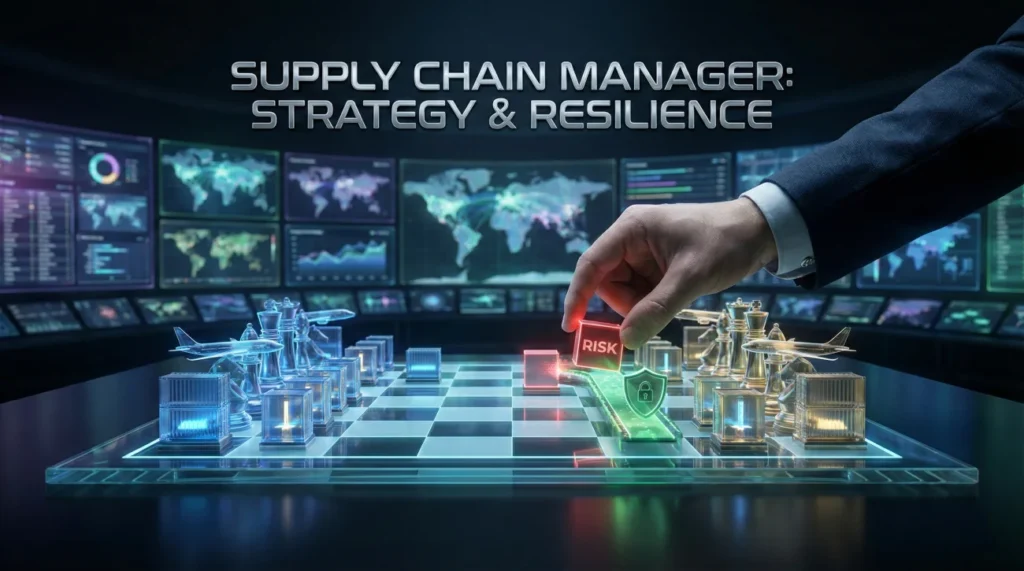
The Architect of Flow
The role of a Supply Chain Manager has evolved from a back-office support function to a boardroom strategic necessity. Modern supply chains are no longer linear; they are complex, interconnected webs vulnerable to geopolitical shifts, climate change, and rapid consumer demand fluctuations. Hiring managers are not just looking for someone who can move a box from Point A to Point B. They are searching for a “Resilience Architect” – someone who can build a system that bends without breaking.
In the current landscape, the focus has shifted from “Just-in-Time” efficiency to “Just-in-Case” reliability. When you walk into the interview room, you will be tested on your ability to balance conflicting KPIs: reducing inventory costs while preventing stockouts, and cutting freight spend while improving speed. The questions will probe your experience with End-to-End (E2E) visibility, your command of the Sales and Operations Planning (S&OP) process, and your foresight in digital transformation.
This guide dives deep into the strategic supply chain manager interview questions that define the role today. We move beyond basic logistics terms to explore high-level decision-making scenarios, crisis management, and the soft skills required to align Sales, Finance, and Operations under one unified vision.
Strategic Vision & E2E Visibility
Q: How do you define “End-to-End” supply chain visibility, and how have you improved it in previous roles?
Strategy Note: Visibility is the buzzword of the decade. Do not just say “tracking software.” Talk about breaking down silos between procurement, manufacturing, and distribution.
Sample Answer: End-to-end visibility means having real-time data accessibility from the raw material supplier’s tier all the way to the end customer’s doorstep. It is the ability to see a disruption upstream and understand its exact impact downstream immediately.
In my last role, we had a “black hole” regarding our Tier 2 suppliers. I spearheaded the implementation of a Control Tower approach using a cloud-based ERP module. We integrated our EDI data with key suppliers. This allowed us to shift from reactive expediting to proactive planning. For example, when a raw material shipment was delayed at the port, the system automatically flagged the production risk, allowing us to adjust the manufacturing schedule weeks in advance, preventing line stoppages.
Q: The “Bullwhip Effect” is a classic problem. Describe a time you identified it and mitigated its impact.
Strategy Note: This tests your understanding of demand distortion. The interviewer wants to know if you can diagnose the root cause (usually poor communication) rather than just treating symptoms.
Sample Answer: We experienced a severe Bullwhip Effect where our factory was running overtime to meet a forecasted spike in demand, yet our warehouses were overflowing. The root cause was panic ordering from regional distributors who feared stockouts.
To mitigate this, I implemented a Vendor Managed Inventory (VMI) model with our top three distributors. Instead of relying on their erratic purchase orders, we gained access to their Point-of-Sale (POS) data. This allowed us to replenish based on actual consumption rather than inflated psychological orders. We also reduced the batch sizes for production to smooth out the flow. Within six months, we reduced finished goods inventory by 18% while maintaining a 98% service level.
Q: How do you balance the trade-off between Cost Efficiency and Supply Chain Resilience?
Strategy Note: This is the “Golden Question” of post-pandemic supply chains. Efficiency often means lean (risky), while resilience often means redundant (expensive).
Sample Answer: It is about calculating the “Cost of Risk” versus the “Cost of Holding.” I use a segmented approach. For commodity items with stable supply, I prioritize efficiency and lean principles (single sourcing, low inventory). However, for critical, high-risk components where a shortage would shut down production, I invest in resilience.
This investment manifests as dual sourcing strategies and holding strategic safety stock, even if it hurts working capital slightly. I frame this to stakeholders not as “extra cost” but as an “insurance policy.” For instance, paying 5% more for a near-shore supplier is cheaper than the cost of a two-week factory shutdown due to a shipping container shortage.
Q: Describe your experience with the S&OP (Sales and Operations Planning) process. How do you handle misalignment?
Strategy Note: S&OP is the heartbeat of a manager’s role. Focus on your ability to facilitate consensus between Sales (optimistic) and Ops (realistic).
Sample Answer: I view S&OP as a decision-making forum, not just a reporting meeting. My approach is to move from a “volume discussion” to a “value discussion.” In my previous company, Sales consistently forecasted 20% growth while Operations could only support 10%.
I introduced a “One Number” operating plan. We started with unconstrained demand, then applied operational constraints to create a constrained plan. When misalignment occurred, I presented the financial impact of the gap: “If we chase this unverified sales upside, we incur $50k in overtime and airfreight.” presenting data in dollar terms helped leadership make objective trade-off decisions, aligning the team on a feasible, profitable plan.
Risk Management & Disruption Handling
Q: A key supplier declares bankruptcy overnight. What is your immediate action plan?
First, I secure all owned inventory and tooling immediately from their facility. Second, I activate the pre-qualified backup supplier list.
If no backup exists, I form a “Tiger Team” with R&D to engineer a substitute material or modify the product specs to allow for alternative sourcing options.
Q: How do you assess geopolitical risk in your supply network?
I use a weighted risk scorecard that includes political stability, tariff volatility, and labor strike history for each region.
I also conduct “What-If” scenario planning quarterly. If 40% of our supply comes from a volatile region, we actively develop a “China Plus One” or near-shoring strategy to diversify exposure.
Q: How do you handle a sudden massive spike in freight costs?
I analyze the “Total Landed Cost.” Sometimes paying high freight is better than losing a customer.
However, to mitigate long-term impact, I would consolidate shipments to increase utilization (FCL vs LCL), renegotiate volume contracts with carriers, or explore multi-modal options (e.g., Sea-Air) to balance speed and cost.
Q: Dealing with cybersecurity risks in the supply chain?
Supply chains are entry points for hackers. I ensure all vendors sign a cybersecurity compliance addendum.
I also limit access rights. Suppliers should only access the specific portal modules they need. We conduct annual audits of our key suppliers’ IT security protocols to ensure they are not the weak link.
Q: How do you manage “Expiry Risk” for perishable inventory?
I enforce a strict FEFO (First Expired, First Out) logic in the WMS, overriding standard FIFO where necessary.
I also set up alert triggers. If a batch reaches 75% of its shelf life, the system notifies Sales to run a promotion or discount. It is better to recover cost than to write off the stock completely.
Q: What is your strategy for Supplier Performance Management?
I move beyond “price beating.” I use a scorecard tracking OTIF (On-Time In-Full), Quality Defect Rate, and Innovation responsiveness.
We hold Quarterly Business Reviews (QBRs). If a supplier fails KPIs, we implement a Corrective Action Plan (CAPA). If they improve, we reward them with more volume or “Preferred Status.”
Cross-Functional Collaboration
Scenario: Sales has closed a huge unexpected deal that requires 3x the normal stock immediately. Operations says it is impossible.
I facilitate a “War Room” meeting. I ask Sales: “Is this a one-time deal or a new baseline?” and “Can we stagger the delivery dates?” This breaks the impossible total into manageable chunks.
Then I turn to Operations: “What is the bottleneck? Is it raw materials or machine capacity?” If it is capacity, I calculate the cost of outsourcing or overtime. I present options: “We can meet 100% of the order if we accept a 10% margin reduction due to airfreight.” This empowers the GM to make the final call based on profitability.
Scenario: Finance demands a 10% inventory reduction by year-end, but your team fears stockouts.
I start by analyzing the inventory quality. Usually, a significant portion is “Slow Moving” or “Obsolete” (SLOB). I propose liquidating this bad inventory first to generate cash without impacting active service levels.
For active stock, I propose optimizing safety stock settings based on demand variability rather than a flat cut. I explain to Finance: “A flat 10% cut on fast-movers will lose us sales. Let’s target the long-tail items.” I align with them on a “Healthy Inventory” metric (Inventory Turns) rather than just a raw dollar value.
Scenario: You need to implement a new ERP system, but the warehouse team is resisting the change.
Resistance usually comes from fear of complexity or job loss. I identify “Change Champions” within the warehouse team – influential shift leads – and involve them in the UAT (User Acceptance Testing) phase.
I focus on “What’s in it for them?” I demonstrate how the new system eliminates manual data entry or reduces walking time. I ensure training is hands-on and support is available 24/7 during go-live. I make it clear that the tool is there to make them faster, not to replace them.
Metrics, KPIs & Optimization
Q: Which Supply Chain KPIs do you track daily vs. monthly?
Strategy Note: Differentiate between operational metrics (daily firefighting) and strategic metrics (monthly health check).
Sample Answer: Daily, I track “Operational Heartbeat” metrics: Schedule Attainment (Did we build what we planned?), Backorders (What are we missing?), and Inbound Receiving velocity. These allow for immediate course correction.
Monthly, I look at “Strategic Health” metrics: Cash-to-Cash Cycle Time (financial efficiency), Total Landed Cost as a % of Revenue, Supplier Defect Rate, and Forecast Accuracy (MAPE). These tell me if our structural processes are working.
Q: Explain “ABC Analysis” and how you use it.
Strategy Note: This is fundamental inventory segmentation. Show you use it for more than just counting cycles.
Sample Answer: ABC Analysis segments inventory based on value and consumption. ‘A’ items are the top 20% generating 80% of value. ‘B’ are moderate, ‘C’ are the long tail.
I use this to allocate resources. ‘A’ items get strict weekly cycle counts, tight safety stock settings, and executive attention on forecasting. ‘C’ items might get a “Two-Bin” system or relaxed review periods because stockouts there matter less. It ensures my team spends 80% of their time on the items that drive the business.
Q: How do you approach Cost Reduction without harming quality?
Strategy Note: Avoid saying “I squeeze suppliers.” Focus on process efficiency and waste elimination.
Sample Answer: I look for “Non-Value Added” waste. One major area is usually logistics consolidation – combining LTL (Less Than Truckload) shipments into FTL (Full Truckload) or using “Milk Runs.”
Another area is packaging optimization. Reducing the “air” in boxes increases pallet density, reducing freight cost per unit. I also collaborate with suppliers on “Design for Supply Chain” – slight modifications to product dimensions that allow more units to fit in a container. These save money through physics, not by cutting corners.
Q: What is your experience with Ethical Sourcing and Sustainability?
Strategy Note: ESG is mandatory now. You need a stance on green logistics and fair labor.
Sample Answer: Sustainability is a criterion in my supplier selection matrix, weighted alongside cost. I require Tier 1 suppliers to sign a Code of Conduct regarding labor practices.
Operationally, I focus on carbon footprint reduction. This involves route optimization software to reduce delivery mileage and shifting transport modes from air to ocean or road to rail where lead times allow. I also push for circular supply chain initiatives, such as reusable packaging loops with local vendors.
Supply Chain Management Expertise Quiz
Test Your Strategic Knowledge (20 Questions)
1. The “Bullwhip Effect” results in:
- Amplified demand fluctuations upstream in the supply chain
- Reduced inventory levels at the manufacturing site
- Stabilized pricing across all distribution channels
- Consistent demand signals from the end consumer
2. In Incoterms 2020, who pays for freight in “EXW” (Ex Works)?
- The Seller covers all transport costs
- The Buyer bears all costs and risks from the seller’s premises
- The Freight Forwarder absorbs the cost
- The cost is split 50/50 between parties
3. “Safety Stock” is primarily held to:
- Increase the total value of assets
- Fill up empty space in the warehouse
- Buffer against demand variability and supply lead time uncertainty
- Reduce the cost of goods sold metrics
4. Which KPI best measures the time cash is tied up in operations?
- Return on Investment (ROI)
- Cash-to-Cash Cycle Time
- On-Time In-Full (OTIF)
- Gross Margin Return on Investment
5. Vendor Managed Inventory (VMI) means:
- The supplier monitors inventory and replenishes stock for the buyer
- The buyer dictates the production schedule of the supplier
- A third-party logistics provider owns the inventory
- Inventory is managed exclusively by the finance department
6. Cross-docking is a logistics practice that:
- Stores goods for long periods to age them
- Unloads incoming materials and loads them directly to outbound trucks
- Requires extensive racking systems for storage
- Is used primarily for damaged or returned goods
7. The Kraljic Matrix segments suppliers based on:
- Location and language spoken
- Profit impact and supply risk
- Years of relationship and friendship
- Website quality and marketing material
8. “Reverse Logistics” refers to:
- Driving trucks backwards into docks
- The process of moving goods from customer back to the seller (returns/recycling)
- Ordering goods before they are needed
- Paying suppliers before receiving goods
9. EOQ (Economic Order Quantity) aims to minimize:
- Total holding costs and ordering costs
- The total number of suppliers used
- The transportation time for delivery
- The number of employees in procurement
10. “Last Mile” delivery is often considered:
- The easiest part of the supply chain
- The cheapest part of logistics
- The most expensive and complex part of the delivery process
- Irrelevant to customer satisfaction
11. A “Bill of Lading” (BOL) functions as:
- A simple invoice for payment
- A receipt of freight services and contract of carriage
- A list of employee attendance
- A marketing brochure for the carrier
12. Six Sigma methodologies in supply chain focus on:
- Reducing defects and variability in processes
- Increasing the speed of forklifts
- Hiring more temporary staff
- Expanding warehouse square footage
13. In forecasting, MAPE stands for:
- Maximum Average Product Estimation
- Mean Absolute Percentage Error
- Monthly Actual Production Efficiency
- Material Acquisition Process Entry
14. Strategic Sourcing differs from purchasing by:
- Focusing solely on the lowest price today
- Focusing on long-term value, TCO, and supplier collaboration
- Using only paper-based purchase orders
- Avoiding contracts with suppliers
15. The term “Omnichannel” refers to:
- Selling only through physical retail stores
- Providing a seamless customer experience across online and offline channels
- Using only one channel for distribution
- Blocking customers from returning items
16. “Lead Time” is defined as:
- The time it takes to lead a team meeting
- The latency between initiating a process and its execution/completion
- The time the CEO speaks during town halls
- The duration of a supplier contract
17. FIFO (First-In, First-Out) is critical for:
- Durable goods like gravel or sand
- Perishable goods or items with expiration dates
- Items that never lose value
- Warehouses with no inventory system
18. A “Control Tower” in SCM provides:
- Traffic control for trucks in the yard
- Centralized, real-time visibility and decision-making across the network
- A physical tower for security guards
- A separate office for the manager
19. “Dunnage” refers to:
- Material used to protect cargo during transportation
- The fee paid for late returns
- The uniform worn by warehouse staff
- The paperwork for customs clearance
20. In Lean manufacturing, “Muda” means:
- Efficiency
- Waste
- Profit
- Inventory
❓ FAQ
📜 Which certifications are best for Supply Chain Managers?
The gold standards are ASCM’s (formerly APICS) CSCP (Certified Supply Chain Professional) for end-to-end strategy and CPIM (Certified in Planning and Inventory Management) for internal operations. A Project Management Professional (PMP) certification is also highly valued for implementing change.
💻 What software tools must I know?
Proficiency in ERP systems (SAP S/4HANA, Oracle NetSuite) is non-negotiable. Additionally, familiarity with data visualization tools (Tableau, PowerBI) for reporting and specialized planning software (Blue Yonder, Kinaxis) will set you apart from generalist candidates.
🔄 Can I switch industries (e.g., Automotive to FMCG)?
Yes, the core principles (Plan, Source, Make, Deliver) are universal. However, you must adapt your speed. Automotive focuses on “Just-in-Time” precision and lean manufacturing, while FMCG focuses on high volume, shelf velocity, and consumer trends. Highlight your adaptability.
📅 What should I include in my 30-60-90 day plan?
Day 30: Listen and learn (Process mapping, stakeholder interviews). Day 60: Assess and diagnose (Identify bottlenecks, low-hanging fruit for cost savings). Day 90: Execute and lead (Implement a pilot improvement project, set long-term KPIs).
🚀 How do I demonstrate “Strategic Thinking”?
Stop talking only about “how” you do things (tactics) and start talking about “why” (strategy). Connect your daily supply chain actions to the company’s financial statements (P&L impact, working capital, market share growth).
Final Thoughts
Ultimately, a company hires a Supply Chain Manager to be its “Chief Problem Solver.” The market will fluctuate, storms will delay ships, and suppliers will fail. Your value lies not in preventing every disaster, but in how fast and effectively you recover from them. By mastering these supply chain manager interview questions, you demonstrate that you possess the cool head and the strategic vision to steer the ship through any storm, ensuring that the product always reaches the customer, no matter what.
⚠️ Disclaimer: The interview strategies, sample answers, and negotiation tips provided in this guide are for educational purposes only. Hiring decisions are subjective and vary by company and industry. While these strategies are based on professional HR standards, they do not guarantee a specific job offer or result.