- What interviewers expect: Strategic awareness beyond systems, including trends, sustainability thinking, and how you balance competing priorities.
- Trends to speak fluently: AI and automation use cases, resilience moves like diversification and nearshoring, plus digital twins, blockchain traceability, last-mile innovation, and real-time IoT visibility.
- Negotiation readiness: Prepare with clear goals and BATNA, build rapport, uncover interests, trade issues beyond price, and close with written clarity while avoiding emotional or adversarial moves.
- Problem-solving approach: Ask clarifying questions first, use structured tools like 5 Whys or DMAIC, explain trade-offs like cost vs speed, then land on one clear recommendation.
- Soft skills proof: Show communication, influence, and conflict resolution with specific STAR examples, stay honest about tech experience, and share results without exposing confidential details.
Beyond Technical Knowledge
Effective supply chain interview preparation requires more than systems proficiency and process knowledge. Modern supply chain professionals must understand emerging industry trends, demonstrate strategic thinking about technology adoption and sustainability, exhibit strong negotiation capabilities, and solve complex problems balancing competing priorities.
This guide establishes comprehensive interview preparation covering current trends, essential soft skills, and strategic thinking frameworks. You’ll learn key industry developments interviewers expect you to know, develop negotiation skills critical for supplier and stakeholder management, master problem-solving approaches, and articulate how soft skills complement technical expertise.
Current Supply Chain Trends
Demonstrating awareness of industry evolution shows you think strategically beyond daily execution and stay current with professional development.
Artificial Intelligence and Automation
AI transforms supply chain capabilities through predictive analytics, autonomous operations, and intelligent decision support.
| AI Application | Supply Chain Impact | Interview Discussion Points |
|---|---|---|
| Demand forecasting | Machine learning analyzes patterns humans miss, improving accuracy | Discuss forecast accuracy improvements, reduction in stockouts/overstock, data quality importance |
| Predictive maintenance | Equipment sensors predict failures before occurrence | Mention uptime improvements, cost savings from preventing breakdowns, transition from reactive to predictive |
| Route optimization | Real-time traffic and constraint analysis optimizes delivery routes | Explain fuel savings, delivery time improvements, dynamic rerouting capabilities |
| Warehouse automation | Robots, AGVs, and AI-powered picking systems increase efficiency | Discuss productivity gains, labor cost impacts, implementation challenges, human-robot collaboration |
| Supplier risk monitoring | AI scans news, financial data, social media for early warning signals | Talk about proactive risk mitigation, faster response to disruptions, supplier diversification strategies |
Sustainability and Circular Economy
Environmental considerations increasingly influence supply chain strategy, driven by regulation, customer demand, and cost reduction.
- 🌱 Carbon footprint reduction: Optimizing transportation modes, warehouse energy efficiency, sustainable packaging
- ♻️ Circular supply chains: Reverse logistics, product take-back programs, recycling integration, remanufacturing
- 🏭 Ethical sourcing: Supplier audits for labor practices, conflict minerals avoidance, fair trade considerations
- 📊 ESG reporting: Tracking environmental/social/governance metrics, transparency requirements, stakeholder communication
Additional Key Developments
Other significant trends shaping modern supply chain management.
- Supply chain resilience: Post-pandemic focus on redundancy, diversification, nearshoring, visibility across tiers
- Digital twins: Virtual replicas enabling scenario testing and optimization without real-world disruption
- Blockchain for traceability: Immutable records tracking products from source to customer
- Last-mile innovation: Drones, autonomous delivery vehicles, micro-fulfillment centers, crowdsourced delivery
- Real-time visibility: IoT sensors providing continuous tracking and condition monitoring throughout supply chain
💡 Pro tip: When discussing trends, avoid generic “AI is transforming everything” statements. Instead, mention specific applications relevant to target role: demand planner discusses ML forecasting, warehouse manager talks automation ROI, procurement professional mentions supplier risk AI. Show you understand how trends apply to your specific function.
Expert advice: Don’t claim expertise in technologies you haven’t used. Instead, express informed awareness: “I’ve read about digital twins in Supply Chain Management Review and see potential applications in our network optimization, though I haven’t implemented one yet.” Curiosity about emerging tech combined with honest assessment of your experience impresses more than pretending familiarity.
Developing Negotiation Capabilities
Supply chain professionals constantly negotiate with suppliers, carriers, internal stakeholders, and customers, making negotiation skills essential across roles.
Effective Negotiation Framework
Systematic approach to negotiation preparation and execution improves outcomes while maintaining relationships.
| Negotiation Phase | Key Activities | Success Factors |
|---|---|---|
| Preparation | Research other party, define objectives, establish BATNA, identify leverage points | Thorough preparation, clear priorities, realistic alternatives, understanding other party’s constraints |
| Relationship building | Establish rapport, find common ground, demonstrate respect and understanding | Genuine interest, active listening, cultural awareness, long-term perspective |
| Information exchange | Share positions, ask probing questions, uncover underlying interests | Strategic disclosure, listening more than talking, distinguishing positions from interests |
| Problem-solving | Generate options, explore trade-offs, create value beyond price | Creativity, flexibility, looking for mutual gains, packaging issues strategically |
| Agreement and closure | Summarize terms, document clearly, plan implementation | Clarity, written confirmation, accountability mechanisms, celebrating agreement |
Common Negotiation Scenarios
Supply chain professionals encounter predictable negotiation situations requiring specific strategies.
- Supplier price increase requests: Understand cost drivers, negotiate phase-in periods, explore alternative specifications, consider volume commitments for better pricing
- Delivery timeline conflicts: Prioritize critical items, offer expedite fees for acceleration, negotiate partial shipments, find win-win schedule adjustments
- Quality disputes: Present objective data, propose corrective actions, negotiate cost sharing for rework, establish prevention measures
- Internal resource allocation: Build business case with ROI, align with strategic priorities, find creative resource sharing, demonstrate risk mitigation value
Common Negotiation Pitfalls
Avoiding typical errors improves outcomes and preserves relationships.
- ❌ Focusing only on price: Neglecting payment terms, quality, delivery reliability, innovation potential
- ❌ Adversarial approach: Creating win-lose mentality damaging long-term partnerships
- ❌ Poor BATNA: Negotiating without clear alternative, weakening position
- ❌ Insufficient preparation: Not researching market rates, other party’s situation, industry benchmarks
- ❌ Emotional reactions: Taking positions personally, making concessions when frustrated or pressured
Supply Chain Problem-Solving Approaches
Interviewers assess problem-solving through situational questions and case studies requiring systematic thinking and trade-off analysis.
Problem-Solving Methodologies
Structured approaches ensure comprehensive analysis rather than jumping to solutions prematurely.
| Framework | When to Apply | Key Steps |
|---|---|---|
| 5 Whys | Root cause analysis for operational failures | Ask “why” iteratively until reaching fundamental cause, not just symptom |
| Fishbone (Ishikawa) | Complex problems with multiple potential causes | Categorize causes (people, process, equipment, materials, environment), investigate systematically |
| DMAIC (Define, Measure, Analyze, Improve, Control) | Process improvement projects requiring data-driven approach | Define problem, measure current state, analyze root causes, implement improvements, control to sustain gains |
| Pareto Analysis | Prioritizing issues when resources limited | Identify vital few (20% of causes creating 80% of problems), focus efforts where impact greatest |
| Decision Matrix | Choosing between multiple options with competing criteria | Weight criteria by importance, score options objectively, calculate total scores for comparison |
Balancing Competing Priorities
Supply chain decisions inherently involve trade-offs requiring transparent analysis and stakeholder alignment.
- Cost vs. speed: Expedited shipping increases costs but prevents stockouts, revenue loss, customer dissatisfaction
- Inventory vs. service level: Higher inventory improves availability but increases carrying costs and obsolescence risk
- Quality vs. price: Cheaper suppliers may compromise quality, creating warranty costs and reputation damage
- Flexibility vs. efficiency: Standardization improves efficiency but reduces ability to customize for customers
- Local vs. global sourcing: Nearshoring reduces lead time and risk but often increases unit costs
Tackling Interview Case Studies
Case study exercises test analytical thinking, business acumen, and communication under pressure.
- 📋 Clarify the problem: Ask questions ensuring you understand situation, constraints, success criteria
- 🧮 Structure your analysis: Break complex problems into components, tackle systematically
- 💭 Think out loud: Verbalize reasoning so interviewer follows your thought process
- 📊 Use frameworks: Apply relevant analytical tools showing structured thinking
- ⚖️ Acknowledge trade-offs: Explain why you prioritize certain factors, what you’re sacrificing
- 💡 Recommend decisively: Provide clear recommendation with supporting logic, not just analysis
Expert advice: When solving case studies or situational questions, resist urge to immediately suggest solutions. Pause, ask clarifying questions, structure your thinking, then work through analysis systematically. Interviewers assess your problem-solving process as much as final answers. Rushing to conclusions without demonstrating analytical rigor raises concerns about decision-making quality under real-world pressure.
Essential Soft Skills for Supply Chain Success
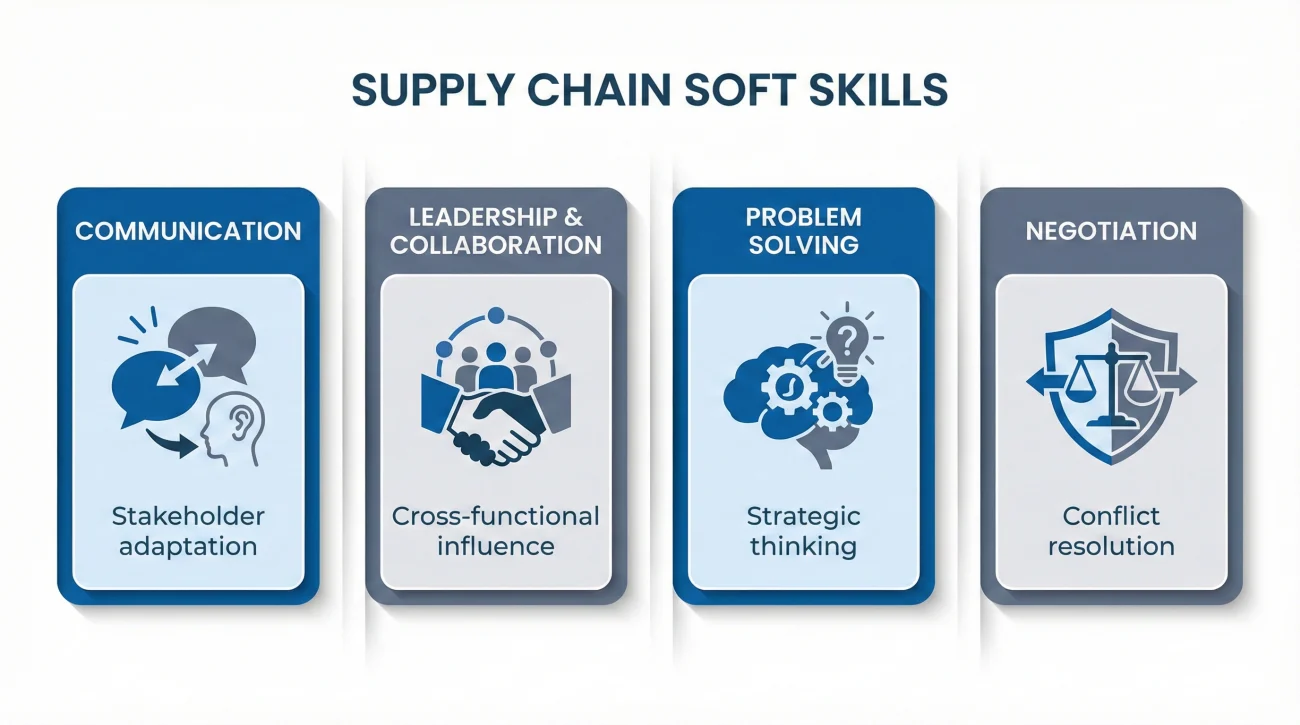
Technical competence alone proves insufficient without interpersonal and leadership capabilities.
Effective Communication
Supply chain coordination depends on clear, precise communication across diverse audiences.
- Stakeholder adaptation: Explaining technical concepts to non-technical executives, detailed coordination with operations teams
- Conflict resolution: Mediating disputes between departments with competing priorities
- Persuasive presentation: Building business cases for investments, process changes, strategic shifts
- Active listening: Understanding underlying concerns beyond stated positions in negotiations
- Written clarity: Email precision preventing costly misunderstandings, documentation supporting decisions
Leadership and Collaboration
Even individual contributor roles require influencing others and driving initiatives without formal authority.
- 🎯 Cross-functional influence: Gaining buy-in from sales, finance, operations without direct control
- 🤝 Relationship building: Developing trust with suppliers, carriers, internal partners over time
- 📈 Change management: Leading process improvements, technology implementations, strategic shifts
- 👥 Team development: Mentoring junior staff, sharing knowledge, building organizational capability
Demonstrating Soft Skills in Interviews
Provide concrete examples showing how soft skills enabled results.
- Describe specific stakeholder conflict you resolved through communication and negotiation
- Explain how you influenced cross-functional team to adopt your recommendation
- Share example of adapting communication style for different audiences (technical team vs. executives)
- Discuss learning from mistakes, showing self-awareness and growth mindset
- Mention mentoring or knowledge sharing demonstrating leadership regardless of title
For comprehensive interview techniques and behavioral question frameworks, review our specialized supply chain career resources covering case studies and situational scenarios.
❓ FAQ
🎯 How much should I discuss sustainability in interviews?
Research company’s sustainability commitments before interview. If they emphasize ESG, discuss sustainability initiatives you’ve contributed to or awareness of trends. If they don’t prioritize it publicly, mention awareness without overemphasizing. Frame sustainability as business opportunity (cost reduction through efficiency, brand value, regulatory compliance) rather than purely altruistic. Show you understand sustainability as strategic consideration, not just feel-good initiative.
💼 What if I don’t have AI or advanced technology experience?
Demonstrate awareness and learning mindset even without direct experience. Discuss how you stay current (industry publications, webinars, certifications), express genuine interest in emerging technologies, and show willingness to learn. Many companies prefer hiring people with strong fundamentals and learning agility over those claiming shallow tech expertise. Focus on analytical thinking and process improvement foundation that transfers regardless of specific technology stack.
⏰ How do I prepare for negotiation questions?
Prepare 2-3 specific negotiation examples using STAR method: context, what you negotiated (price, terms, timeline), your approach (preparation, relationship building, creative problem-solving), and quantified results. Practice common scenarios: supplier price increase, delivery acceleration, quality dispute, internal resource conflict. Emphasize win-win outcomes and relationship preservation alongside achieving your objectives. Show you negotiate strategically, not just aggressively demand concessions.
📋 Should I mention supply chain disruptions from recent years?
Yes, but focus on lessons learned and proactive responses rather than complaining about challenges. Discuss how you adapted to disruptions (supplier diversification, safety stock adjustments, alternative sourcing), what you’d do differently, how experience shaped your risk management thinking. Show disruptions taught valuable lessons about resilience, flexibility, and scenario planning rather than viewing as unfortunate circumstances beyond your control.
✨ How do I show problem-solving skills without giving away company secrets?
Sanitize examples by removing proprietary details while preserving problem-solving methodology. Instead of “We reduced Widget X costs from Supplier Y,” say “We reduced component costs 15% through supplier negotiation and specification optimization.” Share your analytical approach, frameworks used, stakeholders involved, and results achieved without disclosing confidential supplier names, exact formulas, or proprietary processes. Interviewers assess thinking process more than specific company details.
Final Thoughts
Comprehensive supply chain interview preparation extends beyond technical knowledge to encompass industry awareness, soft skills, and strategic thinking. Strong candidates demonstrate understanding of emerging trends, exhibit negotiation and problem-solving capabilities through specific examples, and articulate how interpersonal skills enable technical results.
⚠️ Disclaimer: The interview strategies, sample answers, and negotiation tips provided in this guide are for educational purposes only. Hiring decisions are subjective and vary by company and industry. While these strategies are based on professional HR standards, they do not guarantee a specific job offer or result.