The Air Traffic Controller of Freight
The Logistics Coordinator is often described as the operational nervous system of the supply chain. While managers set the high-level strategy and directors negotiate the annual contracts, the Coordinator is responsible for the minute-by-minute execution that keeps the business moving. You are the one ensuring that the physical reality matches the digital plan. Hiring managers understand that a brilliant strategy is worthless if the Coordinator forgets to attach a Commercial Invoice or fails to notice that a critical container has been rolling its ETA for three days straight.
The interview for this role is intensely tactical. It focuses less on theoretical supply chain concepts and more on operational grit. Interviewers want to know exactly what you do when a truck breaks down 50 miles from the customer. They want to verify that you can navigate complex Transport Management Systems (TMS) without getting lost. They need to see that you can audit messy shipping documents for compliance errors that could result in five-figure fines. Most importantly, they are looking for resilience. They need someone who can communicate bad news to angry Sales teams with professionalism, clarity, and a solution already in hand.
This comprehensive guide dives deep into the practical logistics coordinator interview questions you will face. We focus on documentation mastery, rigorous shipment tracking protocols, and the crisis management skills needed to keep the freight moving when the world stops.
Daily Operations & Shipment Tracking
Q: Walk me through your specific process for tracking a high-priority shipment. How do you ensure nothing slips through the cracks?
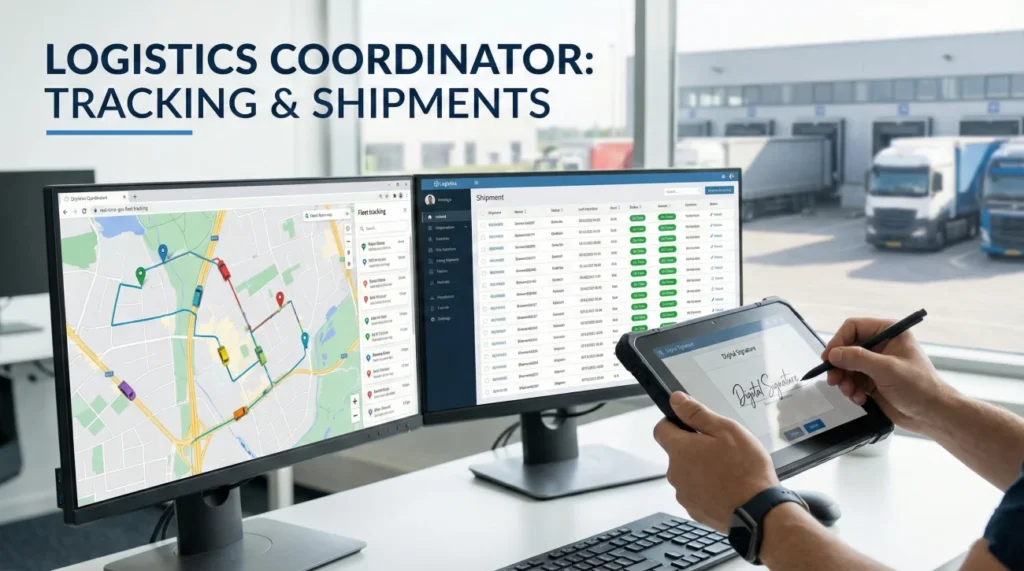
For high-priority or “hot” shipments, I never rely solely on automated system updates. Systems can lag by hours, and in logistics, hours equal money. My process is proactive and layered. First, I flag the shipment in the TMS with a specific “Watch” code that puts it on my primary dashboard. I then set personal calendar reminders for the key milestones: Pickup, Mid-transit check, and Out for Delivery.
At the Pickup milestone, I confirm the driver is actually on-site and has loaded the correct quantity. A common failure point is the driver leaving with a partial shipment. At the Mid-transit point, especially for long-haul trucking, I check the GPS macro-point to ensure the driver is making sufficient miles per day to hit the appointment. If they are falling behind, I know 24 hours in advance, not 2 hours before delivery. Finally, on the day of delivery, I call the receiving dock to confirm they are ready and verify with the carrier that the driver is on the final leg. This “trust but verify” approach ensures I can intervene before a delay becomes a disaster.
Q: How do you prioritize your workload when you have 50 active shipments to manage and multiple urgent emails coming in?
I use a prioritization matrix based on “Immediacy of Impact” and “Strategic Value.” My first priority is always “Line Down” or “Customer Stop” situations. If a factory is about to run out of raw materials or a key customer is refusing delivery, that gets my immediate and undivided attention. I pick up the phone for these issues because email is too slow.
My second priority tier is “Today’s Execution.” These are the shipments that must be tendered, booked, or picked up by the close of business today to meet standard lead times. Missing these deadlines creates the fires for tomorrow, so I clear them next. My third priority is administrative tasks and documentation for future orders. I batch these tasks during the “quiet hours” of the mid-afternoon. I also use email rules to filter automated notifications into folders, keeping my main inbox focused only on human communications that require action.
Q: Describe a time you caught a documentation error that would have caused a significant failure.
I was reviewing a Bill of Lading (BOL) for a shipment of industrial cleaners. The system had auto-generated the BOL based on the order entry, but I noticed the UN number for the hazardous material was missing from the description field. Although the Safety Data Sheet (SDS) clearly listed the product as a Class 8 Corrosive, the paperwork made it look like general cargo.
If I had released this paperwork to the carrier, two things would have happened. First, the driver likely would have refused the load at the dock because they are trained to check for Hazmat endorsements. We would have been charged a “Dry Run” fee. Second, if the driver had taken it, we would have been in violation of DOT regulations, risking a fine of thousands of dollars and a safety incident. I immediately placed the order on hold, contacted the Compliance Manager to update the master data in our ERP, and generated a corrected BOL with the proper Hazmat declarations and placards. This attention to detail prevented a legal liability and a significant delay.
Q: How do you handle a carrier who consistently misses pickup windows or delivers late?
I approach carrier management with data, not emotion. I do not just call them and complain. I pull a “Carrier Performance Report” from our TMS for the last 30 days. I look at their On-Time Pickup and On-Time Delivery percentages. If I see a trend of failure, I schedule a call with the carrier representative.
I ask for a “Root Cause Analysis.” Is the issue specific to one difficult lane? Is it because our warehouse takes too long to load their drivers, causing them to miss their next connection? If the data shows the problem is internal, I work with our warehouse to fix it. If the data shows the carrier is simply overbooking and failing to execute, I place them on a “Probationary Status.” I reduce their tender volume for two weeks and monitor them closely. If performance does not improve, I recommend to the Logistics Manager that we remove them from the routing guide. My responsibility is to protect the customer’s supply chain reliability.
Q: What is your protocol for handling “Damaged in Transit” claims?
Speed and evidence are critical for claims. As soon as I am notified of damage, I instruct the receiving warehouse to take clear photos of the pallet, the packaging, and the specific damage to the product. Crucially, I instruct them to note the damage specifically on the Proof of Delivery (POD) before the driver leaves. A “clean” POD makes it almost impossible to win a claim later.
I then gather the “Claim Packet” which includes the original Invoice (to prove value), the BOL (to prove custody), the annotated POD, and the photos. I submit this to the carrier immediately. I also proactively order a replacement shipment for the customer. I do not wait for the claim to settle before making the customer whole. The claim is an internal financial recovery process; the customer experience is a separate priority that requires immediate restitution.
Documentation & Compliance Knowledge
Q: Bill of Lading (BOL) vs. Packing List?
The BOL is the legal contract of carriage. It acts as a receipt for the goods and evidence of the contract between shipper and carrier. It focuses on total weight and pallet count.
The Packing List details the specific contents inside each package (SKUs, sizes, colors). Customs needs the Packing List to verify inventory, but the Carrier relies on the BOL for movement.
Q: Commercial Invoice vs. Pro Forma?
A Commercial Invoice is the final bill used for Customs declaration and payment. It must be 100% accurate regarding value and origin.
A Pro Forma Invoice is a preliminary bill or quote used to secure an import license or Letter of Credit. Customs will reject a Pro Forma for final clearance; they require the final Commercial Invoice.
Q: Certificate of Origin (COO)?
The COO certifies the country where the goods were manufactured, which is distinct from where they were shipped from.
It is critical for determining duties. Without a valid COO, a shipment that should be duty-free under a trade agreement (like USMCA) will be charged full tariffs, costing the company huge sums.
Q: Proof of Delivery (POD)?
The POD is the document signed by the consignee confirming receipt. It triggers the invoicing cycle.
I verify every POD is “Clean.” If a POD has a notation like “1 carton missing,” I initiate an investigation immediately rather than waiting for the customer to file a shortage claim weeks later.
Q: Shipper’s Letter of Instruction (SLI)?
The SLI is a document provided by the exporter to the freight forwarder. It gives specific instructions on how to handle the shipment.
It covers insurance requirements, Incoterms, and who to notify upon arrival. It essentially transfers the responsibility of accuracy from the shipper to the forwarder for filing the export declaration.
Q: Dangerous Goods Declaration (DGD)?
For Hazmat shipments by air or sea, a standard BOL is insufficient. The DGD acts as a “passport” for the hazardous items.
It must be signed by a certified individual. Airlines are incredibly strict; a single typo on the UN number or packing group will cause the cargo to be rejected at the gate.
Scenarios: Crisis Management
Scenario: A truck driver arrives at your pickup location, but the warehouse says the order is not packed yet. The driver is angry and wants to leave.
I intervene immediately to de-escalate. I get the Warehouse Supervisor and the Driver on the phone. My first question to the warehouse is: “What is the realistic time to finish packing? Is it 15 minutes or 2 hours?”
If it is 30 minutes, I ask the driver to wait and I offer to approve a “Detention Fee” (e.g., $50/hour) to compensate them for their lost time. This is far cheaper than paying a “Truck Ordered Not Used” (TONU) fee and having to rebook the load for the next day. If the delay is going to be 2 hours or more, I respect the driver’s logbook limits. I release the driver, pay the TONU fee, and rebook the load for the following morning. I then notify the customer of the one-day delay and work with the warehouse manager to understand why the freight was not ready, ensuring we fix the process gap.
Scenario: A critical international shipment is stuck in Customs, and the customer is furious because their production line is waiting.
First, I find out the specific status code. Is it a routine “Document Review” or a physical “X-Ray Exam”? If it is a document issue (e.g., a missing commercial invoice or an unclear description), I email the correct document to the broker within minutes. Speed is the only variable I can control here.
Then, I manage the customer. I avoid promising a specific release time because Customs is unpredictable. Instead, I say: “The shipment is currently under a routine customs review. I have supplied all the requested information to the broker. I will update you every 4 hours until it releases.” This maintains trust. Once it clears, I have a hot-shot truck on standby to rush the delivery from the port to the customer, minimizing the final leg transit time.
Scenario: You booked a carrier, but they “bounced” (cancelled) the load 2 hours before the scheduled pickup.
I immediately switch to “Recovery Mode.” I go to the Spot Market (Load Boards) or call our trusted backup carriers. I accept that I will likely have to pay a higher rate to cover this last-minute failure, and I am prepared to justify that cost to management later.
I book the recovery truck first. Only after the freight is covered do I deal with the failed carrier. I log the failure in their performance record. If the recovery truck is going to be late for the pickup, I call the loading dock to ask if they can keep the doors open an extra hour or leave the freight staged near the door. My goal is to shield the customer from the carrier’s failure. I will communicate the new ETA to the customer, framing it as a “carrier equipment issue” that has been resolved, rather than leaving them in the dark.
Technical Skills & Tools
Q: How do you use Excel to manage logistics data effectively?
I use Excel to bridge the gaps that our TMS cannot handle. I frequently use VLOOKUP (or XLOOKUP) to merge tracking reports from different carriers into one master status sheet for the customer. This allows me to send a single, clean report instead of forwarding five different emails. I use Pivot Tables to analyze freight spend by lane or to spot trends in carrier performance (e.g., identifying which region has the highest rate of late deliveries). I also use Conditional Formatting to highlight shipments that are approaching their “Must Arrive By” date, creating a visual alert system so nothing slips through the cracks.
Q: Describe your experience with Transport Management Systems (TMS). What functions do you use most?
I have extensive experience with [Insert System Name like Oracle OTM, SAP TM, or MercuryGate]. I am comfortable with the full lifecycle of a load in the TMS. This includes tendering loads to the routing guide, accepting spot bids, generating shipping labels, and managing the audit status of freight bills. I understand that “Garbage In, Garbage Out” applies heavily here. If I do not enter the correct weight, class, or dimensions in the TMS, the quote will be wrong, and we will get hit with a re-weigh fee later. I also use the TMS reporting module to generate the carrier scorecards I use for negotiations.
Q: How do you handle email overload? You are likely cc’d on hundreds of emails a day.
I live by “Inbox Zero” principles adapted for the high-volume logistics environment. I use Outlook Rules to automatically file automated notifications (like “Delivered” receipts or “In-Transit” pings) into specific folders so they do not clog my main view. I check those folders periodically, but they don’t distract me.
I keep only actionable emails in my primary inbox. I use a color-coding system: Red for “Urgent/Problem,” Green for “Internal Updates,” and Blue for “FYI.” I also use standardized subject lines (e.g., “URGENT: PO#12345 – DELAY”) when I send emails. This ensures my recipients know exactly what the email is about before they even open it, which reduces the back-and-forth and speeds up resolution time.
Logistics Coordinator Competency Quiz
Test Your Operational Knowledge (20 Questions)
1. “ETA” stands for:
- Estimated Truck Arrival
- Estimated Time of Arrival
- Estimated Truck Availability
- Early Truck Allocation
2. Who issues the Bill of Lading?
- The customer receiving goods
- The carrier (or their agent)
- The bank handling payment
- The customs officer
3. A “Blind Shipment” means:
- The driver drives without lights
- The shipper’s identity is hidden from the consignee
- The shipment has no tracking number
- The goods are invisible
4. “HS Code” is used for:
- Tracking the truck’s GPS
- Classifying goods for customs and duties
- Identifying the driver’s license
- Coding the warehouse rack
5. “TEU” measures capacity for:
- Air freight pallets
- Ocean containers (Twenty-foot Equivalent Unit)
- Truck trailer volume
- Warehouse shelf space
6. A “Pro Number” is:
- A professional driver’s ID
- A tracking number assigned by the carrier (Progressive Number)
- A production batch code
- A promotional discount code
7. “Cartage” refers to:
- Long-distance trucking
- Short-haul trucking within a local area or town
- Shipping by horse and cart
- The cost of cardboard boxes
8. “Accessorial Charges” are:
- Fees for accessing the website
- Fees for extra services (liftgate, inside delivery)
- Discounts for loyal customers
- Taxes paid to the government
9. “FCL” stands for:
- Fast Cargo Logistics
- Full Container Load
- Freight Cost Liability
- Final Customer Location
10. A “Packing List” usually excludes:
- The item description
- The price or value of the goods
- The quantity of items
- The weight of the box
11. “Consignee” refers to:
- The person shipping the goods
- The person receiving the goods
- The driver driving the truck
- The customs broker
12. “Drayage” is:
- Drainage of liquids from a tank
- Transport of a container from port to a nearby yard/rail
- Long-haul cross-country driving
- Storage of dry goods
13. “Re-weigh” fees occur when:
- The truck weighs less than expected
- The actual weight exceeds the weight listed on the BOL
- The driver weighs himself
- The scale is broken
14. “Tailgate” or “Liftgate” service is needed when:
- The driver wants to have a party
- The delivery location has no loading dock
- The goods are very light
- The truck is too tall
15. “O/D Pairs” stands for:
- Over/Draft Pairs
- Origin / Destination Pairs
- Owner / Driver Pairs
- Open / Door Pairs
16. A “Customs Broker”:
- Drives the truck across the border
- Clears goods through customs on behalf of the importer
- Sells confiscated goods
- Inspects the warehouse for safety
17. “Seal Number” is critical for:
- Identifying the animal inside
- Ensuring the container has not been opened (Security)
- Paying the port fees
- Tracking the temperature
18. “Landed Cost” includes:
- Only the manufacturing cost
- Product cost + Freight + Duties + Insurance + Fees
- Only the freight cost
- The cost of the land for the factory
19. “Expedited Shipping” means:
- Shipping at the cheapest rate
- Shipping faster than standard service (Rush)
- Shipping expired goods
- Shipping very heavy goods
20. “Backorder” means:
- The order is returned to the back of the warehouse
- The item is out of stock but will be shipped later
- The customer cancelled the order
- The order was shipped backwards
❓ FAQ
⏳ How stressful is this job?
Logistics is inherently high-pressure because it is deadline-driven and subject to external disruptions like weather or traffic. However, the stress is manageable if you are organized. The key is not to take problems personally. A delayed truck is a puzzle to solve, not a personal failure. Be prepared for longer hours during peak seasons (like Q4), but the day-to-day is about efficient problem solving.
🗣️ Do I need to speak another language?
It is not mandatory, but it is highly beneficial. Spanish is extremely useful in North American trucking to communicate with drivers. Mandarin is a huge asset for import coordinators dealing with Asian suppliers. Even knowing basic logistics terms in these languages helps build rapport and can get you out of a jam when communication is difficult.
🎓 What is the next step after Coordinator?
The natural progression is to Logistics Specialist (focusing on one mode or region) or Logistics Analyst. From there, you can move up to Logistics Manager. Some coordinators also pivot to Supply Chain Planner roles if they enjoy the data side, or Procurement Agents if they enjoy the vendor negotiation side.
⚠️ Most common mistake new coordinators make?
Assuming “No News is Good News.” New coordinators often book a shipment and forget it until the customer calls to ask where it is. Experienced coordinators check in before the deadline. Also, failing to document verbal conversations is a trap. Always follow up a phone call with an email saying “As discussed, we agreed to…” to protect yourself.
🖥️ Is this an IT job?
No, but you must be “Tech Savvy.” You will work in 3 or 4 different software platforms daily (TMS, ERP, WMS, Carrier Portals). Being able to learn new software quickly and troubleshoot basic data entry errors is essential. You don’t need to code, but you need to be very comfortable with data.
Final Thoughts
The Logistics Coordinator is the glue that holds the supply chain together. While the managers talk about “strategy” and “synergy,” you are the one ensuring the paperwork matches the physical cargo and the driver has the gate code. It is a role that rewards operational discipline and cool-headed problem solving. By mastering these logistics coordinator interview questions, you show that you are ready to step into the control tower and keep the freight moving safely and efficiently.
⚠️ Disclaimer: The interview strategies, sample answers, and negotiation tips provided in this guide are for educational purposes only. Hiring decisions are subjective and vary by company and industry. While these strategies are based on professional HR standards, they do not guarantee a specific job offer or result.