The Gatekeeper of the Dock
The Shipping and Receiving Clerk is the first and last line of defense for a company’s inventory. You are not just moving boxes; you are verifying value. Every item you sign for becomes a company asset, and every item you ship impacts revenue. Hiring managers are looking for a “Eagle-Eyed Auditor” who can spot a discrepancy on a packing slip from ten feet away and who has the backbone to refuse a damaged shipment from an impatient truck driver.
The interview will test your attention to detail and your ability to multitask in a high-velocity environment. They will ask you to explain the difference between a Bill of Lading and a Packing List. They will challenge you with scenarios: What do you do when the physical count doesn’t match the paperwork? How do you handle a driver who is late for their appointment? This guide provides the practical shipping and receiving clerk interview questions to prove you are the reliable gatekeeper who keeps the inventory accurate and the dock moving.
Receiving & Inspection Protocols
Q: Walk me through your step-by-step process for receiving a shipment. What do you check first?
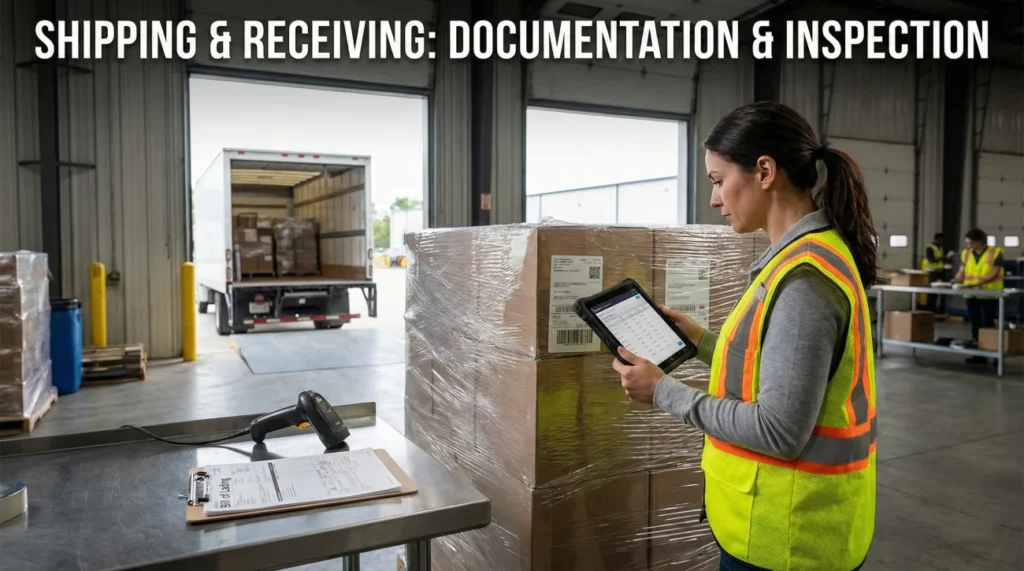
I start before the truck unloads. I verify the driver’s paperwork against our appointment schedule. Is this the right truck? Once verified, I inspect the condition of the trailer seal. Is it intact? Does the number match the BOL?
As the goods come off, I check for exterior damage immediately (crushed corners, water stains). Then I verify the quantity. I count the pallets and check the SKU labels against the Packing List. I do not sign the BOL until I am 100% satisfied. My signature transfers legal liability to my company, so I treat it like signing a check.
Q: Explain “Blind Receiving.” Why is it used?
Blind receiving is when I receive a shipment without seeing the expected quantity on the paperwork (the numbers are blacked out or omitted). I have to count the items and enter the number into the system.
This forces me to actually count, rather than just assuming the vendor is right and ticking a box. It is the highest standard of accuracy. If my blind count matches the system’s expected count, the receipt is validated. If not, it triggers an immediate recount.
Q: How do you handle a shipment with visible damage?
It depends on the severity. If it is minor (one crushed box), I accept the shipment but note the specific damage on the Proof of Delivery (POD) before the driver leaves. I take photos and segregate the damaged item for a claim.
If the damage is catastrophic (e.g., a pallet of glass tipped over), I refuse the shipment entirely. I do not let it onto our dock. I mark “Refused – Damaged” on the BOL, have the driver sign it, and notify the Purchasing Department immediately so they can reorder. Accepting damaged goods makes it our problem; refusing it keeps it the carrier’s problem.
Q: What is the difference between a Bill of Lading (BOL) and a Packing List?
The BOL is the legal contract between the shipper and the carrier. It lists the total weight, pallet count, and freight class. It is what the driver needs to move the goods.
The Packing List is the inventory detail. It tells me exactly what is inside each box (SKUs, colors, sizes). I use the BOL to sign for the freight, but I use the Packing List to verify the inventory entry.
Shipping & Documentation
Q: Preparing a LTL Shipment?
I verify the pallet is wrapped tight and labeled on two sides. I calculate the total weight accurately to avoid re-weigh fees.
I generate the BOL and schedule the pickup. I ensure the “Pro Number” stickers are applied to the freight for tracking.
Q: Handling Hazardous Materials?
I verify the Safety Data Sheet (SDS). I ensure the correct UN number placards are on the box and the truck.
I separate incompatible materials. I verify the driver has a Hazmat endorsement before loading.
Q: International Shipping documents?
I ensure the Commercial Invoice is attached with accurate HS Codes and Country of Origin.
If wood pallets are used, I check for the ISPM-15 heat-treatment stamp. Without it, the shipment will be rejected at the border.
Q: Using UPS/FedEx software?
I am proficient with WorldShip and Ship Manager. I verify the address is residential or commercial to avoid surcharges.
I double-check the service level (Next Day vs. Ground) to match the customer’s request.
Q: “Staging” an order?
I pull the completed orders to the designated shipping lane. I check them against the load manifest one last time.
I organize them by drop sequence if it is a multi-stop truck (First in, Last out logic).
Q: Handling “Short Ships”?
If we don’t have enough stock to fill an order, I mark it as a “Backorder” on the packing slip.
I communicate this to Sales immediately. I never ship a partial order without documenting it, or the customer will claim theft.
Scenarios: Dock Reality
Scenario: A truck driver arrives 2 hours late for his appointment. He is angry and demands to be unloaded now because he is out of driving hours.
I remain calm but firm. I explain that the dock is currently full with on-time appointments. I do not let his poor planning become my emergency.
I offer him two options: “I can work you in as a ‘work-in’ if a gap opens up, which might be in 3 hours, or you can reschedule for tomorrow morning.” I do not allow him to bully me into delaying other scheduled carriers. If he becomes aggressive, I call my supervisor or security. I control the dock schedule, not the driver.
Scenario: You receive a shipment of 50 boxes. The paperwork says 50, but you count 51.
I do not just keep the extra box. That is an inventory error waiting to happen. I identify which specific SKU is over. I note “Overage: +1 Case of SKU X” on the BOL and have the driver initial it.
I enter the correct count (51) into the WMS. I notify the vendor. Honesty builds trust with suppliers, and if we pay for 50 but sell 51, our inventory counts will be permanently misaligned later.
Scenario: The warehouse is overflowing. There is no space to put away the incoming shipment, but the truck is at the door.
I coordinate with the Warehouse Manager immediately. I look for “Cross-Dock” opportunities. Can any of this incoming stock fill a pending outbound order right now?
If not, I stage the freight in the aisle temporarily (if safe) or use a “overflow trailer” in the yard if available. I prioritize receiving the “Hot” items that are on backorder and leave the rest for later. I do not turn the truck away unless absolutely necessary, as re-delivery fees are expensive.
System & Equipment Skills
Q: Experience with WMS Data Entry?
I treat data entry as the most critical part of the job. I enter receipts into the WMS (like SAP, Oracle, or Fishbowl) in real-time, not at the end of the day. Delaying entry causes “phantom stockouts” where the goods are here but the system thinks they aren’t.
I double-check my typing. Entering a quantity of 100 instead of 10 creates a massive variance. I use scanners whenever possible to eliminate manual entry errors.
Q: Operating Dock Equipment?
I am certified on the sit-down forklift and the electric pallet jack. I know how to operate the dock leveler and lock the trailer to the building (Dock Lock).
I inspect the equipment daily. If the dock plate is hydraulic and leaking fluid, I tag it out. Safety on the dock is non-negotiable because forklifts and pedestrians mix here.
Q: How do you organize your files?
I maintain a strict filing system. Inbound (Receiving) paperwork is filed by Date and Vendor. Outbound (Shipping) is filed by Date and Carrier.
I scan all signed BOLs into the digital archive daily. If a customer claims they never received a shipment from 6 months ago, I can pull the signed POD in 2 minutes to prove delivery. Documentation is our insurance policy.
Shipping & Receiving Quiz
Test Your Dock Knowledge (20 Questions)
1. “BOL” stands for:
- Box Of Labels
- Bill Of Lading
- Back Order List
- Basic Operating License
2. A “POD” proves:
- The driver was paid
- The goods were delivered and signed for
- The warehouse is open
- The product is damaged
3. “LTL” shipping is for:
- Loads That are Late
- Less Than Truckload (Palletized freight)
- Long Term Logistics
- Large Truck Loads
4. If a shipment arrives damaged, you should:
- Hide it
- Note it on the delivery receipt/BOL immediately
- Tell the driver it’s okay
- Fix it yourself
5. “Blind Receiving” means:
- Receiving with eyes closed
- Counting goods without knowing the expected quantity
- Trusting the vendor completely
- Receiving at night
6. A “Packing List” details:
- The freight charges
- The contents of each package
- The driver’s lunch order
- The truck’s license plate
7. “FOB” determines:
- The forklift battery level
- When ownership/risk transfers from seller to buyer
- The freight weight
- The box size
8. A “Seal” on a trailer ensures:
- The truck is waterproof
- The cargo has not been tampered with since loading
- The doors don’t open
- The driver stays inside
9. “Overage” means:
- The shipment is late
- You received more items than ordered
- The items are too old
- The truck is too heavy
10. “Shortage” means:
- The driver is short
- You received fewer items than ordered
- The boxes are small
- The time is short
11. A “Pro Number” is used to:
- Identify professional drivers
- Track a specific shipment with the carrier
- Open the warehouse gate
- Calculate profit
12. “Dunnage” bags are used to:
- Carry trash
- Fill empty space and prevent load shifting
- Store lunch
- Cover the pallets
13. “Cross-Docking” moves goods:
- To long-term storage
- Directly from receiving to shipping
- Across the street
- To the trash compactor
14. “Hazmat” stands for:
- Hazardous Materials
- Hazardous Materials
- Hazardous Management
- Heavy Materials
15. A “Dock Leveler” connects:
- Two buildings
- The warehouse floor to the trailer bed
- The forklift to the charger
- The manager to the office
16. “FIFO” prevents:
- Theft
- Inventory obsolescence/spoilage
- Speeding
- Overtime
17. If a driver refuses to sign the BOL:
- Let him go
- Do not release the freight
- Sign it yourself
- Call the police
18. “Backorder” means:
- The item is returned
- The item is out of stock but will ship later
- The order is cancelled
- The warehouse is closing
19. A “Manifest” is:
- A ghost in the warehouse
- A summary document of all shipments on a truck
- A safety rule
- A type of forklift
20. “Tare Weight” is:
- The total weight
- The weight of the empty packaging/container
- The weight of the product
- The weight of the driver
❓ Frequently Asked Questions
💪 Is this job physically demanding?
Yes. Even as a clerk, you are on your feet all day. You will lift boxes to inspect them, climb into trailers, and walk the warehouse floor. It is not a desk job. Expect to be active for 8-10 hours a shift.
🖥️ What software do I need to know?
Familiarity with any WMS (SAP, Oracle) is a plus, but UPS WorldShip and FedEx Ship Manager are the most common specific tools. Basic Excel is also essential for tracking logs. Most companies will train you on their specific ERP.
⚖️ How do I handle pressure from drivers?
Drivers are always in a hurry because they are paid by the mile. Be polite but firm. Do not let them rush your inspection. If you sign for a damaged load because you were rushed, it’s your job on the line, not theirs. Use the phrase “I need to verify this for both our protection.”
📈 What is the career path?
This is a great entry point. You learn the products, the system, and the vendors. From here, you can move up to Warehouse Supervisor, Inventory Control Specialist, or move into the office as a Logistics Coordinator or Purchasing Assistant.
⚠️ Biggest mistake a clerk can make?
Signing a BOL without counting. Once you sign “Received in Good Order,” the carrier is off the hook. If you find a shortage later, your company eats the cost. Never sign blindly.
The Final Count
The Shipping and Receiving Clerk is the auditor of the physical world. You are the one who ensures that what the computer says matches what is actually happening on the dock. It is a role of high integrity and precision.
By mastering these shipping and receiving clerk interview questions, you show that you are not just checking boxes; you are protecting the company’s assets and reputation with every signature you write.
⚠️ Disclaimer: The interview strategies, sample answers, and negotiation tips provided in this guide are for educational purposes only. Hiring decisions are subjective and vary by company and industry. While these strategies are based on professional HR standards, they do not guarantee a specific job offer or result.