The Architect of Delivery
A Logistics Manager does more than just book trucks. You are the final guardian of the customer experience, ensuring that the product promised by Sales and built by Production actually arrives at the destination intact and on time. However, hiring managers know that speed costs money. The core tension of this role is balancing the “Iron Triangle” of Logistics: Speed, Cost, and Quality. You cannot maximize all three simultaneously.
In the modern landscape, the interview will focus heavily on your ability to manage external partners (3PLs/Carriers), your proficiency with Transport Management Systems (TMS), and your strategy for the notoriously expensive “Last Mile.” They are looking for a leader who can negotiate aggressive freight rates without compromising service levels and who can design a distribution network that is resilient enough to withstand port strikes and fuel spikes.
This guide covers the essential logistics manager interview questions, focusing on cost optimization techniques, carrier relationship management, and the tactical execution of complex distribution networks.
Distribution Network Strategy
Q: How do you determine whether to use a Centralized or Decentralized distribution network?
Centralized (one main hub) lowers inventory holding costs and facility expenses but increases shipping costs and lead times to distant customers. Decentralized (multiple regional hubs) puts product closer to the customer, reducing delivery time and last-mile cost, but explodes inventory investment (safety stock needed at every location).
My decision logic is based on product value and demand density. For high-value, low-turnover items, I centralize to protect cash. For low-value, high-volume items (like FMCG), I decentralize to minimize transport costs and meet “Next Day” expectations.
Q: Explain “Cross-Docking” and when you would implement it.
Cross-docking is the practice of unloading materials from an incoming truck and loading them directly onto outbound trucks with little to no storage in between. It essentially eliminates the “put-away” and “picking” steps.
I implement this for high-velocity goods with predictable demand (like perishable food or scheduled retail replenishment). It reduces warehouse labor and storage space but requires precise synchronization. If the inbound truck is late, the outbound truck sits idle, costing money. It requires a mature supply chain with high schedule adherence.
Q: How do you approach “Reverse Logistics” (Returns)?
Returns are often treated as an afterthought, but they bleed margin. My strategy is “Asset Recovery.” I segregate returns at the point of entry: Restock (Grade A), Refurbish (Grade B), Liquidation/Recycle (Grade C).
I also analyze the “Reason Codes” for returns. If 20% of returns are due to “Shipping Damage,” I don’t just process the return; I audit the packaging specs and the carrier’s handling procedures to stop the bleeding at the source.
Q: Build vs. Buy: When should you use a 3PL (Third Party Logistics) versus your own fleet?
I use a Private Fleet when customer service is the competitive differentiator (e.g., white-glove delivery) or when volume is dense and consistent enough to maximize asset utilization. Control is high, but fixed costs are high.
I use a 3PL for fluctuating volume, remote geographies, or specialized needs (like cold chain) where investing in assets doesn’t make ROI sense. 3PLs offer scalability. My ideal model is often hybrid: a core private fleet for the stable “base load” and 3PLs to handle the peaks and the long-tail lanes.
Cost Management & Operations
Q: FTL (Full Truckload) vs. LTL (Less Than Truckload)?
FTL is faster and safer (less handling) but requires volume. LTL is cheaper for smaller loads but risks damage due to multiple transfers.
I actively consolidate LTL shipments. I might hold orders for 2 days to build a full truckload (Zone Skipping), trading a bit of speed for significant cost savings.
Q: Managing “Detention” and “Demurrage”?
Detention is the fee for keeping a driver waiting. Demurrage is the fee for leaving a container at the port too long.
I reduce Detention by scheduling strict appointment windows (dock scheduling). I reduce Demurrage by pre-clearing customs documents before the ship arrives.
Q: What is “Volumetric Weight” (Dim Weight)?
Carriers charge based on whichever is greater: actual weight or dimensional weight. Shipping a box of feathers costs as much as a box of bricks if the volume is the same.
I audit our packaging efficiency. If we are shipping “air” (oversized boxes), we are overpaying. I push for “right-sizing” cartons.
Q: 3PL vs. 4PL?
A 3PL handles the assets (trucks, warehouses). A 4PL manages the 3PLs and the entire supply chain strategy/technology.
I would engage a 4PL if our organization lacks the internal bandwidth or IT infrastructure to orchestrate a complex global network of multiple 3PLs.
Q: The role of a TMS (Transport Management System)?
A TMS automates carrier selection (Least Cost Routing), consolidates orders, audits freight bills, and provides track-and-trace visibility.
Without a TMS, we rely on spreadsheets and gut feel, which leads to overspending and lack of data for negotiations.
Q: “Last Mile” challenges?
The Last Mile accounts for up to 50% of total shipping cost. Challenges include failed deliveries, traffic congestion, and lack of density.
I mitigate this by using route optimization software, offering “Click and Collect” options to customers, or partnering with local courier networks for urban density.
Scenarios: Negotiation & Crisis
Scenario: Your primary carrier announces a 15% rate increase due to fuel and labor costs. You have zero budget for this.
I do not just accept the hike, nor do I just say “No.” I look for “Non-Rate” levers to negotiate. I ask the carrier: “What can we do to make your life easier?”
Perhaps we can offer “Drop and Hook” programs to reduce their driver wait time, or commit to consistent lane volume so they can plan backhauls. I trade operational efficiency for rate stability. If that fails, I run a mini-RFQ (Request for Quotation) to benchmark the market and potentially shift volume to a challenger carrier.
Scenario: A nationwide trucker strike or capacity crunch makes it impossible to book trucks. Freight is piling up.
I triage the freight immediately based on customer priority and penalties. Strategic accounts get the limited truck space. For the rest, I look for modal shifts.
Can we move long-haul freight to Intermodal (Rail)? It is slower but keeps moving. Can we collaborate with other shippers to co-load? I also communicate proactively with Sales to reset customer delivery expectations, preventing the “Where is my stuff?” firestorm.
Scenario: A customer claims products are consistently arriving damaged.
I initiate a “Chain of Custody” audit. I ask the customer for photos of the damage. Is it crushed corners (handling issue) or water damage (trailer leak)?
I place “Shockwatch” impact indicators on a test shipment to pinpoint exactly where the abuse happens (Warehouse loading vs. Carrier transit). If it is the carrier, I file claims and threaten to pull volume. If it is our packaging, I work with Engineering to redesign the dunnage or pallet stacking patterns.
Compliance & Metrics
Q: What are Incoterms and why are they critical?
Incoterms (International Commercial Terms) define who pays for shipping, who carries the risk, and where transfer of liability occurs. Mixing them up is a legal disaster. For example, buying “Ex Works” (EXW) means we take risk at the supplier’s dock in China. Buying “DDP” (Delivered Duty Paid) means the supplier handles everything to our door. I ensure my team matches the Incoterm to our risk appetite and logistical capability.
Q: Which Logistics KPIs do you track?
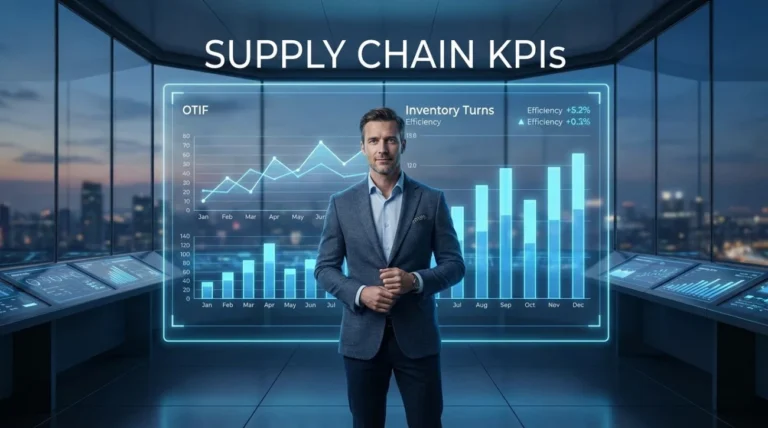
OTIF (On-Time In-Full) is the king of service metrics. Cost Per Unit/Kg monitors efficiency. Freight Bill Accuracy tracks overcharges. Perfect Order Rate measures the error-free execution (No damage, correct documentation, on time). I look for trends, not just snapshots.
Q: How do you handle Hazmat (Hazardous Materials) shipping?
Compliance is non-negotiable. I ensure all staff are certified (e.g., DOT/IATA HAZMAT training). We check Safety Data Sheets (SDS) for every SKU. We ensure proper labeling, placarding on trucks, and UN-spec packaging. One mistake here leads to massive fines and safety risks, so I implement a “Two-Person Check” process for all Hazmat documentation.
Logistics Management Competency Quiz
Test Your Distribution Knowledge (20 Questions)
1. “Cross-Docking” is best described as:
- Storing goods for long-term preservation
- Moving goods directly from inbound to outbound with minimal storage
- Shipping goods across the ocean by ship
- inspecting goods for quality defects
2. Which Incoterm places the maximum obligation on the Seller?
- EXW (Ex Works)
- DDP (Delivered Duty Paid)
- FOB (Free On Board)
- CIF (Cost, Insurance, and Freight)
3. “LTL” stands for:
- Long Term Logistics
- Less Than Truckload
- Late Truck Liability
- Local Transport License
4. A “3PL” provider typically handles:
- Manufacturing of the product
- Outsourced logistics functions like warehousing and transport
- Marketing and sales campaigns
- Product design and engineering
5. “Demurrage” charges are incurred when:
- A driver is kept waiting at a dock
- Cargo is left at the port/terminal beyond free time
- Goods are damaged during transit
- A truck breaks down on the highway
6. “Intermodal” transportation involves:
- Shipping only within one mode (e.g., only trucks)
- Using multiple modes (e.g., Rail + Truck) for a single shipment
- Shipping internationally via air freight
- Transporting passengers and cargo together
7. “Reverse Logistics” primarily deals with:
- Driving trucks in reverse gear
- Managing product returns, recycling, and disposal
- Back-ordering out-of-stock items
- Negotiating previous contracts
8. “Volumetric Weight” is calculated based on:
- The actual weight of the package on a scale
- The dimensions (Length x Width x Height) of the package
- The value of the goods inside
- The distance the package travels
9. A “Bill of Lading” (BOL) serves as:
- A quote for potential shipping costs
- A receipt of goods and contract of carriage
- A packing list for the warehouse
- A customs declaration form
10. “Last Mile” delivery refers to:
- The final mile of a marathon
- The movement of goods from a hub to the final customer
- The first leg of a shipment from the factory
- The longest part of the journey
11. “Freight Class” (NMFC) is used to determine:
- The quality of the truck driver
- The shipping rate based on density and stowability
- The priority of the shipment delivery
- The insurance value of the cargo
12. “Drop Shipping” means:
- Dropping packages from a drone
- Shipping directly from supplier to customer, bypassing the retailer
- Damaging goods by dropping them
- Shipping to a drop-off point
13. A “Milk Run” logistics strategy involves:
- Delivering only dairy products
- A truck picking up loads from multiple suppliers in one loop
- Using very small trucks for delivery
- Running trucks only at night
14. “Deadhead” miles refer to:
- Miles driven by a tired driver
- Miles driven by an empty truck with no cargo
- The most dangerous miles of a route
- Miles driven in heavy traffic
15. “Zone Skipping” is a technique to:
- Avoid delivering to certain zones
- Bypass parcel carrier zones by trucking closer to the destination
- Skip safety inspections in zones
- Ignore time zone changes
16. “Proof of Delivery” (POD) confirms:
- The driver has a license
- The consignee received the goods in good condition
- The invoice has been paid
- The truck has fuel
17. A “TMS” (Transportation Management System) helps with:
- Designing the product packaging
- Planning, executing, and optimizing shipments
- Managing employee payroll
- Forecasting sales revenue
18. “OTIF” stands for:
- Over Time Is Free
- On Time In Full
- Order Tracking In Field
- Outsourced Transport In Freight
19. “Cabotage” laws regulate:
- The use of taxis for delivery
- Transport of goods between two points in the same country by a foreign carrier
- The storage of cabbage in warehouses
- The weight of the truck cab
20. “Containerization” standardized shipping by:
- Using plastic bags for everything
- Using uniform steel boxes (TEUs) for intermodal transport
- Reducing the size of ships
- Eliminating the need for cranes
❓ FAQ
🚜 How do I handle driver shortages?
You become a “Shipper of Choice.” Drivers prefer warehouses that have clean restrooms, fast loading times (under 2 hours), and friendly staff. If you treat drivers well, they will pick up your loads when capacity is tight. It is about relationship, not just rate.
📉 How do I reduce freight costs immediately?
Audit your invoices. Studies show 3-5% of freight bills have errors (wrong accessorials, duplicate charges). Implementing a rigorous freight audit process is the fastest way to recover cash without changing operations.
🌐 Managing international logistics challenges?
Hire a competent Freight Forwarder and Customs Broker. Do not try to DIY customs clearance unless you have a massive internal compliance team. Visibility is key; use digital trackers to know when containers are stuck at the port.
📦 Is “Free Shipping” really free?
Never. Logistics always has a cost. “Free shipping” is a marketing term; the cost is baked into the product price or absorbed as a customer acquisition cost. As a manager, you must calculate the true margin impact of this policy.
🤖 Will AI replace Logistics Managers?
AI will replace the “dispatcher” tasks (matching loads to trucks), but not the manager. AI cannot negotiate a complex contract dispute, calm an angry customer, or design a creative solution for a warehouse strike. The role shifts from execution to strategy.
Final Thoughts
The Logistics Manager is the unsung hero of the supply chain. You operate in a world where “nothing happens until something moves.” It is a role of high pressure and constant problem-solving. By mastering these logistics manager interview questions, you prove that you have the operational grit and the financial savvy to keep the world moving, one shipment at a time.
⚠️ Disclaimer: The interview strategies, sample answers, and negotiation tips provided in this guide are for educational purposes only. Hiring decisions are subjective and vary by company and industry. While these strategies are based on professional HR standards, they do not guarantee a specific job offer or result.