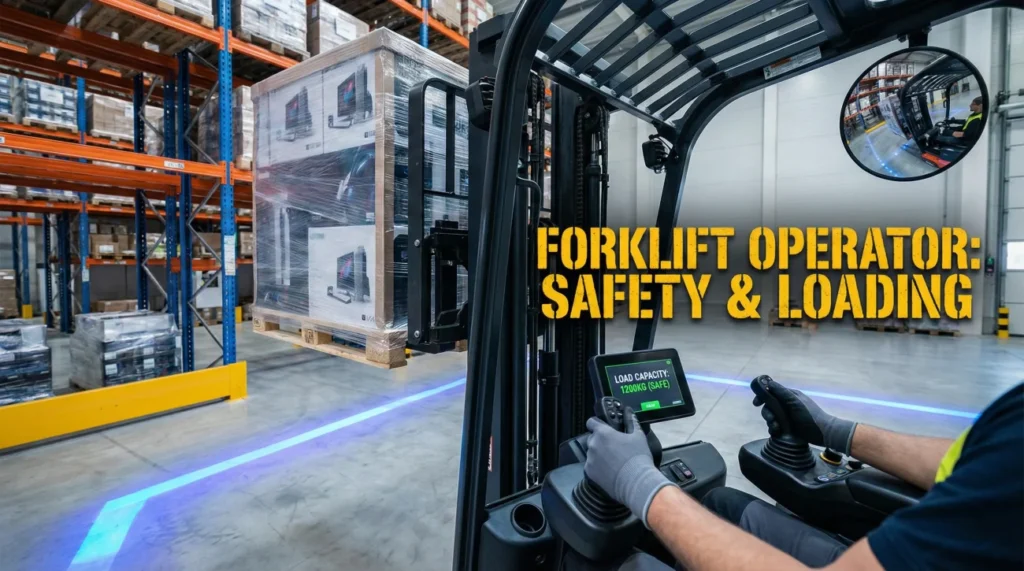
The Heavy Lifter
Being a Forklift Operator is about more than just driving; it is about precision and physics. You are operating a machine that weighs 9,000 pounds and can lift 5,000 pounds over your head. One wrong move doesn’t just damage a pallet; it can destroy racking or injure a coworker. Hiring managers are looking for operators who respect the power of the machine.
The interview will focus heavily on safety. They will ask you about the “Stability Triangle” and how to handle a tip-over. They want to know if you check your hydraulic hoses before every shift or if you just turn the key and go. Speed matters, but safety is the gatekeeper. If you can’t prove you are safe, you won’t get the job.
This guide provides the essential forklift operator interview questions to help you demonstrate your technical knowledge and your commitment to a zero-accident workplace.
OSHA Safety & Stability
Q: Explain the “Stability Triangle.” Why is it critical?
The Stability Triangle is the three-point suspension system of the forklift (two front wheels and the center of the steer axle). The Center of Gravity (COG) must stay within this triangle.
If I turn too fast, lift a load too high while moving, or drive across a slope, the COG shifts outside the triangle, causing a tip-over. Understanding this physics keeps the truck upright.
Q: What do you do if the forklift starts to tip over?
My instinct is to jump, but that is fatal. I follow the “Stay in the Cage” rule. I grip the steering wheel tightly, brace my feet, and lean away from the fall.
The overhead guard protects me from crushing. Jumping out usually results in being pinned by the overhead guard.
Q: Walk me through a Pre-Trip Inspection. What are you looking for?
I start with a visual walk-around. I check tires for chunking (missing rubber). I look for puddles (hydraulic leaks) under the truck. I check the forks for cracks or bent tips.
Then I check the engine/battery compartment. I verify fluid levels (oil, coolant, electrolyte). Finally, I turn it on and test the controls: lift, tilt, side-shift, horn, and brakes. If anything fails, I tag it out and do not drive it.
Q: How do you handle a “Blind Corner”?
I treat every corner as if a pedestrian is there. I slow down to a crawl. I sound my horn firmly before entering the intersection.
I use the convex mirrors if available. I always yield to pedestrians; they have the right of way 100% of the time.
Operating Techniques
Q: Carrying a Load on a Ramp?
The load must always face uphill. When going up, I drive forward. When going down, I drive in reverse.
This keeps the weight on the drive wheels for traction and prevents the load from sliding off the forks.
Q: Handling an “Unstable Load”?
I do not lift it. I set it down and re-stack or shrink-wrap it.
Lifting a wobbly pallet is a gamble. If it falls at height, it can kill someone. I fix it on the ground first.
Q: “Free Lift” vs. “Full Lift”?
Free lift is how high the forks go before the mast extends. This is critical for stacking inside a trailer.
If I don’t know my free lift height, I will punch a hole in the trailer roof.
Q: Propane Tank Exchange?
I wear heavy gloves (PPE) to prevent freeze burns. I ensure the valve is closed before disconnecting.
I verify the locating pin engages the hole in the tank collar so the pickup tube is at the bottom.
Q: Reach Truck vs. Counterbalance?
Counterbalance uses weight at the back to lift. Reach trucks use outriggers and extend the forks.
Reach trucks are for narrow aisles and high racking; they require more precision and stopping distance.
Q: “Load Center” calculation?
Standard load center is 24 inches. If the load is longer (e.g., 60 inches), the center moves to 30 inches.
This reduces the lifting capacity. I check the data plate de-rating chart before lifting odd-sized loads.
Scenarios: Dock & Warehouse
Scenario: You are loading a trailer and the truck driver starts to pull away while you are inside.
This is a terrifying “Drive-Away” incident. I brace for impact. I stay in the trailer; I do not try to jump out the back.
Once safe, I report it immediately. To prevent this, I always check for wheel chocks or engage the “Dock Lock” (red light/green light) before entering. If the facility lacks locks, I ask the driver for his keys (Glad Hand Lock) as insurance.
Scenario: A supervisor asks you to lift a person on the forks to change a light bulb because the scissor lift is broken.
I refuse. It is an OSHA violation and incredibly dangerous. “I can’t do that, boss. It’s against regulations and my license.”
I offer a solution: “Let’s wait for the scissor lift repair or use a proper man-basket with a safety harness.” I will not risk my job or their life for a light bulb.
Scenario: You clip a rack upright while turning. There is a small dent, but it looks stable.
I stop and report it. Structural damage is often invisible. A small dent can compromise the weight-bearing capacity of the entire bay.
I unload the rack immediately to remove stress. Hiding the damage is worse than the accident itself because it sets a trap for the next person.
Loading & Unloading Skills
Q: How do you load a trailer to maximize space and stability?
I verify the weight distribution plan first. I place heavier pallets on the floor and lighter ones on top (stacking). I use “Pinwheeling” (turning pallets sideways) to fit more in if the dimensions allow.
I ensure the load is tight to prevent shifting. I use dunnage bags or load bars to secure the final row. A shifted load is a rejected load at the receiver.
Q: What is the procedure for battery charging (Electric Lifts)?
I park in the designated charging station. I wear a face shield and apron (acid protection). I open the battery cover to vent hydrogen gas.
I verify the water levels after charging, not before. I check the cables for fraying. Handling massive batteries requires respect for electricity and acid.
Q: Dock Plate safety?
I check the capacity rating of the plate. I ensure it overlaps the trailer bed by at least 8 inches.
I verify the trailer floor is sound. Driving a 9,000lb forklift onto a rotten trailer floor is a disaster. If the floor looks weak, I don’t go in.
Forklift Safety Quiz
Test Your Operating Knowledge (20 Questions)
1. The “Fulcrum” of a forklift is:
- The rear axle
- The front wheels
- The mast
- The steering wheel
2. When driving without a load, the forks should be:
- High for visibility
- 4-6 inches off the ground
- Dragging on the floor
- Waist height
3. If the rear wheels come off the ground:
- Add more counterweight
- The load is too heavy; put it down
- Drive faster
- Ask a friend to sit on the back
4. Rear-end swing is dangerous because:
- It looks cool
- The back swings wide (3x steer angle) hitting pedestrians
- It slows you down
- It wears out tires
5. “Inch pounds” refers to:
- Tire pressure
- Lifting capacity rating
- Engine torque
- Fuel tank size
6. You should sound your horn when:
- Saying hello
- Approaching intersections or blind spots
- Driving straight
- Backing up only
7. “Deadman’s Switch” (or seat switch):
- Turns off the lights
- Disables hydraulics/drive if operator leaves seat
- Calls 911
- Locks the wheels
8. Carrying passengers on forks is:
- Allowed if careful
- Strictly forbidden
- Okay for short distances
- Allowed with a pallet
9. A “Dock Lock” secures:
- The forklift keys
- The trailer to the building (ICC bar)
- The warehouse door
- The cargo inside
10. Propane is heavier than air, so leaks settle:
- On the ceiling
- On the floor
- In the middle
- They evaporate instantly
11. “Side Shift” allows you to:
- Shift gears sideways
- Move the carriage left/right without moving the truck
- Turn faster
- Tilt the mast
12. Max speed in a warehouse is typically:
- 10 MPH
- Walking speed (approx 5 MPH)
- As fast as possible
- 15 MPH
13. To pick up a load, the mast should be:
- Tilted forward
- Vertical (or slightly back for stability)
- Tilted all the way back
- It doesn’t matter
14. “Chunking” refers to:
- Throwing boxes
- Pieces of rubber falling off solid tires
- Engine noise
- Loading heavy items
15. Carbon Monoxide (CO) is a risk with:
- Electric trucks
- Propane/Diesel/Gas trucks indoors
- Hand trucks
- Conveyor belts
16. The “Data Plate” tells you:
- The manufacturing date
- Capacity, weight, and lift height limits
- The price of the truck
- The owner’s name
17. “Racking” refers to:
- Torture devices
- Steel storage shelves
- Engine noise
- Cleaning the floor
18. High visibility vests are for:
- Fashion
- Being seen by other operators
- Keeping warm
- Carrying pens
19. If visibility is blocked by the load:
- Lean out the side
- Drive in reverse
- Guess and go
- Honk loudly
20. “OSHA 1910.178” covers:
- Office chairs
- Powered Industrial Trucks
- Ladder safety
- Noise control
❓ Common Questions
📜 Is my certification transferable?
No. OSHA requires you to be evaluated at the workplace on the specific equipment you will use. A card from a previous job proves experience, but your new employer must re-certify you on their machines.
🚜 Stand-up vs. Sit-down: Which is harder?
Stand-up (Reach Trucks) have a steeper learning curve due to reverse steering (turning the wheel left moves the back right) and the “deadman pedal” mechanics. Sit-down is more like driving a car but with rear-wheel steering.
⚖️ Can I be fired for one accident?
Yes. If the accident involved “Gross Negligence” (speeding, phone use, horseplay), it is usually immediate termination. If it was an honest mistake, you might get a warning and retraining, but safety is zero-tolerance.
⏳ How fast should I be?
Accuracy first, speed second. Managers prefer a steady operator who doesn’t break things over a “cowboy” who is fast but damages product. Your speed will come naturally with muscle memory.
🎧 Can I wear headphones?
Almost never. You need your ears to hear horns, shouting, and approaching equipment. Some warehouses allow one earbud, but most ban them completely for safety reasons.
Operator Excellence
Forklift operating is a skilled trade. It requires focus, coordination, and a constant awareness of your surroundings. You are the muscle that moves the economy.
By mastering these forklift operator interview questions, you show that you respect the equipment and value human life. That attitude is what gets you hired and keeps you safe.
⚠️ Disclaimer: The interview strategies, sample answers, and negotiation tips provided in this guide are for educational purposes only. Hiring decisions are subjective and vary by company and industry. While these strategies are based on professional HR standards, they do not guarantee a specific job offer or result.