The Gatekeeper of Global Trade
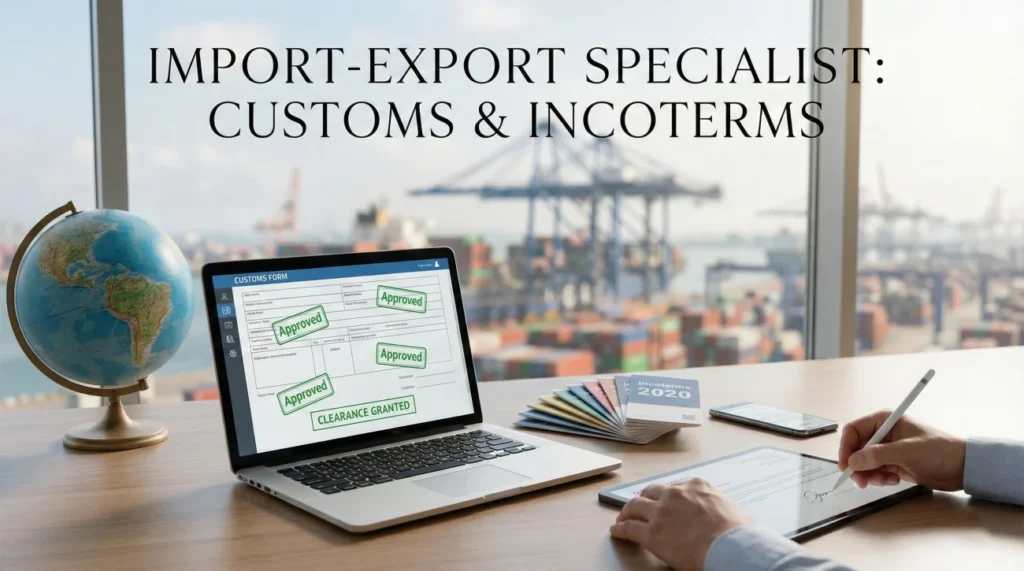
The role of an Import Export Specialist is one of the most technically demanding positions in the supply chain. While a Logistics Manager focuses on the physical movement of goods, you are responsible for the legal movement of goods. You act as the firewall between your company and the federal government. Hiring managers are acutely aware that a single clerical error, such as a misclassified HS code or a forgotten “Country of Origin” label, can result in cargo seizures, massive fines, and even the revocation of export privileges.
The interview for this role is not about generalities. It is a precise test of your regulatory knowledge. Interviewers will drill down into your understanding of Incoterms 2020, asking specifically where the risk transfers in complex scenarios like “CIP” versus “CIF.” They will test your ability to navigate the General Rules of Interpretation (GRI) for HS classification. They want to see if you can spot a “red flag” in a Letter of Credit before it reaches the bank. This guide provides the deep, technical import export specialist interview questions necessary to prove you are the expert they can trust with their compliance liability.
Customs Compliance & Classification
Q: Walk me through your step-by-step process for classifying a difficult product under the HS Code system.
I never classify based on the commercial name alone, as marketing terms are often misleading. My process begins with gathering the “DNA” of the product. I request technical drawings, material composition sheets (CAS numbers for chemicals), and a functional description from the engineering team.
I then apply the General Rules of Interpretation (GRI) in strict order. I start with GRI 1, looking for a specific heading that describes the item completely. If it is a composite good, like a kit containing a flashlight and a radio, I move to GRI 3(b) to determine the “essential character” of the set. I consult the CROSS database (Customs Rulings Online Search System) to see if Customs has issued a binding ruling on similar items. If significant ambiguity remains, I advise management to file for a binding ruling to guarantee certainty. I document this entire logic trail to demonstrate “Reasonable Care” in case of a future audit.
Q: How do you handle “Valuation” for goods provided free of charge, such as samples, warranty replacements, or “Assists”?
This is a major compliance trap. Customs does not care if the customer pays zero; they care about the value of the goods entering the commerce of the country. Declaring a value of “$0” or “No Commercial Value” is illegal and causes immediate flags.
For samples, I declare the “Fair Market Value,” which is what the item would cost if sold. On the Commercial Invoice, I state this value clearly for “Customs Purposes Only” and include the phrase “value for customs purposes only; no charge to customer.” For “Assists” (like molds, dies, or engineering work provided free to a foreign manufacturer), I ensure their value is added to the dutiable value of the imported goods. Failing to declare assists is one of the most common reasons for penalties during a Focused Assessment audit.
Q: Describe your protocol for “Denied Party Screening” and export controls.
Export compliance is a strict liability offense, meaning “I didn’t know” is not a valid defense. I integrate automated screening into our ERP system (like SAP GTS or Descartes) to check every new customer and vendor against the Consolidated Screening List (CSL), which includes the Entity List, SDNs, and Unverified List.
If the system generates a “hit,” I place the order on immediate “Compliance Hold.” I then perform due diligence to rule out “false positives” by verifying addresses and corporate structures. I also check for “Red Flags” listed by the BIS (Bureau of Industry and Security), such as a bakery ordering advanced missile guidance chips. If a match is confirmed, I block the transaction permanently and report it to the Empowered Official. I strictly adhere to the principle: When in doubt, do not ship.
Q: How do you resolve a shipment that has been seized or held by Customs?
Speed and transparency are my tools here. First, I identify the specific reason for the hold from the “Notice of Action” (CBP Form 29). Is it a marking issue? A suspected IP violation? A random exam?
If it is a marking issue (e.g., missing “Made in China” label), I petition to move the goods to a bonded warehouse to apply the markings under supervision. If it is a documentation request, I supply the missing data immediately. I communicate with the Customs Broker daily to keep pressure on the release. Simultaneously, I inform the customer of the delay, framing it as a “regulatory inspection,” and provide realistic updated timelines rather than false hope.
Incoterms 2020 & Trade Terms
Q: Why do you prefer FCA over EXW for exports?
EXW (Ex Works) is risky for exporters because we lose control of the export declaration. The buyer’s forwarder might fail to send us the proof of export (AES filing).
With FCA (Free Carrier) at our facility, we are legally the exporter of record. We file the EEI, ensuring compliance, but the buyer still pays for the main transport.
Q: Explain the risk transfer in CIP vs CIF.
In both, the seller pays freight and insurance. However, in CIF (Sea), risk transfers when goods are on the ship. In CIP (Multimodal), risk transfers when goods are handed to the first carrier (e.g., the truck picking up from our factory).
CIP creates a gap where we pay for freight, but the buyer holds the risk during transit.
Q: What are the dangers of selling DDP?
DDP (Delivered Duty Paid) makes the seller responsible for import clearance and duties in the foreign country.
Unless we have a registered entity in that country, we may be legally unable to act as the importer. It also exposes us to unknown tax liabilities (VAT/GST) that we cannot recover. I advise against DDP for this reason.
Q: When should FOB be used?
FOB (Free On Board) is strictly for sea and inland waterway transport. Risk transfers when the cargo is physically loaded on the vessel.
It should never be used for air freight or containerized ocean freight where goods are handed over at a terminal. For those, FCA is the correct term.
Q: DAP (Delivered at Place) responsibilities?
Under DAP, we deliver to the buyer’s door, but the buyer is responsible for import clearance and duties.
This is the best balance for customer service. We control the logistics flow, but we avoid the legal headache of foreign customs formalities.
Q: Does Incoterms cover title transfer?
No. This is a common misconception. Incoterms define risk and cost allocation only.
Transfer of title (ownership) is defined in the sales contract or commercial code. I ensure the contract explicitly states when title transfers (e.g., upon full payment) to protect our assets.
Scenarios: Banking & Documentation
Scenario: You submit documents to the bank for a Letter of Credit (LC), but they are rejected due to a “Discrepancy.” The LC expires in 3 days.
I act immediately. I analyze the discrepancy note. If it is a correctable error, such as a missing signature or a typo on the invoice, I fix the document and resubmit it within hours.
If the discrepancy is unfixable, for example, the shipment date was late or the LC required a “Clean On Board” bill of lading but the carrier noted packaging damage, I contact the buyer directly. I explain the situation and ask them to instruct their bank to “Waive the Discrepancy.” I maintain a close relationship with the buyer’s logistics team precisely for these moments. I act as the bridge between the rigid banking rules and the fluid commercial reality to ensure we still get paid.
Scenario: A supplier sends you a Certificate of Origin claiming “USMCA Preference” so you pay zero duty. You suspect the goods don’t actually qualify.
I do not file the claim. As the importer of record, my company is liable for the accuracy of the declaration, not the supplier. A supplier might lie to make their product more attractive.
I ask the supplier for their “Affidavit of Manufacture” or the specific Regional Value Content (RVC) calculation sheet. If they cannot or will not provide the backup data to prove origin, I enter the goods as dutiable and pay the standard tariff. It is cheaper to pay 5% duty now than to face a Customs audit later where we owe the duty plus interest and a 200% penalty for negligence.
Scenario: Sales wants to ship a replacement part urgently to a new customer in a sanctioned country (e.g., Iran or North Korea).
I exercise my veto power immediately. I explain to the Sales Director that sanctions are not “guidelines” but federal laws with criminal penalties. I check the OFAC (Office of Foreign Assets Control) regulations specifically.
Even if the part itself is harmless (EAR99), the destination is blocked. I refuse to process the shipment. If Sales pushes back, I escalate to the Legal Department or the Chief Compliance Officer. I frame it as protecting the company’s existence, as violations can lead to being placed on the Denied Party List, effectively killing our export business.
Logistics & Operations
Q: How do you manage Freight Forwarders to ensure performance?
I treat forwarders as strategic partners but manage them with strict KPIs. I provide a detailed Standard Operating Procedure (SOP) that outlines our specific requirements, such as “No transshipment allowed without approval” or “Draft BL must be sent 48 hours before sailing.” I score them quarterly on metrics like booking roll-over rate, transit time accuracy, and billing accuracy. If a forwarder consistently fails to meet the SOP, I put them on a performance improvement plan or move the volume to a competitor.
Q: Explain the “Automated Export System” (AES) and your filing process.
AES is the electronic system used to declare exports to the US Census Bureau. Filing is mandatory for any shipment where a single Schedule B line item exceeds $2,500 in value. I ensure the Electronic Export Information (EEI) is filed before the goods leave the country, adhering to specific timeframes (e.g., 24 hours prior for sea freight).
I carefully verify the data inputs, especially the ECCN (Export Control Classification Number) and the ultimate consignee. Once filed, I obtain the ITN (Internal Transaction Number) and ensure it is printed on the Bill of Lading. Filing late or incorrect data attracts automated penalties of $10,000 per violation, so I double-check every entry.
Q: What is the strategic value of a Foreign Trade Zone (FTZ)?
An FTZ allows us to treat a domestic facility as if it were outside US Customs territory. The strategic value is cash flow and duty reduction. We can import components, hold them indefinitely without paying duty, and manufacture them into finished goods.
If the duty rate on the finished good is lower than the duty on the parts (Inverted Tariff), we pay the lower rate upon entry into the US market. If we re-export the finished good, we pay zero US duty. I use FTZ feasibility studies to determine if the savings on high-volume imports justify the administrative cost of maintaining the zone.
Import Export Competency Quiz
Test Your Trade Knowledge (20 Questions)
1. “Incoterms” are published by:
- The World Trade Organization
- The International Chamber of Commerce (ICC)
- The United Nations
- The US Department of Commerce
2. Which Incoterm requires the seller to purchase insurance?
- FOB (Free On Board)
- CIF (Cost, Insurance, Freight)
- EXW (Ex Works)
- DAP (Delivered At Place)
3. An “HS Code” consists of at least how many digits for international harmonization?
- 4 digits
- 6 digits
- 10 digits
- 2 digits
4. “Dumping” in international trade refers to:
- Disposing of waste in the ocean
- Exporting a product at a price lower than its home market value
- Cancelling an order last minute
- Offloading cargo to save a sinking ship
5. A “Letter of Credit” minimizes risk for:
- Only the Buyer
- Both the Buyer and Seller
- Only the Seller
- The Freight Forwarder
6. “Cabotage” rules prevent:
- Ships from carrying weapons
- Foreign carriers from transporting domestic goods between two domestic points
- Trucks from driving at night
- Pilots from flying overtime
7. The “Importer of Record” is responsible for:
- Driving the delivery truck
- Payment of duties and compliance with customs laws
- Manufacturing the goods
- Selling the goods to the final consumer
8. “Demurrage” is a fee charged for:
- Late payment of invoice
- Delay in picking up a container from the port
- Damage to the goods
- Extra weight in the container
9. A “Carnet” (ATA Carnet) is used for:
- Permanent import of food
- Temporary duty-free import of goods (e.g., trade show displays)
- Shipping hazardous materials
- Tracking lost shipments
10. “Embargo” means:
- A tax on luxury goods
- A government ban on trade with a specific country
- A discount on bulk shipping
- A type of shipping container
11. “Schedule B” numbers are used for:
- Import classification in the US
- Export classification in the US
- Scheduling truck appointments
- Bank account identification
12. “FCA” (Free Carrier) means delivery is completed when:
- Goods arrive at the buyer’s warehouse
- Goods are handed over to the carrier nominated by the buyer
- Goods are loaded on the ship
- Goods cross the border
13. A “Bill of Exchange” is:
- A request to exchange damaged goods
- A written order binding one party to pay a fixed sum to another
- A receipt for currency exchange
- A list of items to be bartered
14. “Generalized System of Preferences” (GSP) offers:
- Priority boarding on flights
- Reduced duties for products from developing countries
- Faster customs clearance for everyone
- Cheaper fuel for ships
15. “ISF” (Importer Security Filing) involves:
- Filing a security complaint
- Sending data to US Customs 24 hours before loading (10+2 rule)
- Securing the cargo with locks
- Inspecting the factory security
16. “Transshipment” refers to:
- Shipping across the ocean
- Moving goods from one vessel to another at an intermediate port
- Shipping transparent goods
- Direct shipping without stops
17. A “Force Majeure” clause covers:
- Minor delays in production
- Unforeseeable events preventing contract fulfillment (e.g., war, disaster)
- Price increases due to inflation
- Employee strikes
18. “Countervailing Duties” (CVD) are imposed to:
- Counterfeit goods
- Offset subsidies given to foreign producers by their government
- Fund the customs department
- Protect intellectual property
19. “Ro-Ro” ships are designed for:
- Containerized cargo
- Roll-on/Roll-off cargo like cars and trucks
- Oil and gas transport
- Frozen food transport
20. “NVOCC” stands for:
- New Vessel Operating Cargo Carrier
- Non-Vessel Operating Common Carrier
- National Vehicle Operations Control Center
- North Valley Ocean Container Corp
❓ FAQ
🛂 What is the difference between a Freight Forwarder and a Customs Broker?
Think of the Freight Forwarder as the travel agent for the cargo; they book the flight or the ship. The Customs Broker is the lawyer for the cargo; they handle the legal clearance with the government agencies. While many large logistics firms offer both services under one roof, the legal liabilities and skill sets are distinct. The broker carries a license and represents the importer to Customs.
📜 Which professional certification carries the most weight?
In the United States, the Licensed Customs Broker (LCB) license is the pinnacle. It requires passing a grueling federal exam with a low pass rate. Holding an LCB license proves you have mastered the regulations. The Certified Customs Specialist (CCS) is a good entry-level credential but does not grant the legal authority to transact customs business on behalf of others.
⚖️ How do I stay current with constantly changing trade wars and tariffs?
I build a routine of consuming daily trade intelligence. I subscribe to the Federal Register for official government notices. I also read industry publications like the Journal of Commerce and receive daily bulletins from our brokerage partners. In this field, reading the news is not a break; it is a core part of the job description.
💻 What software proficiency is required?
You must be comfortable with the ACE (Automated Commercial Environment) portal. Experience with global trade management (GTM) modules within ERPs like SAP or Oracle is highly valued. You also need advanced Excel skills to analyze large datasets of HTS codes and duty spend.
🛡️ What is CTPAT?
CTPAT (Customs-Trade Partnership Against Terrorism) is a voluntary program where companies work with Customs to strengthen their supply chain security. In exchange for strict security protocols, members get benefits like fewer inspections and “Front of the Line” processing at the border.
Final Thoughts
The Import Export Specialist is the unsung diplomat of the modern corporation. You navigate the complex, often conflicting web of international laws to ensure that commerce flows smoothly. It is a role that demands the precision of a surgeon and the vigilance of a guard. By mastering these import export specialist interview questions, you demonstrate to hiring managers that you have the knowledge, the discipline, and the integrity to safeguard the company’s global operations from risk.
⚠️ Disclaimer: The interview strategies, sample answers, and negotiation tips provided in this guide are for educational purposes only. Hiring decisions are subjective and vary by company and industry. While these strategies are based on professional HR standards, they do not guarantee a specific job offer or result.