The Guardian of Assets
The Fleet Manager role has transformed significantly over the last decade. It is no longer just about handing out keys and changing oil. Today, a Fleet Manager is an asset strategist responsible for millions of dollars in rolling capital. You are the person who decides whether the company buys or leases, when to retire a truck to maximize resale value, and how to use data to stop drivers from wasting fuel. Hiring managers are looking for a “Data-Driven Mechanic”. They want someone who understands the nuts and bolts of a vehicle but makes decisions based on spreadsheets, financial models, and telematics data.
The interview will be a rigorous test of your financial acumen and your operational grit. You will be asked how you calculate Total Cost of Ownership (TCO) down to the penny per mile. They will challenge you on your strategy for transitioning to Electric Vehicles (EVs) without disrupting operations. They want to know how you handle the “human element”, specifically how you enforce safety protocols with drivers who think they know better than the GPS. This guide prepares you for the deep, technical fleet manager interview questions that separate the fleet administrators from the strategic fleet leaders.
Maintenance Strategy & Asset Lifecycle
Q: Describe your approach to Vehicle Maintenance. How do you move from Reactive to Predictive?
My philosophy is that “Reactive Maintenance”, which is fixing it when it breaks, is the most expensive operational failure a fleet can suffer. It incurs not just the premium repair cost, but the massive hidden costs of unscheduled downtime, missed deliveries, and tow trucks. I implement a strict “Preventive Maintenance” (PM) schedule based on engine hours or mileage, ensuring compliance is consistently above 95%. I automate these alerts through the Fleet Management System (FMS) so that no interval is missed.
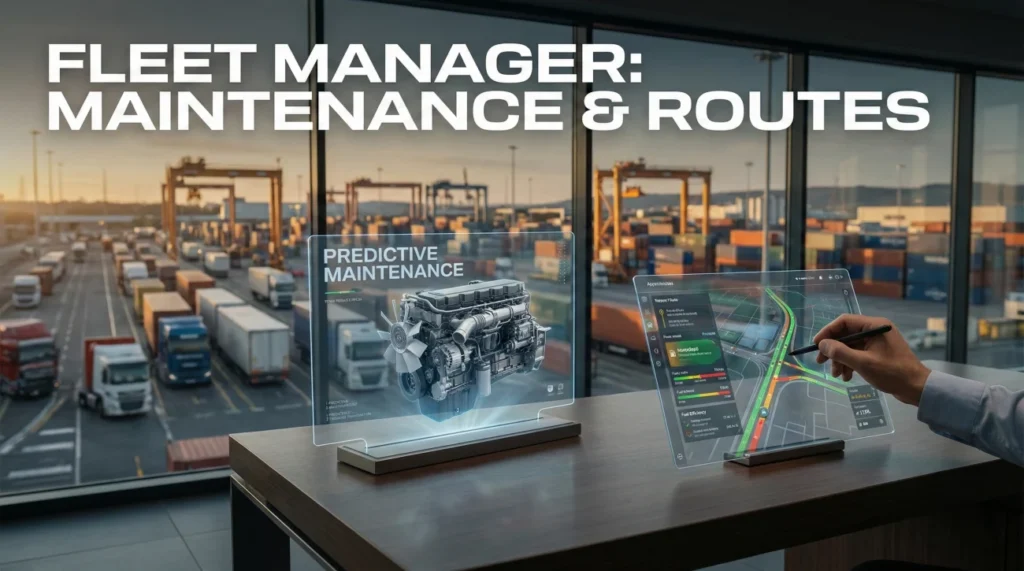
To move to “Predictive Maintenance,” I leverage telematics data integration. By monitoring Diagnostic Trouble Codes (DTCs) in real-time, I can see a “Check Engine” light remotely before the driver even reports it. If the telematics show a trend of rising coolant temperatures over a week, I schedule the truck for inspection immediately. This allows us to replace a $50 thermostat today instead of replacing a $5,000 engine block next month due to overheating. This shift reduces major breakdown costs by significant margins and keeps the fleet utilization rate high.
Q: How do you determine the optimal time to replace a vehicle (Asset Lifecycle)?
I do not guess or rely on gut feeling. I use a “Break-Even Analysis” of the Total Cost of Ownership (TCO). Every vehicle has a “sweet spot” where the rising cost of maintenance intersects with the falling cost of depreciation. Typically, in the first 3 years, depreciation is the main cost driver. In years 5 to 7, maintenance costs begin to spike vertically.
I track the “Cost Per Mile” (CPM) for every individual unit. When the CPM of an older truck, including fuel efficiency loss and repair downtime, exceeds the projected CPM of a new monthly lease payment, it is time to cycle it out. I also look closely at the “Remarketing Value” trends. I aim to sell the asset while it still has residual value in the secondary market, rather than driving it into the ground until it is scrap. This strategy turns the fleet from a simple cost center into a actively managed asset portfolio.
Q: Lease vs. Buy: How do you decide which acquisition strategy to use?
This decision depends entirely on the company’s capital strategy (CapEx vs. OpEx) and the specific application of the vehicle. For core, heavy-duty assets that we plan to keep for 10 years or more and modify significantly, like bucket trucks or specialized cranes, I prefer to Buy. This avoids mileage penalties and strict return conditions, and we get the depreciation tax benefit on the books.
For light-duty delivery vans or sales cars where technology changes fast and mileage is predictable, I prefer an Open-End TRAC Lease. This keeps the fleet young, improves corporate image, and provides cash flow flexibility since we are not tying up capital in depreciating metal. I always present both options to Finance with a Net Present Value (NPV) calculation to demonstrate which path yields the best long-term Return on Investment (ROI).
Q: How do you manage “In-House” vs. “Outsourced” maintenance?
I use a hybrid model based on “Core Competency.” For routine PMs such as oil, filters, and tires, and minor repairs, I prefer Outsourced national vendors. They have broader geographic coverage, negotiated labor rates, and faster turnaround for simple jobs. It is not cost-effective to maintain a full shop inventory and labor force just for oil changes.
However, if we have a large fleet concentration at a central hub (for example, 50 units or more), I advocate for an In-House mechanic. The ROI here comes from “Priority Scheduling.” An external shop puts my truck in a queue behind other customers. My internal mechanic fixes it tonight so it rolls tomorrow morning. For specialized heavy equipment, in-house expertise is often mandatory because vendor lead times are too long and the knowledge is too niche.
Fuel, Safety & Telematics
Q: Strategies to reduce fuel costs?
I attack fuel from three angles: Asset, Driver, and Procurement. I buy more fuel-efficient vehicles. I train drivers to reduce idling and harsh acceleration.
I use a “National Fuel Card” program with Level 3 data reporting to prevent theft and lock purchases to fuel-only. This eliminates unauthorized snack purchases.
Q: What is “Telematics” and why use it?
Telematics is the GPS and onboard diagnostic system. It is my eyes on the road. I use it for tracking location, but more importantly for behavior.
It tells me who is speeding, who is not wearing a seatbelt, and who is idling for 2 hours. I use this data to coach drivers toward safer habits.
Q: Understanding GVWR vs. Payload?
GVWR (Gross Vehicle Weight Rating) is the max allowable weight of the entire truck plus cargo. Payload is the weight of cargo you can carry.
Overloading causes safety risks and massive fines. I ensure we spec the right truck for the job. Buying a Class 3 truck for a Class 5 load is a mistake.
Q: Managing “Grey Fleet”?
Grey Fleet refers to employees using personal cars for work. It is a huge liability risk. We have no control over their maintenance or insurance.
I enforce a strict policy: annual checks of their driver’s license, insurance validity, and vehicle roadworthiness. I prefer to move high-mileage drivers into company cars.
Q: What is an ELD (Electronic Logging Device)?
ELDs mandate the electronic tracking of Hours of Service (HOS) to prevent driver fatigue. It is a federal compliance requirement for commercial drivers.
I monitor unassigned driving time and ensure drivers verify their logs daily. HOS violations can shut down our fleet, so I have zero tolerance.
Q: Handling “Vehicle Remarketing”?
Remarketing is selling the used asset. I do not just trade them in. I utilize auctions or direct sales to maximize return on the asset.
I clean and detail the vehicles (“Reconditioning”) before sale. Spending $200 on detailing can increase the auction price by $1,000. Appearance matters.
Scenarios: Drivers & Operations
Scenario: Your telematics report shows a specific driver has 5 “Harsh Braking” and 3 “Speeding” events this week. What do you do?
I do not fire them immediately, but I do act immediately. I pull the specific data events and map them. Was the harsh braking to avoid an accident (which is good) or because they were tailgating (which is bad)? Context matters.
I schedule a coaching session. I show them the data. I frame it as safety, not surveillance. I tell them “I want you to get home safely to your family.” If it is a pattern, I assign remedial driver training. If they continue to drive aggressively after training, then I initiate the disciplinary process. A dangerous driver is the biggest liability my fleet has, and one lawsuit can bankrupt the department.
Scenario: You are ordered to cut the Fleet Budget by 10% immediately. Where do you look first?
I start with “Utilization.” I run a report on “Idle Assets.” If a truck has not moved in 30 days, why do we have it? I pool or sell underutilized vehicles immediately. That cuts insurance, depreciation, and maintenance costs instantly.
Next, I look at fuel. I audit for “Premium Fuel” usage where Regular is sufficient. I check for idling. A 10% reduction in idling time is essentially free money. I also delay the replacement of non-critical assets by 6 months, pushing the capital spend into the next period, provided the maintenance data shows they are safe to run.
Scenario: Drivers are refusing to use the new Dash Cams, claiming it is an invasion of privacy.
This is a culture change issue. I hold a town hall meeting. I explain clearly that these cameras are outward-facing (or dual-facing) and they are your witness.
I share examples (anonymized) where a dash cam exonerated a driver who was falsely accused of causing an accident. I explain that “Without this camera, you would have lost your license. With it, we proved the other car cut you off.” I emphasize that the cameras trigger only on events (g-force), not continuous recording. Once they see it as a protection tool rather than a spy tool, adoption improves.
Technology & Future Trends
Q: What is your strategy for transitioning to Electric Vehicles (EVs)?
Transitioning to EVs is not just swapping keys. It is a massive infrastructure project. My strategy starts with a “Feasibility Audit.” I analyze the daily range of our current routes. If a van drives 200 miles and the EV range is only 150, it is a no-go for that route.
I start the pilot with “Return-to-Base” vehicles that drive low miles and park at our depot overnight, making charging management easy. I calculate the TCO, factoring in the higher upfront cost against the lower fuel and maintenance (no oil changes, fewer brake jobs due to regenerative braking). I also work with Facilities to install Level 2 chargers before the trucks arrive. I do not buy the vehicle until the plug is ready.
Q: How do you use Route Optimization software?
Route optimization is about density and flow. I use software to sequence stops to minimize left turns, which are dangerous and slow, and avoid crossing traffic patterns. I look for “Cluster” opportunities.
The goal is to reduce total miles driven while maintaining stop counts. If I can save 5 miles per route across 100 trucks, that is 500 miles a day, or 125,000 miles a year. That is massive fuel and depreciation savings. I also use dynamic routing to adjust for real-time traffic or cancellations, communicating changes directly to the driver’s tablet.
Q: How do you handle “Fuel Theft” or misuse?
I set strict controls on the fuel cards. I set limits on: Time of Day (no fuel at 2 AM), Gallon Limit per Transaction (cap at tank size), and Frequency (max 2 times a day). I require the driver to input the Odometer reading and Driver ID at the pump.
I run exception reports. If a sedan fills up 30 gallons, or if the MPG calculation based on odometer entry drops to 5 MPG, the system flags it. I investigate immediately. Often it is just a typo, but if I see a pattern of “side fueling” (filling a personal car), I involve HR and Legal. I have zero tolerance for theft.
Fleet Management Competency Quiz
Test Your Fleet Knowledge (20 Questions)
1. “TCO” stands for:
- Total Cost of Ownership
- Total Car Operation
- Truck Compliance Office
- Transport Cost Optimization
2. “Preventive Maintenance” (PM) is triggered by:
- The vehicle breaking down
- Time, mileage, or engine hours intervals
- The driver complaining of noise
- The annual budget review
3. “GVWR” is defined as:
- The weight of the empty truck
- The maximum allowable weight of the vehicle plus its load
- The weight of the cargo only
- The towing capacity of the vehicle
4. An “ELD” is required to track:
- Fuel consumption efficiency
- Driver Hours of Service (HOS) compliance
- GPS location for marketing
- Tire pressure monitoring
5. “Telematics” combines:
- Television and mathematics
- Telecommunications and informatics (GPS + Data)
- Telephone and automatic braking
- Telemetry and mechanics
6. “Remarketing” in fleet refers to:
- Putting new logos on trucks
- Selling used vehicles at the end of their lifecycle
- Advertising the fleet to customers
- Refueling the vehicles
7. A “TRAC Lease” (Terminal Rental Adjustment Clause) means:
- The lease has no end date
- The lessee guarantees the residual value at the end
- The vehicle must be returned in perfect condition
- The payments fluctuate with interest rates only
8. “Downtime” cost includes:
- Only the mechanic’s labor bill
- Repair costs plus lost revenue/productivity
- The cost of the new part
- The driver’s lunch break
9. “Grey Fleet” vehicles are:
- Vehicles painted grey
- Personal vehicles used by employees for business
- Vehicles that are leased, not owned
- Old vehicles ready for scrap
10. “Idling” wastes fuel and also:
- Charges the battery faster
- Causes excessive engine wear and pollution
- Cools down the tires
- Improves the resale value
11. “VIN” stands for:
- Vehicle Inspection Number
- Vehicle Identification Number
- Variable Insurance Note
- Vendor Invoice Number
12. “Utilization Rate” measures:
- How fast the vehicle drives
- How much the asset is used vs. available time
- How much fuel is in the tank
- How many passengers fit inside
13. “Geofencing” allows a manager to:
- Build a physical fence around the lot
- Set virtual boundaries and get alerts when vehicles enter/exit
- Lock the vehicle doors remotely
- Block the GPS signal
14. “Regenerative Braking” in EVs helps to:
- Clean the brake pads
- Recharge the battery while slowing down
- Stop the car instantly
- Cool the engine
15. “DOT” compliance usually refers to:
- Department of Technology
- Department of Transportation regulations
- Delivery on Time metrics
- Driver Over Time pay
16. “Depreciation” is best managed by:
- Never selling the vehicle
- Selling the asset at the optimal lifecycle point
- Parking the vehicle in a garage
- Painting the vehicle frequently
17. “Fuel Hedging” is a strategy to:
- Use less fuel
- Lock in fuel prices to protect against market volatility
- Mix different types of fuel
- Buy fuel only on weekends
18. “PM Compliance” tracks:
- The Project Manager’s hours
- Percentage of preventive maintenance completed on time
- Percentage of miles driven at night
- Payment of monthly invoices
19. “Upfitting” refers to:
- Updating the GPS software
- Adding specialized equipment (racks, bins, lifts) to a vehicle
- Driving up a hill
- Increasing the price of the service
20. “Pool Vehicles” are:
- Vehicles used for cleaning swimming pools
- Shared vehicles available for booking by multiple employees
- Vehicles that have water damage
- Vehicles parked permanently
❓ FAQ
🔧 How technical do I need to be?
You don’t need to be a mechanic, but you must speak the language. You need to know what a “DPF Regeneration” is or why “DEF fluid” matters. If you can’t distinguish between a transmission slip and an engine misfire based on a report, you will struggle to audit repair bills effectively.
📊 What are the top KPIs for Fleet?
CPM (Cost Per Mile) is the holy grail metric. Also critical are Utilization Rate (is the asset working?), PM Compliance (is it safe?), and Safety Score (accidents/incidents per million miles). These metrics together tell the full story of health and cost.
⚡ Is EV experience mandatory now?
It is becoming a strong differentiator. Even if the company hasn’t switched yet, they want a manager who knows how to switch. Understanding charging infrastructure (Level 2 vs DC Fast) and range anxiety mitigation is a huge plus for any resume.
🤝 How do I handle driver pushback on policies?
Focus on “Safety” and “Protection.” Drivers hate feeling watched, but they love feeling protected. Frame every policy, from cameras to speed limits, as a tool to protect their license and their livelihood. Involve senior drivers in the policy-making process to gain buy-in.
📝 What certifications help?
The CAFM (Certified Automotive Fleet Manager) from NAFA is the gold standard. It covers everything from finance to maintenance. Having this proves you are a strategic professional, not just a car enthusiast.
Final Thoughts
The Fleet Manager is the ultimate steward of company capital. You balance the books while keeping the wheels turning. It is a role that requires you to be part accountant, part logistician, and part safety officer. By mastering these fleet manager interview questions, you demonstrate that you can drive efficiency, reduce liability, and manage a complex portfolio of assets that keeps the business moving forward.
⚠️ Disclaimer: The interview strategies, sample answers, and negotiation tips provided in this guide are for educational purposes only. Hiring decisions are subjective and vary by company and industry. While these strategies are based on professional HR standards, they do not guarantee a specific job offer or result.