The Guardian of Working Capital
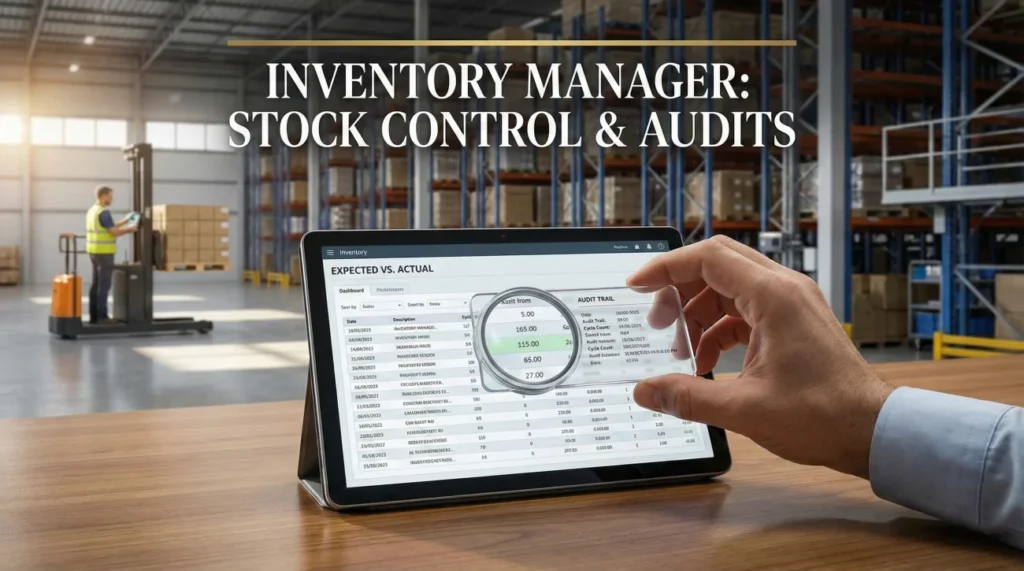
An Inventory Manager does not just count boxes; they manage the company’s cash that is sitting on a shelf. Every dollar tied up in excess stock is a dollar that cannot be used for growth, while every missing item represents a lost sale and a damaged customer relationship. Hiring managers are looking for a financial steward with a logistician’s mindset. They need someone who can balance the conflicting goals of high service levels (never running out) and low carrying costs (never having too much).
The interview will test your ability to implement rigorous “Cycle Counting” programs that eliminate the need for annual shutdowns, your strategy for investigating “Phantom Inventory,” and your courage to write off obsolete stock before it destroys the P&L. This guide covers the critical inventory manager interview questions designed to prove you possess the analytical rigor and operational discipline to protect the company’s bottom line.
Auditing & Accuracy Strategy
Q: Physical Inventory vs. Cycle Counting: Which do you champion and why?
I champion Cycle Counting. An annual Physical Inventory (PI) is a disruptive “autopsy” that tells you what you lost over the last year, but it is too late to fix the root cause. It also freezes operations, costing revenue.
Cycle Counting is a preventive health check. By counting a subset of high-value (A-items) daily and lower-value items quarterly, I maintain 99% accuracy year-round. It allows me to identify and fix process errors (like a receiving mistake) the day they happen, ensuring the system matches reality constantly.
Q: How do you investigate a significant Inventory Variance?
I do not just adjust the number. I act like a forensic accountant. First, I check “In-Transit” movements; is the pallet on a forklift somewhere? Second, I check receiving logs for mis-keyed quantities (e.g., entering 10 cases instead of 10 units).
Third, I look for “Item Substitution” errors where a picker might have scanned one item but picked a similar-looking one. Only after exhausting all transaction trails do I authorize a write-off. I document the root cause to prevent recurrence.
Q: What is your strategy for reducing “Shrinkage”?
Shrinkage comes from three sources: Theft, Damage, and Admin Error. I attack all three. For theft, I implement a “Cage” for high-value items with a sign-in log.
For damage, I audit the receiving dock to ensure we aren’t accepting broken goods. For admin error, I enforce “Blind Receiving” where staff must count items without seeing the packing slip quantity. This prevents them from just ticking the box without checking.
Q: Explain “Phantom Inventory” and how to kill it.
Phantom Inventory is when the system says we have 5 units, but the shelf is empty. This is disastrous because the system thinks we are stocked, so it doesn’t reorder, leading to lost sales.
I kill it with “Zero-Balance Walks.” If a picker goes to a bin and finds it empty, they must flag it immediately. I verify the zero count and zero out the system instantly to trigger a replenishment order. Speed is key to fixing the availability gap.
Planning & Optimization
Q: Calculating Safety Stock?
I don’t guess. I use the standard deviation of demand and lead time variability.
If supplier lead times are erratic, I increase safety stock. It is a buffer against uncertainty, not a buffer against poor planning.
Q: Managing “Obsolete Stock”?
I run an aging report monthly. If an item hasn’t moved in 12 months, it is dead cash.
I propose “Fire Sales,” bundling with fast movers, or scrapping it to free up valuable warehouse space. Holding it costs more than the write-off.
Q: ABC Analysis application?
I classify inventory by value consumption. ‘A’ items (top 20%) get weekly counts and strict security.
‘C’ items (bottom 50%) get looser controls and bulk locations. I don’t waste labor counting penny bolts every week.
Q: Inventory Turnover Ratio?
COGS divided by Average Inventory. A high ratio means efficient sales; a low ratio means overstocking.
I benchmark this against industry standards. If we turn inventory 4 times a year and competitors turn 8, we are inefficient.
Q: “Just-in-Time” (JIT) risks?
JIT reduces holding costs but increases stockout risk. I only use JIT for reliable, local suppliers.
For overseas suppliers with 60-day lead times, JIT is a gamble I won’t take without a strategic safety stock buffer.
Q: What is a “Min-Max” system?
It is a replenishment logic. When stock hits the “Min” (reorder point), we order enough to reach the “Max.”
I maintain the Min levels dynamically based on seasonality. A static Min leads to stockouts in peak season.
Scenarios: Crisis & Conflict
Scenario: Sales launches a massive promo without telling you, and you run out of stock in 2 days. They blame you.
I bring data to the meeting, not defensive arguments. I show the historical usage (baseline) versus the spike. “We forecasted 100 units based on history; the promo drove 500.”
I explain that inventory follows the plan. If the plan changes (promo), I need lead time to react. I propose a new SOP: “Marketing must sign off on inventory readiness 4 weeks before any campaign launch.” This turns a blame game into a process improvement.
Scenario: Your warehouse is at 95% capacity. You physically cannot fit the inbound containers arriving tomorrow.
I declare a “Space Emergency.” I look for “Floor Stacking” opportunities for bulk items to clear rack space. I identify slow-moving pallets and authorize moving them to temporary off-site storage or renting a trailer for yard storage.
Simultaneously, I push outbound. I ask Sales if we can ship any future orders early. I prioritize cross-docking the inbound straight to outbound if possible. I stop receiving non-critical items until the backlog clears.
Scenario: During an audit, you find a pallet of high-value electronics that is not in the system (excess).
Finding extra stock is almost as bad as losing it because it means a process failed. I investigate the “Receipt Date.” Was it received but not entered? Was it a customer return that bypassed the system?
I add it to inventory immediately to make it sellable. Then I trace the serial numbers to find the gap. I re-train the receiving team. If we don’t fix the leak, we will just have another variance next month.
Systems & Technology
Q: How do you optimize a WMS (Warehouse Management System)?
A WMS is only as good as its configuration. I optimize the “Put-away Logic.” I configure the system to direct heavy items to bottom racks and high-velocity items to the golden zone automatically.
I also set up “Task Interleaving.” Instead of a forklift driving empty (deadhead) after a put-away, the WMS directs it to a nearby pick task. This reduces travel time and wear on the equipment.
Q: Experience with Barcoding vs. RFID?
Barcoding is reliable and cheap but requires “Line of Sight.” You have to see it to scan it. It is great for individual picking.
RFID (Radio Frequency Identification) allows scanning an entire pallet instantly without unpacking it. It is superior for high-volume receiving and asset tracking, but expensive. I recommend RFID for closed-loop high-value inventory systems.
Q: How do you handle Data Integrity?
Garbage in, garbage out. I enforce strict “Unit of Measure” (UOM) discipline. If a vendor sells by the case but we sell by the each, the receiving team must convert it correctly in the system.
If someone receives 1 case as 1 unit instead of 12 units, our inventory is wrong instantly. I audit UOM conversions regularly.
Inventory Control Quiz
Test Your Stock Knowledge (20 Questions)
1. “Cycle Counting” is defined as:
- Counting items while riding a bike
- Auditing a subset of inventory on a rotating schedule
- Counting only once a year
- Counting only damaged items
2. “Safety Stock” acts as a buffer against:
- Fire and theft
- Demand variability and lead time uncertainty
- Price increases
- Employee turnover
3. “FIFO” stands for:
- Fast In Fast Out
- First In First Out
- Fit In Fit Out
- Five In Five Out
4. “Phantom Inventory” is:
- Inventory reserved for Halloween
- System stock that does not physically exist
- Stock that moves very fast
- Items that are invisible to scanners
5. “Lead Time” is the time between:
- Hiring and training
- Placing an order and receiving it
- Opening and closing the warehouse
- Manufacturing and selling
6. “COGS” stands for:
- Cost Of Goods Sold
- Cost Of Goods Sold
- Count Of Goods Stored
- Cash On Goods Sold
7. “ABC Analysis” is based on:
- The alphabet
- The Pareto Principle (80/20 rule)
- The size of the box
- The supplier’s name
8. A “SKU” is a:
- Stock Keeping Unit
- Stock Keeping Unit
- Safe Keeping Unit
- Standard Kit Unit
9. “Inventory Turnover” measures:
- How often shelves are cleaned
- How many times stock is sold and replaced in a period
- The speed of the forklift
- The number of returns
10. “Shrinkage” refers to:
- Boxes getting wet
- Loss of inventory value (theft/error)
- Wrapping pallets in plastic
- Reducing staff numbers
11. “Economic Order Quantity” (EOQ) balances:
- Supply and Demand
- Ordering costs and Holding costs
- Labor costs and Fuel costs
- Import and Export duties
12. “Vendor Managed Inventory” (VMI) means:
- The vendor pays for the warehouse
- The supplier monitors and replenishes stock for the buyer
- The buyer manages the vendor’s factory
- Inventory is managed by a robot
13. “Dead Stock” is:
- Inventory that has expired
- Items that have not sold for a long period
- Dangerous chemicals
- Heavy items on the floor
14. “Blind Receiving” requires:
- Receiving in the dark
- Counting goods without seeing the expected quantity
- Trusting the driver blindly
- Scanning without looking
15. A “Reorder Point” (ROP) triggers:
- A sales promotion
- A replenishment order
- A warehouse audit
- A safety alarm
16. “Cross-Docking” bypasses:
- The shipping dock
- Long-term storage and picking
- The receiving inspection
- The security check
17. “LIFO” is typically used for:
- Milk and eggs
- Non-perishable bulk goods (coal, sand)
- Electronics
- Fashion items
18. “Obsolete Inventory” should be:
- Hidden in the back
- Written off and disposed of/liquidated
- Sold at full price
- Counted weekly
19. “Stockout” costs include:
- Only the lost sale
- Lost sale, lost customer goodwill, and potential brand damage
- The cost of the reorder
- The shipping fee
20. “Consignment Inventory” is owned by:
- The warehouse
- The supplier until it is used/sold
- The customer
- The government
❓ Frequently Asked Questions
📊 How do you fix a “broken” inventory process?
Map the flow. Start at receiving. 80% of inventory errors originate at the dock (wrong count, wrong SKU). Fix the intake process, ensure every item has a barcode before it moves, and the downstream accuracy will improve naturally.
📉 What is a good accuracy rate?
World-class is 99.5% or higher. If you are below 95%, your operations are bleeding money through expedited freight and lost sales. The goal is 100%, but the acceptable floor is 98%.
🚜 Do I need to manage people?
Yes. You will likely manage Inventory Clerks, Cycle Counters, and Receiving staff. You need to train them that accuracy is more important than speed. A fast receiver who makes mistakes is a liability.
💻 Excel vs. WMS?
Excel is for analysis; WMS is for execution. You need both. You use the WMS to run the floor, but you dump the data into Excel (or SQL/PowerBI) to find the trends, like which vendor consistently short-ships us.
🛡️ How do I handle theft?
Process is the best deterrent. Regular cycle counts make theft visible quickly. Clear bag policies and secure cages for high-value items remove the opportunity. Most theft is opportunistic; remove the opportunity, and you reduce the theft.
The Bottom Line
An Inventory Manager is the ultimate realist of the supply chain. You deal in hard numbers and physical facts. Your job is to ensure that the digital promise made to the customer matches the physical reality on the shelf.
By mastering these inventory manager interview questions, you demonstrate that you are the financial guardian who can protect the company’s assets and ensure the operational machine never runs dry.
⚠️ Disclaimer: The interview strategies, sample answers, and negotiation tips provided in this guide are for educational purposes only. Hiring decisions are subjective and vary by company and industry. While these strategies are based on professional HR standards, they do not guarantee a specific job offer or result.