The Sergeant of the Supply Chain
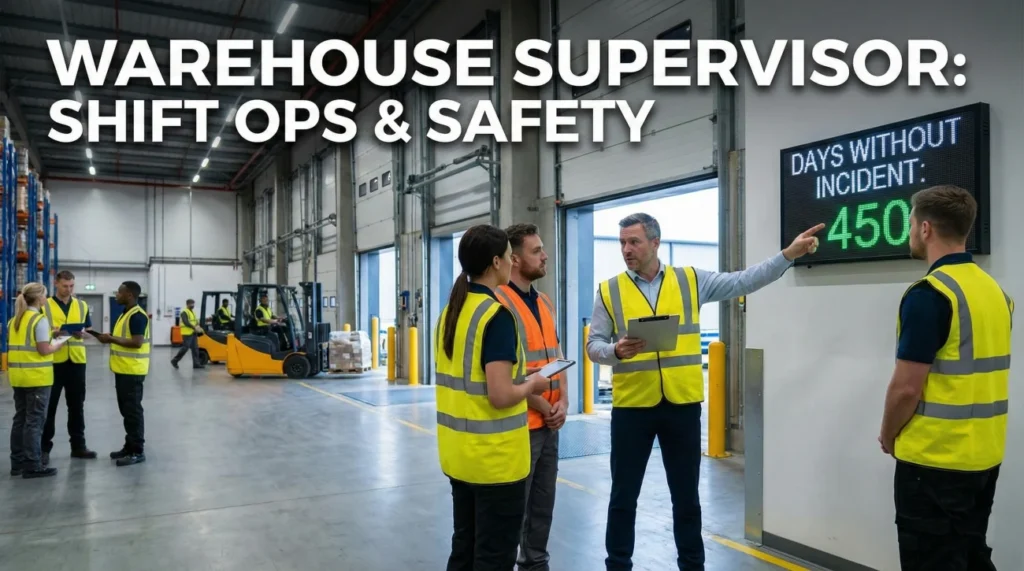
If the Warehouse Manager is the General setting the strategy, the Warehouse Supervisor is the Sergeant running the platoon. You are not sitting in an office looking at spreadsheets all day; you are on the concrete floor, ensuring that the plan actually happens. Hiring managers know that the Supervisor is the linchpin of operations. A bad Supervisor can destroy morale, increase turnover, and cause safety incidents that shut down the facility.
The interview for this role focuses on your ability to lead a diverse, often blue-collar workforce under high pressure. They don’t just want to know if you can drive a forklift; they want to know if you can motivate a team to hit a pick rate target at 2 AM. They will test your conflict resolution skills with real-world scenarios: What do you do when two pickers get into a fistfight? How do you handle a star performer who refuses to wear safety boots? This guide arms you with the practical, battle-tested warehouse supervisor interview questions that prove you have the grit and the leadership to run a tight ship.
Leadership & Floor Management
Q: Describe your management style on the warehouse floor. How do you earn respect?
I practice “Management by Walking Around” (MBWA). I am rarely at my desk. I spend 80% of my time on the floor, observing processes and removing obstacles for my team. I earn respect by not being afraid to get my hands dirty. If we are behind on the loading dock, I jump on a forklift and help clear the backlog.
However, I balance this with accountability. My team knows I will fight for them (getting better equipment, fixing payroll issues), but in exchange, I demand strict adherence to safety and attendance. I am fair but firm. I treat the temps with the same respect as the veterans, which builds a cohesive culture rather than an “us vs. them” mentality.
Q: How do you handle a “Shift Handover” to ensure continuity?
The handover is the most critical 15 minutes of the day. A bad handover creates chaos for the next shift. I use a standardized checklist.
I walk the floor with the incoming Supervisor. We review: 1. Safety incidents or near misses. 2. Equipment status (dead batteries, broken scanners). 3. Volume status (what is left on the dock versus the plan). I don’t just leave a note; I have a verbal conversation to flag priorities. “Lane 4 is hot; get that truck out first.” This ensures the operation runs as one continuous flow, not two separate islands.
Q: How do you motivate a team during peak season when mandatory overtime is high?
Burnout is the enemy during peak. Money motivates, but only to a point. I focus on “Micro-Goals” and recognition. Instead of staring at a mountain of 10,000 orders, I set hourly goals. “Let’s clear this aisle by lunch.”
I also bring energy. I might organize a pizza lunch or bring in donuts on a Saturday shift out of my own pocket to show appreciation. I make sure to publicly recognize the high performers in the daily huddle. When the team sees that I am grinding right there with them, not hiding in the AC, they are willing to push harder.
Q: Dealing with “Absenteeism” and lateness?
I track it religiously using the Bradford Factor or a simple point system. I address it immediately. If someone is late, I talk to them that day, not at the end of the month.
“John, you’ve been late twice this week. Is there a personal issue we need to adjust your schedule for, or is this a discipline issue?” I try to solve the root cause first (e.g., bus schedule change). But if it is just laziness, I move to progressive discipline quickly. One unreliable person forces the rest of the team to work harder, which kills morale.
Safety & Compliance Enforcement
Q: Enforcing PPE compliance?
I have zero tolerance for PPE violations. If I see someone without a vest or safety shoes, I stop them immediately. I don’t walk past it.
I explain why (visibility/protection), not just quote the rule. If they resist, I send them home. Safety is a condition of employment.
Q: Handling a “Near Miss”?
I treat a near miss exactly like an accident. If a pallet falls but hits no one, we stop and investigate.
I do a “Root Cause Analysis.” Was the pallet stacked poorly? Was the driver speeding? I use it as a teaching moment in the next shift briefing to prevent a real injury.
Q: Forklift Safety protocols?
I enforce the “3-foot halo” rule for pedestrians. I check that daily checklists (OSHA inspections) are actually filled out, not just pencil-whipped.
If I see a driver cornering too fast or not honking at intersections, I pull their certification immediately and require retraining.
Q: Hazardous Material (Hazmat) handling?
I ensure Hazmat items are stored in the designated area with proper containment. I check that the SDS (Safety Data Sheets) binder is accessible.
I verify that my team knows the spill cleanup procedure. We run mock spill drills so panic doesn’t set in during a real leak.
Q: Emergency Evacuation role?
As Supervisor, I am the sweep leader. My job is to account for every person on my roster at the muster point.
I check the bathrooms and locker rooms on my way out. I carry the roster clipboard. I don’t leave until I know my people are safe.
Q: Managing “Fatigue” risks?
Tired workers get hurt. During long shifts, I rotate tasks. If someone has been loading heavy trucks for 4 hours, I switch them to scanning or labeling.
This “Job Rotation” uses different muscles and keeps the mind fresh, reducing repetitive strain injuries and errors.
Scenarios: Conflict & Productivity
Scenario: Two of your best workers get into a heated argument on the shipping dock, shouting and shoving. Other staff are watching.
I intervene immediately and physically separate them. “Time out! Both of you, off the floor, now.” I separate them into different offices. I do not let them continue the argument.
I interview witnesses first to get the unbiased story. Then I talk to each worker individually. I make it clear: “I don’t care who started it; physical aggression is instant termination.” If it was just shouting, I might issue final warnings depending on the severity. I address the rest of the team immediately to shut down the rumor mill and reset the focus on work.
Scenario: Your team is consistently missing the “Pick Rate” target. The Manager is pressuring you to fix it.
I look at the data first. Is the whole team slow, or just a few individuals? If it is the whole team, it is likely a process issue (e.g., slotting is bad, scanners are lagging, or aisles are congested).
If it is specific individuals, I observe them. Are they taking too many breaks? Is their technique inefficient? I coach them on the floor: “Watch how I pick this; I park the cart here to save steps.” I set individual improvement plans. If they can’t improve after coaching, I move them to a different role (like receiving) where speed is less critical, or manage them out.
Scenario: You catch a long-time employee, who is popular with the team, violating a major safety rule (e.g., riding on the forks of a lift).
This is the hardest test, but I have to be consistent. I stop the activity immediately. I document the violation. Riding on forks is a “Life Critical” rule violation in most companies.
I cannot let it slide just because they are popular. That sends a message that safety is optional for the “cool kids.” I follow the company’s disciplinary matrix strictly, which often means termination or a final written warning. I explain to the team afterwards (without naming names if possible) that safety rules are written in blood and apply to everyone, no exceptions.
Operational KPIs
Q: How do you measure “Productivity”?
I use UPH (Units Per Hour) for picking and LPH (Lines Per Hour) for packing. However, I also look at “Indirect Time.”
If a worker has high UPH but 2 hours of “gap time” (unaccounted downtime) a day, they are actually inefficient. I track “Utilization” (Time on task / Total paid time). I want high productivity and high utilization.
Q: Ensuring “Inventory Accuracy” on your shift?
I hold my team accountable for “Scan Compliance.” No moving product without a scan. I audit my pickers daily.
If a picker marks a location as “Short” (empty), I go check it myself immediately. Often, the item is there but pushed to the back. Catching these “false shorts” instantly prevents inventory errors from propagating through the system.
Q: Managing “Housekeeping” (5S)?
I follow the “Clean as you go” rule. I don’t leave cleanup for the last 10 minutes. Empty pallets must be stacked immediately. Shrink wrap must be binned immediately.
A messy warehouse is a dangerous warehouse. I walk the aisles constantly. If I see trash, I pick it up, but I also find the person responsible for that aisle and have them finish the job. It sets the standard.
Warehouse Leadership Quiz
Test Your Supervisor Skills (20 Questions)
1. The “Bradford Factor” measures:
- Forklift speed
- Employee absenteeism impact
- Inventory value
- Warehouse temperature
2. “MBWA” stands for:
- Management By Warehouse Analysis
- Management By Walking Around
- Moving Boxes With Automation
- Making Better Warehouse Areas
3. A “Near Miss” should be:
- Ignored to save time
- Reported and investigated like an accident
- Celebrated as good luck
- Hidden from management
4. “Cross-Training” benefits the shift by:
- Making employees work harder for less pay
- Providing flexibility to cover absences and peaks
- Allowing the supervisor to sleep
- Reducing the need for safety training
5. “UPH” stands for:
- Units Per Hand
- Units Per Hour
- Unloading Pallet Height
- Under Paid Hours
6. If a worker refuses to wear PPE:
- Let it go this time
- Stop them working immediately and discipline
- Ask them nicely to wear it tomorrow
- Wear their PPE for them
7. “5S” is a system for:
- Five Supervisors per shift
- Workplace organization and cleanliness
- Five Steps to shipping
- Counting inventory by 5s
8. A “Shift Handover” ensures:
- Tools are locked up
- Continuity of operations and information
- Everyone goes home early
- The manager gets paid
9. “Progressive Discipline” involves:
- Firing everyone at once
- Verbal warning, Written warning, Termination
- Yelling louder each time
- Reducing pay randomly
10. “Pipelines” or “Pick Paths” should be optimized to:
- Make the walk longer
- Reduce travel time and congestion
- Confuse the pickers
- Look nice on a map
11. “Job Rotation” helps prevent:
- Promotions
- Repetitive strain injuries and boredom
- Inventory accuracy
- Forklift usage
12. A “Bill of Lading” (BOL) is checked by:
- The janitor
- Shipping/Receiving clerks and drivers
- The customer service team
- Nobody
13. “Cycle Time” in picking refers to:
- How fast a bicycle goes
- Total time to complete one order/task
- Time between breaks
- The battery life of a forklift
14. “Root Cause Analysis” asks:
- Who is to blame?
- Why did this happen effectively?
- How much does it cost?
- When is lunch?
15. “Dock Plate” safety requires:
- Running over it quickly
- Ensuring it is securely overlapping the trailer bed
- Greasing it daily
- Painting it blue
16. “Inventory Shrinkage” is mainly caused by:
- Cold weather shrinking boxes
- Theft, damage, and administrative error
- Selling too much
- Buying too little
17. Ideally, heavy items should be placed:
- On the top shelf
- In the “Golden Zone” or lower levels
- Outside the building
- On top of fragile items
18. A “Spotter” is used when:
- Looking for lost items
- A forklift has a blind spot or is backing up
- Counting inventory
- Watching employees work
19. “Lockout/Tagout” protects against:
- Theft of forklifts
- Energy release during machine maintenance
- Unauthorized visitors
- Leaving doors open
20. “Servant Leadership” means:
- Doing everyone’s work for them
- Removing barriers to help the team succeed
- Acting like a servant
- Ordering people around
❓ Frequently Asked Questions
🗣️ Do I need to be bilingual?
In many regions (especially US/Southwest), yes. Being able to give safety instructions in Spanish (or the local dominant language) is a massive asset. If you can’t communicate directly with 50% of your workforce, you can’t lead them effectively.
🚜 Do I need to know how to drive a forklift?
You don’t need to be the best driver, but you must be certified. You cannot police safety if you don’t know the machine. Plus, in a pinch, you need to be able to move a pallet to clear a blockage without waiting for a driver.
🎓 Degree vs. Experience?
For a Supervisor role, experience wins. Hiring managers respect “University of the Floor” more than a generic business degree. They want to know you’ve survived a peak season and managed real people, not just studied theory.
🕒 What are the hours?
Brutal. Warehouses often run 24/7. Expect to work “swing shifts,” weekends, and holidays. You are the first one in and the last one out. If the truck is late, you stay late. It is not a 9-to-5 desk job.
🤝 How do I move up to Manager?
Master the numbers. Supervisors run the people; Managers run the P&L (Profit and Loss). Start asking to see the budget. Learn how your labor hours impact the bottom line. Show you can think strategically, not just operationally.
Boots on the Ground
The Warehouse Supervisor job is one of the toughest in logistics. You are the shock absorber between management’s demands and the workforce’s reality. Success isn’t about being the loudest voice in the room; it is about being the steadiest. By mastering these warehouse supervisor interview questions, you demonstrate that you are the leader who can turn a group of individuals into a disciplined, safe, and high-performing unit.
⚠️ Disclaimer: The interview strategies, sample answers, and negotiation tips provided in this guide are for educational purposes only. Hiring decisions are subjective and vary by company and industry. While these strategies are based on professional HR standards, they do not guarantee a specific job offer or result.