The Face of the Last Mile
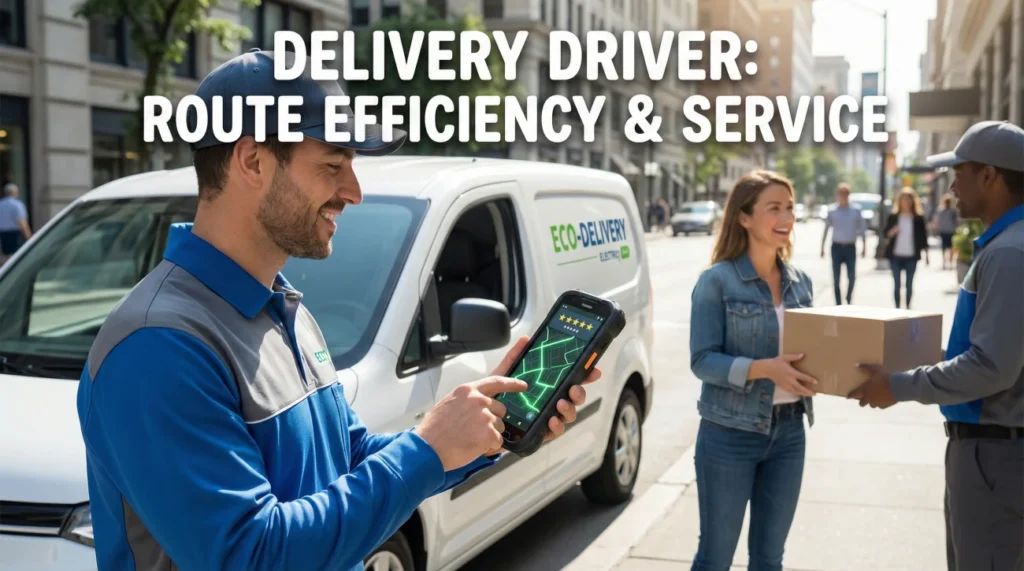
The “Last Mile” is widely known as the most expensive and complex link in the entire supply chain. It is also the only point where the digital promise of an online order meets the physical reality of a customer’s hands. As a Delivery Driver, you are not just transporting cardboard boxes. You are the final brand ambassador. Whether you are delivering a hot meal, a critical prescription, or a new laptop, the customer’s entire perception of the company rests on your interaction at their doorstep.
Hiring managers in this sector are looking for a specific blend of stamina, spatial intelligence, and diplomacy. They need drivers who can maintain a high “Stops Per Hour” (SPH) count without compromising safety in residential neighborhoods. They need problem solvers who know what to do when a gate code doesn’t work or when a loose dog blocks a porch. This guide provides the tactical delivery driver interview questions designed to prove you can handle the pressure of the route while protecting the company’s reputation and assets.
Route Efficiency & Organization
Q: Walk me through how you organize your vehicle at the start of a shift. Why is this critical?
I live by the “First In, Last Out” loading principle, but adapted for route density. I organize my truck by zones or shelf numbers corresponding to my route manifest. I spend an extra 15 minutes at the depot organizing because digging for a package at a stop kills my Stops Per Hour (SPH). If I spend 2 minutes searching for a box at 100 stops, that is over 3 hours of lost time. I place the first 20 stops in the passenger seat or the immediate shelf behind the bulkhead for rapid access.
Q: How do you maintain a high delivery pace without speeding?
Speeding saves seconds but risks minutes (getting pulled over) or hours (an accident). My efficiency comes from “Micro-Optimizations” outside the vehicle. I scan the package before I walk to the door. I have my keys ready. I check the delivery notes (e.g., “Side Door”) before I park so I don’t walk to the wrong entrance. I park strategically to avoid backing up whenever possible, as backing is a slow maneuver and a safety risk. It is about smooth flow, not raw speed.
Q: What is your process for “Unable to Locate” addresses?
I do not give up immediately. First, I check adjacent streets in case of a GPS drift. Second, I look for visual clues like a different house color mentioned in notes or a unique mailbox. If I still cannot find it, I call the customer immediately. If there is no answer, I mark the location in the GPS for the dispatcher and move on. I do not spend more than 5 minutes on a ghost address because it jeopardizes the rest of the route’s delivery window.
Q: How do you handle “Porch Piracy” prevention?
I never “drop and run” in plain sight. I look for concealment. I place packages behind planters, pillars, or porch furniture. If a home is close to the sidewalk with no cover, I ring the doorbell to alert the resident, even if a signature isn’t required. If the neighborhood looks high-risk and there is no safe place, I mark it as “No Safe Location” and bring it back. A frustrated customer picking up at the depot is better than a furious customer whose package was stolen.
Safety & Package Handling
Q: Safe Parking Protocols?
I park legally whenever possible. I engage the parking brake at every single stop. I turn wheels towards the curb on hills.
I avoid “blind backing.” If I must back up, I do it upon arrival so I can pull out forward when leaving, which gives me better visibility of new hazards.
Q: Handling Dog Encounters?
I rattle the gate before entering. If a dog approaches, I use the package as a shield between me and the animal.
I do not run. I back away slowly facing the dog. If the threat is real, I mark “Animal Interference” and do not deliver. My safety overrides the package.
Q: Lifting Heavy/Bulky Items?
I use the “Power Zone” (between knees and shoulders). I verify the weight on the label first. If it is over 70lbs or awkward, I use a hand truck.
I never twist my spine while holding a load; I pivot with my feet. This prevents the back injuries that end driving careers.
Q: Proof of Delivery (POD) Quality?
The photo must be clear. It needs to show the package and a landmark (like the house number or a unique doormat).
A blurry photo of just a box on concrete proves nothing. The photo is my evidence against “Did Not Receive” claims.
Q: Driving in Residential Zones?
I scan constantly for kids and balls rolling into the street. I drive 5 MPH below the limit in neighborhoods.
I assume every parked car door might open. I keep my radio volume low to hear ambient noise like children playing.
Q: Vehicle Inspections?
I do a pre-trip and post-trip check every day. I check tires, lights, and fluid leaks.
I report body damage immediately. Driving a dented van reflects poorly on the brand, and driving with bald tires is negligent.
Scenarios: At the Doorstep
Scenario: You are delivering a package requiring a signature (Alcohol or High Value). No one is home, but a note on the door says “Please leave package, signature is here” with a scribbled signature.
I do not leave the package. A note is not a valid ID check or legal signature, especially for age-restricted items. I leave a “Missed You” tag on the door. I scan the package as “Business Closed/No Answer” and return it to the truck. Leaving it violates federal law (for alcohol) and company policy, putting my job at immediate risk.
Scenario: A customer storms out of the house yelling that you drove over their lawn or flower bed.
I de-escalate immediately. I do not argue or deny it. I stop, get out, and inspect the damage with them. I apologize sincerely for the accident. I provide them with my manager’s contact information and the company’s insurance claim process. I take photos of the damage for my own report. I own the mistake to calm them down, rather than fleeing the scene which turns an accident into a hit-and-run complaint.
Scenario: You are behind schedule due to traffic. You have 20 stops left and only 1 hour of shift time.
I triage the remaining stops. I look for “Time Sensitive” or “Business” deliveries that close at 5 PM. I deliver those first. I communicate with dispatch: “I am running late due to the accident on Main St. I can clear the businesses, but the 5 residential stops might roll over.” I ask for guidance: should I authorize overtime to finish, or return to base? I do not speed to catch up.
Technology & Customer Experience
Q: How do you handle a “Damaged Package” you discover in your truck?
I inspect it before I walk to the door. If the box is crushed but the contents sound intact, I deliver it but point out the damage to the customer. I mark it as “Damaged” in the scanner so the system knows.
If the contents are clearly broken (rattling glass or leaking fluid), I do not deliver it. Delivering a leaking box ruins the customer experience and stains their porch. I scan it as “Damaged/Refused” and return it to the station for processing. I save the customer the hassle of a return.
Q: Explain the importance of “Geofencing” in your scanner.
The scanner uses GPS to ensure I am at the correct coordinates. If I try to scan a package and get a “Wrong Geofence” error, I stop. It usually means I am at the neighbor’s house or the wrong apartment building.
I verify the address physically. I do not override the Geofence warning unless I am absolutely certain the GPS is wrong (e.g., new construction). This technology prevents mis-deliveries.
Q: How do you represent the brand when you are exhausted?
I remember that to the customer, I am the only human connection to their purchase. Even if it is my 100th stop and I am tired, I smile. I don’t throw the box. I place it gently. I wear my uniform correctly. A sloppy driver suggests a sloppy company. My professionalism builds trust in the service.
Delivery Driver Competency Quiz
Test Your Delivery Knowledge (20 Questions)
1. “SPH” stands for:
- Speed Per Hour
- Stops Per Hour
- Scans Per Handheld
- Safety Protocol Handbook
2. The “Last Mile” refers to:
- The drive home after work
- The final leg of delivery to the customer’s door
- The distance between warehouses
- A marathon for drivers
3. If a package requires an “Adult Signature” (21+):
- You can leave it if they look old enough
- You must verify ID and get a signature
- A note on the door is sufficient
- Any person inside the house can sign
4. “Porch Piracy” is:
- A game played by drivers
- Theft of packages from a doorstep
- Delivering to the wrong porch
- A type of porch furniture
5. “Blind Backing” means:
- Backing up with your eyes closed
- Backing up where you cannot see the path behind you
- Backing up into a blind alley
- Backing up without a camera
6. A “Manifest” is:
- A tool for changing tires
- The list of all stops/packages on your route
- A safety sticker on the van
- The engine maintenance log
7. “Three Points of Contact” applies to:
- Calling the customer three times
- Entering and exiting the vehicle safely
- Holding the steering wheel
- Scanning the package
8. If a dog is loose in the yard:
- Run to the door quickly
- Do not enter; stay in the vehicle and call customer
- Give the dog a treat
- Yell at the dog to scare it
9. “COD” stands for:
- Call On Delivery
- Cash On Delivery (Collect payment)
- Customer On Demand
- Check On Door
10. “UTF” usually codes for:
- Under The Fence
- Unable To Find (Address)
- Use The Front
- Unlock The Front
11. A “Tote” or “Bag” is used to:
- Carry your lunch
- Group small packages for the same zone
- Cover the seat
- Store trash
12. Why scan the package at the door?
- Because the scanner works better there
- To geocode the delivery location accurately
- So the customer hears the beep
- To save battery life
13. “High Value Goods” should be:
- Left on the sidewalk
- Handed directly to a person or hidden securely
- Thrown over the fence
- Marked with a bright sticker
14. “Sortation” involves:
- Cleaning the van
- Organizing packages by route order
- Sorting mail for the post office
- Checking tire pressure
15. “Dead Battery” on a scanner means:
- You can go home early
- You must charge it or use manual entry protocols
- You deliver without scanning
- You guess the addresses
16. Defensive driving includes:
- Tailgating to save time
- Scanning ahead and expecting the unexpected
- Honking at slow cars
- Checking your phone at red lights
17. “Lifting with your back” causes:
- Better muscle growth
- Injury and strain
- Faster movement
- Better balance
18. A “Access Code” is needed for:
- Starting the van
- Entering a gated community or apartment
- Accessing the internet
- Clocking out
19. “RTS” stands for:
- Ready To Ship
- Return To Station
- Run To Safety
- Route Time Standard
20. Customer Service means:
- Spending 20 minutes talking to each person
- Professional, polite, and accurate delivery
- Giving free items
- Ignoring complaints
❓ Frequently Asked Questions
🚐 Do I need my own vehicle?
It depends on the model. For Gig Economy apps (like DoorDash, Amazon Flex), yes, you use your personal car. For DSPs (Delivery Service Partners) or carriers like FedEx/UPS, they provide the branded van, fuel, and insurance. The interview will specify if it is an “Owner-Operator” or “Company Driver” role.
💪 How physically demanding is the job?
Very. It is an “Industrial Athlete” role. You will walk 15,000 to 20,000 steps a day, lift boxes up to 50-70 lbs repeatedly, and climb stairs in all weather conditions. It is not just driving; it is a cardio workout.
📜 Do I need a CDL?
Usually, no. Most delivery vans (Sprinter vans, step vans) are under 26,000 lbs GVWR, so a standard driver’s license is sufficient. However, you often need a “For-Hire” endorsement (like a Chauffeur license) depending on the state, and a clean MVR (Motor Vehicle Record) is mandatory.
🕒 What are the hours like?
Expect “Route Pay” or “Shift Pay” rather than hourly in some cases. The day ends when the truck is empty. Peak seasons (Christmas) mean 10 to 12 hour days. Weekends are often required. It is not a strict 9-to-5 job.
📱 How hard is the technology?
The apps (like Amazon’s Rabbit) are user-friendly but strict. You need to be comfortable using a smartphone for navigation, scanning, and photos. If you struggle with GPS maps or apps freezing, you will find the job frustrating.
Delivering the Promise
Being a Delivery Driver is a role of autonomy and endurance. You are your own boss on the road, but you carry the weight of the company’s promise in your hands. Success isn’t just dropping a box; it is solving the puzzle of the route safely and efficiently. By mastering these delivery driver interview questions, you demonstrate that you are the reliable professional they can trust to close the loop and deliver the perfect customer experience, every single time.
⚠️ Disclaimer: The interview strategies, sample answers, and negotiation tips provided in this guide are for educational purposes only. Hiring decisions are subjective and vary by company and industry. While these strategies are based on professional HR standards, they do not guarantee a specific job offer or result.