From Cost Cutter to Value Architect
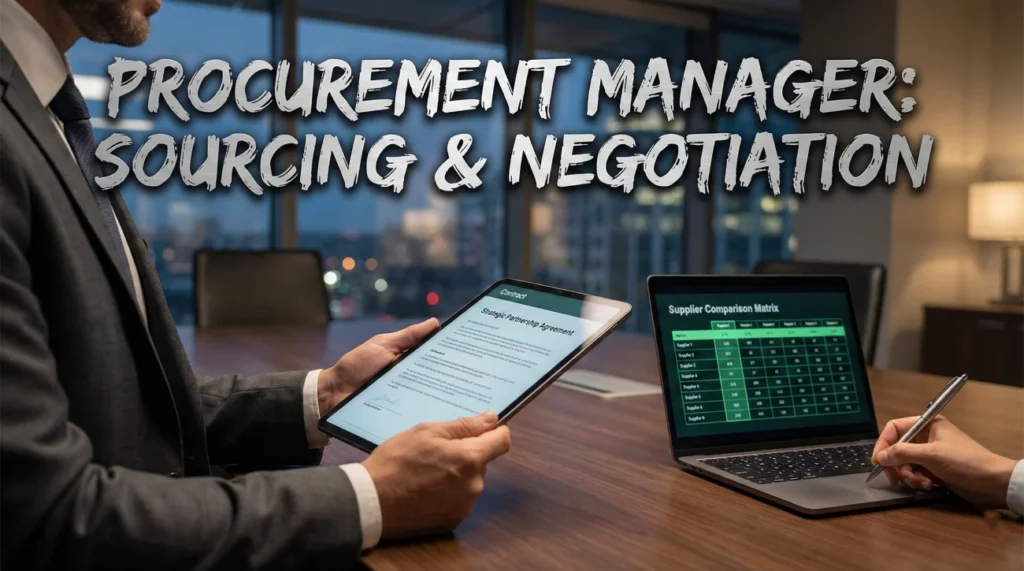
The role of a Procurement Manager has evolved drastically. It is no longer about beating suppliers down for the lowest unit price. In a world of fragile supply chains, trade wars, and ESG mandates, Procurement is now a strategic function focused on risk mitigation and value creation. Hiring managers are looking for a “Value Architect” who can build resilient supply networks that withstand global shocks, rather than just a “Cost Cutter” who saves a penny today but costs the company a dollar tomorrow in quality failures.
The interview will be a rigorous examination of your strategic mindset. You will be asked to demonstrate how you use data to drive decisions, not just gut feeling. They will challenge you on your ability to manage “Sole Source” risks and how you handle ethical dilemmas when a key supplier violates labor laws. They want to know if you can speak the language of Finance (Working Capital, EBITDA) as fluently as the language of Logistics. This guide provides the deep, strategic procurement manager interview questions that separate the tactical buyers from the future Chief Procurement Officers.
Strategic Sourcing & TCO
Q: Walk me through your “Strategic Sourcing” process. How do you decide what to buy and from whom?
I follow a 7-step sourcing methodology. It starts with a deep “Spend Analysis” to understand what we are buying and who we are buying it from. I categorize spend using the Kraljic Matrix (Leverage, Strategic, Routine, Bottleneck items).
For “Strategic” items (high value, high risk), I do not just run an auction. I build a cross-functional team with engineering and quality to define the requirements. We conduct a rigorous market analysis, issue an RFP (Request for Proposal), and then shortlist suppliers based on capability and culture, not just price. I negotiate a long-term partnership with KPIs. For “Routine” items (low value, low risk), I automate the process using catalogs or e-auctions to minimize administrative effort. One size does not fit all.
Q: Explain “Total Cost of Ownership” (TCO) with a concrete example.
TCO is the only price that matters. It includes the Purchase Price plus Acquisition Costs (freight, duties), Operating Costs (maintenance, energy), and End-of-Life Costs (disposal).
For example, buying a fleet of printers. Supplier A offers a printer for $500. Supplier B offers it for $600. A novice buyer picks A. But I calculate TCO. Supplier A’s toner cartridges cost $100 and yield 1,000 pages. Supplier B’s cartridges cost $80 and yield 2,000 pages. Over a 3-year lifecycle printing 10,000 pages a month, Supplier B is actually $5,000 cheaper despite the higher upfront sticker price. I present this TCO model to stakeholders to justify the higher initial investment.
Q: How do you manage “Sole Source” risk?
Sole sourcing is a vulnerability. If that supplier has a fire or goes bankrupt, we stop production. My first strategy is to qualify a second source (“Dual Sourcing”) immediately, even if we only give them 20% of the volume to keep them warm.
If dual sourcing is impossible (e.g., patented technology), I implement a rigorous risk management plan. I demand transparency into their financial health. I require them to hold safety stock in a third-party location that I can access. I also negotiate “Step-In Rights” in the contract, allowing us to take over their production or IP if they fail to perform. I treat sole sources as critical infrastructure.
Q: “Cost Avoidance” vs. “Cost Savings.” Which is more important?
Both are critical, but they serve different narratives. “Cost Savings” (Hard Savings) creates a tangible reduction in the budget (e.g., renegotiating a contract from $1M to $900k). This creates P&L impact.
“Cost Avoidance” (Soft Savings) prevents a negative impact (e.g., fighting off a 10% price increase due to inflation). While it doesn’t lower the budget, it protects margins. In an inflationary environment, Cost Avoidance is often the primary metric of success. I track both separately and educate stakeholders that avoiding a cost increase is just as valuable as cutting a cost.
Negotiation & Supplier Relations
Q: What is your BATNA?
Best Alternative to a Negotiated Agreement. It is my walk-away point.
I never enter a negotiation without knowing my BATNA. If I have no alternative supplier, my leverage is weak, and I focus on partnership. If I have 3 backup suppliers, I negotiate hard on price.
Q: “Should-Cost” Modeling?
I build a bottom-up cost model before asking for a quote. I estimate raw material, labor, overhead, and profit.
If a supplier quotes $100 and my model says $70, I challenge them to explain the gap. It forces transparency and removes “fluff” from the price.
Q: Handling Price Increases?
I demand a detailed breakdown. “You say labor went up 10%. Labor is only 20% of your cost structure. So that justifies a 2% price increase, not 10%.”
I use indices (like PPI or metal exchanges) to validate their claims. I make them earn every penny.
Q: Supplier Scorecards?
I measure Quality (PPM), Delivery (OTIF), Cost, and Service. I review these quarterly (QBR).
It is not just a report card; it is a roadmap for improvement. Suppliers who consistently score low are put on a “Get Well” plan or exited.
Q: Payment Terms Strategy?
Cash flow is vital. I try to extend terms (e.g., Net 60 to Net 90) to improve our working capital.
However, I balance this. If I push a small supplier too hard on terms, I might bankrupt them. For critical small suppliers, I might offer faster payment in exchange for a discount (Dynamic Discounting).
Q: What is SRM?
Supplier Relationship Management. It is treating strategic suppliers as partners, not vendors.
We collaborate on innovation. I ask them: “How can we design this better to save money?” We share risks and rewards. SRM unlocks value that contracts cannot.
Scenarios: Ethics & Crisis
Scenario: You discover that a key supplier uses child labor in a Tier 2 factory. Firing them immediately stops production.
I act on ethics immediately, but strategically. I notify executive leadership and Legal. We cannot be complicit. I issue a “Cure Notice” giving the supplier 48 hours to prove they have severed ties with the unethical sub-contractor and remediated the situation.
If they comply and allow a third-party audit, we may continue on probation. If they deny or delay, I trigger the Business Continuity Plan (BCP) to move tooling to a backup supplier, accepting the short-term production hit to protect the long-term brand reputation. Reputation risk > Supply risk.
Scenario: Internal stakeholders (Marketing) want to hire an agency without a bid because “they are the best,” but the price is double the budget.
I position myself as a “Commercial Advisor,” not a blocker. I say, “I understand you want Quality. Let’s validate the market.” I run a limited RFP inviting their preferred agency and two qualified competitors.
I present the data side-by-side. “Agency A (your choice) is $200k. Agency B is $100k. Is the quality difference worth $100k of your budget?” If they still choose A, I require them to sign a budget variance approval. My job is to ensure they make an informed financial decision, not to make the creative decision for them.
Scenario: A supplier sends you an expensive gift (iPad) during contract negotiations.
I return it immediately with a formal letter citing company policy. “Thank you, but I cannot accept this.”
I report the incident to the Ethics Officer. Accepting it creates a conflict of interest and compromises my leverage. It suggests the supplier thinks they can buy my favor. I scrutinize their bid even harder afterwards because ethical lapses usually correlate with other performance issues.
Contracts & Compliance
Q: What are the most critical clauses in a procurement contract?
Beyond price, I focus on the “Exit Clause.” Getting into a contract is easy; getting out is hard. I ensure we can terminate for convenience (with notice), not just for cause. I also demand “IP Ownership” clauses to ensure we own any tooling or designs paid for.
I include strict KPIs and Service Level Agreements (SLAs) with “Liquidated Damages” (penalties) for failure. A contract without penalties is just a wish list.
Q: How do you handle “Maverick Spend” (Rogue Buying)?
Maverick spend destroys value. I conduct a spend analysis to identify who is buying off-contract. I don’t just punish them; I ask “Why?”
Usually, the procurement process is too slow or complex. I simplify the buying channels (e.g., implementing an Amazon Business catalog or P-Cards for small items). Then I block the rogue vendors in the AP system so invoices cannot be paid. I make the right way the easiest way.
Q: How do you use data to drive procurement strategy?
I don’t just look at what we bought; I look at market trends. I use indices (like the LME for metals or oil prices) to predict cost changes.
If I see copper rising, I might lock in a fixed-price contract now. If I see it falling, I switch to index-based pricing. I use data to hedge the market, turning procurement into a competitive advantage.
Procurement Mastery Quiz
Test Your Strategic Knowledge (20 Questions)
1. “RFP” stands for:
- Request For Price
- Request For Proposal
- Run For Profit
- Ready For Purchasing
2. “TCO” includes:
- Only the invoice price
- Acquisition + Operation + Disposal costs
- The shipping cost only
- The tax rate only
3. “Maverick Spend” is:
- Buying Top Gun merchandise
- Unauthorized/Off-contract purchasing
- Strategic spending
- Buying under budget
4. A “Blanket PO” covers:
- Buying blankets
- Multiple deliveries over a period of time
- One specific delivery
- Buying without approval
5. “Force Majeure” is a clause for:
- Minor delays
- Unforeseeable events (Acts of God)
- Price negotiation
- Employee strikes
6. “Incoterms” determine:
- Payment currency
- Transfer of risk and delivery responsibility
- Product quality
- Import duties only
7. “Vendor Managed Inventory” (VMI):
- Increases buyer workload
- Transfers inventory management responsibility to the supplier
- Increases stockouts
- Requires the buyer to count stock daily
8. “SLA” stands for:
- Standard Labor Agreement
- Service Level Agreement
- Supplier Location Area
- Safe Loading Area
9. The “Pareto Principle” in spend analysis means:
- Spend is distributed evenly
- 80% of spend is with 20% of suppliers
- Buying 20 items saves 80%
- Negotiating 80% of the time
10. “MRO” refers to:
- Major Revenue Orders
- Maintenance, Repair, and Operations supplies
- Marketing Resource Optimization
- Monthly Recurring Orders
11. A “Sole Source” situation exists when:
- You choose one supplier out of many
- Only one supplier is capable of providing the item
- The supplier is local
- The supplier is the cheapest
12. A “Reverse Auction” aims to:
- Increase the price
- Drive the price down through competitive bidding
- Sell surplus assets
- Evaluate quality only
13. “Payment Terms 2/10 Net 30” offers:
- 2% interest penalty after 10 days
- 2% discount if paid in 10 days, full amount due in 30
- 2 payments over 10 months
- 10% discount if paid in 2 days
14. “Strategic Sourcing” is different from purchasing because:
- It is faster
- It focuses on long-term value and TCO
- It only looks at price
- It uses more paper
15. “Consignment Stock” is owned by:
- The buyer immediately
- The supplier until it is used/consumed
- The warehouse
- The bank
16. “Benchmarking” involves:
- Sitting on a bench
- Comparing metrics against industry standards
- Guessing the price
- Ignoring competitors
17. “Direct Spend” buys materials that:
- Are used for office supplies
- Go directly into the final product
- Pay for travel
- Pay for cleaning services
18. “Cost Avoidance” is:
- A direct budget reduction
- Preventing a price increase or extra cost
- Not paying invoices
- Refusing to buy
19. An “NDA” is signed to:
- Close the deal
- Protect confidential information
- Negotiate the price
- Hire staff
20. “Green Procurement” prioritizes:
- The color green
- Environmental sustainability and social responsibility
- Cheapest plastic options
- Disposal over recycling
❓ Frequently Asked Questions
🌐 How much travel is required?
In a strategic role, expect 25-40% travel. You cannot verify a supplier’s quality or capacity over Zoom. You need to walk their factory floor, see their inventory, and build trust over dinner. Relationships are still human.
📜 Which certification is better: CPSM or CIPS?
It depends on your geography. CPSM (ISM) is the gold standard in the USA. CIPS (Chartered Institute) is preferred in the UK, Europe, and Asia. Both are highly respected and signal that you treat procurement as a profession, not just a job.
⚖️ How do I deal with “Kickbacks” or bribes?
Zero tolerance. If a supplier offers a bribe, they are cutting corners on quality or safety. Refuse politely but firmly, report it to Compliance/Legal immediately, and start looking for a new supplier. Your integrity is your career.
📈 How do I move from Buyer to Manager?
Stop talking about “placing POs” and start talking about “Risk” and “Strategy.” Show how your decisions improved EBITDA or reduced supply chain risk. Volunteer for cross-functional projects (e.g., NPI launches) to show leadership.
📉 What if I can’t get cost savings?
In an inflationary market, savings might be impossible. Pivot to “Value.” Did you improve payment terms? Did you secure supply when competitors ran out? Did you improve quality? Money isn’t the only metric of success.
The Strategic Edge
The Procurement Manager is the gatekeeper of the company’s profitability. Every dollar you save flows directly to the bottom line, often faster than sales can generate new revenue. But more importantly, you are the architect of the supply base.
By mastering these procurement manager interview questions, you demonstrate that you possess the financial acumen to protect margins and the strategic foresight to build partnerships that will power the company’s future growth.
⚠️ Disclaimer: The interview strategies, sample answers, and negotiation tips provided in this guide are for educational purposes only. Hiring decisions are subjective and vary by company and industry. While these strategies are based on professional HR standards, they do not guarantee a specific job offer or result.