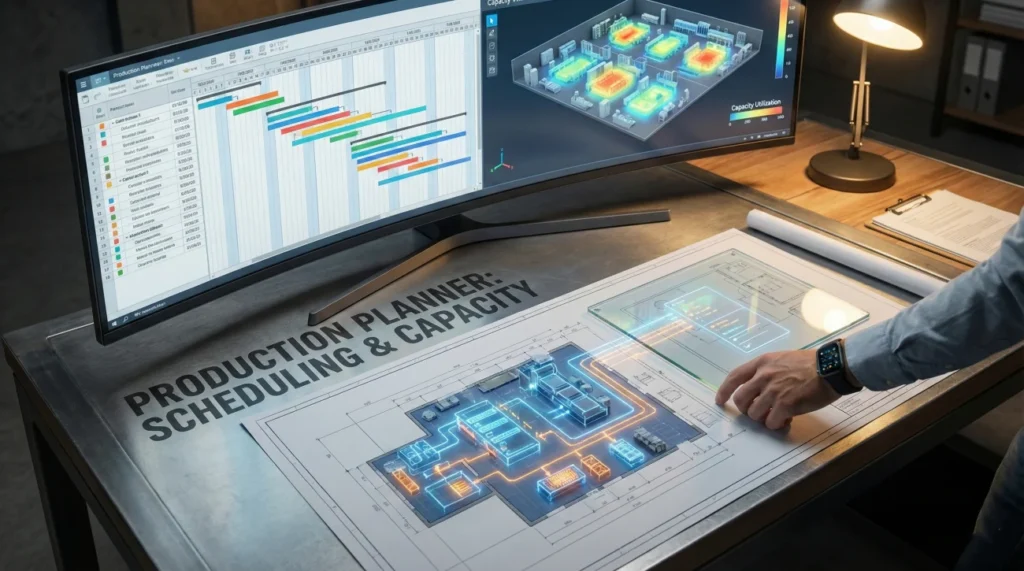
The Heartbeat of the Factory
If the Demand Planner predicts the future, the Production Planner builds it. You sit right at the friction point where aggressive sales targets crash into the hard reality of machine limits and raw material lead times. Hiring managers are not looking for someone who just pushes paper; they need a tactician who can optimize the “Master Production Schedule” (MPS) to maximize throughput without blowing up the budget on overtime.
The core challenge of this role is managing finite resources. You must balance the need for efficiency (long production runs) with the need for agility (quick changeovers for urgent orders). This guide covers the critical production planner interview questions regarding scheduling logic, capacity constraints, and the diplomatic skills needed to manage the shop floor supervisors.
Core Scheduling Concepts
Q: Differentiate between MPS (Master Production Schedule) and MRP (Material Requirements Planning).
MPS is the build plan for finished goods. It answers: “What exactly are we making and when?” It drives the factory floor. MRP is the calculator that takes the MPS and explodes it through the Bill of Materials (BOM). It answers: “What raw materials do we need to buy to execute that plan?” MPS is for the factory; MRP is for procurement.
Q: Explain “Finite Loading” vs. “Infinite Loading.” Which do you prefer?
Infinite Loading assigns work to a work center based on what is needed, ignoring actual capacity limits. It is useful for identifying load spikes but is unrealistic for execution. Finite Loading schedules work only up to the available capacity limit (e.g., 80 hours/week). I prefer Finite Loading for generating the daily dispatch list because it gives the shop floor a realistic target they can actually hit, preventing bottlenecks from staying hidden.
Q: What is “Takt Time” and how does it differ from “Cycle Time”?
Takt Time is the heartbeat of customer demand (Available Time / Customer Demand). It dictates how fast we must produce to meet sales. Cycle Time is how fast we actually produce. My job as a planner is to ensure Cycle Time is less than or equal to Takt Time. If Cycle Time is slower, we miss shipments; if it is significantly faster, we build excess inventory.
Q: How do you handle “Time Fences” in your schedule?
I strictly enforce the “Frozen Zone” (usually the next 3-5 days). Inside this zone, no changes are allowed because materials are staged and machines are set up. Breaking the frozen zone causes chaos and kills efficiency. Beyond that, I have a “Slush Zone” where trade-offs are possible, and a “Liquid Zone” for long-term rough cut planning.
Strategies for Capacity & Constraints
Q: Backward vs. Forward Scheduling?
Backward Scheduling starts from the customer due date and works back to find the latest start date. It minimizes inventory holding cost.
Forward Scheduling starts today and finishes as soon as possible. I use Backward for standard orders to stay lean, but Forward for rush orders to quote the earliest possible delivery.
Q: Managing a “Bottleneck”?
I follow the Theory of Constraints. The bottleneck dictates the output of the entire plant. I ensure the bottleneck machine never stops.
I place a “Time Buffer” of inventory in front of it so it doesn’t starve. I also offload non-critical work from the bottleneck to other machines, even if they are less efficient.
Q: Make-to-Stock (MTS) vs. Make-to-Order (MTO)?
MTS relies on a forecast to build inventory ahead of demand (efficiency focus). MTO waits for a confirmed order (customization focus).
I often manage a hybrid “Assemble-to-Order” model, keeping semi-finished goods in stock (MTS) and finishing them only when the customer order arrives (MTO).
Q: Reducing “Changeover Time”?
I schedule utilizing “Campaign Runs” or “Rhythm Wheels.” I group orders with similar attributes (e.g., same color or bottle size) to run consecutively.
This minimizes the downtime required for washouts or tool changes. However, I balance this against inventory costs; too big a campaign bloats the warehouse.
Q: Handling “Scrap” in planning?
I factor a “Yield Rate” into the production order. If a process historically has 5% scrap, I plan to produce 105 units to get 100 good ones.
I continuously review this rate. Over-planning for scrap that doesn’t happen leads to excess inventory (“Over-yield”), which is also a waste.
Q: What is “Rough Cut Capacity Planning” (RCCP)?
RCCP validates the MPS against key resource limits (like labor hours or critical machine time) before we commit to it.
It is a sanity check. If the MPS requires 200 hours on a machine that only runs 168 hours a week, RCCP flags it so I can smooth the load or request overtime.
Scenarios: Firefighting on the Floor
Scenario: A key machine breaks down unexpectedly, halting production for 24 hours.
I immediately re-prioritize the queue. I identify which orders are stuck at that machine and check their “Slack Time” (difference between due date and process time). I move orders with zero slack to alternative work centers, even if those machines are slower/older.
For the remaining volume, I assess if we can outsource the step to a local subcontractor or if we need to schedule mandatory overtime on the weekend to catch up once the machine is fixed. I communicate the delay to Sales immediately, not at the last minute.
Scenario: Sales pushes an “Urgent” order that requires breaking into a long production run.
I calculate the “Cost of Interruption.” Breaking a setup might cost 4 hours of downtime plus scrapped material. I present this impact: “We can run this urgent order, but it will delay these three other standard orders by 2 days and cost $2,000 in setup labor.”
If the GM approves the cost, I execute the change. If not, I offer the earliest available slot after the current campaign finishes. This ensures the decision is business-based, not emotional.
Scenario: Procurement informs you that a raw material will be 3 days late.
I pull forward jobs in the backlog that do not require that missing material. Keeping the line running is the priority.
I check if the missing material has an approved substitute in the BOM. If so, I issue a deviation request to Quality. If not, I adjust the schedule to maximize utilization on available materials and flag the affected orders as “Material Constrained” so the warehouse doesn’t stage them in vain.
Metrics & Continuous Improvement
Q: What is OEE and how does it impact your planning?
OEE (Overall Equipment Effectiveness) measures Availability x Performance x Quality. A machine might be available 24 hours, but if OEE is 60%, I can only plan for 14.4 hours of output. I use the historical OEE, not the theoretical speed, to set realistic schedules. If I plan based on 100% efficiency, I guarantee failure.
Q: How do you measure “Schedule Attainment”?
Schedule Attainment tracks compliance: (Planned Production / Actual Production). However, I also track “Mix Compliance.” Producing 1000 units of Product A when the plan called for 500 A and 500 B is still 100% volume attainment, but 50% mix failure. I focus on the mix to ensuring the right customers get served.
Q: Managing WIP (Work in Process) levels?
High WIP clogs the factory floor and hides quality issues. I use Little’s Law (WIP = Throughput x Cycle Time) to cap WIP. I only release a new production order to the floor when a previous one is completed (CONWIP – Constant Work in Process). This “Pull” logic prevents the shop floor from becoming a warehouse.
Production Planning Competency Quiz
Test Your Scheduling Skills (20 Questions)
1. The “Master Production Schedule” (MPS) specifies:
- The total dollar value of the company
- What end items to produce and when
- The exact list of all raw materials
- The maintenance schedule for trucks
2. “Backward Scheduling” begins from:
- The date the order was received
- The first day of the current month
- The customer’s requested due date
- The date raw materials arrive
3. A “Bill of Materials” (BOM) is:
- A structured list of components to make a product
- A bill sent to the customer for payment
- A list of all employees in the factory
- A forecast of future sales demand
4. “Finite Capacity Planning” assumes:
- Resources are unlimited and flexible
- Work centers have defined limits on output
- Production can always be outsourced
- Machines never break down or stop
5. “Takt Time” is calculated based on:
- The fastest speed of the machine
- Customer demand rate and available time
- The number of workers on the line
- The total inventory in the warehouse
6. In MRP, “Lead Time” is:
- The time for a manager to approve a plan
- The time required to acquire or produce an item
- The time needed to train a new employee
- The duration of the morning meeting
7. A “Bottleneck” operation is one that:
- Has the lowest capacity and limits total output
- Is the most expensive machine to run
- Produces the highest quality parts
- Is located at the end of the line
8. “Safety Stock” buffers against:
- Planned maintenance downtime
- Uncertainty in demand or supply
- Known seasonal holidays
- Expected price increases
9. “OEE” stands for:
- Overall Employee Efficiency
- Overall Equipment Effectiveness
- Operational Energy Expenditure
- Organized Engineering Effort
10. “Kanban” is a system used for:
- Forecasting long-term sales
- Signaling production execution (Pull system)
- Hiring new factory staff
- Calculating financial taxes
11. A “Router” or “Routing” defines:
- The sequence of operations to make a part
- The path a truck takes to the customer
- The internet connection in the office
- The hierarchy of management
12. “WIP” stands for:
- Weekly Inventory Plan
- Work in Process
- Warehouse Inspection Protocol
- Waste in Production
13. The “Frozen Zone” in scheduling means:
- Production is stopped due to cold weather
- Changes to the schedule are not permitted
- Only frozen goods can be produced
- New orders can be added freely
14. “SMED” (Single-Minute Exchange of Die) aims to:
- Reduce equipment changeover/setup time
- Increase the speed of the conveyor belt
- Reduce the number of operators needed
- Make dies last longer before breaking
15. “Rough Cut Capacity Planning” (RCCP) occurs:
- After the materials have been purchased
- Along with the MPS to validate feasibility
- Only when a machine breaks down
- At the end of the fiscal year
16. “Cycle Counting” is a method for:
- Counting how many bicycles are made
- Auditing inventory accuracy continuously
- Measuring the speed of a machine cycle
- Counting the number of shifts worked
17. “Dispatching” refers to:
- Firing an employee for poor work
- Assigning specific jobs to work centers
- Calling 911 for an emergency
- Sending invoices to customers
18. “Economic Batch Quantity” (EBQ) balances:
- Setup costs and holding costs
- Labor costs and material costs
- Shipping costs and tax rates
- Marketing costs and sales revenue
19. A “Gantt Chart” is primarily used to:
- Calculate the profit margin of a product
- Visualize the schedule of tasks over time
- List the phone numbers of suppliers
- Design the product packaging
20. “Level Loading” (Heijunka) aims to:
- Max out production at the end of the month
- Smooth out production volume and mix
- Load trucks as full as possible
- Run machines at maximum speed
❓ FAQ
🛠️ Which ERP systems are most common?
SAP PP (Production Planning) module is the enterprise standard. Oracle and Microsoft Dynamics 365 are also common. Knowing how to read MRP exception messages and navigate transaction codes in these systems is a hard skill interviewers look for.
🏭 Do I need shop floor experience?
It is highly preferred. A planner who has never walked the line often creates unrealistic schedules. Mention any time you spent shadowing operators or solving physical constraints; it shows you respect the reality of the floor.
📜 CPIM vs. CSCP for Planners?
CPIM (Certified in Planning and Inventory Management) is the gold standard for Production Planners as it focuses on internal factory operations (Master Scheduling, MRP, Execution). CSCP is broader and better for Supply Chain Managers.
🚧 How is this different from a Demand Planner?
The Demand Planner looks outward at the customer (Forecasting). The Production Planner looks inward at the factory (Execution). The Demand Planner says “Sales wants 100,” and the Production Planner says “We can only make 80 by Friday.”
📈 Key soft skills for this role?
Negotiation and thick skin. You are often the bearer of bad news to Sales (delays) or the person pushing Production (expedites). You need to maintain relationships with floor supervisors while holding them accountable to the plan.
Final Thoughts
A Production Planner does not just make schedules; they orchestrate the efficient use of millions of dollars in machinery and materials. The best candidates understand that a plan is useless if the shop floor cannot execute it. By mastering these production planner interview questions, you demonstrate that you can bridge the gap between the theoretical promise of a spreadsheet and the gritty reality of the production line.
⚠️ Disclaimer: The interview strategies, sample answers, and negotiation tips provided in this guide are for educational purposes only. Hiring decisions are subjective and vary by company and industry. While these strategies are based on professional HR standards, they do not guarantee a specific job offer or result.