The Voice in the Storm
A Dispatcher is the operational heartbeat of any transportation company. You are the critical link between the customer’s urgent need and the driver’s reality on the road. While the Logistics Manager plans the strategy, the Dispatcher executes the play, often adjusting it in real-time as chaos unfolds. Hiring managers are looking for a candidate who possesses “Grace Under Fire.” They need someone who can stare at a screen full of red alerts – delayed trucks, breakdown notifications, angry customer emails – and methodically solve each problem without losing their cool.
The interview for a Dispatcher role is less about textbook theory and more about practical crisis management. You will be tested on your ability to multitask effectively, your geographical knowledge, and your proficiency with Computer-Aided Dispatch (CAD) or Transport Management Systems (TMS). Crucially, interviewers want to assess your emotional intelligence: Can you firm up a lazy driver without causing them to quit? Can you calm down a furious client whose delivery is late? This guide prepares you for the intense, scenario-based dispatcher interview questions that determine if you have what it takes to sit in the hot seat.
Operational Strategy & Scheduling
Q: Walk me through your dispatching process at the start of a shift. How do you prioritize?
My shift begins 30 minutes before the first truck rolls. I start by reviewing the “Pass-Down Log” from the previous shift to identify any unresolved issues, such as breakdowns or carry-over loads. I then check the weather forecast for our key routes, as a storm in the Midwest affects ETA calculations immediately.
My priority hierarchy is: Safety > Service > Efficiency. I first address any safety alerts (e.g., driver fatigue warnings). Next, I focus on “Hot Loads” or time-sensitive deliveries with strict appointment windows. I verify that drivers assigned to these loads are active and moving. Finally, I look at route optimization for the remaining standard loads, ensuring we are maximizing asset utilization. I clear the “Red” (problems) before I optimize the “Green” (standard ops).
Q: How do you handle a situation where a driver refuses a load?
I do not react with anger; I react with curiosity. I ask “Why?” Is it a safety concern (e.g., “The truck has a bad tire”) or a personal preference (e.g., “I hate driving into NYC”)? If it is safety, I thank them for reporting it and reassign the load while booking the truck for maintenance. Safety is non-negotiable.
If it is a preference issue, I use negotiation. I remind them of the “Give and Take” relationship. I might say, “I need you to cover this difficult load today because you are the most reliable driver I have for this customer. If you help me out here, I will make sure you get that long-haul run to Florida you wanted next week.” I document the refusal. If a driver consistently cherry-picks loads without valid reasons, I escalate it to the Fleet Manager as a performance issue.
Q: Describe your experience with Route Optimization. How do you decide the best path?
I rely on a combination of software logic and human intuition. I use the TMS to generate the baseline route based on mileage and traffic patterns. However, software often misses nuances.
For example, the shortest route might go through a city center with heavy construction or low bridges that the software hasn’t updated yet. I adjust the route to bypass potential bottlenecks, even if it adds 5 miles, because keeping the wheels moving is more fuel-efficient than idling in traffic. I also consider the driver’s Hours of Service (HOS). If a route is faster but risks putting the driver over their 11-hour limit just 20 miles from home, I plan a route that includes a safe rest stop earlier.
Q: How do you manage “Deadhead” (Empty Miles)?
Deadhead is the enemy of profit. I view every empty mile as a failure of planning. Before I dispatch a truck to drop off a load, I am already looking for the “Backhaul” (return load) from that destination.
I use load boards and our internal customer network to find freight near the drop-off point. If I cannot find a backhaul immediately, I calculate the cost of deadheading to a better market versus waiting. Sometimes, moving an empty truck 50 miles to a “Hot Market” is better than letting it sit in a “Dead Market” waiting for a load that might never come.
Communication & Crisis Tools
Q: Computer-Aided Dispatch (CAD)?
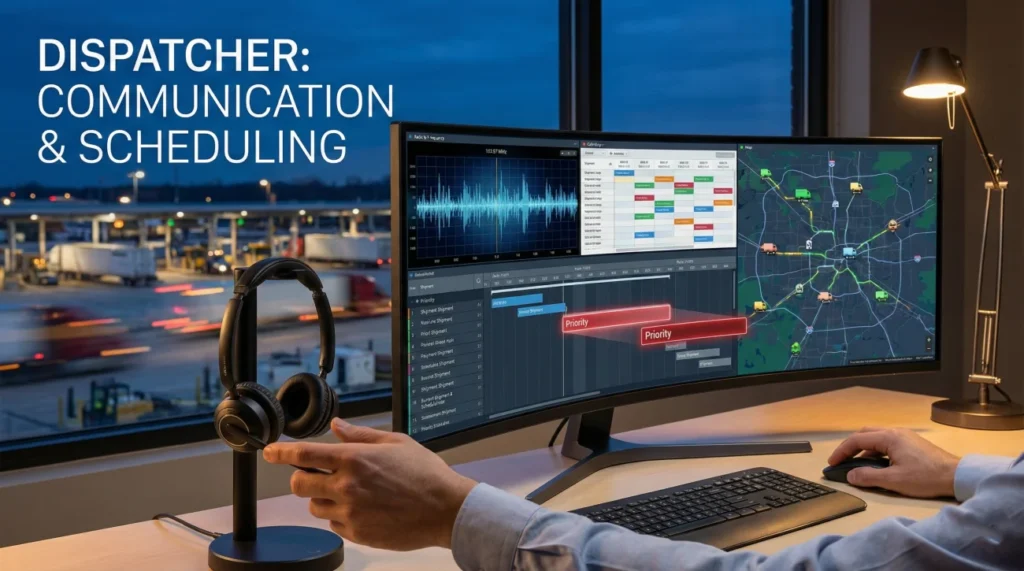
CAD is my command center. It visualizes all assets on a map. I use it to drag-and-drop loads to drivers and monitor status codes (En Route, Arrived, Clear).
I am proficient in filtering views to focus only on exceptions (e.g., “Show only delayed units”) to prevent information overload.
Q: Handling “Geofence” Alerts?
A Geofence alert tells me when a truck enters or leaves a specific zone. It automates the “Arrival” and “Departure” timestamps.
If I get a “Geofence Exit” alert but the driver hasn’t marked the load as complete, I call immediately. They might be leaving without the paperwork or going off-route.
Q: Managing “Hours of Service” (HOS)?
I monitor the ELD (Electronic Logging Device) dashboard constantly. I know exactly how many drive hours each driver has left.
I never dispatch a load that forces a driver to violate HOS. If a driver is running low on hours, I proactively plan a “Relay” (swapping the load to a fresh driver) to keep the freight moving.
Q: What is a “Check Call”?
Traditionally, it is calling the driver for a status update. Modern dispatching automates this via GPS, but I still make manual check calls for high-value loads.
Hearing the driver’s voice tells me things GPS can’t – like if they sound sick, tired, or stressed. It is a wellness check as much as a location check.
Q: Emergency Response Protocols?
In an accident, my role shifts to coordinator. I follow the “S.A.F.E.” protocol: Secure the driver (call 911), Assess the situation, Fact-find (get photos), and Escalate (notify management/insurance).
I remain the calm voice on the radio, guiding the driver through the post-accident checklist so they don’t miss critical steps due to shock.
Q: Dealing with “Detention” pay?
If a driver is stuck at a dock for more than 2 hours, they deserve Detention Pay. I track the arrival time via GPS to prove it to the customer.
I fight for my drivers to get paid. If a customer refuses to pay valid detention, I note it in the CRM. Repeat offenders get higher rates or deprioritized service.
Scenarios: The Hot Seat
Scenario: A driver calls you at 2 AM saying their truck broke down 200 miles from the delivery, and the load is due at 6 AM. The customer will fine you for being late.
Step 1 is Analysis. I ask the driver: “Is it a quick fix (blown hose) or a tow event?” If it is a tow, the truck is dead. Step 2 is Notification. I email the customer immediately – 2 AM is better than 6 AM. “Unit 101 has suffered a mechanical failure. We are executing a recovery plan. New ETA is TBD, will update in 30 mins.”
Step 3 is Recovery. I look for another company truck nearby to “re-power” the load (hook to the trailer). If none are available, I call a third-party partner or a tow-service to bring the trailer to a safe haven. My focus is the freight, not the broken truck (Maintenance handles that). I keep the customer updated every hour. Bad news delivered early is manageable; bad news delivered late is fatal.
Scenario: You have two urgent loads but only one available driver. How do you choose?
I prioritize based on “Contractual Consequence” and “Customer Relationship.” Does Load A have a massive penalty fee for failure? Is Customer B a strategic partner who gives us 50% of our volume? I usually protect the strategic partner first.
For the load I cannot cover, I do not just fail it. I look for alternatives. Can I “broker” it out to a partner carrier? Can I ask the customer for a “window extension” (delivery tomorrow morning instead of tonight)? I communicate the capacity constraint honestly: “I have a truck shortage. I can cover Load A guaranteed. For Load B, I need a 4-hour extension or permission to broker it. What is your preference?”
Scenario: A driver is screaming at you over the radio because of a bad route/traffic. Other drivers can hear it.
I do not engage in a shouting match. That destroys morale. I say calmly, “Driver 5, I hear your frustration. Please switch to Channel 2 (private line) or call me on the cell so we can fix this.”
Once private, I let them vent for 60 seconds without interrupting. Validation (“I know that traffic in Atlanta is a nightmare”) often defuses the anger. Then I pivot to solution: “The traffic is there, we can’t move it. Do you want me to call the customer and push back your appointment so you don’t have to rush?” By offering to take the pressure off, I turn from an enemy into an ally.
Tools & Soft Skills
Q: How do you multitask without making mistakes?
I use a “System of Checks.” I never rely on memory. If I promise a driver I will call the shipper, I write it on a sticky note or enter a task in the TMS immediately. I use dual or triple monitors to keep my map, my load board, and my email open simultaneously.
I also “Batch Process.” I make all my check calls in one block, then handle all my email updates in another. Switching contexts every 10 seconds leads to errors (like sending the wrong load number to a driver). I close the loop on every task before opening a new one.
Q: How do you handle a “Difficult Customer” who calls constantly?
I proactively “feed the beast.” A customer who calls constantly is usually anxious because they lack visibility. I set up automated email notifications for their loads so they get a ping at every milestone.
When they do call, I answer with specific details before they even ask. “Hi John, I know you’re calling about Load 123. Driver is at mile marker 50, ETA is still 2 PM.” This shows I am on top of it, which builds trust and eventually reduces the frequency of their calls.
Q: What geographical knowledge is most important for a Dispatcher?
It is not just knowing where cities are; it is knowing the “freight lanes.” I know that sending a driver to Florida is easy, but getting them out of Florida with a paying load is hard because it is a consumption state, not a production state.
I also know the major choke points (e.g., the GW Bridge in NY, the perpetual construction on I-35 in Texas). I factor these into my ETA calculations. Dispatching a driver through Chicago at 5 PM is setting them up for failure, so I plan around it.
Dispatcher Competency Quiz
Test Your Dispatch Knowledge (20 Questions)
1. “Deadhead” refers to:
- A driver who is sleeping
- Driving an empty truck/trailer to a pickup location
- Driving with a hazardous load
- The end of a cul-de-sac road
2. “HOS” stands for:
- Home of Service
- Hours of Service
- Highway Operations System
- Heavy Operating Standards
3. A “Bobtail” is:
- A truck with a short trailer
- Driving a tractor (truck) without a trailer attached
- A cat in the truck cab
- A type of knot used to tie cargo
4. “LTL” allows you to:
- Drive faster than the speed limit
- Combine partial loads from multiple customers
- Load the truck from the top
- Leave the truck loaded overnight
5. “Detention” is charged when:
- A driver gets a speeding ticket
- A driver is kept waiting at a shipper/receiver beyond free time
- A truck is impounded by police
- A load is cancelled
6. A “BOL” (Bill of Lading) is primarily:
- The invoice for the driver’s pay
- The contract of carriage and receipt of goods
- The map of the delivery route
- The maintenance log of the truck
7. “Backhaul” is:
- Driving the truck in reverse
- A return load that brings the driver back towards their home base
- Hauling goods on the back of a flatbed
- Calling the dispatcher back
8. “ETA” stands for:
- Estimated Truck Arrival
- Estimated Time of Arrival
- Early Time Availability
- Electronic Tracking Application
9. A “Drop and Hook” means:
- Dropping the cargo on the ground
- Dropping a loaded/empty trailer and picking up another one immediately
- Dropping the price and hooking the customer
- An accident involving a tow hook
10. “Reefer” refers to:
- A refrigerated truck/trailer
- A refrigerated truck/trailer
- Refueling the truck
- Referencing a map
11. A “Lumper” fee is for:
- The fuel surcharge
- Third-party labor used to load/unload the trailer
- Crossing a bridge
- Cleaning the truck
12. “CAD” in dispatching means:
- Computer Aided Design
- Computer Aided Dispatch
- Central Area Distribution
- Call All Drivers
13. “Relay” operations involve:
- Running a race
- Handing off a load from one driver to another to keep it moving
- Delaying the shipment for a day
- Relaying a message to the customer
14. “Factoring” allows a trucking company to:
- Calculate route miles
- Sell invoices to get immediate cash flow (minus a fee)
- Hire new drivers
- Buy factory equipment
15. “Load Board” is used to:
- Secure the load inside the trailer
- Find available freight or post available trucks
- List the daily cafeteria menu
- Track driver attendance
16. “Headhaul” is:
- The primary load taking the driver away from home (usually higher rate)
- The primary load taking the driver away from home (usually higher rate)
- The front of the truck
- Hauling hats and helmets
17. A “Rate Confirmation” (Rate Con) must be signed:
- After the delivery is made
- Before the load is picked up to lock in the price
- By the security guard
- Only if the load is late
18. “Geofencing” triggers alerts when:
- A truck crosses a state line
- A truck enters or exits a predefined virtual boundary
- A driver speeds
- A fuel card is used
19. “TONU” stands for:
- Time On New Unit
- Truck Ordered Not Used
- Total Operating Net Unit
- Traffic On North Union
20. “Intermodal” means:
- Driving on the interstate
- Using multiple modes (Truck + Rail/Ship) for one load
- Communication between models
- The internet modem in the truck
❓ FAQ
📞 Do I have to be on call 24/7?
Often, yes. Transportation never sleeps. Many companies have “After-Hours” shifts or rotating on-call schedules. Be prepared to answer your phone at 3 AM to approve a repair or help a lost driver. Burnout is a risk, so ask about the rotation schedule during the interview.
🗣️ What if I don’t know the geography perfectly?
You will learn. Start by memorizing the major US Interstates (I-95 goes North/South on East Coast, I-5 on West Coast, I-10 goes East/West). Understanding the “flow” of freight (Produce moves from CA/FL to the North; Consumer goods move from ports inland) is more important than knowing every small town.
💼 Is this a sales job?
It has sales elements. You are constantly “selling” loads to your drivers (convincing them to take them) and “selling” your service to customers (convincing them you are on time). Negotiation skills are critical, especially if you work for a brokerage where you negotiate rates with carriers.
🚜 How do I earn the respect of drivers?
Respect their time and their reality. Don’t lie to them about load details (“It’s just a light load” when it’s max weight). Answer their calls. If you fight for their detention pay and get them home when you promised, they will run through walls for you.
📈 What is the career path?
Dispatcher is the boot camp of logistics. From here, you can move up to Fleet Manager (managing the people, not just the trucks), Operations Manager, or pivot to Freight Brokerage (Sales). The operational grit you learn here is respected everywhere in the industry.
Final Thoughts
Dispatching is not for the faint of heart. It is a high-octane role where the plan changes every hour. However, it is also incredibly rewarding to be the person who solves the puzzle and keeps the supply chain moving. By mastering these dispatcher interview questions, you demonstrate that you have the thick skin, the sharp mind, and the steady hand required to be the calm voice in the storm that guides the fleet home.
⚠️ Disclaimer: The interview strategies, sample answers, and negotiation tips provided in this guide are for educational purposes only. Hiring decisions are subjective and vary by company and industry. While these strategies are based on professional HR standards, they do not guarantee a specific job offer or result.