The Data Translator
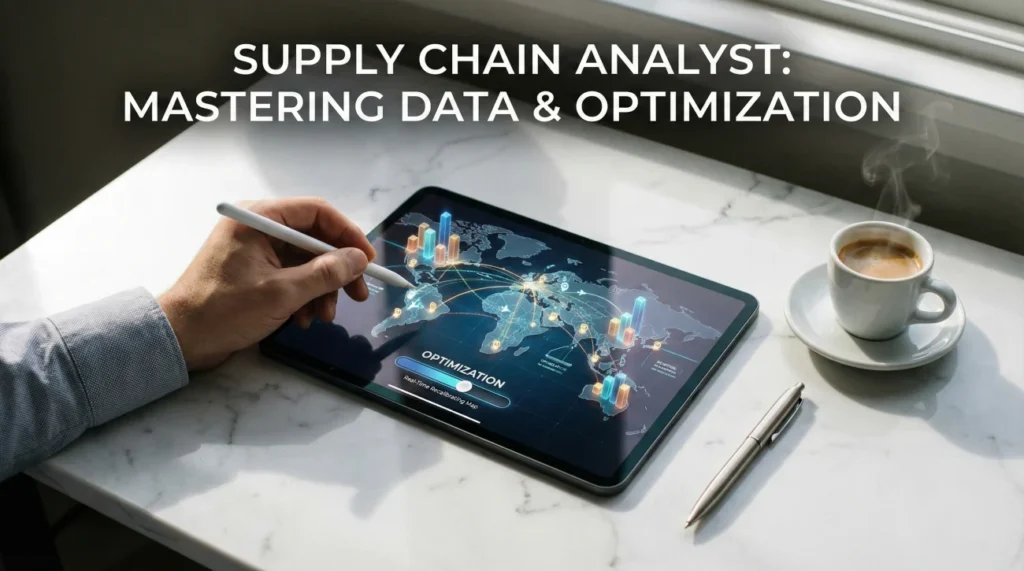
If the Supply Chain Manager is the captain of the ship, the Supply Chain Analyst is the navigator charting the course. In today’s data-rich environment, companies are drowning in numbers but starving for insights. Hiring managers are looking for candidates who can do more than just build a spreadsheet. They need storytellers who can translate raw data rows into actionable strategies that cut costs and improve speed.
The modern interview for this role is a two-pronged test: technical proficiency and business acumen. You will be grilled on your ability to clean messy datasets, your fluency in SQL or Python, and your mastery of forecasting algorithms. But equally important is your ability to explain a complex regression analysis to a non-technical Sales Director. They want to know: Can you find the needle of opportunity in the haystack of data?
This guide prepares you for the specific supply chain analyst interview questions that focus on data modeling, inventory optimization logic, and the critical soft skill of influencing decisions with evidence.
Data Proficiency & Technical Skills
Q: Describe a time you had to handle a large, messy dataset. How did you ensure data integrity?
Analyst Insight: This tests your reality. Data is never clean. Focus on the “Cleaning” process before the “Analysis.”
Sample Answer: In my previous role, I analyzed shipment data from three different 3PLs, each with different date formats and SKU naming conventions. I used Python (Pandas) to script a normalization process, mapping all variations to a master SKU list. I also implemented validation checks to flag outliers (e.g., negative transit times) before loading the data into our BI tool. This reduced our reporting error rate from 15% to under 1%.
Q: Excel is still king. Which advanced functions do you use most frequently for supply chain analysis?
Analyst Insight: Move beyond VLOOKUP. Mention tools that handle arrays and logic.
Sample Answer: While I use VLOOKUP/XLOOKUP daily, my go-to tools are Power Query for repeating ETL tasks and Solver for optimization problems (like load balancing). I also frequently use nested IF/AND/OR statements to categorize inventory aging. Recently, I built a dynamic dashboard using Pivot Tables and Slicers to allow the logistics team to self-serve their daily performance metrics.
Q: How do you approach “Root Cause Analysis” when a KPI is missed?
Analyst Insight: Show your detective skills. Don’t just report “what” happened, find “why.”
Sample Answer: I use the “5 Whys” methodology supported by data drill-downs. For example, when OTIF dropped last month, I didn’t just report the drop. I drilled down by Carrier, then by Lane, and finally by Origin. The data showed the issue was isolated to one specific warehouse dock. It turned out a scanner was broken. By pinpointing the exact failure point, operations could fix it immediately.
Q: Explain the difference between “Correlation” and “Causation” in supply chain data.
Analyst Insight: A fundamental statistical concept. Confusing them leads to bad strategy.
Sample Answer: Correlation means two variables move together, while causation means one drives the other. For instance, ice cream sales and sunglass sales are correlated (both rise in summer), but selling more ice cream doesn’t cause more sunglasses to be sold. In supply chain, I might see high freight costs correlated with high sales, but the cause might be rush shipments due to poor planning, not the sales volume itself.
Forecasting & Optimization Models
Q: Moving Average vs. Exponential Smoothing
Simple Moving Average treats all past data points equally (good for stable demand). Exponential Smoothing gives more weight to recent data.
I use Exponential Smoothing for trend-based products where last month’s sales are more predictive of next month than sales from a year ago.
Q: Calculating Safety Stock
I don’t just use a “weeks of supply” rule. I calculate it based on the standard deviation of both demand and lead time variability.
Formula: Z-score (Service Level) × √[(Avg Lead Time × Demand Variance) + (Avg Demand² × Lead Time Variance)]. This accounts for supply risks.
Q: EOQ (Economic Order Quantity)
EOQ finds the sweet spot where ordering costs equal holding costs. It answers “How much to buy?”
However, I treat EOQ as a guideline, not a law, because it assumes constant demand. I adjust it for seasonality and bulk discount tiers.
Q: Seasonality Index
This measures how much a specific month deviates from the average. If December is 1.5, it sells 50% more than average.
I de-seasonalize data to see the underlying trend, forecast the trend, and then re-seasonalize the forecast for accuracy.
Q: ABC/XYZ Analysis
ABC segments by value (Revenue), while XYZ segments by volatility (Predictability).
An “AX” item is high value and stable (Automate replenishment). An “AZ” item is high value but erratic (Needs human attention and lower safety stock to avoid obsolescence).
Q: Network Optimization (Center of Gravity)
This analysis finds the optimal location for a distribution center to minimize total transportation distance/cost.
I use latitude/longitude coordinates weighted by the volume of demand to pinpoint the theoretical ideal location for a new warehouse.
Scenario: Handling Bad News & Ambiguity
Scenario: Your forecast model was wrong, leading to a stockout of a key product. The VP asks for an explanation.
I own the error immediately. “My model relied heavily on historical averages and missed the signal from the recent marketing promo.” I avoid blaming the market.
Then I pivot to the solution. “I have updated the algorithm to include promotional tagging as a variable. I also ran a post-mortem to identify the variance triggers. Moving forward, I will manually review items with >20% promo lift.” This shows accountability and continuous improvement.
Scenario: Sales wants to launch a new product and asks for a forecast, but there is no historical data.
I use “Like Modeling” (Proxy Forecasting). I ask Sales, “Which existing product is this most similar to in terms of price and target market?”
I take the launch curve of that similar product and apply it here. I also present a range (Best Case, Worst Case, Most Likely) rather than a single number, to help Operations plan capacity for different scenarios without over-committing capital.
Scenario: You identify a way to save 10% on freight, but it requires the warehouse team to change their loading process. They resist.
I translate the data into their language. I don’t just say “We save money.” I say, “This change means you will have to load 15 fewer trucks per week.”
I show them the data simulation proving that optimizing pallet density reduces their workload (fewer dock turns). By aligning the corporate goal (cost) with their personal goal (less busy work), I gain their buy-in.
Visualization & Reporting
Q: What are the key principles of an effective Supply Chain Dashboard?
Analyst Insight: Dashboards are for quick decisions, not just pretty charts. Focus on “Actionability.”
Sample Answer: The user should know within 5 seconds if they are winning or losing. I follow the “Top-Down” design: KPI cards at the top (Red/Green indicators), trend lines in the middle, and detailed data tables at the bottom. I avoid clutter; if a metric doesn’t drive a decision, it doesn’t belong on the executive dashboard.
Q: Which chart type would you use to show Inventory Composition?
Analyst Insight: Choosing the wrong chart confuses the audience.
Sample Answer: For composition at a single point in time, I might use a Stacked Bar Chart or a Treemap to show the relative size of inventory categories (Raw vs WIP vs Finished). I avoid Pie Charts as they are hard to compare precisely. To show composition changes over time, a Stacked Area Chart is my preference.
Q: How do you present complex data to a non-technical audience?
Analyst Insight: This is about communication. Simplify without dumbing down.
Sample Answer: I focus on the “So What?” I start with the insight, not the method. Instead of explaining the regression coefficient, I say, “Our data shows that for every 1% increase in price, volume drops by 0.5%.” I use analogies and clean visuals, keeping the heavy math in the appendix for those who want to dig deeper.
Supply Chain Analyst Competency Quiz
Test Your Analytical Skills (20 Questions)
1. In SQL, which command is used to retrieve data from a database?
- GET
- SELECT
- FETCH
- PULL
2. Which Excel function looks up a value in a table and returns a corresponding value?
- VLOOKUP
- COUNTIF
- SUMPRODUCT
- AVERAGEIF
3. MAPE stands for:
- Mean Average Product Estimation
- Mean Absolute Percentage Error
- Monthly Actual Production Efficiency
- Median Absolute Performance Entry
4. A “Z-score” in safety stock calculation represents:
- The total inventory value
- The desired service level factor
- The average lead time days
- The cost of the product
5. Which chart is best for showing trends over time?
- Pie Chart
- Scatter Plot
- Line Chart
- Venn Diagram
6. In “ABC Analysis”, ‘A’ items typically represent:
- 80% of items, 20% of value
- 20% of items, 80% of value
- 50% of items, 50% of value
- 100% of items, 10% of value
7. What does “ETL” stand for in data warehousing?
- Estimate, Track, Load
- Extract, Transform, Load
- Enter, Test, Log
- Evaluate, Train, Learn
8. A “Stockout” occurs when:
- Inventory exceeds demand
- Inventory falls to zero while demand exists
- Goods are returned by customers
- A warehouse is fully stocked
9. Regression analysis helps analysts to:
- Count the physical inventory
- Understand relationships between variables
- Organize the warehouse layout
- Negotiate better freight rates
10. In Python, “Pandas” is a library used for:
- Creating 3D games
- Data manipulation and analysis
- Web server management
- Graphic design editing
11. “Dead Stock” refers to:
- Items that are selling very fast
- Inventory that has not sold for a long period
- Stock reserved for VIP customers
- Damaged goods in transit
12. The “Reorder Point” (ROP) triggers:
- A new sales promotion
- A replenishment order to suppliers
- A warehouse safety audit
- A customer satisfaction survey
13. Which metric measures forecast bias?
- RMSE (Root Mean Square Error)
- MPE (Mean Percentage Error)
- ROI (Return on Investment)
- KPI (Key Performance Indicator)
14. What is a “Pivot Table” used for?
- Creating database schemas
- Summarizing and aggregating data
- Writing SQL queries
- Sending automated emails
15. “Lead Time Variability” impacts:
- The price of the product
- The amount of safety stock needed
- The number of warehouse doors
- The marketing budget allocation
16. A “Heat Map” visualization is useful for:
- Checking the temperature of goods
- Showing density or intensity of data values
- Listing employees alphabetically
- Showing a timeline of events
17. “Clean Data” implies the data is:
- New and recently collected
- Accurate, complete, and consistent
- Stored in a secure cloud
- Encrypted for safety reasons
18. The “Bullwhip Effect” describes:
- Increasing demand swings upstream
- Decreasing prices downstream
- Stable demand across the chain
- Faster delivery times to customers
19. In optimization, constraints are:
- Suggestions for the model
- Limitations the solution must satisfy
- The goals to be maximized
- The input data for the model
20. Which tool is a BI (Business Intelligence) platform?
- Adobe Photoshop
- Tableau
- Microsoft Word
- Google Chrome
❓ FAQ
📜 Do I need to know Python or R?
For entry-level roles, advanced Excel and SQL are usually sufficient. However, for Senior Analyst roles or Data Scientist tracks, Python (Pandas/NumPy) or R is increasingly required for predictive modeling and handling big data that Excel cannot support.
💼 What is the career path for an Analyst?
You typically start as a Supply Chain Analyst, progress to Senior Analyst, then to Supply Chain Manager or Data Scientist. Some branch out into specialized roles like Demand Planner or Logistics Network Engineer depending on their interest in operations vs. pure data.
🎓 Is a Master’s degree required?
Not strictly. A Bachelor’s in Supply Chain, Statistics, Math, or Business is standard. Experience with tools (Tableau, SQL) and a portfolio showing problem-solving often outweigh an advanced degree for analyst positions.
📊 How do I build a portfolio?
Use public datasets (like Kaggle) to solve a supply chain problem (e.g., “Optimize delivery routes” or “Predict next month’s sales”). Document your process, code, and insights on GitHub or a personal blog to show interviewers your practical skills.
🔍 What is the difference between an Analyst and a Planner?
A Planner (Demand/Supply) is focused on execution: “What do we order next week?” An Analyst is focused on optimization and strategy: “Is our ordering logic correct?” Analysts support Planners with better models and tools.
Final Thoughts
To succeed as a Supply Chain Analyst, you must be comfortable living in the gap between the warehouse floor and the executive suite. You need the technical grit to wrestle with bad data and the communication skills to sell your findings. By mastering these supply chain analyst interview questions, you prove that you are not just a number cruncher, but a strategic partner capable of turning data into a competitive advantage.
⚠️ Disclaimer: The interview strategies, sample answers, and negotiation tips provided in this guide are for educational purposes only. Hiring decisions are subjective and vary by company and industry. While these strategies are based on professional HR standards, they do not guarantee a specific job offer or result.