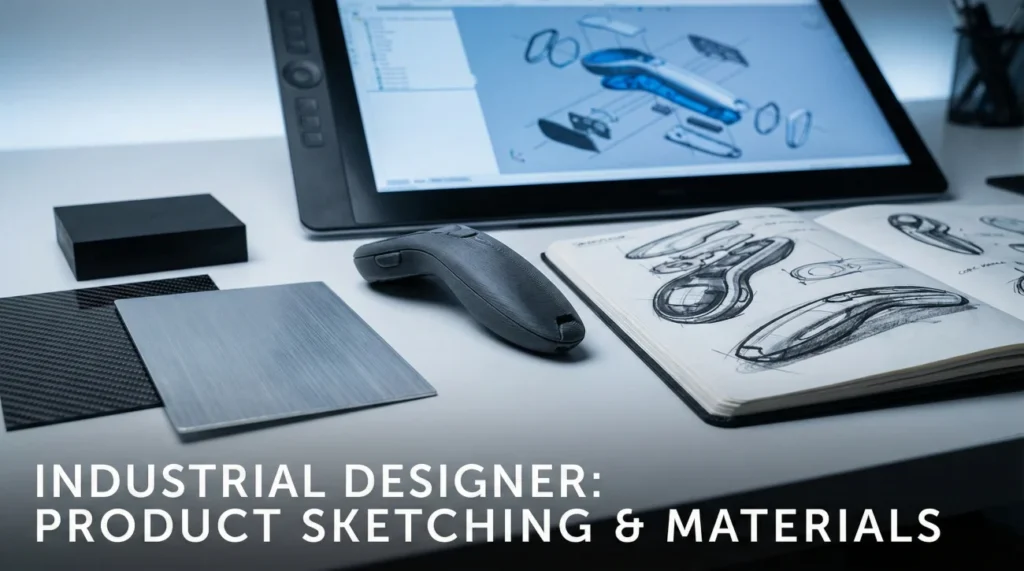
Shaping Products People Use Every Day
Industrial designer interview questions evaluate your ability to create physical products that balance aesthetics, functionality, ergonomics, and manufacturability. You are not just making things look good; you are solving problems through form, selecting materials that meet performance requirements, and designing for real-world production constraints. Your sketches become the products people hold, use, and interact with daily.
Hiring managers want designers who can move fluidly from rough concept sketches to refined prototypes, who understand how material choices affect both user experience and manufacturing costs, and who consider human factors throughout the design process. They need someone who collaborates effectively with engineers, understands production realities, and can communicate design intent clearly to non-designers.
This guide covers sketching and ideation processes, CMF (color, material, finish) selection, ergonomics and human factors, prototyping and iteration, and collaboration with engineering and manufacturing teams.
Sketching & Ideation
Q: Walk me through your design process from initial concept to final product.
I begin with research: understanding the user, the problem, competitive landscape, and any technical constraints. This informs ideation, where I generate numerous concepts through rapid sketching without judgment. I might produce fifty or more initial sketches exploring different directions, forms, and mechanisms before narrowing focus.
Promising concepts move into refinement through more detailed sketches, quick mockups, and early prototypes. I test assumptions through user feedback and technical feasibility checks. The design evolves through multiple iterations, with CAD modeling for precision and physical prototypes for validation. Throughout, I collaborate with engineering to ensure manufacturability while maintaining design intent.
Q: How important is hand sketching versus digital tools in your workflow?
Hand sketching remains essential for rapid ideation. Nothing matches the speed of pencil on paper for exploring ideas quickly. I can generate and evaluate dozens of concepts in the time it takes to model one digitally. Sketching also communicates thinking process and design intent in ways that final renderings cannot. It invites discussion and iteration.
Digital tools become critical as concepts mature. I use CAD software like SolidWorks or Rhino for precise modeling, surface development, and engineering documentation. Rendering tools like KeyShot help communicate material choices and finishes to stakeholders. The best workflow integrates both: sketching for exploration and speed, digital tools for precision and production.
Q: How do you communicate design concepts to non-designers?
I use visual communication strategically. Early-stage sketches show thinking and invite input. Renderings help stakeholders visualize materials and finishes before physical prototypes exist. Physical models, even rough foam mockups, help people understand scale and form in ways images cannot. I choose the communication method based on what decisions need to be made.
I translate design language into terms stakeholders understand. Instead of discussing visual weight or form language, I explain how design choices affect user experience, brand perception, or manufacturing cost. I listen actively to understand concerns and address them through design rather than defending aesthetic choices. Good communication builds trust and alignment.
Q: How do you balance creativity with practical constraints?
I view constraints as creative opportunities rather than limitations. Budget, manufacturing capabilities, timeline, and technical requirements focus ideation toward solutions that can actually be built. Understanding constraints early prevents wasted effort on concepts that cannot be realized. The most elegant designs often emerge from tight constraints.
I maintain creative ambition while respecting reality. I push boundaries where it matters most for user experience and differentiation, while accepting standard solutions where innovation adds no value. I collaborate with engineering early to understand what is possible and where trade-offs exist. The goal is the best achievable design, not the most creative impossible one.
CMF & Material Selection
Q: How do you approach color, material, and finish decisions?
CMF decisions begin with understanding brand, user, and context. I consider how the product will be used, who will use it, what environment it lives in, and what emotional response it should evoke. Materials communicate quality, durability, and brand values before users even touch the product. I research options, create material samples, and test how different combinations read together.
I balance aesthetics with performance requirements. A beautiful finish that scratches easily fails in high-use products. A premium material that increases cost beyond market tolerance does not ship. I evaluate materials against criteria including appearance, tactile quality, durability, cost, sustainability, and manufacturing compatibility. The best CMF solutions satisfy multiple requirements simultaneously.
Q: Describe your experience with different manufacturing materials and processes.
I have worked extensively with injection-molded plastics, understanding how material choice, wall thickness, and draft angles affect both appearance and manufacturability. I know the differences between ABS, polycarbonate, and various polymers in terms of strength, finish quality, and cost. I have designed for sheet metal, understanding bend radii, tolerances, and finishing options like powder coating and anodizing.
I stay current with emerging materials and processes. Additive manufacturing enables geometries impossible with traditional methods. Sustainable materials increasingly matter for brand positioning and regulatory compliance. I evaluate new options critically, understanding that proven materials often outperform novel ones in production reality. Material selection always considers the full manufacturing context.
Q: How do you ensure design intent survives the manufacturing process?
I involve manufacturing early, understanding their capabilities and constraints before finalizing designs. I create detailed specifications covering critical dimensions, acceptable tolerances, surface finishes, and color standards. I provide physical samples and clear documentation so manufacturing knows exactly what matters and where flexibility exists.
I stay engaged through production. I review first articles, identifying where manufacturing interpretation differs from design intent. I distinguish between critical issues requiring tooling changes and acceptable variations. I build relationships with manufacturing partners so communication flows freely in both directions. Design is not complete when CAD files ship; it is complete when quality products reach customers.
Ergonomics & Human Factors
How do you incorporate ergonomics into your design process?
Ergonomics starts with understanding users and use contexts. I research anthropometric data for the target population, considering the full range of body sizes and abilities. I observe how people actually use similar products, noting pain points and workarounds. I consider duration and frequency of use, physical demands, and environmental factors that affect comfort and safety.
I test ergonomic assumptions through prototypes. Foam models help evaluate grip, reach, and control placement. I conduct user testing with diverse participants, observing interactions and gathering feedback. I iterate based on findings, sometimes discovering that intuitive-seeming designs fail in actual use. Ergonomic success is measured by user comfort and safety, not designer assumptions.
Describe a project where ergonomic considerations significantly influenced the design.
I designed a handheld tool intended for extended use by workers with varying hand sizes and grip strengths. Initial concepts prioritized aesthetic form, but user research revealed that workers experienced fatigue and discomfort with existing products. This shifted ergonomics from a secondary consideration to the primary design driver.
I created multiple handle prototypes with different grip profiles, materials, and textures. Testing with actual users in realistic conditions identified the best performing options. The final design featured a contoured grip with soft-touch overmolding, balanced weight distribution, and control placement optimized for natural hand position. User feedback confirmed significantly improved comfort during extended use, and the design received recognition for ergonomic innovation.
How do you design for accessibility and diverse user needs?
I design for the broadest possible user range rather than an idealized average user. This means considering users with limited strength, dexterity, vision, or cognitive abilities alongside typical users. Universal design principles guide decisions: flexibility in use, simple and intuitive operation, perceptible information, tolerance for error, and low physical effort.
I test with diverse users including those with disabilities when possible. I consider edge cases that reveal design weaknesses. Designing for accessibility often improves experience for everyone. Larger controls benefit users with limited dexterity and typical users wearing gloves. High-contrast interfaces help users with visual impairments and everyone in bright sunlight. Inclusive design is simply good design.
Prototyping & Collaboration
Q: What prototyping methods do you use and when?
I match prototyping method to purpose. Foam and cardboard mockups explore form and scale quickly and cheaply during early ideation. 3D printing produces detailed models for evaluating fit, mechanism function, and appearance when geometry matters more than material properties. CNC machining creates prototypes in production materials when strength and surface quality must be evaluated.
I prototype strategically, testing what matters at each stage. Early prototypes validate concepts before investing in detail. Later prototypes verify engineering and manufacturing assumptions. I build multiple prototypes when evaluating alternatives, letting physical comparison inform decisions. The goal is learning, not perfection: rough prototypes that answer questions are more valuable than beautiful ones that teach nothing new.
Q: How do you collaborate with engineers during product development?
I involve engineering early and continuously rather than handing off completed designs. Early conversations establish what is technically feasible and where innovation requires engineering partnership. I learn enough engineering fundamentals to communicate effectively and understand constraints, even though detailed engineering is not my role.
Collaboration requires mutual respect. I listen to engineering concerns seriously and adapt designs when constraints are real. I also advocate for design intent when engineering convenience would compromise user experience. We work toward solutions that satisfy both perspectives. The best products emerge from genuine collaboration where design and engineering challenge each other constructively.
Q: Describe a challenging project and how you overcame obstacles.
I worked on a consumer electronics product where initial designs could not be manufactured within budget. Tooling costs for complex surfaces exceeded targets, and assembly time drove labor costs higher than projected. The project risked cancellation without significant redesign.
I collaborated intensively with manufacturing engineers to understand exactly where costs originated. We identified geometry simplifications that dramatically reduced tooling complexity while preserving design character. We redesigned assembly sequences to reduce part count and labor time. The final product looked nearly identical to the original concept but cost significantly less to produce. This experience reinforced the importance of designing for manufacturing from the start rather than optimizing afterward.
Industrial Design Knowledge Quiz
20 Practice Questions
1. CMF stands for:
- Computer Modeling Format
- Color, Material, Finish
- Concept Manufacturing Framework
- Creative Management Function
2. Hand sketching in industrial design is valuable because:
- Digital tools are too expensive
- It enables rapid exploration of many concepts quickly
- Engineers prefer hand drawings
- Manufacturing requires hand-drawn plans
3. Draft angles in injection molding:
- Are purely aesthetic choices
- Allow parts to release from molds
- Increase material strength
- Are only needed for metal parts
4. Ergonomic design should be based on:
- Designer intuition alone
- User research, anthropometric data, and prototype testing
- What looks most attractive
- Manufacturing convenience
5. Early prototypes should focus on:
- Perfect finish and detail
- Validating concepts and answering specific questions
- Impressing stakeholders
- Final production materials
6. When engineering raises concerns about a design:
- Ignore them and proceed
- Listen seriously and collaborate on solutions
- Escalate to management
- Compromise design intent completely
7. Material selection should consider:
- Appearance only
- Performance, cost, manufacturability, and sustainability
- Whatever is newest
- Engineering preference only
8. Design constraints should be viewed as:
- Obstacles to creativity
- Opportunities that focus and inspire creative solutions
- Reasons to reject projects
- Problems for engineers to solve
9. Communicating design intent to non-designers requires:
- Technical design terminology
- Visual aids and translation to stakeholder concerns
- Defending aesthetic choices
- Avoiding feedback
10. Universal design principles:
- Only matter for medical products
- Improve experience for all users, not just those with disabilities
- Increase costs without benefit
- Conflict with aesthetic goals
11. CAD software in industrial design is used for:
- Replacing all sketching
- Precise modeling, surface development, and production documentation
- Early ideation only
- Marketing presentations only
12. First article review involves:
- Reviewing initial sketches
- Evaluating initial production samples against design specifications
- Writing the first design brief
- Creating the first prototype
13. User testing with prototypes should:
- Only include ideal users
- Include diverse participants representing the target user range
- Be conducted by designers alone
- Wait until production
14. Design for manufacturing means:
- Engineering handles production concerns
- Considering production constraints throughout the design process
- Compromising all design intent
- Using only standard parts
15. 3D printing for prototyping is best when:
- Final material properties must be tested
- Geometry and fit need evaluation before production tooling
- Mass production is planned
- Cost is the only concern
16. Ideation should generate:
- One perfect concept
- Many concepts exploring different directions
- Only manufacturable ideas
- What stakeholders expect
17. Ergonomic success is measured by:
- Designer satisfaction
- User comfort and safety in actual use
- Aesthetic appearance
- Manufacturing efficiency
18. Sustainable material considerations include:
- Cost only
- Environmental impact, recyclability, and regulatory compliance
- Whatever is trendy
- Engineering preference
19. Physical mockups help stakeholders:
- See detailed engineering
- Understand scale and form in ways images cannot
- Replace all other communication
- Finalize production specifications
20. Collaboration with engineering should begin:
- After design is complete
- Early and continue throughout development
- Only when problems arise
- During production only
❓ FAQ
🎓 What education do industrial designers need?
Most positions require a bachelor’s degree in industrial design or a related field. Strong portfolios demonstrating design thinking and execution often matter as much as degrees. Some designers have backgrounds in engineering, architecture, or fine arts with additional design training.
💼 What software should industrial designers know?
Essential tools include CAD software like SolidWorks, Rhino, or Fusion 360 for 3D modeling. Rendering software like KeyShot or V-Ray creates photorealistic visualizations. Adobe Creative Suite supports 2D work. Sketching software like Procreate enables digital ideation. Requirements vary by employer and industry sector.
📈 What career paths exist for industrial designers?
Paths include specialization in areas like consumer electronics, furniture, medical devices, or automotive. Senior designers lead projects and mentor juniors. Design managers oversee teams and strategy. Some move into user experience, brand strategy, or entrepreneurship. Consultancy and in-house corporate roles offer different experiences.
📋 How important is the portfolio for getting hired?
The portfolio is the most critical element in industrial design hiring. It demonstrates thinking process, technical skill, and design judgment better than any resume. Include diverse projects showing range, process documentation showing how you work, and final outcomes demonstrating execution quality. Tailor portfolios to target employers.
🏭 How does industrial design differ from industrial engineering?
Industrial designers focus on user experience, aesthetics, and product form. Industrial engineers optimize manufacturing processes, production efficiency, and system operations. Designers ask how products should look and feel; engineers ask how to make them efficiently. Both collaborate in product development but with distinct expertise.
Final Thoughts
Success with industrial designer interview questions requires demonstrating both creative vision and practical execution. Show that you can sketch rapidly, select materials intelligently, design for human comfort and safety, and collaborate effectively with engineering and manufacturing. Your portfolio proves your capability; your interview shows how you think and work with others.
The best industrial designers balance artistic sensibility with technical understanding. Highlight your process from research through production, your material and manufacturing knowledge, and your commitment to user-centered design. Employers want designers who create products that are beautiful, functional, manufacturable, and successful in the market.
⚠️ Disclaimer: The interview strategies, sample answers, and negotiation tips provided in this guide are for educational purposes only. Hiring decisions are subjective and vary by company and industry. While these strategies are based on professional HR standards, they do not guarantee a specific job offer or result.